


Spot Gold Pulls Back From Record Highs but the Floor Is Holding
Spot Gold (XAUUSD) ran above $5,500 earlier this year and has been giving it back ever since. The correction has carved out support between $4,360 and $4,500 and last week’s bounce off $4,366.23 produced a potentially bullish closing price reversal bottom on the weekly chart. The pullback looks finished on the surface. Whether it actually is depends entirely on what comes out of Friday’s Non-Farm Payrolls report and how the U.S. Dollar Index and 10-Year U.S. Treasury yields react to it.
Payrolls Decide the Rate Story
Spot Gold (XAUUSD) does not pay interest. That is the entire problem right now. The Federal Reserve has stayed restrictive, inflation readings have been sticky enough to keep officials cautious, and the market has pushed rate cut expectations further out. Every week that rates stay elevated is another week where money sits in Treasuries and cash instruments instead of gold.
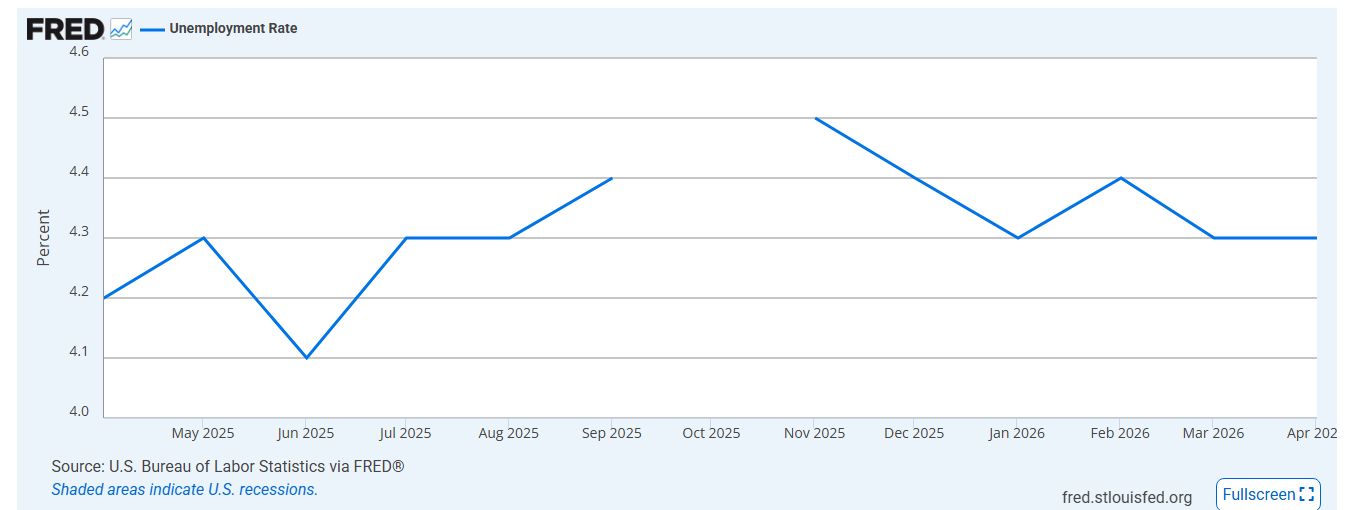
Friday’s May Employment Situation Report is the event that either reinforces that story or cracks it open. Strong job creation and accelerating wage growth would push 10-Year U.S. Treasury yields higher, firm up the U.S. Dollar Index, and send Spot Gold (XAUUSD) back toward the $4,360 to $4,500 support zone for another test. That is the bearish path and it is the one the market is already leaning toward.
A miss changes everything. Slower hiring or a rising unemployment rate would be the first real evidence that economic conditions are cooling enough to give the Federal Reserve room to move. That reprices rate expectations, pulls yields lower, and gives Spot Gold (XAUUSD) the fuel for a short-covering rally back toward resistance. One report. Two completely different outcomes.
Gold Price Forecast
Every new Gold analysis as it publishes, today's technical signal and key levels, live price — on one page.
See all Gold forecastsISM Sets the Tone First
The ISM Manufacturing Index on June 1 and the ISM Services Index on June 3 hit before the jobs data and the prices-paid components inside both reports matter more than the headlines. Rising input costs across the economy mean inflation is not going away and the Federal Reserve has no reason to cut. That keeps real yields elevated and Spot Gold (XAUUSD) stays under pressure.
Moderating costs and slowing business activity tell a different story. If businesses are reporting lower input prices, the inflation argument weakens and the rate cut case gets some room. The ISM data will set the direction for the U.S. Dollar Index and 10-Year U.S. Treasury yields heading into Friday and Spot Gold (XAUUSD) will follow both.
Peace Deal Helps Gold More Than War
This is where the gold trade gets misread every single time. Rising tensions in the Middle East pushed oil prices higher earlier this year and the knee-jerk reaction was to buy Spot Gold (XAUUSD) on safe-haven demand. That reaction was wrong. Higher oil means higher inflation pressure. Higher inflation pressure means the Federal Reserve stays restrictive. That is bearish for Spot Gold (XAUUSD), not bullish.
Progress toward de-escalation actually helps gold more. Lower oil prices ease inflation concerns, reduce pressure on the Federal Reserve to stay restrictive, and open the door for rate expectations to shift. Spot Gold (XAUUSD) would lose some safe-haven premium in that scenario but it would gain something more important, a path to lower real rates. The rate trade is bigger than the fear trade right now.
Central Banks Keep Buying Dips
Every time Spot Gold (XAUUSD) pulls back toward $4,360 to $4,500, size shows up. Central banks have not stopped accumulating. Their buying has been running well above pre-2022 averages all year and the correction did not slow it down. Reserves are moving out of traditional fiat holdings and into gold and that trade has not reversed despite weeks of selling pressure from the rate side.
Wall Street has trimmed some near-term targets after the pullback but nobody has walked away from the structural case. The biggest buyers in the world are not chasing. They are waiting for exactly these prices. That is why the dips hold instead of breaking down. Downside risk is real but building a bear case against a market where sovereign buyers treat every 5% pullback as a gift is a hard argument to win.
Weekly Spot Gold (XAUUSD) Technical Analysis
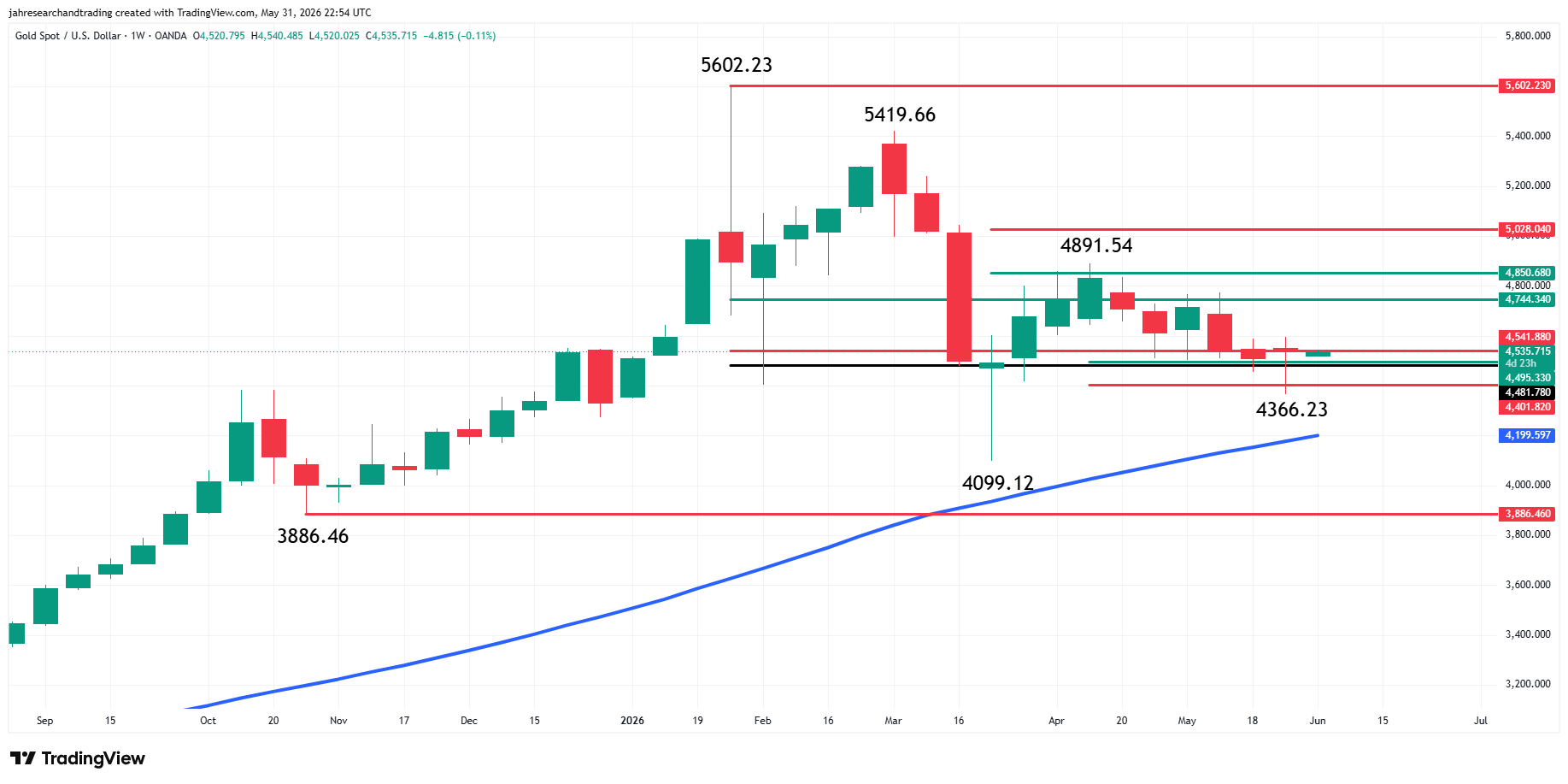
Spot gold (XAUUSD) finished higher last week after rebounding from a break to $4366.23, its lowest level since March 23. The bounce produced a potentially bullish closing price reversal bottom. We need a confirmation of this chart pattern to tell us if the buying was a relief rally do to oversold conditions, or if it was fueled by value buyers, hoping to ignite the start of a strong rally.
A trade through $4595.33 will confirm the chart pattern, setting up the possibility of a 2 to 3 week rally.
On the downside, the market is currently engulfed by a number of retracement levels, including the long-term 61.8% level at $4541.88, the short-term 50% level at $4495.33 and the short-term 61.8% level at $4401.82.
Traders have also been defending $4481.78, or the level that represents a 20% decline from the all-time high at $5602.23. By definition, this level separates the bull market from the bear market.
Underneath every support level is the 52-week moving average at $4199.66. This is the long-term support and trend indicator. Last week, the market successfully tested the 200-day moving average, producing a daily reversal. I expect a similar reaction if the 52-week MA is tested.
On the upside, the long-term 50% level at $4744.34 is the key to sustaining any rally. However, we expected some noise at $4850.68 to $5028.04. Inside this area is also the swing top at $4891.54. Taking everything into consideration, overtaking this area is likely to fuel a strong rally.
The direction this week is likely to be determined by trader reaction to $4541.88. A sustained move over this level is likely to bring in new buyers with $4744.34 the first objective.
A failure to overtake $4541.88 will be a sign of weakness, but sellers could face labored pressure until $4366.23. If this level fails then play for the dip into the 52-week MA at $4199.71.
The problem with gold in my opinion is the unwillingness to buy strength or take out offers at current price levels. Everybody seems to be waiting for dips or value and when they get it, they buy it. But when they see resistance, they sell it. The issue for long-term buyers is that the bottoms keep getting lower.
It’s as if traders are still trying to figure out where the value is. Once they do get the price they are looking for then they’ll start taking out offers to drive the market higher.
Weekly Outlook
The short-term bias is bearish because the rate story has not changed. Real yields are elevated, the U.S. Dollar Index is firm, and the Federal Reserve has given no signal that cuts are coming. Friday’s Employment Situation Report is the gate. A strong print reinforces everything that has been pressuring Spot Gold (XAUUSD) for weeks and puts the $4,360 to $4,500 support back under the microscope.
A weak print is the first crack in the wall and the short-covering rally that follows could move fast with central bank buyers underneath providing the floor.
The level is $4,541.88. A sustained move over it confirms the closing price reversal bottom and opens a run at $4,744.34 with noise expected between $4,850.68 and $5,028.04. Failure to hold above $4,541.88 keeps sellers in control with $4,366.23 as the next test and the 52-week moving average at $4,199.66 waiting below that.
The gold trade right now is simple. Everybody wants to buy value and nobody wants to chase. Until that changes, the bottoms keep getting lower.
If you’d like to know more about how to trade gold, please visit our educational area.