



Gold’s Parabolic Rally Hits Pause — But This Isn’t 1980
Spot Gold posted a dramatic weekly closing price reversal top last week after trading at a record $5602.23. The chart pattern does not represent a change in trend based on our three key metrics – trend lines, swing charts and moving averages. It likely represents a correction of a speculative buying spree that put price well ahead of time and value.
Last week, XAUUSD settled at $4895.44, down $92.10 or -1.85%.
I’ve seen comparisons to the 1980 market, but I can say that having witnessed this market, the current rally can’t be compared to the major top 46 years ago. The chart pattern may look similar, but most speculative bubbles have that same parabolic look especially commodities markets like soybeans.
Certainly, the fundamentals aren’t the same. Furthermore, the ’80s represented a time when nearly all money managers preached the negative correlation between hard assets and paper assets. You couldn’t own both equally, you had to choose one or the other. However, conditions changed when money managers started to recognize gold as an investment and not the true safe-haven asset that many believe it is today. Back in the day, I don’t believe major players envisioned gold and the Dow Jones Industrial Average reaching record highs on the same day, but here we are today.

Profit-Taking Drives Sell-Off — Trend Remains Intact
I just want to make it clear that I saw profit-taking and sell stops driving prices lower on Friday. I saw a market that corrected about 50% to 61.8% of a 90-day rally, I didn’t see any major bottoms taken out. I didn’t sense the trend was changing.
Fundamentally, I don’t know if there was any central bank selling or if they had pulled the plug on their buying spree, but I imagined they thought about selling with the idea of buying later at more favorable prices. Furthermore, they strike me as slow and steady investors, most likely favoring anonymity over splashy headlines. Traders should also note that even the World Gold Council doesn’t report what the central banks have done until at least 30 days after they did it.
Gold Price Forecast
Every new Gold analysis as it publishes, today's technical signal and key levels, live price — on one page.
See all Gold forecastsThe Warsh Nomination Didn’t Trigger This — Timing Doesn’t Add Up
I’ve also read commentary suggesting Trump’s naming of former Federal Reserve Governor Kevin Warsh as his choice to succeed Jerome Powell as Fed chair in May, triggered the sell-off. I didn’t see that either. Warsh was the frontrunner for days according to some predictive websites and the market still reached a record high. This would work if someone can prove that big money was not only selling the rally but also shorting the rally.
No Cross-Asset Rebalancing Signals a Major Turn — Yet
When I see a turn in a major asset class like commodities, I immediately look at 10-year Treasury Notes, the dollar and stocks. My experience tells me that if this is going to develop into a major turn, then there would be a major rebalancing in the asset classes. I didn’t see that immediate reaction, but will be watching to see if it develops over the near-term.
Short-Term Top Clears Out Weak Longs — Now Watch for Value
To sum it up, I think we have a short-term top that took out the weak longs. I now see a market that will be looking for value. I see a market that could trade sideways for the month as bulls build a strong support base.
Downside Targets Point to $4744-$4428 Support Zone
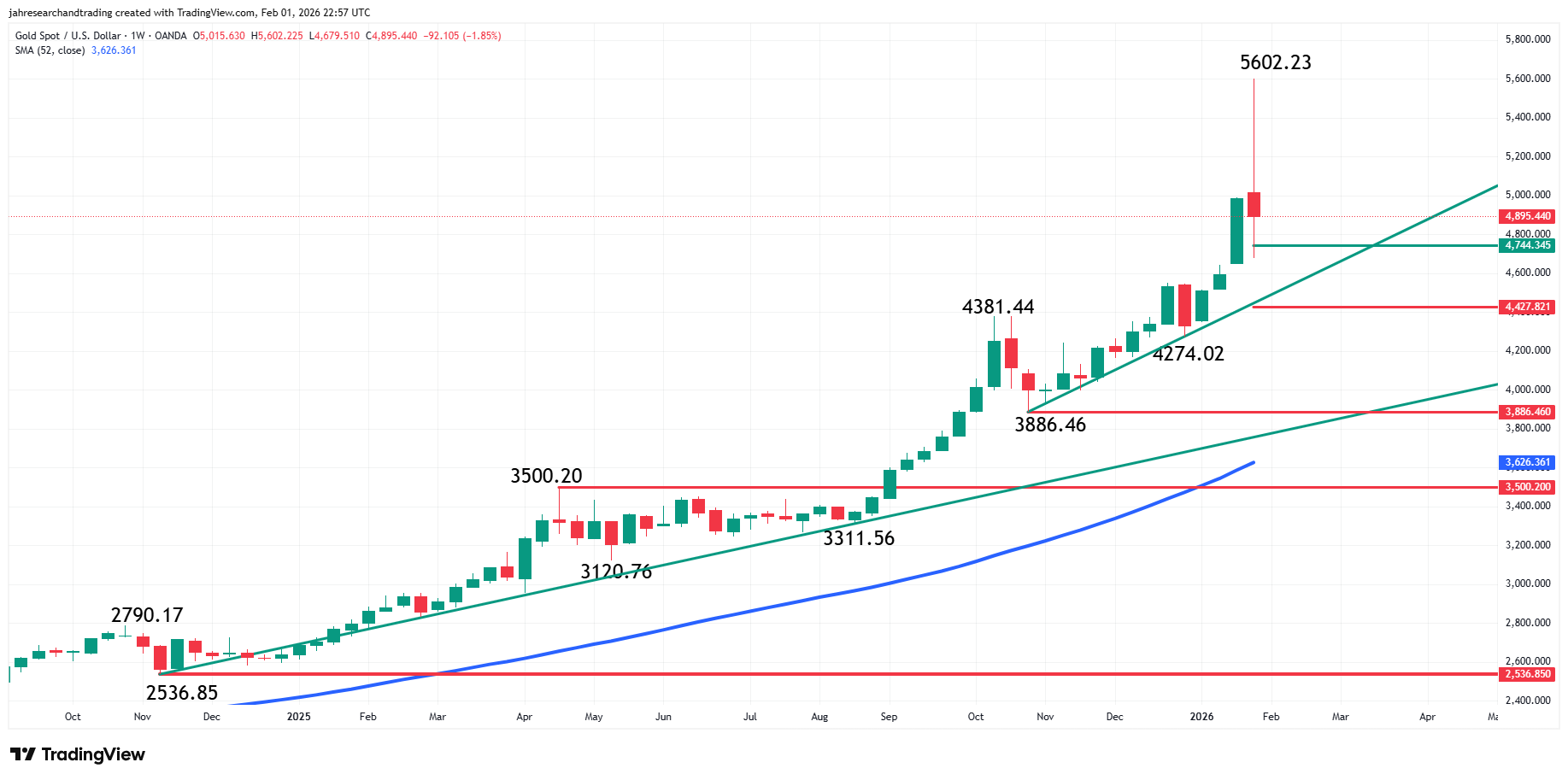
As the dust settled on Friday’s volatile session, I started to work on downside targets and value areas. The first range I settled on was the late October bottom at $3886.46 to last week’s high at $5602.23. Its 50% to 61.8% retracement zone is $4744.34 to $4427.82. Piercing this zone is an uptrend line from the October bottom. It comes in at $4489.33 this week.
We’re going to be watching the price action and order flow on a test of this area to determine if it represents value to the major players. We’re hoping that the speculative pools of traders who drove the vertical price action have moved on to another market so that a solid support base can be built to drive the next leg of the long-term bull market.
More Information in our Economic Calendar.


