Market Overview
Gold prices are steady between $5,020 and $5,038, holding above the important $5,000 level. Although a more positive market mood has slowed the rally, gold is still in a long-term uptrend.

The “Warsh” Pivot & Federal Reserve Independence
The biggest recent change is that Kevin Warsh has been nominated to replace Jerome Powell as Fed Chair, starting in May 2026.
Hawkish Signal: Markets view Warsh as more hawkish than his predecessor, prioritizing inflation control and a strong US Dollar. This has directly challenged the “endless rate cut” narrative that fueled gold’s rise to $5,600 in January.
Policy Credibility: Concerns about the Fed’s independence have eased a bit since the nomination, helping to steady the US Dollar. Still, if the Senate hearings hint at political influence over interest rates, it could quickly drive investors to seek safe-haven assets.
Central Bank & Speculative Liquidity
The Chinese Floor: The People’s Bank of China has now bought gold for 15 months in a row as of January 2026. Although they bought less as prices peaked, their move away from the US Dollar is still a key long-term factor for gold.
Gold Price Forecast
Every new Gold analysis as it publishes, today's technical signal and key levels, live price — on one page.
See all Gold forecastsLunar New Year Drain: With Chinese New Year coming up from February 16 to 23, traders expect less buying and selling from Asia. This could make the market less active and more volatile.
Geopolitical De-escalation vs. “Sanaenomics”
Middle East Thaw: Tensions in the Middle East are easing after talks between the US and Iran in Oman. President Trump called the talks “very good,” which has led investors to shift money from safe assets back into stocks.
Japan’s Landslide: Prime Minister Sanae Takaichi’s big win on February 8 has brought in “Sanaenomics,” which means more government spending and higher military budgets.
This has made investors more willing to take risks and pushed up the Nikkei, so there is less short-term demand for gold. However, worries about Japan’s debt could help gold in the long run.
Upcoming Macro Triggers
Right now, the market is waiting for three important US data releases this week:
- Nonfarm Payrolls (Wednesday): If the number comes in below 50,000, it could renew hopes for a rate cut in March, which would help gold prices.
- CPI Inflation (Friday): Traders are watching for inflation caused by tariffs. If companies pass higher import taxes on to shoppers, the Fed may keep rates high, which could hurt gold prices.
- Retail Sales: If consumer spending is strong, it would support the idea that the economy will keep growing, which would help the US Dollar more than gold.
Gold Price Outlook: $5,035 Stalls Below Fibonacci Resistance as Structure Tightens
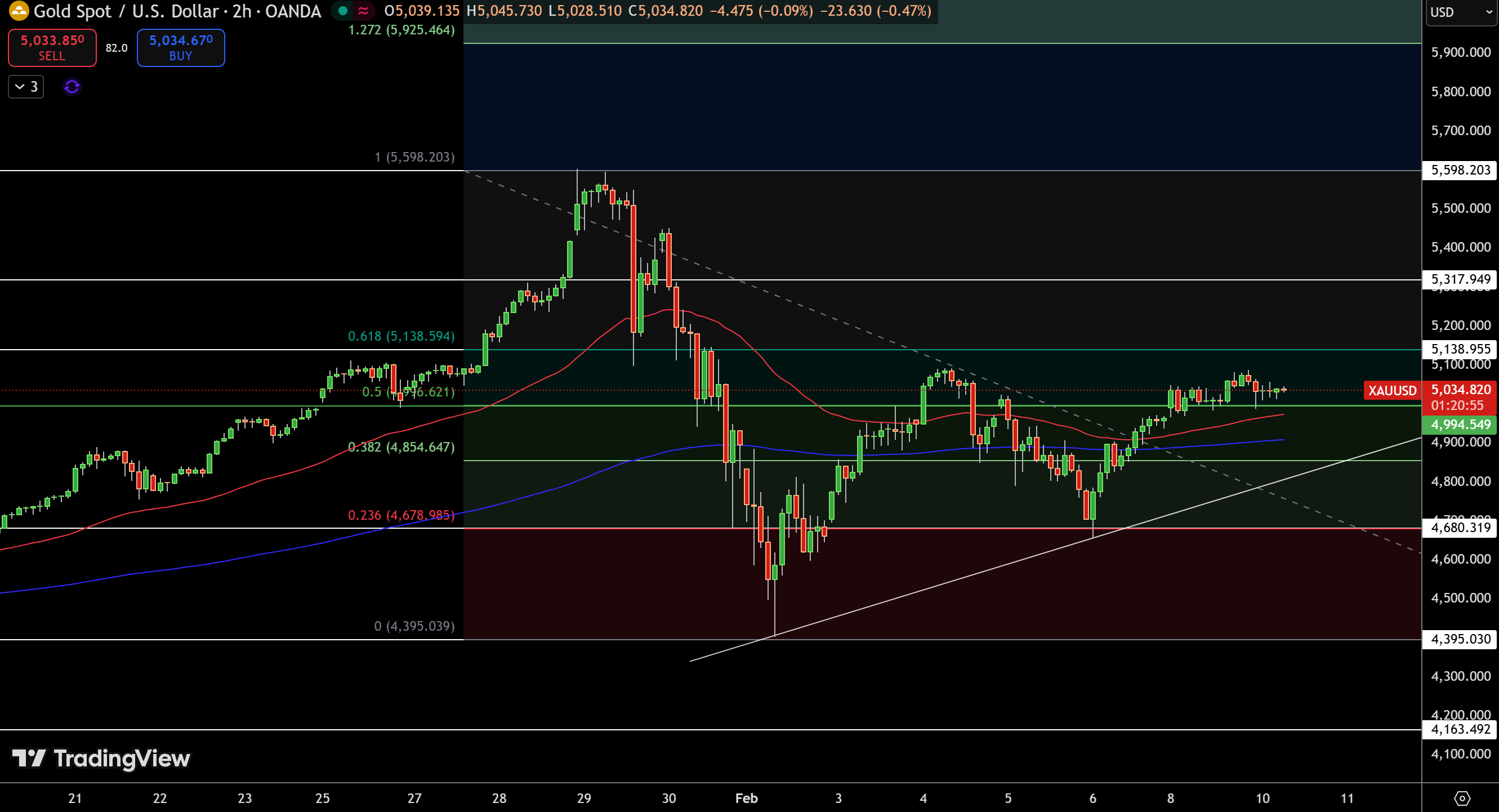
Gold (XAUUSD) is trading near $5,035 on the 2-hour chart, consolidating after bouncing from the $4,680 low. Recent candlesticks are small with short wicks, showing a balanced market. The price remains above the rising trendline from early February, so the recovery is still in place.
The recent move up has reached a key Fibonacci area. The 38.2% level near $4,855 is acting as support, while the 61.8% retracement around $5,138 is limiting gains. The 50-period moving average is flat near $5,020, and the 100-period average around $4,995 is still supporting the price. RSI is just above 50, showing neutral momentum. If price breaks above $5,138, it could reach $5,318. If not, it may pull back toward $4,995.
Trade idea: Consider buying if gold dips near $5,000, with a stop below $4,950 and a target of $5,130.
Silver (XAG/USD) Price Forecast: $82 Faces Trendline Test as XAGUSD Compresses
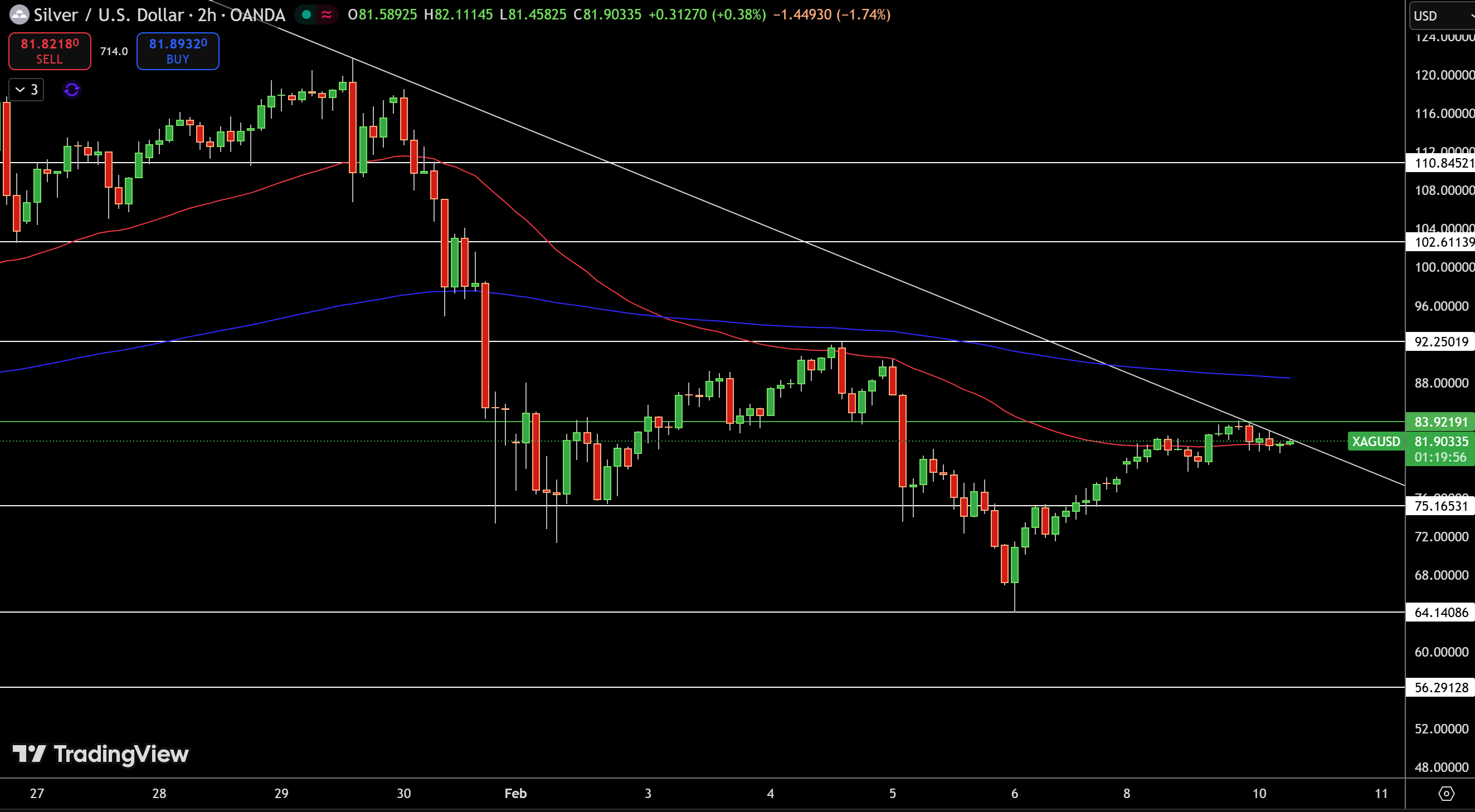
Silver (XAGUSD) is trading around $81.90 on the 2-hour chart and is testing a downward trendline that has held since the $118 high. Recent candles have small bodies and upper wicks near $82 to $83, which suggests sellers are active on rallies. Overall, the market is still in a corrective phase after the sharp fall to $64.
The price is staying just above support at $83.90, but it is still below the 50-period moving average at $85.80 and the 100-period average at $92.25, so the outlook stays cautious. Looking at Fibonacci levels, the bounce has paused near the 38.2% retracement of the last drop, which matches up with the trendline resistance.
The RSI is near 50, showing momentum is balanced and not clearly bullish. If price breaks above $84.00, it could move toward $92.25. If it fails, it might drop back to $75.15.
Trade idea: Consider selling around $83.50, set a stop above $85.80, and aim for a target of $75.20.