
Market Overview
In early February 2026, traders watching the US Dollar Index (DXY) are seeing a strong “Sell America” mood. This comes as changes in global reserve holdings meet easing geopolitical tensions.

The China Factor: A Structural Shift in DXY
The dollar is under immediate pressure after reports that Chinese regulators told local banks to limit how much US Treasury debt they hold.
Concentration Risk: This move is seen less as a rejection of US credit and more as “risk diversification” to reduce exposure to unpredictable US economic policies.
Capital Outflows: Since China holds a large share of dollar reserves, even a slow shift away from US assets lowers demand for the dollar. This is pushing the DXY down to its lowest point since early 2022 (below 97.00).
The “Takaichi Trade” & Global Risk-On Sentiment
The dollar is losing its “safe haven” status as global market confidence rises.
GBP/USD Price Forecast
Every new GBP/USD analysis as it publishes, today's technical signal and key levels, live price — on one page.
See all GBP/USD forecastsJapan’s Supermajority: Prime Minister Sanae Takaichi’s big win on February 8 has removed much of the political uncertainty. The “Takaichi trade,” which expects major government spending in Japan, has lifted the Yen and stocks, drawing money away from the US dollar.
Middle East Diplomacy: President Trump called recent US-Iran talks in Muscat “very good.” This progress toward a nuclear peace deal has lowered the “fear premium” that often supports the dollar during conflicts.
Fed Independence and “Miran’s Mandate”
Internal debates at the Federal Reserve are leading to a mixed, but mostly negative, outlook for the dollar.
Stephen Miran’s Stance: Fed Governor Stephen Miran has called for big rate cuts, up to 100 basis points in 2026, saying current policy is “overly tight.”
The Independence Debate: Miran says that “100% pure independence” is not possible in a crisis. But his recent move from the White House Council of Economic Advisers to the Fed has raised worries about the Fed becoming more political. Traders are concerned that the Fed could face more pressure from the administration to cut rates, which would weaken the dollar.
Key Market Triggers to Watch This Week
Right now, the DXY is in a “wait-and-see” mode as traders look ahead to important data releases:
Delayed Jobs Report (NFP): Markets are looking for signs that the job market is slowing down, which would support a rate cut in June.
CPI Inflation: If inflation comes in lower than expected, it would back up Governor Miran’s call for rate cuts and could push the DXY down toward the 95.00 support level.
Treasury Auctions: Traders are watching the upcoming $125 billion debt auctions to see if foreign buyers stay interested, even after China’s recent warnings.
US Dollar Index Outlook: DXY Stabilizes Near $96.90 as Fib Support Holds
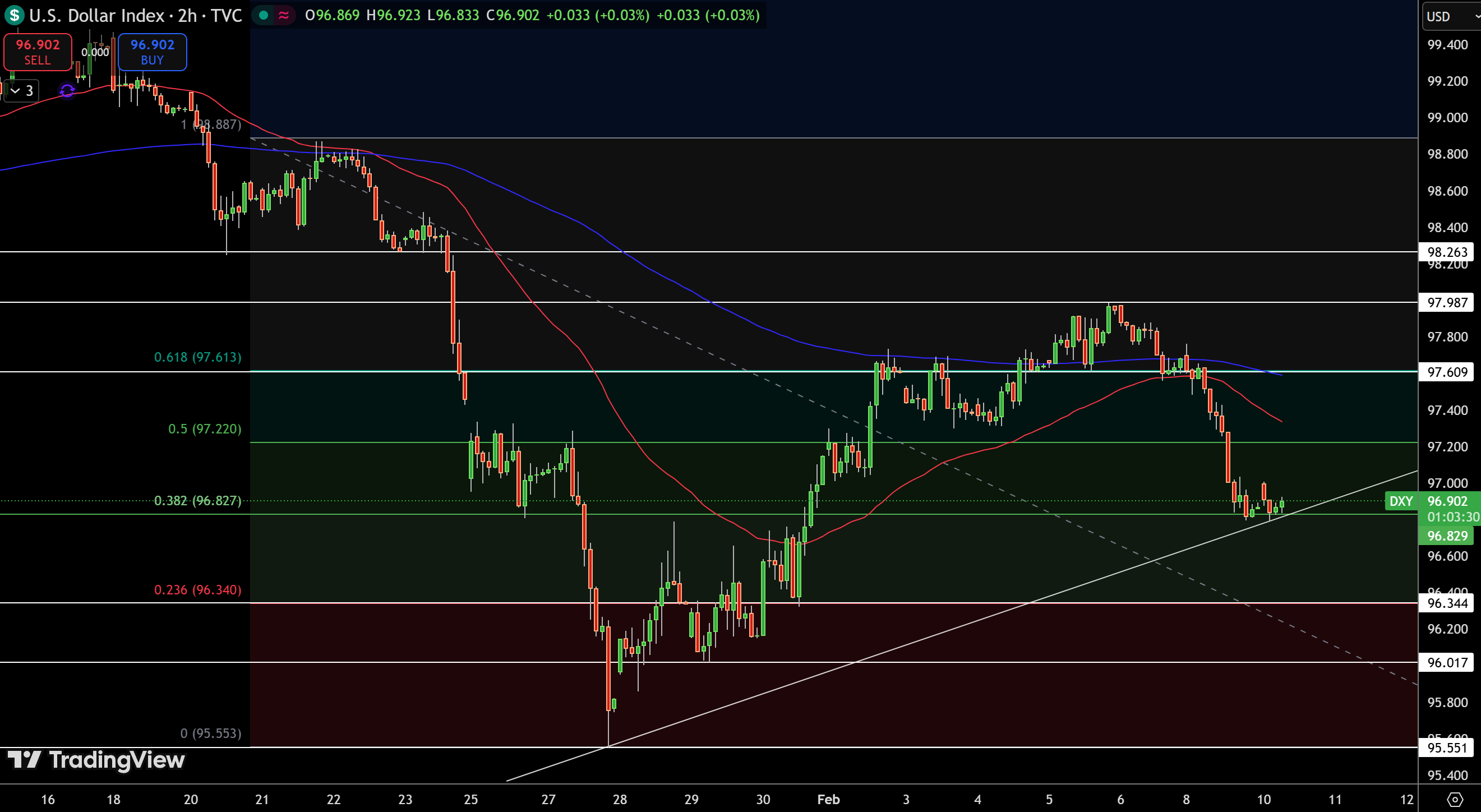
The US Dollar Index (DXY) is trading near $96.90 on the 2-hour chart. It is trying to stabilize after a sharp drop from the $97.99 high. Recent candlesticks have small bodies and long lower wicks near $96.80, which shows buyers are stepping in at support instead of strong selling pressure.
The price is just above the 38.2% Fibonacci retracement at $96.83, which has been a short-term pivot. The index is still below the 50-period moving average near $97.30 and the 100-period average around $97.60, so rallies are limited for now. A rising trendline from late January also provides support near $96.70.
The RSI is between 45 and 50, showing neutral momentum with no divergence. Resistance is at $97.60. If the price falls below $96.70, it could move down to $96.34.
Trade idea: Consider buying near $96.70, set a stop below $96.30, and aim for a target of $97.60.
GBP/USD Price Outlook: $1.3670 Pulls Back Under Trendline Resistance
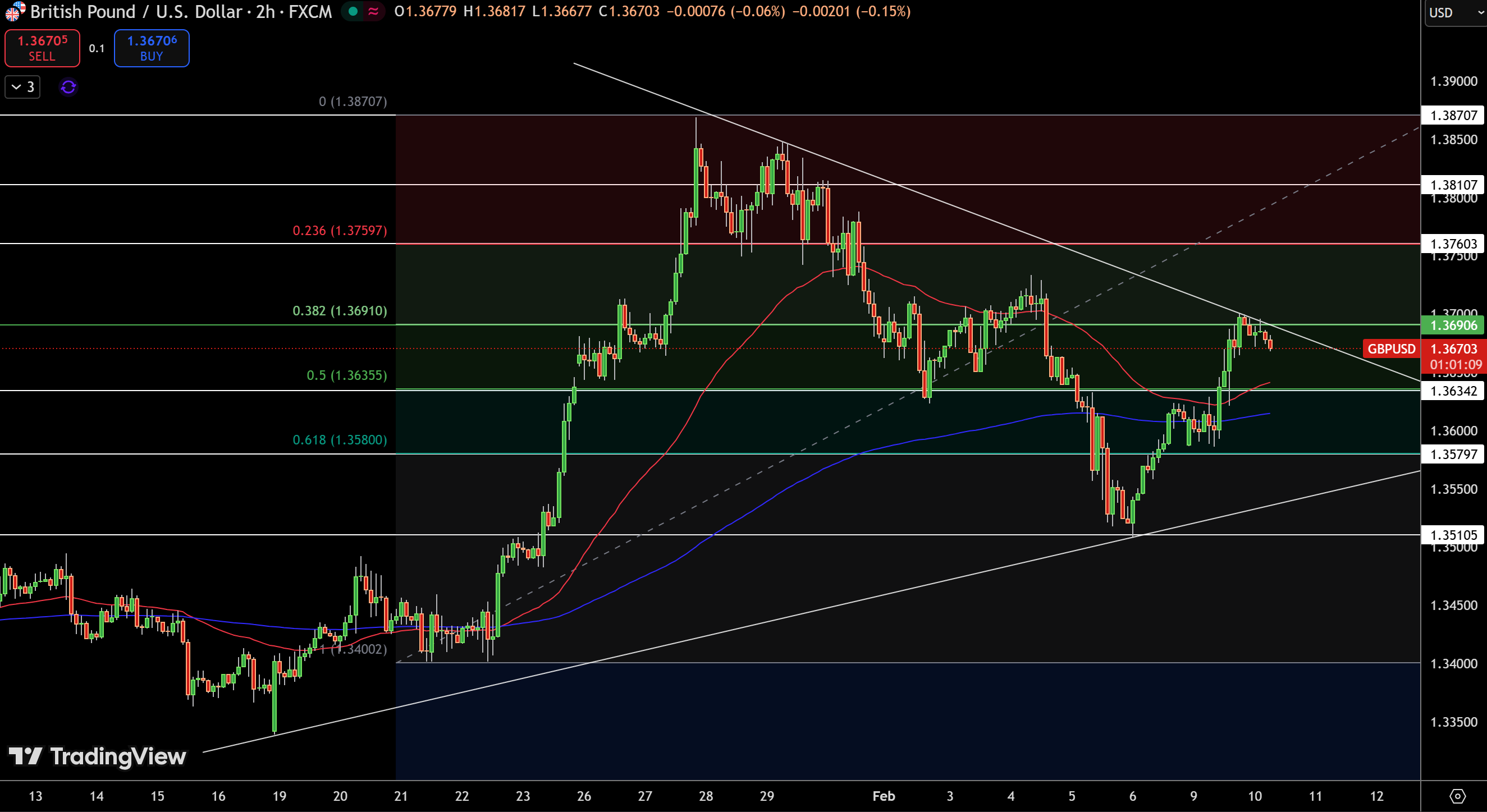
GBP/USD is trading close to $1.3670 on the 2-hour chart. The pair has pulled back after it could not stay above the descending trendline from the $1.3870 high. Recent candlesticks have small bodies and upper wicks near $1.3690 to $1.3710, which suggests sellers are active on rebounds instead of strong buying momentum.
The price is just above the 50% Fibonacci retracement at $1.3655, which serves as a short-term pivot. The 50-period moving average is flat near $1.3660. The 100-period average, around $1.3580, lines up with the rising trendline from mid-January and adds to the support.
The RSI is near 50, which shows neutral momentum after the recent bounce from $1.3510. Resistance is at $1.3710 and $1.3810. If the price falls below $1.3630, it could move down to $1.3580.
Trade idea: Consider buying near $1.3630, set a stop below $1.3580, and aim for a target of $1.3710.
EUR/USD Price Outlook: $1.19 Holds as Bulls Defend Rising Trendline
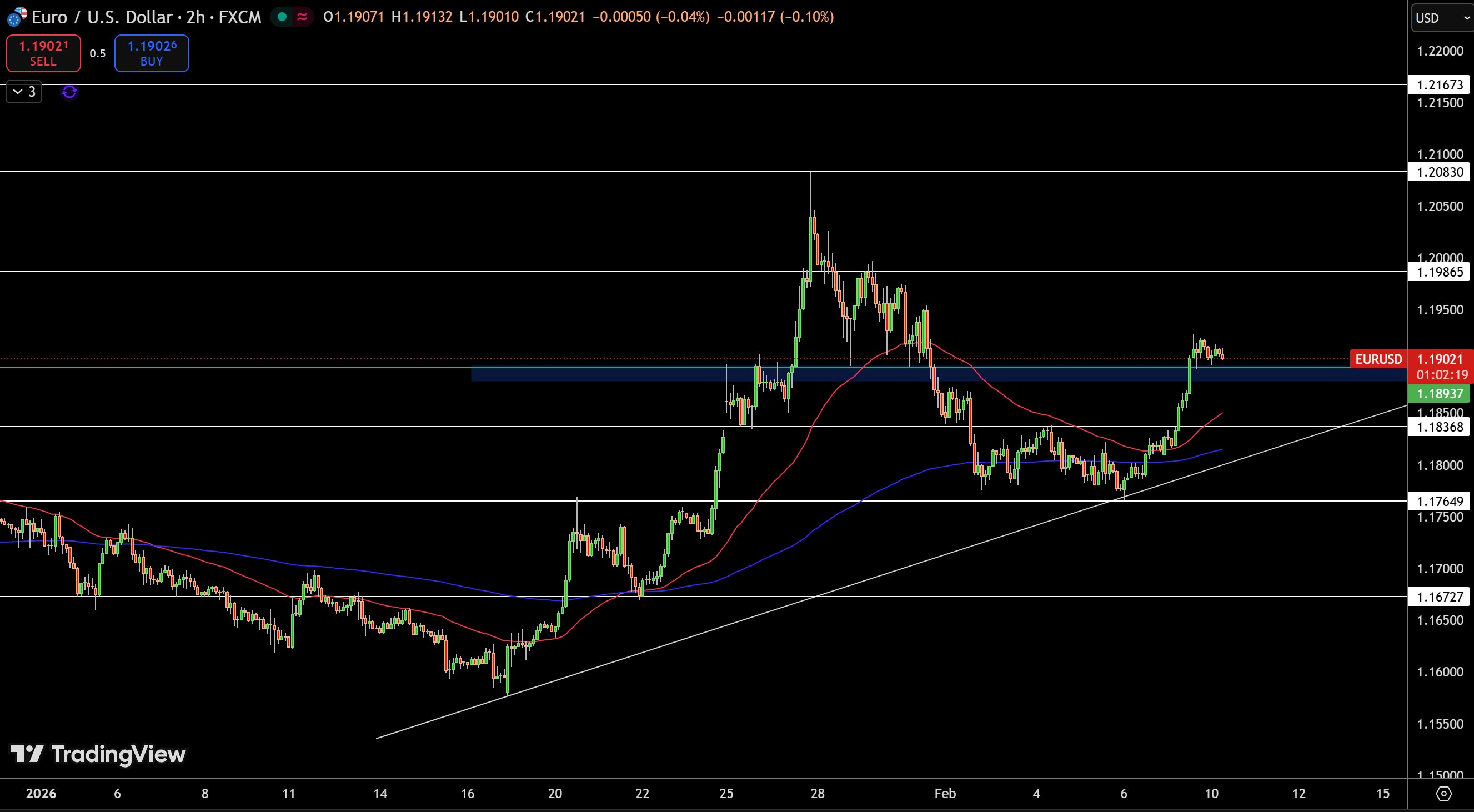
EUR/USD is trading around $1.1902 on the 2-hour chart. The pair is consolidating after a strong rally that nearly reached $1.2050. Recent candlesticks have small bodies and mixed wicks near $1.19, showing short-term indecision instead of a clear reversal. The price is still above a rising trendline from mid-January, so the overall trend remains upward.
The pair is just above a key demand zone near $1.1890. The 50-period moving average is flat around $1.1885. The 100-period average, near $1.1835, matches up with trendline support and adds to the downside protection.
The RSI is close to 50, which suggests neutral momentum after the recent strong move. Resistance is at $1.1965 and then $1.2030. If the price drops below $1.1850, the bullish outlook would weaken.
Trade idea: Consider buying near $1.1880, set a stop below $1.1830, and target $1.1965.