
Gold News: Central Bank Buying Counters Rate Uncertainty
As of July 15, central bank buying, anticipated monetary policy, and geopolitical risk factors have dictated the gold and silver markets. Official sector buying bolsters the long-term outlook. The World Gold Council reported central banks net purchased 41 tonnes of gold in May, with Poland and China buying 18 and 10 tonnes, respectively. Poland has purchased 64 tonnes this year while China has purchased 25 tonnes. Both have purchased while most of the world is concerned with what is going to happen next.
After soft U.S. inflation, the Fed’s policy path has come under reassessment. However, renewed tensions in the Middle East have somewhat countered the disinflation effect, and it is expected the Fed will hold policy. Precious metal investment is dictated by this uncertainty.
Silver’s long-term fundamentals will be underpinned by structural industrial demand, especially in the case of solar manufacturing and electronics, and gold will be supported by central bank buying. In the World Gold Council’s latest survey, 89% of central banks thought that in the next 12 months official gold reserves will increase, signifying the importance of gold in reserve management.

Gold Technical Analysis: Will Triangle Support Hold or Trigger a Move Below $4,000?
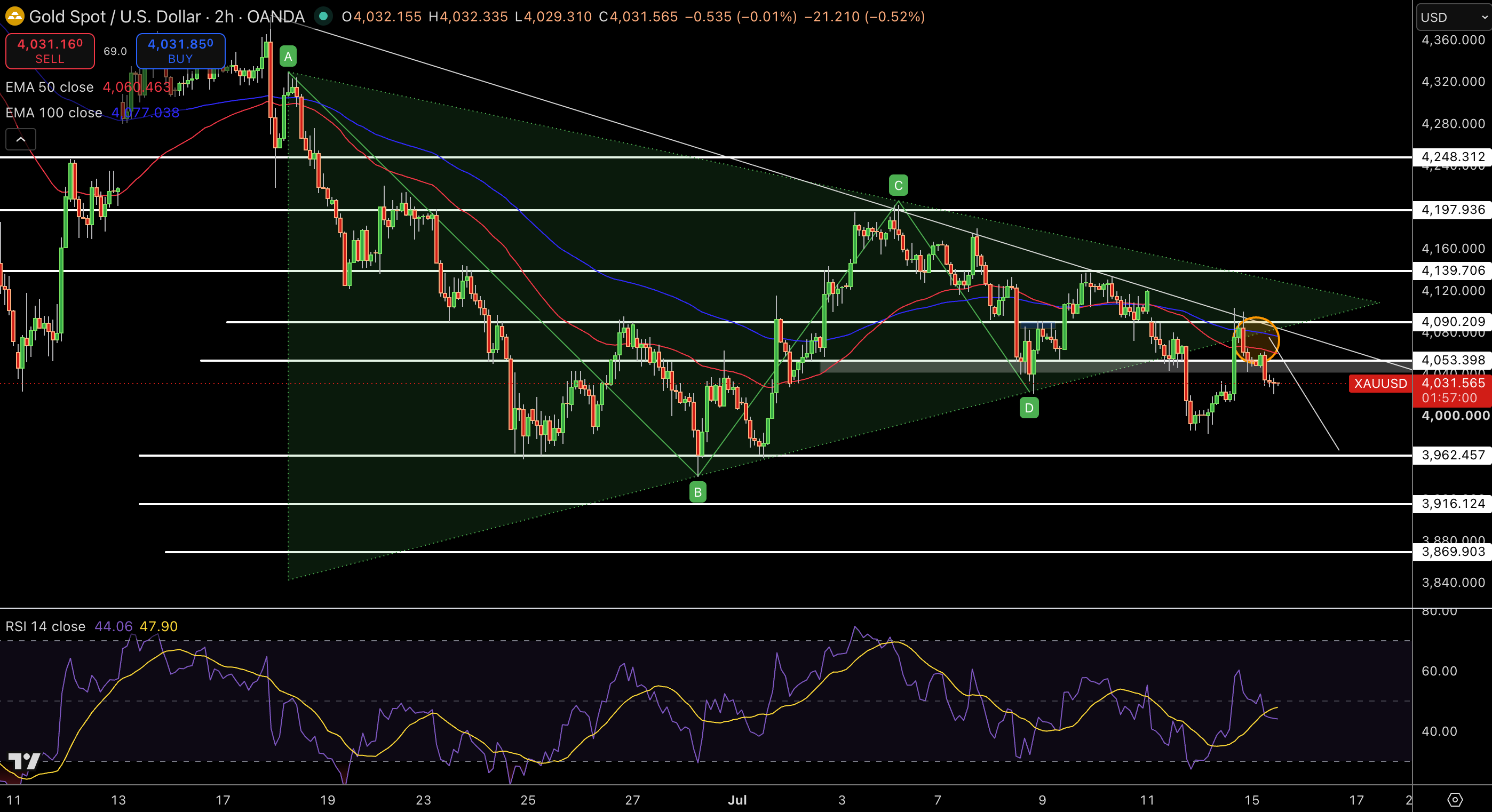
Gold is moving at $4,031 on the 2-hour chart after piercing the 50 EMA at $4,060 and is trading below the 100 EMA at $4,077. This indicates that sellers are stronger in the short term. Gold has been trading in a large symmetrical triangle and continues to develop new candles with lower highs under the descending triangle. There is resistance at $4,090, which has been repeatedly tested.
The gray support area of $4,053-$4,040 has now broken, and the psychological $4,000 mark has been exposed, with additional support at $3,962. The RSI is at 44 and has not passed the midpoint of the RSI, meaning that selling pressure has not reached the oversold region.
Resistance at $4,090 needs to be broken for the price to be pushed back to $4,140. As long as the price is trading under the broken area of support, pressure is expected on the price to continue to decline. Therefore, selling the price at $4,000 is expected to bring the price to $3,962, while $4,140 will be the target only after trade $4,090.
Silver Technical Analysis: Can Buyers Defend $57.15 and Break the Descending Trendline?
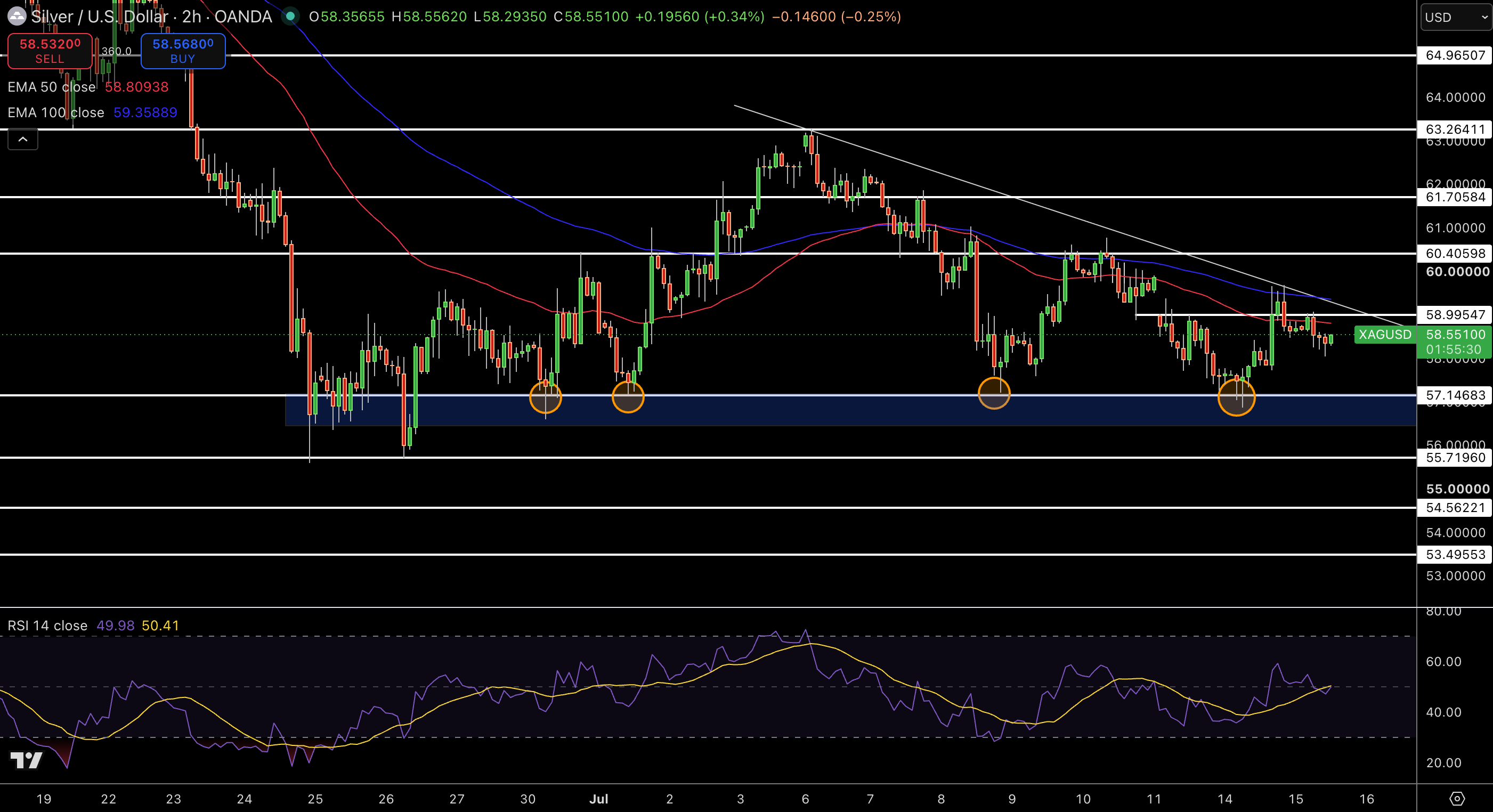
Silver is currently valued at $58.55 after once more rebounding from the most recently tested demand zone at $57.15. Prices have traded under the descending trendline and the 100 EMA at $59.36 and the 50 EMA at $58.81 is the next resistance Silver will likely meet. There has been an observed pattern of small candle formations and a repeated rejection of the $59.00 mark, which has contributed to the loss of positive momentum by Silver.
Gold Price Forecast
Every new Gold analysis as it publishes, today's technical signal and key levels, live price — on one page.
See all Gold forecastsThe support zone at $57.15 has maintained its integrity, making it the primary focus area, with $59.00 and $60.41 forming the resistance barriers. The RSI, having rebounded to $50.00, has shown a near balance of momentum. There are no further developments to suggest that the current situation for Silver will evolve to a positive position.
Given the parameters that have been defined, buying barriers will be set upon the breakout of the $59.00 mark with a target placed at the $60.41 barrier, and a defensive stop will be placed at the $57.15 mark should support fail.