


Market Overview
Gold (XAU/USD) staged a bit of a recovery on Friday, helping to claw back some of the ground it had lost in the days leading up to it, as a rise in demand for safe havens kicked in due to escalating tensions in the Middle East starting to get under people’s nerves.
The price of gold is now trading at about $5,132, which is a gain of over 1% on the day, but even so its still on track to have its first weekly drop in 5 weeks, this at the mercy of some pretty persistent challenges – the strengthening US dollar and a somewhat uncertain outlook on monetary policy.
Gold & Regional Tensions; Safe Haven In Play
Regional tensions have gone up another notch now, following a fresh barrage of missiles and drones that have knocked out some of the region’s energy infrastructure, making a lot of people wonder if this is the start of something bigger.
There’s also been a step up in diplomatic rhetoric, which has pretty much put the kibosh on any hopes of things calming down anytime soon. This latest development has driven many investors towards assets they know and trust, with gold getting an extra boost from renewed risk aversion.
That said, gold’s gains were limited by the US dollar being in better shape than many had expected and by a lingering expectation that the Fed will keep interest rates high as long as there’s still inflation to deal with. And on top of all that, higher oil prices are only making people worry even more about inflation, which is pretty much the last thing gold investors need right now.
Looking to the future, now the focus is on a bunch of upcoming US data releases. The nonfarm payrolls are forecast to come in at 59K, down from 130K last time. And then there’s retail sales, which are predicted to have dropped by 0.3% month on month. If those numbers don’t come in as expected, it could reignite hopes of interest rate cuts, which in turn might give gold a short-term boost.
Gold Price Forecast
Every new Gold analysis as it publishes, today's technical signal and key levels, live price — on one page.
See all Gold forecastsGold (XAU/USD) Analysis: $5,096 Trendline Test After Breakdown Below $5,196
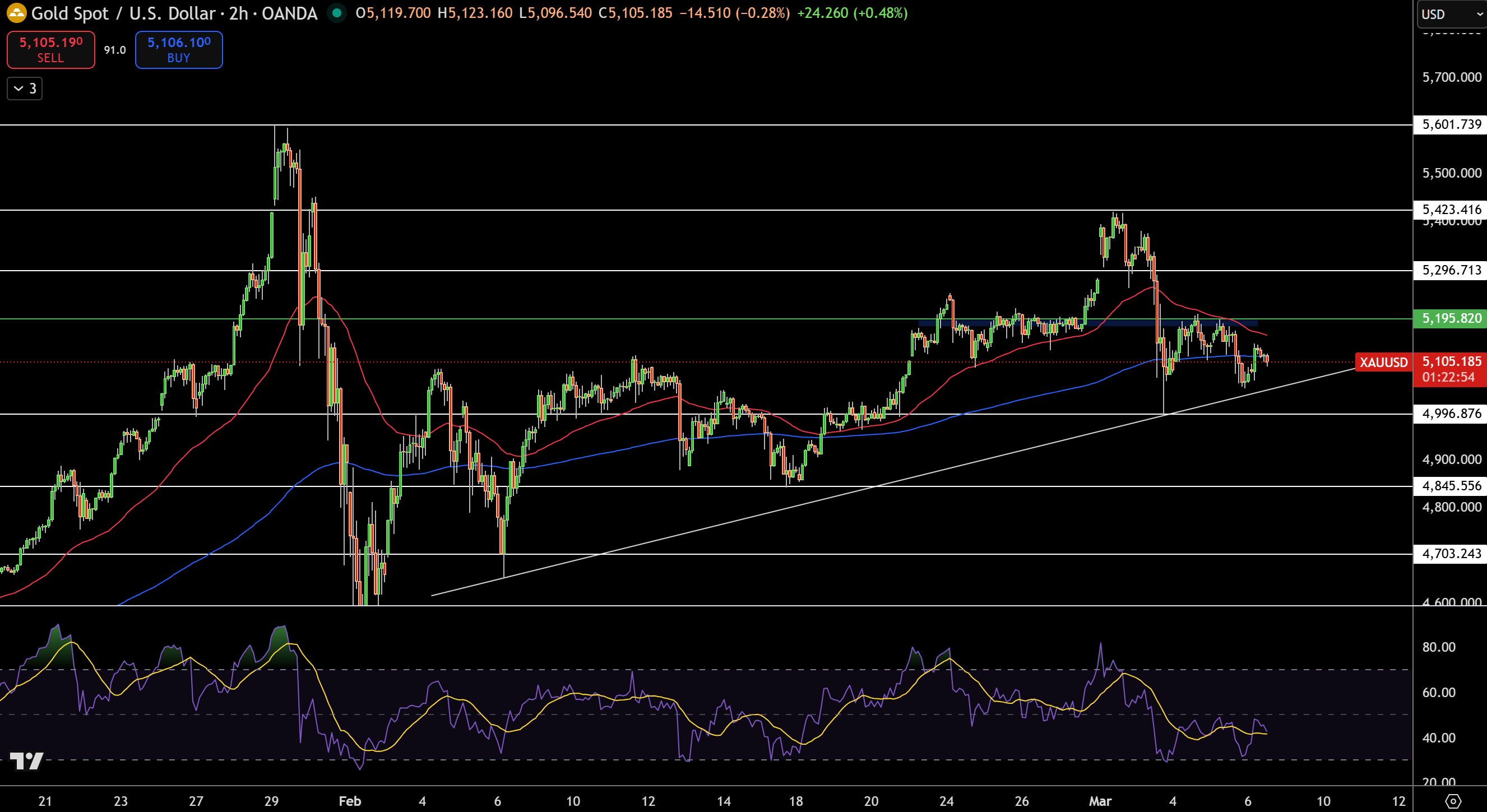
Gold is sitting at around $5,105 at the moment – just about clinging to an uptrend line that starts at the early Feb lows. That was after the price got knocked back from $5,296 and formed a pretty convincing bearish engulfing move – which was then followed by a sharp drop below that key level of $5,196 which is now acting as a barrier to getting any higher.
The price is currently bouncing around between $4,996 and $5,196 – with the 50 day EMA hovering around $5,150 now heading downwards. If the price does manage to break below $4,996 then it might start heading towards $4,845 – but if it can get back above $5,196 then the focus will shift back to trying to hit $5,296.
Trade idea: Consider selling below $4,996, with a target of $4,845, stopping losses if the price heads above $5,120.
Silver (XAG/USD) Analysis: $85.44 Resistance Caps Recovery Attempt
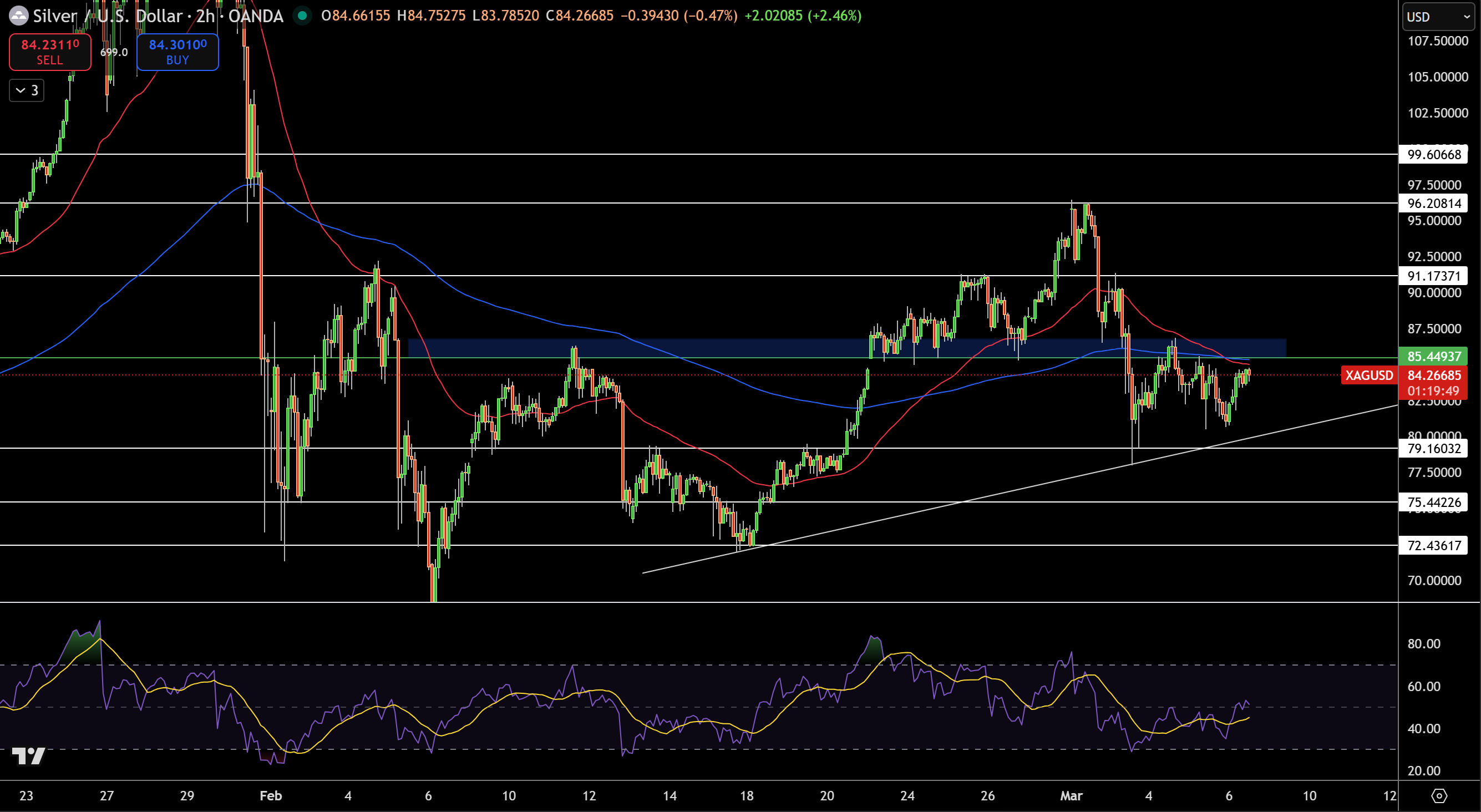
Silver is hovering around $84.27, and as you’d expect, it’s holding its ground firmly above that rising trendline that’s been in play since the low of mid-February. Price has bounced off the $79.16 support level, and when it did, it left those long lower wicks on the chart, which are a pretty clear sign that buyers are starting to get in on the action. However, at this point the recovery is about to put the squeeze on the $85.44 resistance area, which just so happens to align with the 200 day EMA – as well as that ceiling from the past consolidation.
The short term 50 day EMA is sitting around $86.50 and it’s actually turning lower – which is your dead giveaway that at least short term, there’s a bit of pressure building. And then you have the 200 day EMA, which is exactly where it’s been – right at $85.40 – acting as a bit of a dynamic ceiling. If the price can’t get back up above $85.44 then its really just keeping things in a more corrective move within a broader range that runs between $79.16 and $91.17.
Where does it go from here?: The RSI is basically right in the middle – about at 48, which tells us that momentum just isn’t strongly on the side of the bulls right now.
Trade idea: Take a position if you can get price to break above $85.50, the target would be around $88.00 – and your stop loss should be below $83.80.