


In a matter of days, the yellow metal has delivered some of the largest one-day gains ever recorded, reigniting a debate that traders cannot afford to ignore.
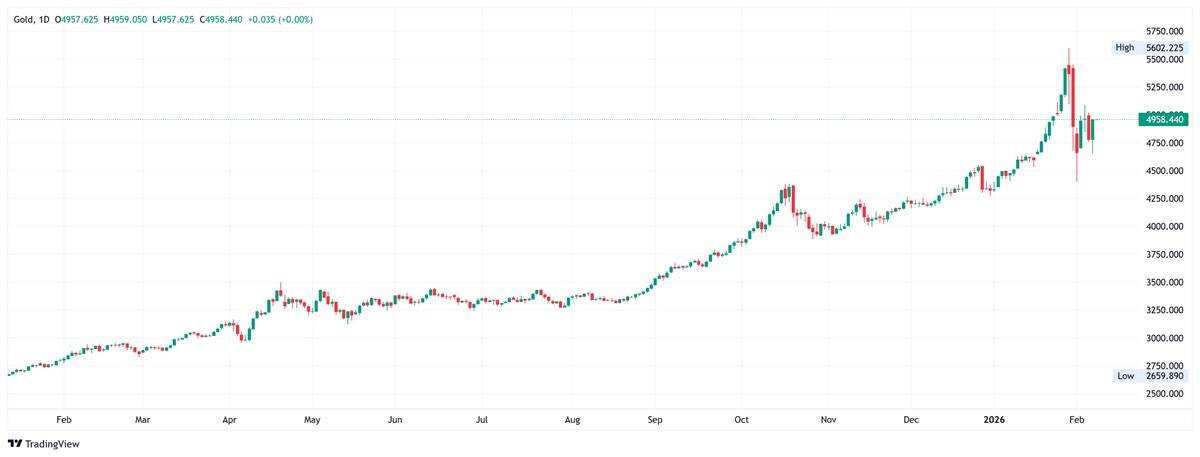
So far this month, Gold has surged back above $5,000 an ounce, rallying more than 17% in less than 48 hours. This follows a sequence of extraordinary moves just days earlier, with prices leaping 11% and 9% in single trading sessions. For casual observers, the charts look chaotic. But for seasoned professionals, they look familiar.
At The Gold & Silver Club, these conditions are viewed not as anomalies, but as opportunities.
“2026 has become the year of buy low, sell high – rinse and repeat,” explains Lars Hansen, Head of Research at The Gold & Silver Club. “This is where fortunes are made. The asymmetry of risk-reward in Gold right now is staggering. A single, well-timed trade can now generate what it used to take months, if not years, to achieve – in a single day.”
Across Wall Street, similar language is being used. A growing number of the world’s most powerful major banks have quietly begun referring to the current environment as a “Golden Age of Trading” – a period defined by extreme volatility, compressed cycles and outsized opportunity for those positioned correctly.
A Natural Reset Inside a Supercharged Bull Market
The recent pullback arrived at a moment when seasonal patterns, positioning and technical dynamics all converged. Yet despite the intensity of the correction, Gold has already clawed back a substantial portion of its losses. A weakening dollar and stabilizing financial conditions have provided immediate tailwinds.
“While near-term volatility is likely to persist, this move is best understood as a positioning-driven reset rather than a fundamental turning point,” says Hansen.
Zoom out and the macro picture remains stubbornly supportive. Nothing has changed to undermine the long-term bullish thesis. U.S fiscal stress continues to deepen. Government debt is ballooning. Confidence in fiat currencies is being quietly eroded. Real yields remain volatile, but Gold’s role as the ultimate monetary hedge is intact – and remains unchallenged.
Central banks across Asia to the Middle East continue to accumulate Gold at a record pace. Meanwhile, geopolitical fault lines – from Eastern Europe to tensions around China – provide a steady undercurrent of uncertainty that structurally supports demand.
“Every driver that pushed Gold to record highs is still in place,” Hansen notes. “If anything, they’re intensifying.”
Hansen describes the current phase as an “accumulation phase” – a technical reset that shakes out leveraged speculators and hands control back to long-term players. “When liquidity shifts, weak hands sell. Strong hands accumulate. Corrections like this don’t end bull markets – they prepare them for the next advance.”
Gold Price Forecast
Every new Gold analysis as it publishes, today's technical signal and key levels, live price — on one page.
See all Gold forecastsSmart Money Keeps Buying the Dip
The data reinforces that view. Even during the sharpest drawdowns, institutional inflows into Gold have remained resilient. This type of demand is strategic, long-term and largely indifferent to short-term volatility – a powerful anchor beneath the market.
“Traders shouldn’t confuse consolidation with completion,” Hansen cautions. “Markets rarely move in straight lines. When this phase ends – and it will – the next advance could make today’s prices look cheap.”
Gold at $6,000 Is More Likely Than $4,000
Over the past 15 years, The Gold & Silver Club has built a reputation as the most accurate forecaster of Precious metal prices, a record well documented across leading financial publications and institutional research reports. The firm’s proprietary models have consistently pinpointed major turning points in both Gold and Silver – earning GSC recognition as a trusted authority among institutional investors and private wealth clients alike.
The Gold & Silver Club’s in-house models project a base-case target of $6,000 for Gold within the next 12 months – a level Hansen calls “conservative.”
Wall Street is moving in the same direction. Goldman Sachs, UBS and Bank of America see prices approaching $5,700 by the end of 2026, while JPMorgan has floated longer-term projections as high as $8,000 an ounce, driven by an accelerating global rotation into hard assets.
The Last Cheap Entry Before Lift-Off
After smashing through $5,600, Gold’s retracement is not an ending – it is a reset before ignition. For patient traders and investors, this period may prove to be the final opportunity to build exposure before the next historic breakout.
“Gold has rarely looked this asymmetric,” Hansen says. “Yes, we’re in a correction. But in the midst of chaos lies opportunity. Dips like this aren’t a warning – they’re an invitation. The real question isn’t whether Gold has peaked. It’s how much longer this window stays open before the next historic breakout begins?”


