


Intel Misses, Warns of Worse Ahead — Can’t Make Enough Chips
Intel reported Q4 after the bell, and the headline is straightforward: they’re running out of supply.
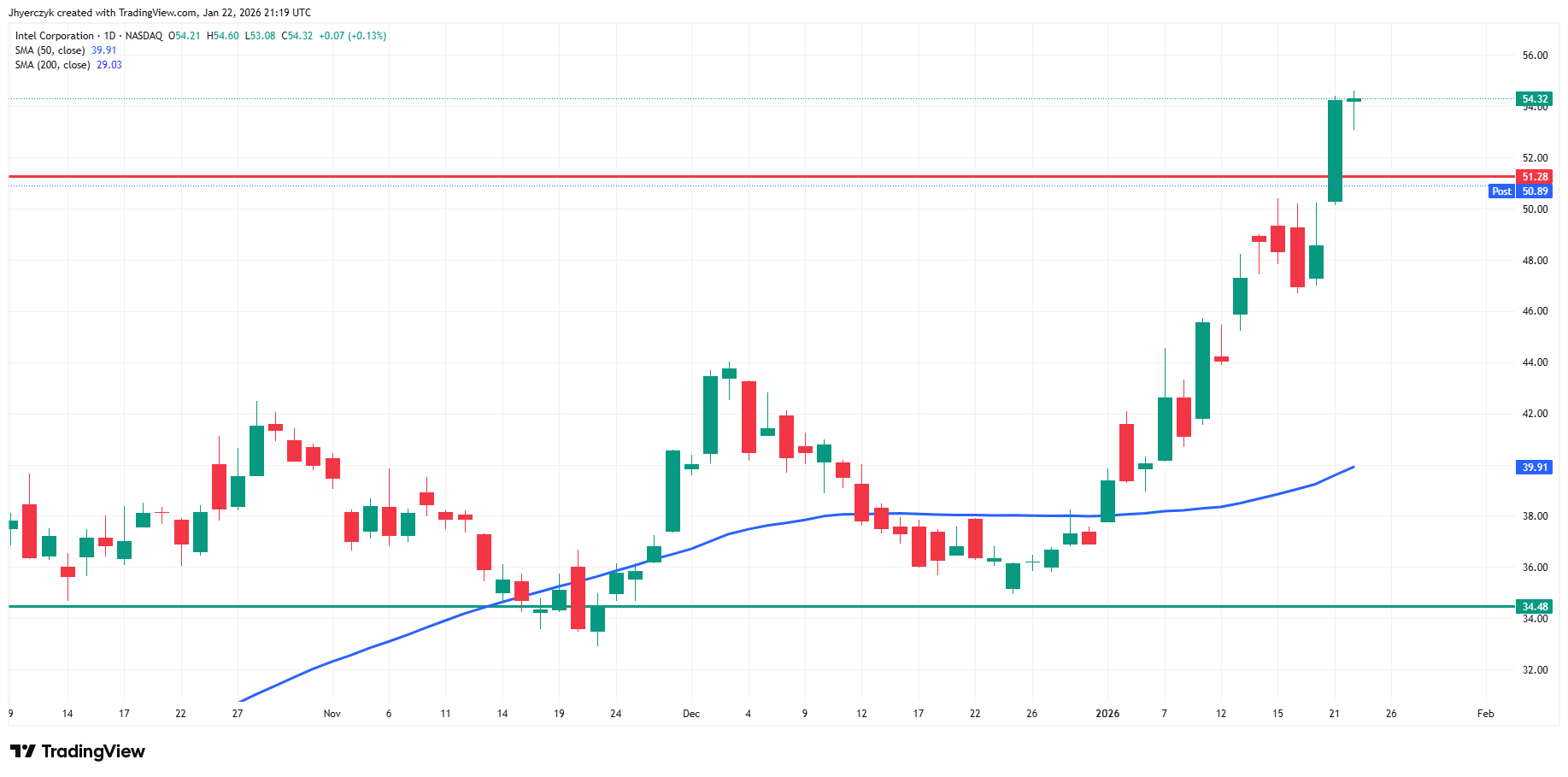
Revenue hit $13.7 billion, down 4% from last year. Q1 guidance came in at $11.7–12.7 billion with earnings per share of exactly zero. Not great and maybe not enough to support its current rally. Traders were quick to respond to the weak report, dropping the stock to $50.60, down $3.72 or -6.85% in post-market activity.
The Supply Problem
CFO David Zinsner was blunt — supply hits its lowest point in Q1, then starts improving. Intel says demand is healthy, but they literally can’t make enough chips to meet it. That’s a problem when you’re already fighting to stay relevant.
The whole industry is dealing with shortages, but Intel’s particularly exposed. They’re trying to ramp new products while also building out foundry capacity, and both are constrained right now. Management keeps talking about “aggressive” efforts to grow supply, which suggests they’re scrambling to catch up.
PC sales (Client Computing Group) dropped 7% to $8.2 billion. Data Center grew 9% to $4.7 billion — the one area working. Intel Foundry, the manufacturing business they’re betting everything on, lost $2.5 billion in Q4. Full-year foundry losses topped $10 billion.
18A Launch — Does It Matter?
Intel finally shipped products on its new 18A process tech. CEO Lip-Bu Tan called it the most advanced chip technology made in America. Fair enough. But can they scale it fast enough to matter? The foundry business grew revenue 4% but is still bleeding billions.
The market’s heard the 18A story for months. Now it needs volume and proof that external customers — not just Intel’s own products — are lining up. So far, that part of the pitch remains theoretical.
Margins Getting Crushed
Gross margin came in at 37.9%, down over 4 percentage points from last year. Q1 guidance? 34.5%. Supply shortages and ramping new manufacturing are killing profitability.
Full-year free cash flow was negative $1.6 billion after backing out capex. Intel’s spending big to build capacity — $17.7 billion on plants and equipment in 2025 — but they’re not seeing the payoff yet. Operating cash flow of $9.7 billion sounds fine until you realize it’s all getting plowed back into fabrication plants.
Bottom Line
Intel rallied hard into earnings — up nearly 60% from the lows — and this report gave longs a reason to book profits. The supply issues are real, but they’re temporary if management delivers. Q1 looks weak, but if production ramps in Q2 like they’re promising, there’s a path forward.
For now, traders could start lightening up on the long side. The stock ran too far too fast on turnaround hopes, and zero earnings guidance for Q1 is enough to justify taking some money off the table. If you’re still long, the question is simple: do you believe the second-half recovery story, or do you wait for proof? It comes down to personal preference, buy strength or play for the pullback.