
The Initial Decline of the Larger Correction Is Likely Over
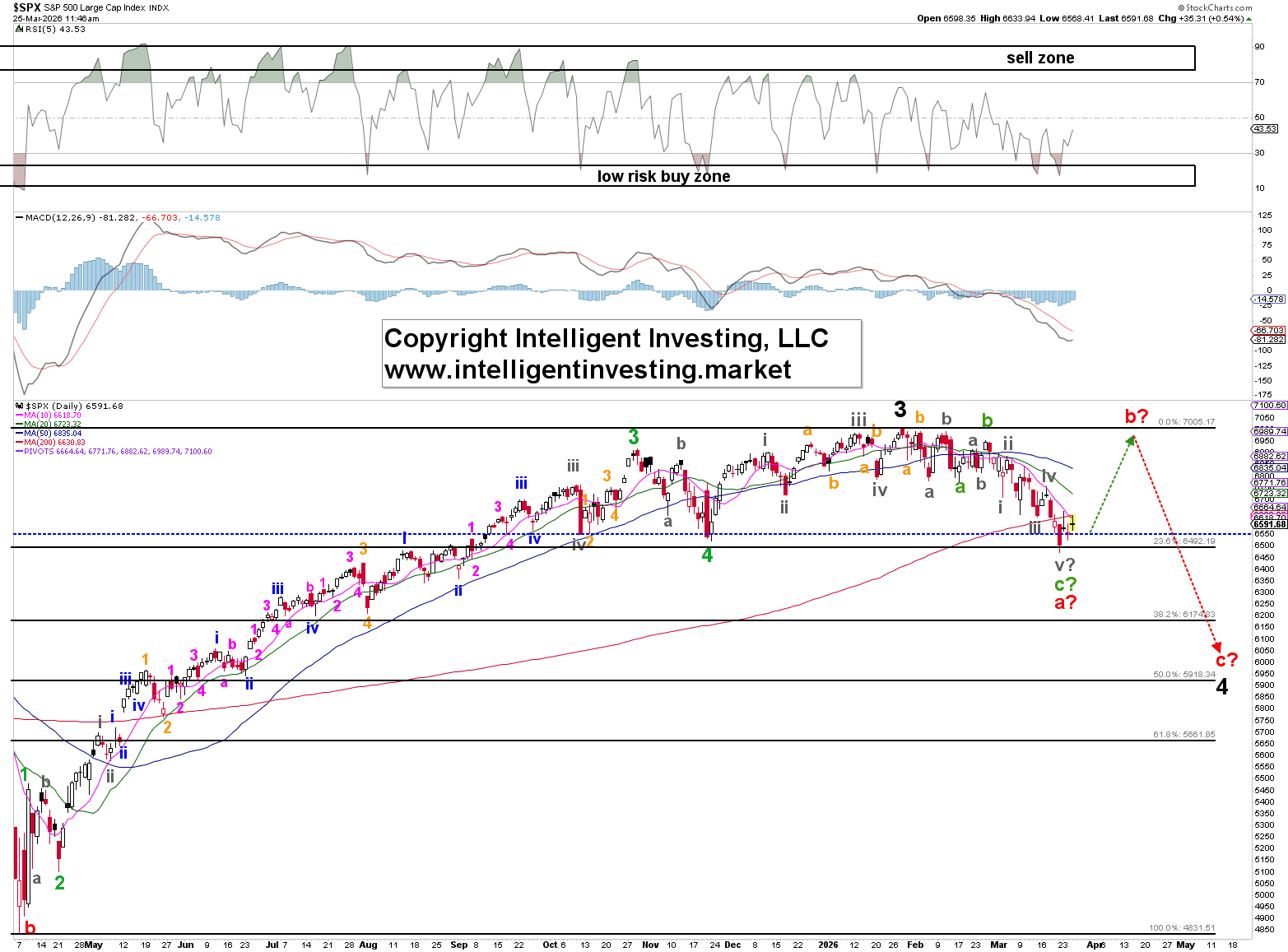
In our update from last Friday (see here), we showed that the SP500 YTD responded quite well to mid-term election-year seasonality, and combined with our Elliott Wave Principle work, we found that
- The [decline] should complete around $6490 ± 10
- A countertrend rally will start when the [decline] completes, …, topping out at around $6900+/-100…
- That should trigger another decline … to at least the 0.382 retracement of the rally from the April low.
Fast forward to today, the index bottomed on Friday at $6473, which is only 7 points below the ideal target zone. It has rallied about 2% since then. Since we are experiencing a fourth-wave correction similar in scope to the 2022 decline—which was a second wave—and corrections involve at least three waves (as shown in Figure 1 below as red Waves a, b, and c), it’s unlikely that such a shallow retracement will constitute the entire correction. It’s possible but unlikely. Therefore, the red Wave-a of the black W-4 has most likely bottomed.
Figure 1. Intermediate-term Elliott wave count for the SPX since April 2025.

Market Breadth Is Exhibiting Several Bullish Signals
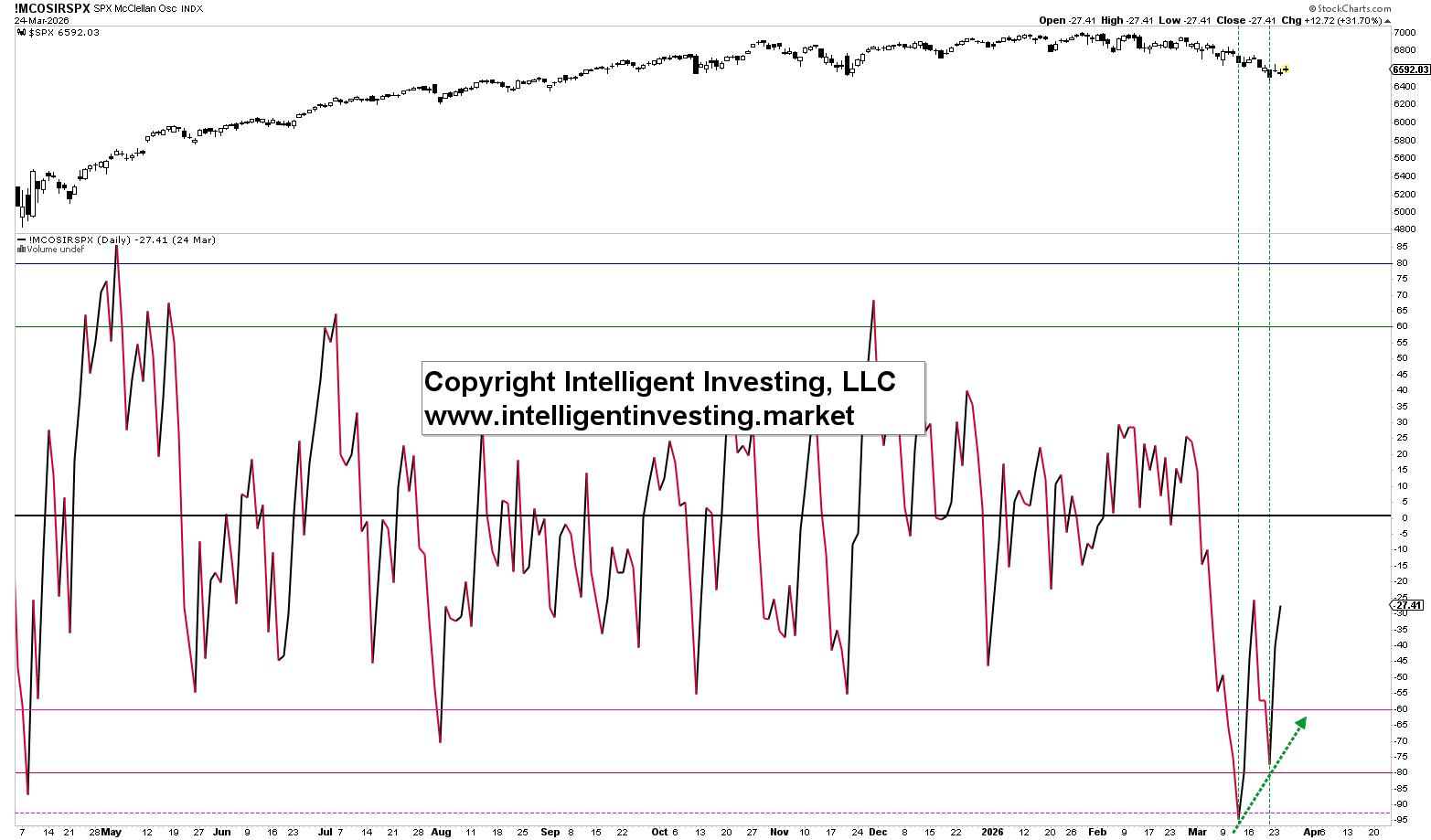
Since we focus on what is most likely rather than what is merely possible, we apply a weight-of-the-evidence approach. While seasonality is one factor, we also evaluate several market breadth indicators. In this case, we examine the McClellan Oscillator for the S&P 500 and find that it recorded a higher low between the March 20 and March 13 price lows. See Figure 2 below. This suggests that fewer stocks participated in the recent decline. This is known as positive divergence (green dotted arrow) and is a bullish signal.
Additionally, the indicator had dropped to levels last seen during the April 2025 crash low. Therefore, market breadth was very oversold, like a rubber band stretched so far it needs to snap back, or it will break. Also, a bullish signal.
Figure 2. McClellan Oscillator for the SP500 since April 2025.
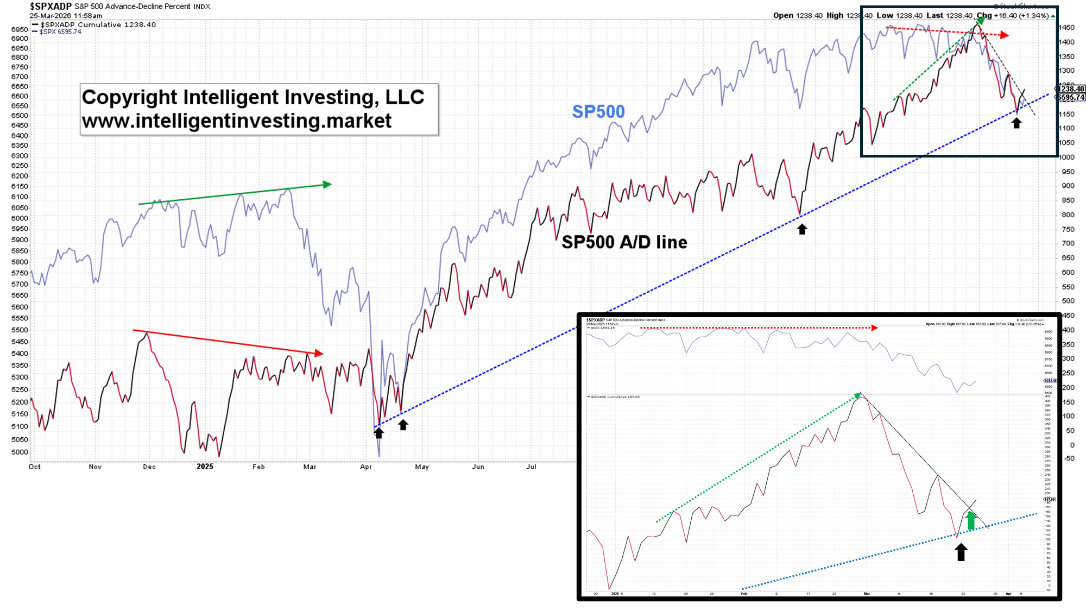
The second market breadth indicator we evaluate is the cumulative Advancing-Declining line for the SP500: the SPXA/D. See Figure 3 below. So far, it has maintained the blue-dotted uptrend line since the April lows (black up arrows). This is a bullish sign. Additionally, in early 2025, there was a negative divergence between the index and its A/D line, foreboding the February-April correction that year (solid red and green arrows).
Recently, there was no such divergence; in fact, the A/D went up, while the index was flat at best (dotted red and green arrows in the black box). Meanwhile, the A/D line has now broken above its downtrend line in place since early March (green up arrow). Another bullish signal
Figure 2. Cumulative Advancing-Declining line for the SP500 since October 2025.
S&P 500 Price Forecast
Every new S&P 500 analysis as it publishes, today's technical signal and key levels, live price — on one page.
See all S&P 500 forecastsTherefore, although price remains the ultimate decider, key market breadth indicators are generally bullish. Meanwhile, the index has hit a bottom exactly at the level our Elliott Wave count and Fibonacci levels predicted. So, if it stays above Friday’s low, we expect the B-wave bounce to ideally $6900 ± $100 to continue; otherwise, the next support level is in the mid-6300s before the Bulls can start again.