Stocks Split as AI Runs and Inflation Bites
The Dow Jones Industrial Average is down nearly 300 points at mid-session Wednesday. The S&P 500 is hovering near flat. The Nasdaq is positive. Same market, three different stories, and the dividing line is simple. If your portfolio is in semiconductors and AI you are having a good week. If it is anywhere near rates, borrowing costs or consumer spending you are not.

Technical Outlook
Nasdaq Composite Index
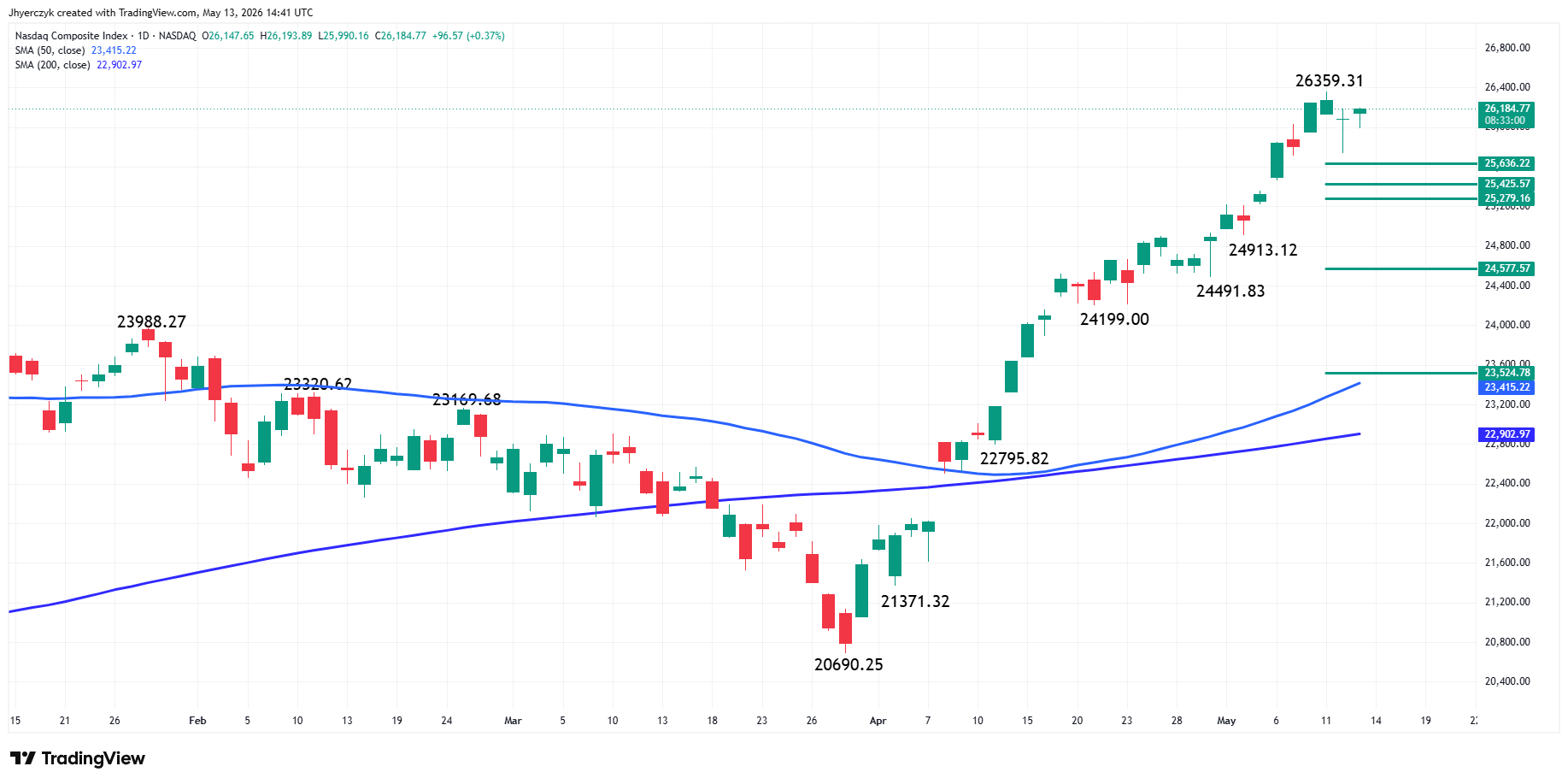
The Nasdaq Composite Index is relatively flat shortly after the opening on Wednesday as investors digest the latest PPI figures. The early inside move suggests investor indecision and impending volatility.
The main trend is up. A trade through the minor swing top at 26,359.31 will signal a resumption of the uptrend. However, even without true resistance, traders will still have to be prepared for a potentially bearish closing price reversal top.
On the downside, potential targets include three pivots at 25,636.22, 25,425.57 and 25,279.16. With the main trend up, buyers could come in on a test of any one of these levels with traders hoping it leads to the resumption of the uptrend and prevents an even steeper break to 24,577.57.
Yesterday’s steep break changed the pattern a little. The sell-off was the biggest since late March. Taking out yesterday’s low at 25,739.22 will be a further sign of weakness and make 26,359.31 a new main top, the market’s first since March 17.
The new minor range is 26,359.31 to 25,739.22. Its pivot is 26,049.26. Trader reaction to this level should set the tone into the close. A sustained move over this level will be bullish. Sustained weakness under it will be bearish.
Dow Jones Price Forecast
Every new Dow Jones analysis as it publishes, today's technical signal and key levels, live price — on one page.
See all Dow Jones forecastsS&P 500 Index
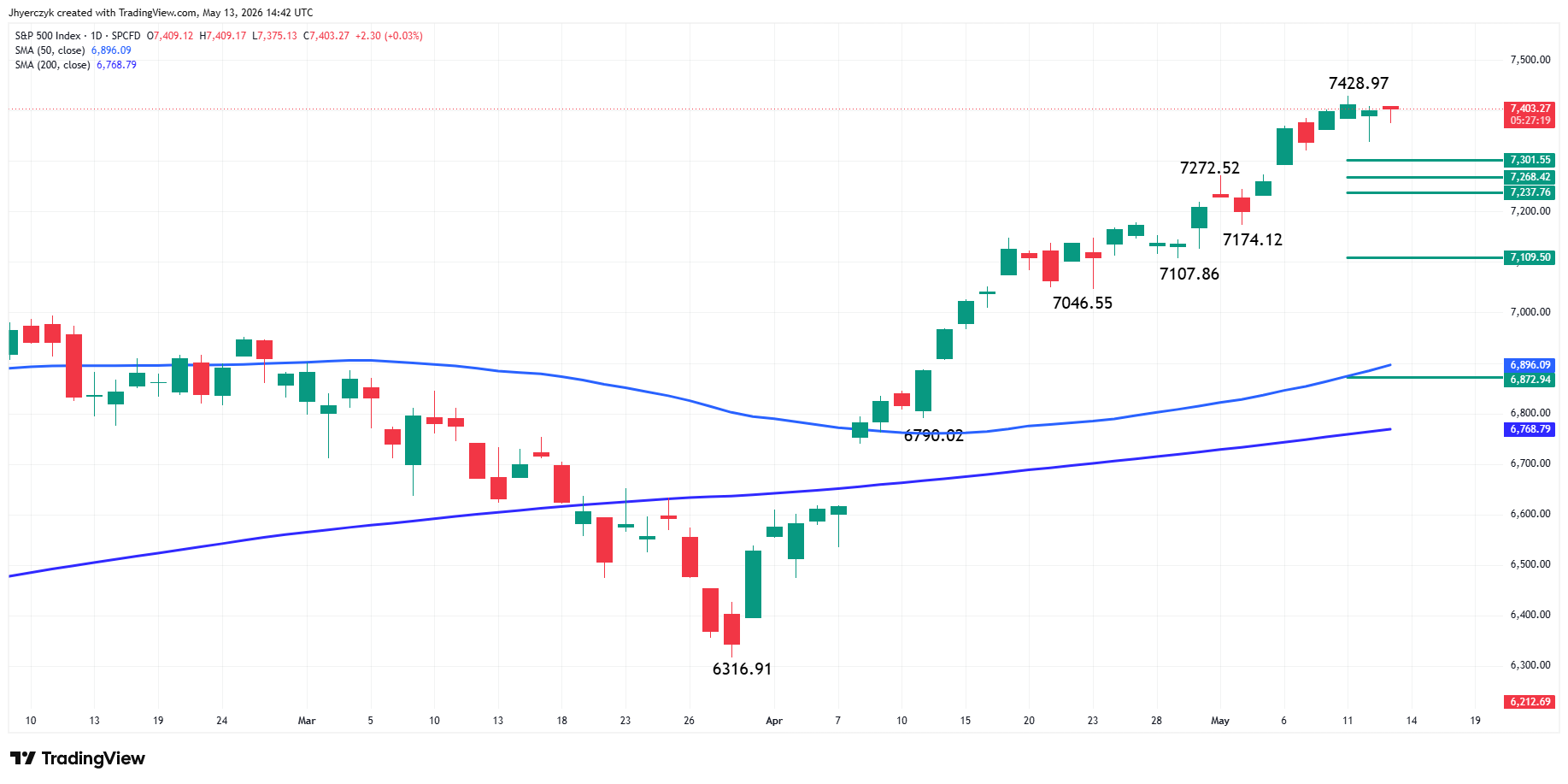
The benchmark S&P 500 Index is edging higher on Wednesday, putting it in a position to challenge the record high at 7,428.97. A trade through this level will reaffirm the uptrend.
Taking out yesterday’s low at 7,338.54 will make 7,428.97 a new main top, which would be a sign of increasing selling pressure. The first downside targets are layered at 7,301.55, 7,268.42 and 7,237.76. Since the main trend is up, buyers are likely to re-enter on a pullback to these levels.
A failure to make a new high on any rebound rally or a breakdown under these pivots will be signs of weakness and a possible shift in momentum.
Dow Jones Industrial Average
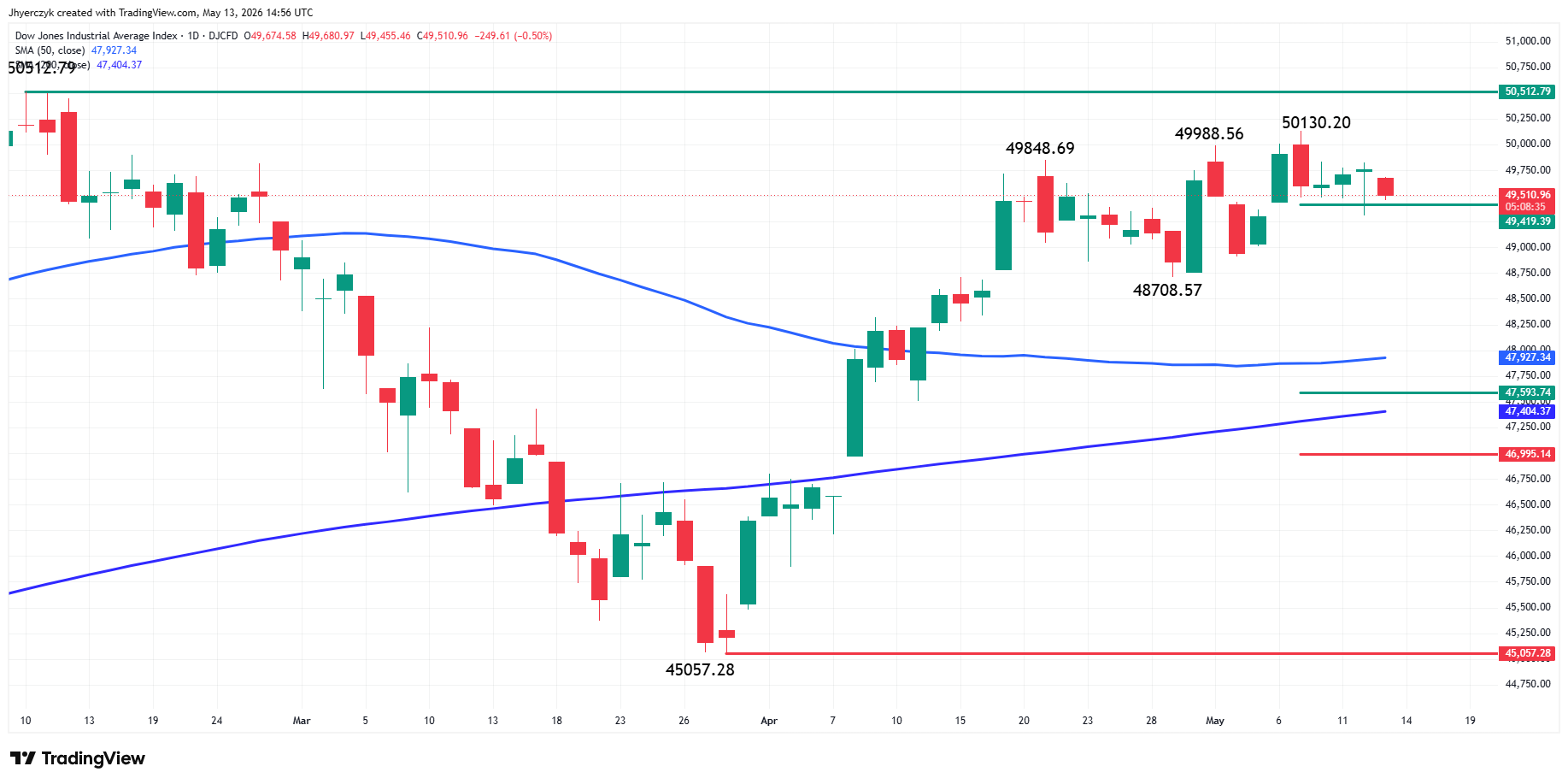
The Dow Jones Industrial Average is in an uptrend. A trade through 50,130.20 will reaffirm the uptrend, putting the record high at 50,512.79 on the radar.
The short-term range is 48,708.57 to 50,130.20. Its 50% level at 49,419.39 has been tested five days in a row. On Tuesday, sellers pierced it down to 49,307.66, but the market recovered. A sustained move under the pivot could trigger an acceleration to the downside with the swing bottom at 48,708.57 the next potential target.
Looking at the major indexes as a group, the common theme is uptrend. The common questions that traders are asking include, is the trend setting up for a change in the trend or just a shift in momentum? Will it form a distributive top with a series of lower tops and lower bottoms, or will it accelerate to the downside?
PPI Came in Hot and the Bond Market Moved Fast
April Producer Price Index rose 1.4% for the month against an expectation of 0.5%. On a yearly basis wholesale inflation hit 6%, the strongest annual reading since late 2022. That number landed and the 10-Year U.S. Treasury yield climbed near 4.49%, its highest level since July. The 30-year Treasury yield pushed above 5%. This came one day after April CPI printed hot at 3.8% annually. Two consecutive inflation reports running above expectations is not a coincidence and the bond market is not treating it as one.
The rate cut timeline that was already thin got thinner. Financials, retailers and housing-related names felt it immediately. Those sectors are directly tied to borrowing costs and when the 10-Year U.S. Treasury yield moves to a multi-month high in a single session, the pain is not subtle. Investors are now genuinely worried that elevated rates could slow consumer spending and weigh on corporate profits before year end and the sector rotation in Wednesday’s session is reflecting that concern in real time.
Oil Is Still Feeding the Fire
June WTI crude oil staying elevated is not a separate story from inflation. It is the same story. Higher energy costs run through production expenses, transportation costs and consumer prices before they show up in a CPI or PPI print. Businesses are still passing those costs along and that is what is making it harder for inflation to move back toward the Fed’s 2% target. Every session that oil holds above $100 is another session the Fed has less room to move. Wednesday is another one of those sessions.
Nvidia and the AI Trade Are Holding the Nasdaq
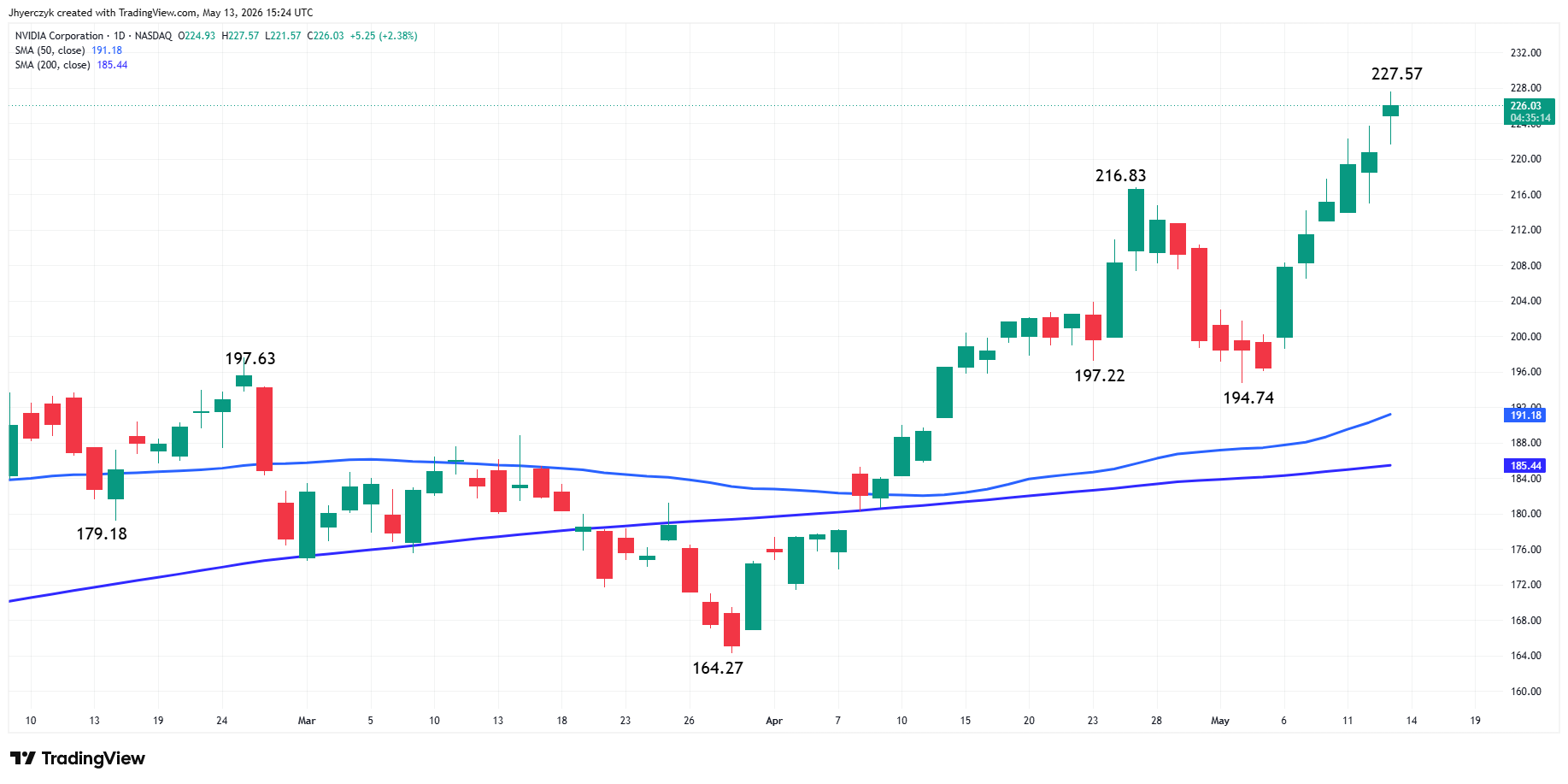
Semiconductor stocks outperformed again Wednesday on renewed AI enthusiasm and optimism around Nvidia’s global business outlook. Reports of Nvidia CEO Jensen Huang joining Trump during his China visit sparked additional buying across chipmakers. Micron Technology jumped more than 5%. The VanEck Semiconductor ETF advanced strongly. Investors keep rotating into AI-related names even as the broader macro picture deteriorates around them. I’ve watched momentum trades run through bad macro environments before. They run until they don’t and right now this one is still running.
What to Watch
The Nasdaq Composite pivot at 26,049.26 is the level that sets the tone into Wednesday’s close. Sustained strength above it and the uptrend is intact. Sustained weakness below it and 25,739.22 becomes the next test.
Two hot inflation prints in two days is the fundamental story sitting underneath that chart level and it is not going away before Friday. The Fed has no room to move and the bond market is telling you that with a 10-Year U.S. Treasury yield near 4.49%.
On the S&P 500 watch 7,428.97 on any push higher and 7,338.54 on any pullback. The Dow pivot at 49,419.39 has been tested five straight days. A sustained break below it puts 48,708.57 in play.
Oil staying above $100 keeps inflation elevated and elevated inflation keeps the pressure on rate-sensitive sectors that are already showing cracks. The AI trade is holding the Nasdaq together right now.
The question I keep coming back to is how long it can do that job alone when everything outside of semiconductors is feeling the weight of higher rates and higher energy costs. The pattern has not broken yet. But two more sessions like Tuesday and it starts to.
More Information in our Economic Calendar.