
USD/JPY faces a key test as rising bets on a Bank of Japan rate hike clash with concerns about Japan’s debt-to-GDP and fiscal spending plans.
Last week, the USD/JPY pair surged to a mid-week high of 159.453. Markets reacted to Prime Minister Sanae Takaichi’s hint at a snap election and expectations of fiscal spending spiraling Japan’s debt-to-GDP ratio.
Notably, 10-year Japanese Government Bond (JGB) yields soared to 2.198%, the highest level in decades, amid rising risk premiums on JGBs, given concerns about fiscal spending and national debt levels.
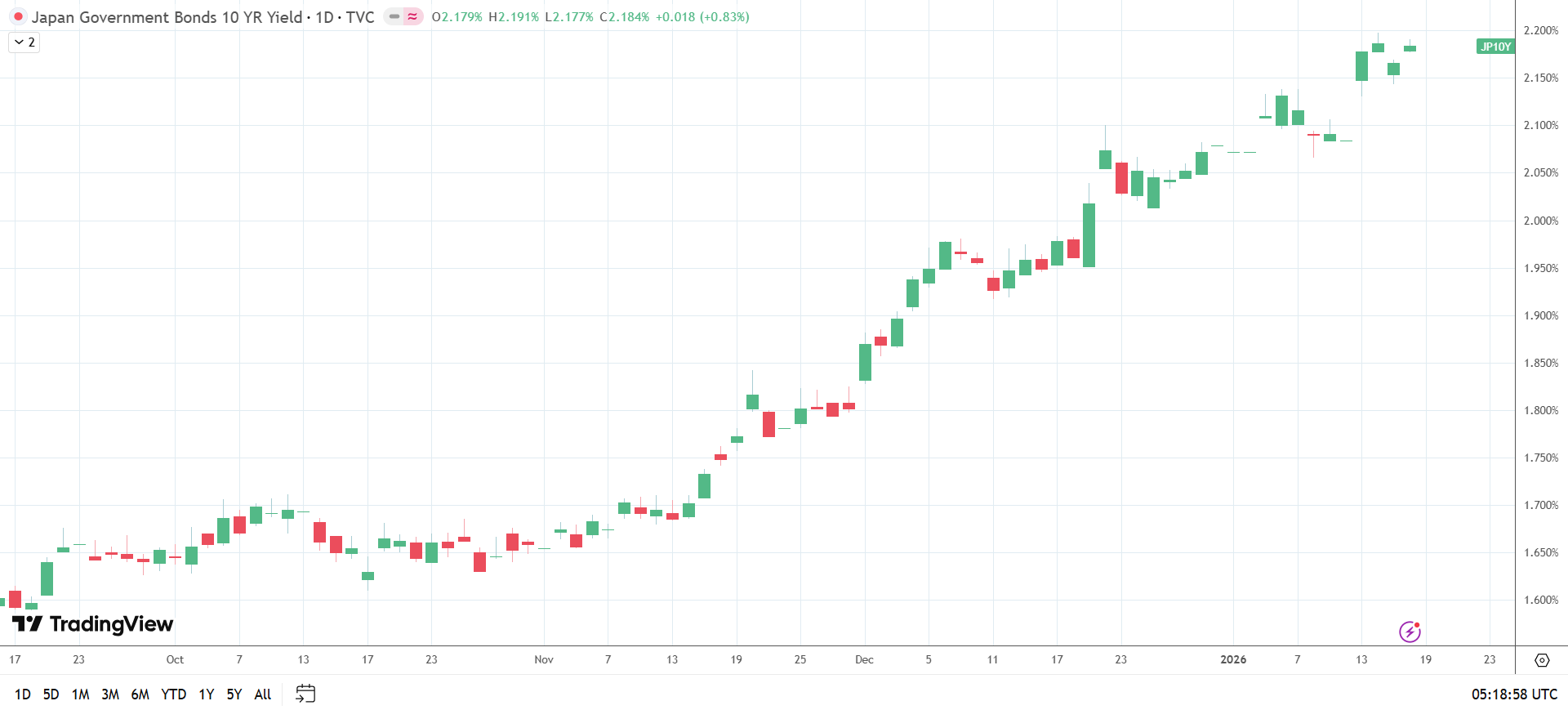
Despite concerns about Japan’s debt-to-GDP ratio, expectations that the BoJ will bring forward rate hikes to combat higher import prices support a cautiously bullish short-term, but a bearish medium-term outlook.
Below, I’ll discuss the macro backdrop, the near-term price catalysts, and technical levels traders should closely watch.

Japan Machinery Orders Challenge BoJ Policy Outlook
The Japanese economy came under scrutiny in early trading on Monday, January 19. Japanese machinery tool orders fell 6.4% year-on-year in November, down sharply from 12.5% in October.
Falling machinery orders could be an indication of waning business sentiment and concerns about the economic outlook. Typically, deteriorating business sentiment has an impact on the labor market and wage growth. A cooling labor market and softer wage growth would weaken consumer sentiment, curb household spending, and dampen demand-driven inflation.
A softer inflation outlook would lower bets on a near-term BoJ rate hike, weighing on the yen.
USD/JPY rose from 157.502 to 157.880 following the release of the data, reflecting the potential impact of the data on the BoJ’s rate path. Despite the data and USD/JPY response, the weaker yen may incentivize the BoJ to tighten monetary policy sooner rather than later, which would support a bullish price outlook.
USD/JPY Price Forecast
Every new USD/JPY analysis as it publishes, today's technical signal and key levels, live price — on one page.
See all USD/JPY forecasts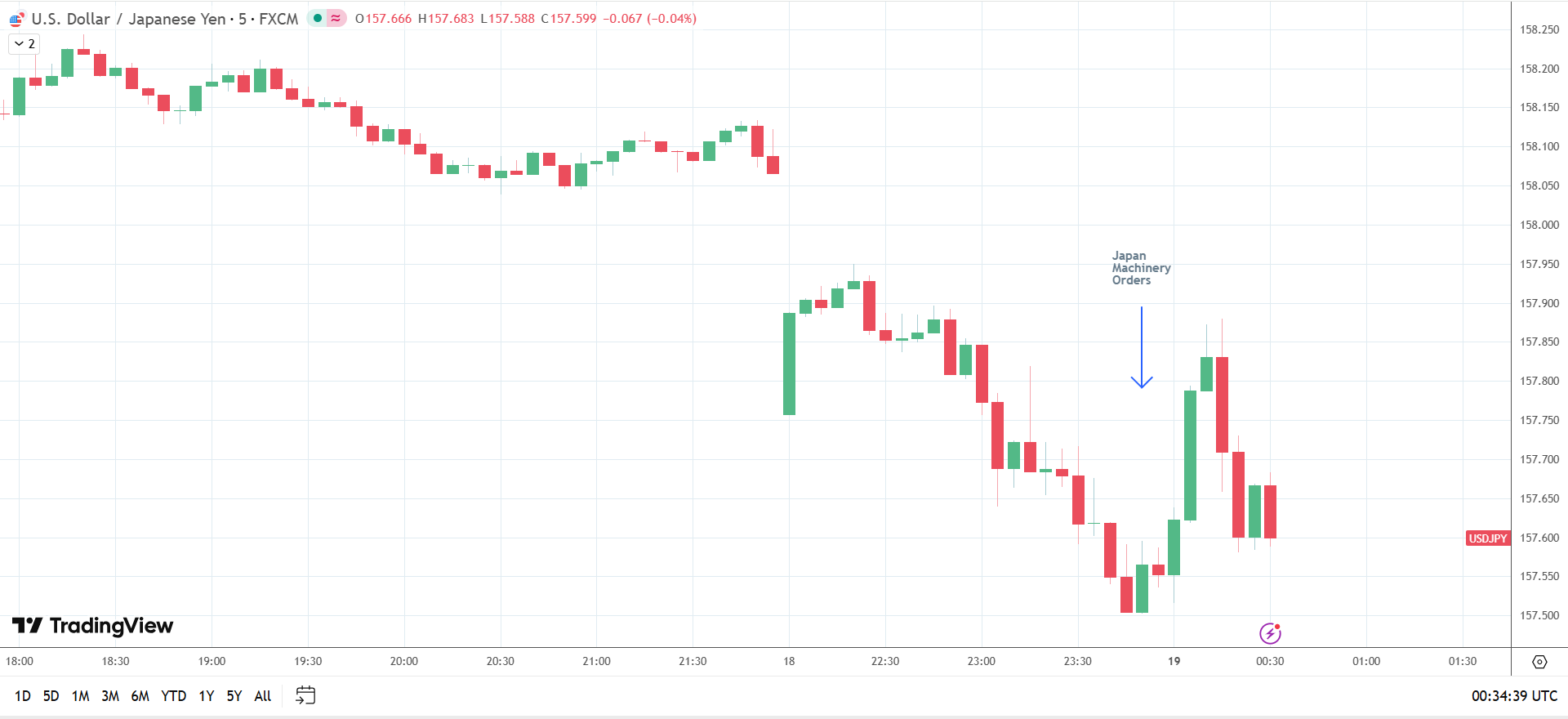
Reuters Poll Points to a July Rate Hike
According to January’s Reuters poll, conducted between January 6-13, 43% of economists predicted a July BoJ rate hike, 27% a June hike, and just 8% an April hike. Economists expect the BoJ to delay raising interest rates to assess the impact of December’s rate hike on the economy.
However, the weaker yen has pushed import prices higher, reducing households’ purchasing power. A more hawkish BoJ policy stance, including hints at cutting JGB purchases, would likely offer much-needed relief. Private consumption is a key contributor to Japan’s economy, accounting for roughly 60% of GDP.
The BoJ monetary policy decision is set for January 23. 65 of 67 economists polled expected the BoJ to keep rates steady in January and March. The slump in machinery orders supported the economists’ outlook. But, political developments and fiscal spending plans are likely to change the narrative, suggesting a USD/JPY pullback from current levels. Sentiment toward the BoJ’s rate path through H1 2026 will be key, given that most economists expect a rate hike in July.
The political uncertainty and fiscal concerns support a cautiously bullish short-term price outlook for USD/JPY. Meanwhile, warnings of yen interventions and expectations of Bank of Japan rate hikes reinforce the bearish medium-term projection. Hawkish BoJ rhetoric and intervention warnings would likely challenge the cautiously bullish short-term outlook.
China Adds Policy Uncertainty to the Policy and Economic Outlooks
Rising Japan-China tensions have added another layer of policy uncertainty into the mix. US tariffs and friction with China have led economists to predict slower growth and softer inflation in 2026.
Natixis Asia Pacific Chief Economist Alicia Garcia Herrero commented:
“All in all, Japan’s GDP is expected to slow to +0.9% in 2026 from +1.3% in 2025, dragged by higher US tariffs and tensions with China. […] With the Yen remaining relatively weak, inflation is expected to slow down only to +2.3% YoY in 2026 from +3.1% YoY in 2025.”
On the BoJ’s monetary policy stance, Alicia Garcia Herrero stated:
“With PM Takaichi’s strong preference for a lax monetary policy to realize her vision, the BoJ is likely to remain cautious in normalizing further. In fact, uncertainties are compounded by the political tension with China, raising the bar to hike. Nevertheless, the ongoing tug of war over policy normalization with the government is anticipated to keep the Yen stubbornly weak. These developments are expected to force the BoJ to hike by 25 bps, possibly in July, to stabilize the currency.”
The prospect of BoJ rate hikes and Fed rate cuts reinforces the bearish medium- to longer-term price trajectory.
US Trade Policy in Focus ahead of Key Economic Data
This week, investors should closely monitor developments on tariffs. A US Supreme Court ruling on the legality of the US administration’s tariff policies is imminent.
A court ruling that blocks tariffs would likely boost risk sentiment, easing demand for the US dollar. Furthermore, the removal of tariffs would improve global trade, benefiting Japanese exporters. These dynamics would likely overshadow the downward effect of removing tariffs on Japanese import prices and the yen, indicating a bearish USD/JPY outlook.
On Monday, US markets are closed for Martin Luther King Jr. Day, with the Fed in its Blackout Period, leaving the USD/JPY exposed to geopolitical risks. President Trump announced tariffs on eight European countries on Saturday, January 17, in a bid to acquire Greenland, potentially escalating trade tensions. The eight countries included Denmark, Norway, Sweden, France, Germany, the UK, the Netherlands, and Finland.
Despite rising geopolitical tensions, expectations of multiple BoJ rate hikes and a new Fed Chair favoring lower interest rates suggest narrower US-Japan rate differentials. These factors reaffirm the bearish medium-term outlook for USD/JPY.
Technical Outlook: Key Levels to Watch
For USD/JPY price trends, traders should assess technicals and closely track the fundamentals.
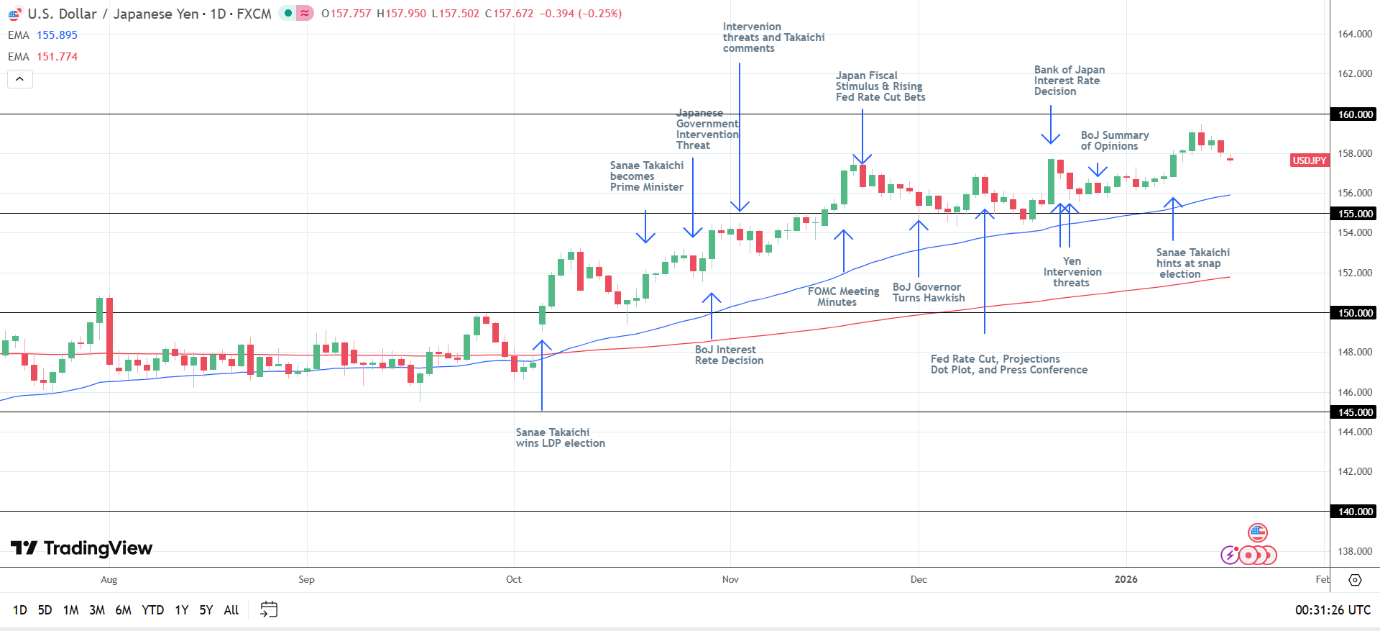
Viewing the daily chart, USD/JPY remains above its 50-day and 200-day Exponential Moving Averages (EMAs), signaling bullish momentum. While technicals remain bullish, bearish fundamentals are developing, countering the technicals.
A break below 157 would expose the 50-day EMA and the 155 support level. A sustained fall through the 50-day EMA would indicate a bearish near-term trend reversal, bringing the 200-day EMA into play. If breached, 150 would be the next key support level.
Crucially, a sustained fall through the 50-day and 200-day EMAs would reaffirm the bearish medium-term price outlook.
Position and Upside Risk
In my view, expectations for BoJ rate hikes, potential threats of yen intervention, and expectations of Fed rate cuts support a negative price outlook. However, the BoJ neutral interest rate, geopolitical events, and upcoming US data will be crucial, given recent USD/JPY trends.
A hawkish BoJ neutral interest rate level (potentially 1.5%-2.5%) would indicate multiple BoJ rate hikes and a narrower US-Japan interest rate differential. A narrower-than-expected rate differential may trigger a yen carry unwind, mirroring events in mid-2024. A yen carry trade unwind would likely send USD/JPY toward 140 over the longer term.
However, upside risks to the bearish outlook include:
- Dovish BoJ rhetoric and a dovish neutral interest rate (potentially 1%-1.25%).
- Upbeat US economic data cools Fed rate cut bets in H1 2026.
- US Supreme Court rules tariffs legal, suggesting more levies.
These factors would send USD/JPY higher. However, the threat of yen interventions is likely to cap the upside at the 160 level, based on the latest communication.
Read the full USD/JPY forecast, including chart setups and trade ideas.
Conclusion: Politics, the BoJ, and US Data in the Spotlight
In summary, the USD/JPY trends will hinge on Prime Minister Takaichi’s election and fiscal spending goals, the BoJ’s neutral rate, and the Fed rate path.
While Prime Minister Takaichi’s policies are headwinds for the yen, a hawkish neutral rate (1.5%-2.5%) would signal a hawkish BoJ rate path, delivering yen strength. Additionally, dovish Fed commentary would align with expectations of narrower rate differentials, reaffirming the bearish outlook for USD/JPY.
Notably, a sharply stronger yen could trigger the unwinding of yen carry trades, which would likely send USD/JPY toward 140 over the longer 6-12 month timeline.
For more in-depth analysis, review today’s USD/JPY trading setups in our latest reports and consult the economic calendar.