Some people have the impression that the purpose of Kim’s visit was to prepare the field for the upcoming meeting with South Korea and the United States. The unpredictable leader of North Korea shows clues of willingness to end this crazy nuclear game. Hence, almost everybody is focused on these meetings.
On Wednesday, 21st of March, China announced that Kim Jong-un met with the Premier of the State Council of the People’s Republic of China, Li Keqiang, within the framework of his unofficial visit. In this meeting, Kim Jong-un was accompanied by his wife, Ri Sol Ju. This trip was the first of Kim’s potential meetings.
Kim Jong-un stated that “The issue of denuclearisation of the Korean Peninsula can be resolved, if South Korea and the United States respond to our efforts with goodwill, create an atmosphere of peace and stability while taking progressive and synchronous measures for the realization of peace”.
The Japanese yen may seem to present a downtrend due to the signs of possible improvements in the geopolitical scene of North Korea.
Based on the Asian stock market analysis, Nikkei lost 1.3% at the close on Wednesday, 28th of March, therefore, equities seem to be affected. According to, the various reports, the Japanese Prime Minister, Shinzo Abe remarked that he will raise the country’s sales tax in the next year and that he will not change his initial plan.
Another significant fact that may affect the Asian markets might be the agreement between the USA and South Korea to revise the trade pact which will include a deal that would contribute to avoiding the competitive devaluation of the currency and offset some of the pressure resulted from the US tariffs on steel announced by Trump administration officials. CNBC reported that this deal will include a provision of 20-years extension of the 25% of the US tariffs on pickup trucks. A potential effect of this could be to double the Korean import limit on automobiles so that to meet the US specifications to 50.000 per manufacturer annually.

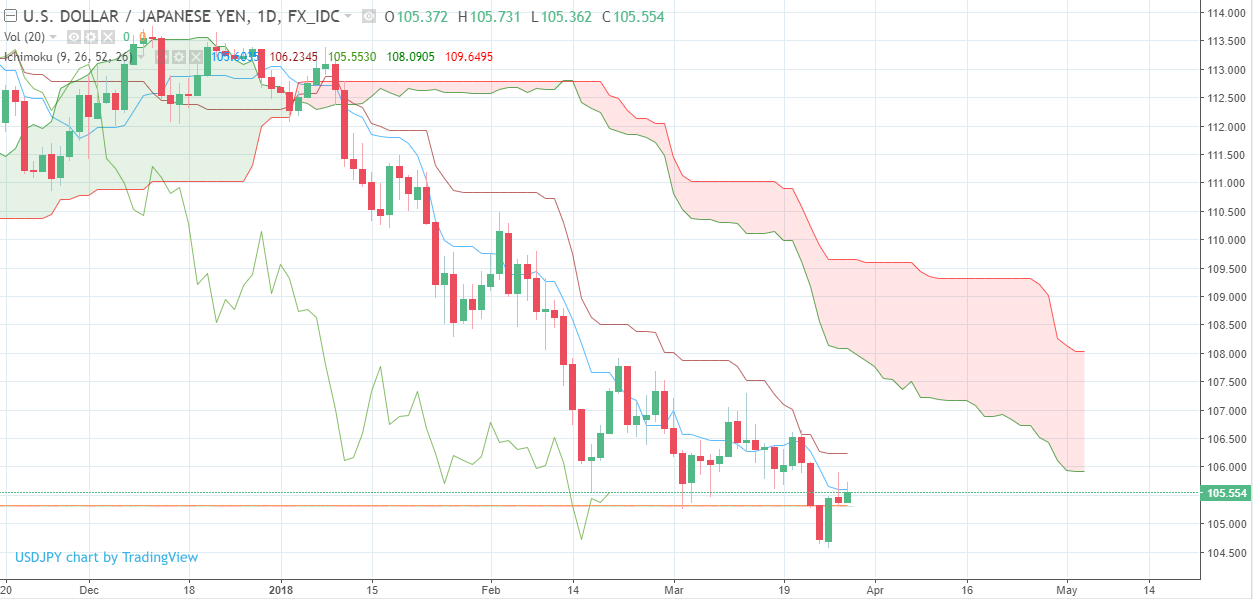
Technical View on USDJPY
In accordance with the Ichimoku system, the USDJPY seems to head downwards. Kumo cloud appears to be dynamically down, the price seems to be below the Kumo, the lines Tekan Sen and Kijun Sen seem to be in a bear formation, and the Chikou Span appears below the price. If the price tends to reach the Kijun Sen, then we could consider looking for bearish signals.