



Market Overview
Oil prices have taken a bit of a dip as signs of diplomatic engagement seem to have eased some immediate fears about a key Middle Eastern producer cutting off supplies, thereby reducing a key component of the oil price increase – the political risk premium embedded in crude.
While progress in talks is giving some hope that the global oil supply situation will get some relief, analysts are being cautious and saying a long term agreement is still far from being a done deal – in fact, some firms are even saying there’s a 65% chance of war escalating again by the end of April.
Things got a bit worse for oil prices from the production side too – output at Kazakhstan’s Tengiz field is headed back up to full capacity by Feb 23rd, which is not helping things. Meanwhile, US crude stocks are expected to increase by 2.3 million barrels, which should help to keep supplies buoyant over the short term.
Natural Gas Forecast: $3.00 Support in Focus – Breakdown or Rebound?
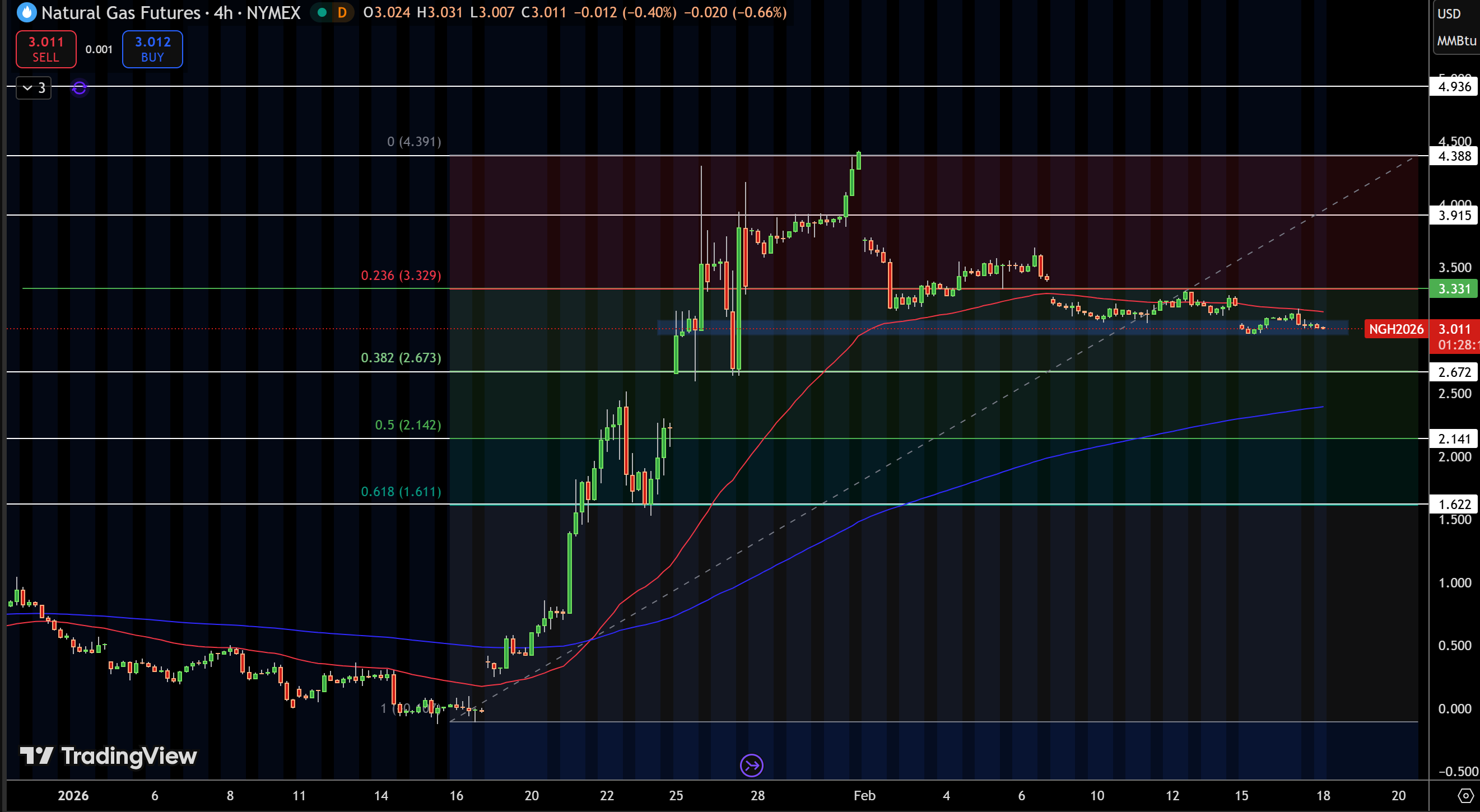
Natural Gas futures are trading around $3.01 on the 4-hour chart and are propped up at the moment just above a short-term support band around $3.00. Price hasn’t been able to get back over the 0.236 Fibonacci retracement at $3.329 and is still below the 0.382 level at $2.673 – and now its pressing up against the 0.236 level again. We’re seeing a lot of short-range candelsticks at present, indicating that traders are getting a bit more uncertain after the price surged up to $4.39.
The 50-period Exponential Moving Average is pretty flat at the moment, but the 200-period Exponential Moving Average is definitely trending up, which is a positive sign for the overall trend. If natural gas can stay above $3.00 then $2.67 and $2.14 look like possible support levels. On the other hand, resistance is at $3.33 and $3.91.
Trade Idea: Sell if natural gas drops below $2.99, target $2.67 and then stop out if it goes up above $3.20.
WTI Crude Oil Forecast: $62 Trendline Test – Breakdown or Bounce Ahead?
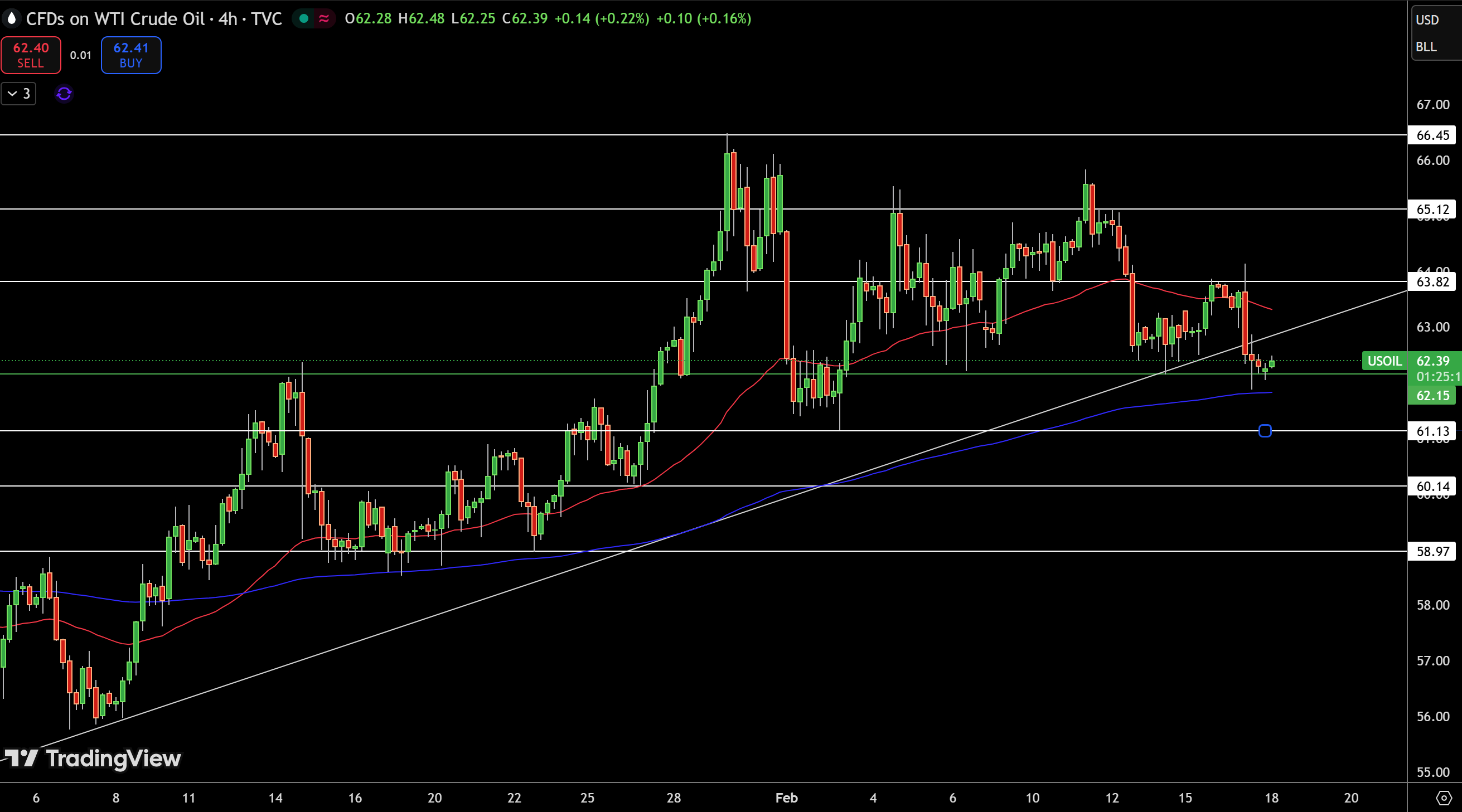
WTI crude has been trading at $62.39 on the 4-hour chart, propped up at the moment by rising trendline support that kicked in back in early January. Price has dropped below the 50-period Exponential Moving Average and has also slipped below the 200-period one at $61.13, which is acting as a deeper support point.
Natural Gas Price Forecast
Every new Natural Gas analysis as it publishes, today's technical signal and key levels, live price — on one page.
See all Natural Gas forecastsWe’re seeing small-bodied candles on the charts, indicating that traders are getting pretty uncertain after price got knocked back from $63.82. – a break below the 61.13 level could take crude down to $60.14 and $58.97. On the flip side, if crude can get back up above $63.82 it may well go back up to $65.12 and $66.45.
Trade Idea: Sell if crude drops below $61.10, target $60.15 and then stop out if it goes up above $62.80.
Brent Crude Oil Forecast: $67 Trendline Holds – Break Toward $70?
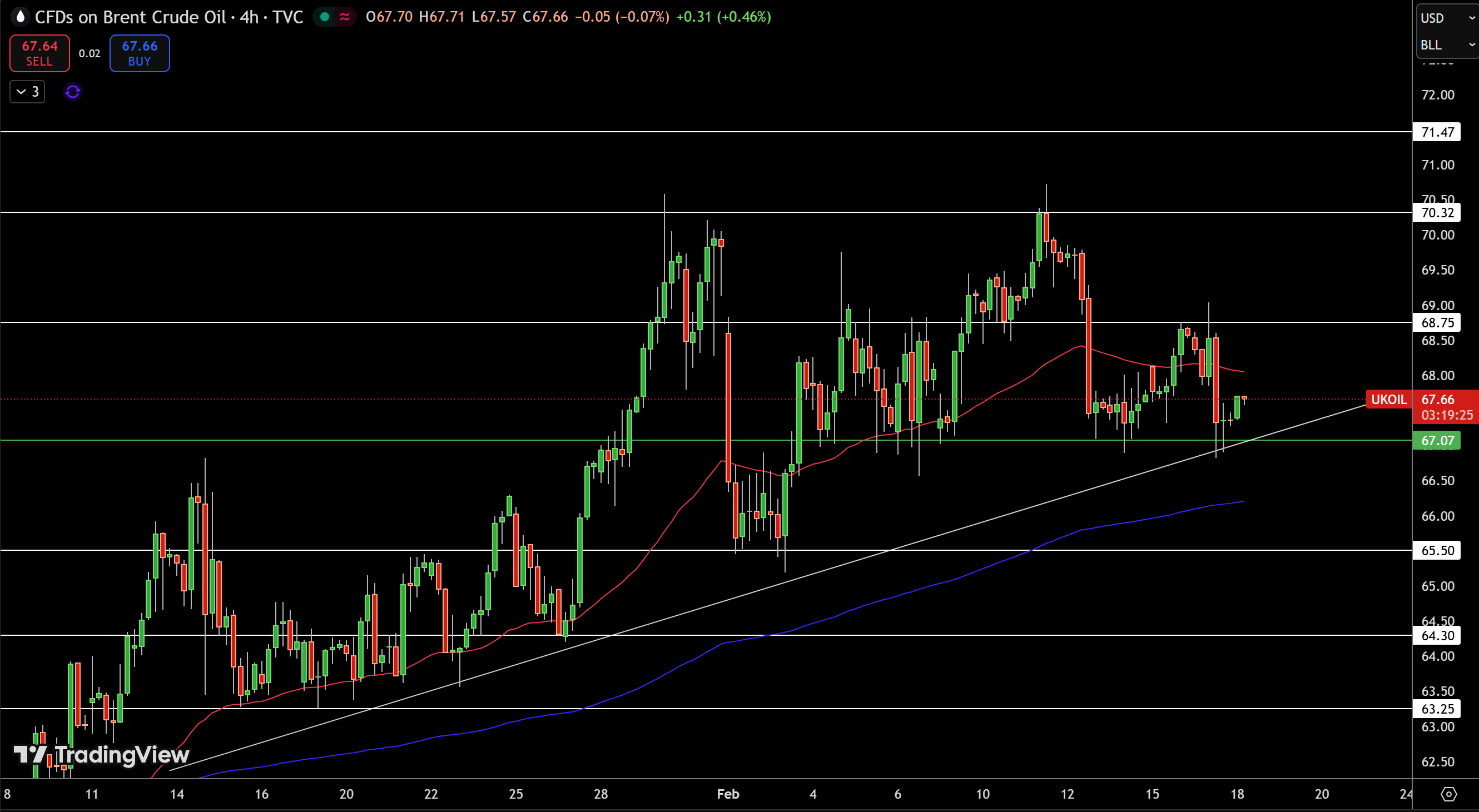
Brent crude is trading at $67.66 on the 4-hour chart and is holding up for the moment just above its rising trendline support around $67.07. Price has already been knocked back from $70.32 resistance and has left some pretty long upper wicks on the charts, which suggests a lot of resistance at that level.
The 50-period and 200-period Exponential Moving Averages are fairly close to each other at the moment, which is a positive sign for the trend. If Brent can stay above $67.07 then $65.50 and $64.30 look like possible support zones. On the upside, if Brent can get back up over $68.75 then $70.32 and $71.47 are both back in play.
Trade Idea: Buy if Brent goes above $68.80, target $70.30 and then stop out if it goes down below $67.00.