



XRP fails to break $1.5 despite increased utility as traders turn cautious ahead of the next White House stablecoin session.
Meanwhile, inflows into XRP-spot ETFs continue to indicate strong demand for the token, likely driven by increased XRP utility.
Crucially, expectations that the US Senate will pass the Market Structure Bill, increased XRP utility, and resilient demand for US-XRP-spot ETFs support a bullish medium-term (4-8 weeks) outlook for XRP, with a price target of $2.5.
Below, I will explore the key drivers behind recent price trends, the medium-term outlook, and the technical levels traders should watch.
Institutional Demand Strengthens as Grayscale Signals Confidence
This week, XRP-spot issuer Grayscale underscored institutional investor sentiment toward the token, aligning with the US XRP-spot ETF market’s flow trends. Rayhaneh Sharif-Askary, Head of Product & Research, Grayscale, remarked on strong interest in XRP, stating:
“Advisors are constantly asked by their clients about XRP, and in some cases, it’s the second most talked about asset in this community behind Bitcoin.”
Notably, since launching on November 24, 2025, the Grayscale XRP ETF (GXRP) has reported $131.46 million in inflows. GXRP ranked 4/5 by net inflows. The US XRP-spot ETF market has seen total net inflows of $1.23 billion since launch, a sharp contrast to the net outflows from the US BTC-spot and ETH-spot ETF markets.
Ripple’s expansion onto Main Street through acquisitions and the OCC granting Ripple’s US-chartered banking license have put XRP in the spotlight. Increased utility remains a key price driver, supporting the bullish medium- to longer-term outlook for XRP.
Bitcoin Price Forecast
Every new Bitcoin analysis as it publishes, today's technical signal and key levels, live price — on one page.
See all Bitcoin forecastsLegislative Developments: Market Structure Bill in Focus
Crypto-friendly legislation will be crucial to the token’s broader adoption, underscoring XRP’s heightened sensitivity to legislative developments on Capitol Hill.
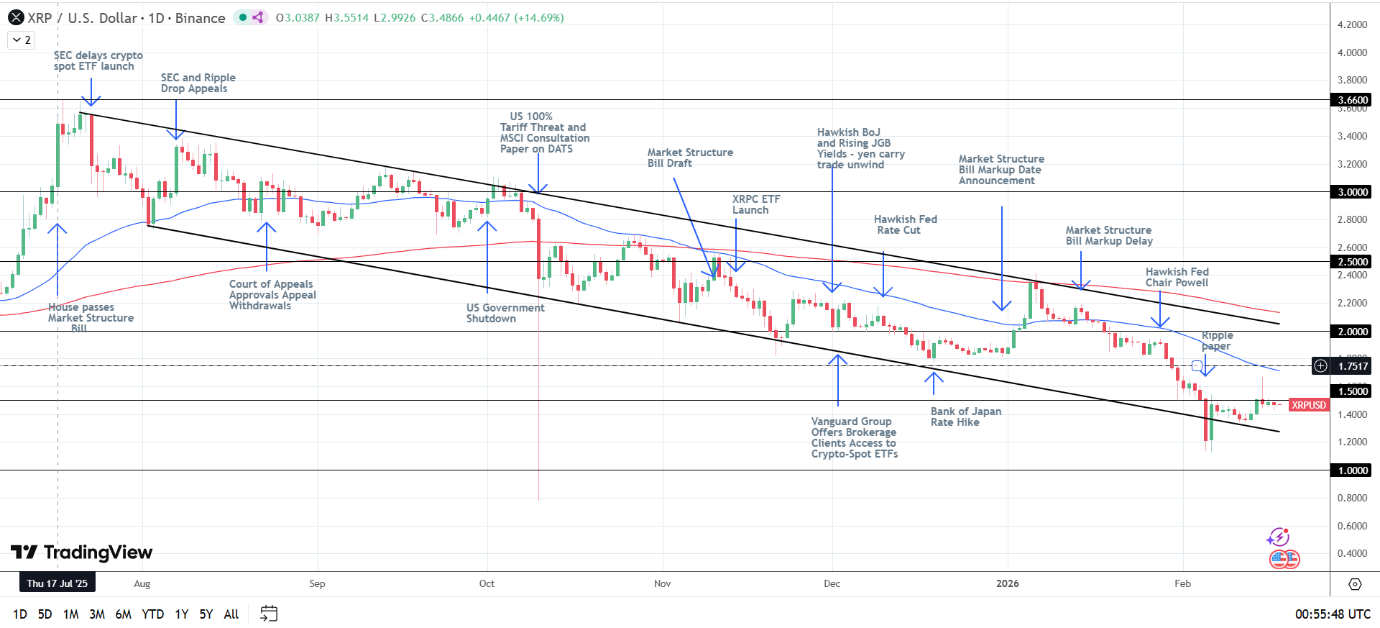
XRP has fallen from a January 5 high of $2.4151 to a February 6 low of $1.1227 as delays to a Senate floor vote on the Market Structure Bill weighed on sentiment. However, progress toward a Senate vote would likely trigger an XRP bull run. XRP soared 14.69% on July 17, 2025, after the US House of Representatives passed the Market Structure Bill to the Senate, suggesting potential upside if the Bill reaches President Trump’s desk.
There has been speculation about a third White House session on stablecoin yields being scheduled for Thursday, February 19. The TradFi-DeFi stalemate over rewards continues as US banks resist DeFi’s threat to US depositors.
XRP Price Forecast: Short-, Medium-, and Long-Term Targets
Despite rebounding from the February 6 low of $1.1227, XRP has dropped 11% in February, supporting a cautiously bearish short-term outlook (1-4 weeks), with a target price of $1.0.
Nevertheless, robust demand for XRP-spot ETFs, expectations that the US Senate will pass the Market Structure Bill, and increased XRP utility reinforce the bullish medium- to long-term price projections:
- Medium-term (4-8 weeks): $2.5.
- Longer-term (8-12 weeks): $3.0.
Key Downside Risks to the Bullish Medium-Term Outlook
Several scenarios could unravel the constructive medium-term bias. These include:
- Upbeat US data tempers expectation of an H1 2026 Fed rate cut.
- Delays and/or partisan opposition to the Market Structure Bill.
- Extended periods of XRP-spot ETF net outflows.
Traders should also consider the Bank of Japan’s monetary policy guidance, given the effects of the mid-2024 yen carry trade unwind on XRP.
A hawkish Bank of Japan, with a higher neutral interest rate (potentially 1.5%-2.5%). Multiple BoJ rate hikes could narrow US-Japan rate differentials in favor of the yen. Narrowing rate differentials could trigger a yen carry trade unwind, drying up market liquidity. For context, the BoJ previously announced a wider neutral rate band of 1%-2.5% but stated it would announce a narrower range at a later date.
These events would weigh on XRP, send the token toward $1.0, and reinforce the cautiously bearish short-term outlook.
Technical Analysis: Levels to Watch
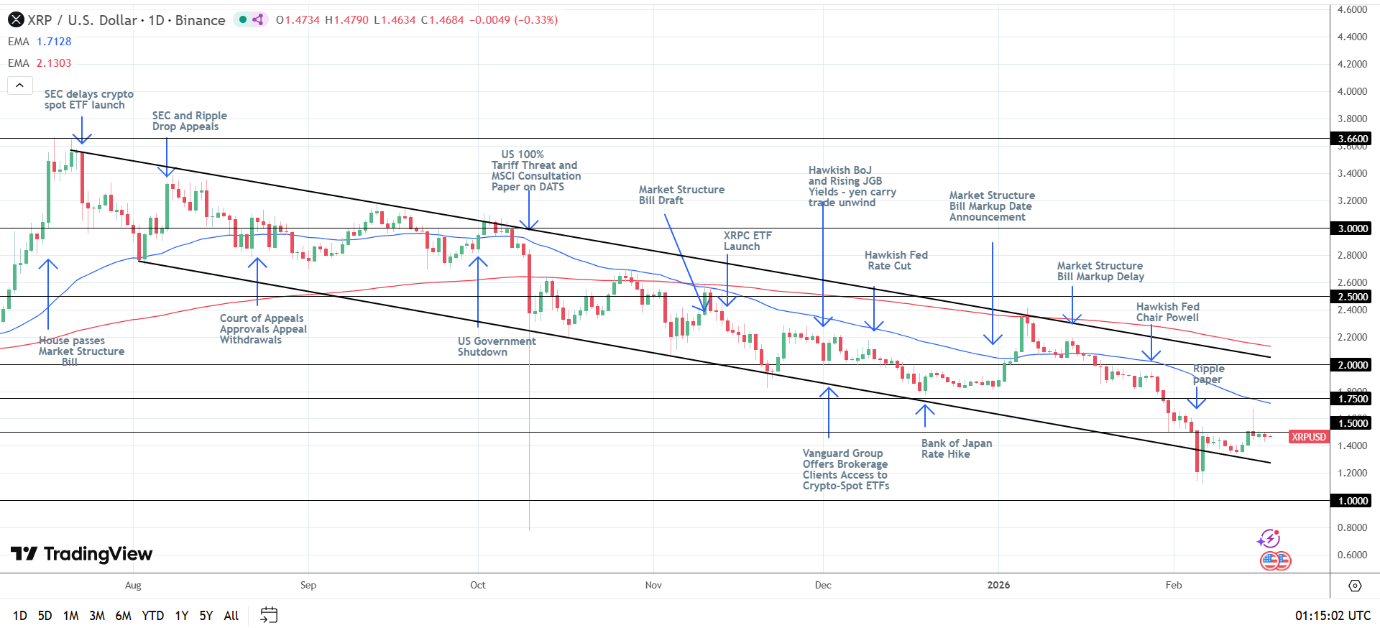
XRP fell 0.98% on February 17, reversing the previous day’s 0.87% gain, closing at $1.4733. The token faced less selling pressure than the broader crypto market cap, which declined 1.44%.
Tuesday’s pullback left XRP trading well below its 50-day and 200-day EMAs. The EMA positions signaled a bearish bias. Notably, the 50-day EMA has steepened, suggesting further selling pressure. Nevertheless, several positive fundamentals continue to counter bearish technicals, supporting the bullish medium-term outlook. Despite these positive fundamentals, short-term technicals remain bearish.
Key technical levels to watch include:
- Support levels: $1.0, and then $0.7773.
- 50-day EMA resistance: $1.7128.
- 200-day EMA resistance: $2.1303.
- Resistance levels: $1.5, $2.0, $2.5, and $3.0.
On the daily chart, reclaiming $1.50 would bring the 50-day EMA into play. A sustained move through the 50-day EMA would signal a near-term bullish trend reversal. A bullish trend reversal would enable the bulls to target the 200-day EMA.
A sustained break above the EMAs would affirm a bullish trend reversal and support the medium- to longer-term price targets.
Fundamental Events Driving Near-Term Price Action
Near-term price drivers include:
- XRP-spot ETF flows.
- US economic data and the Fed’s rate path. This week, the FOMC meeting minutes, FOMC member speeches, US GDP, and US inflation numbers are likely to be key price catalysts.
- Crypto-related legislative developments.
- The Bank of Japan’s neutral rate and rate path.
- Increased geopolitical risks in the Middle East.
Bearish Structure Intact: $1.0 Remains Crucial Support
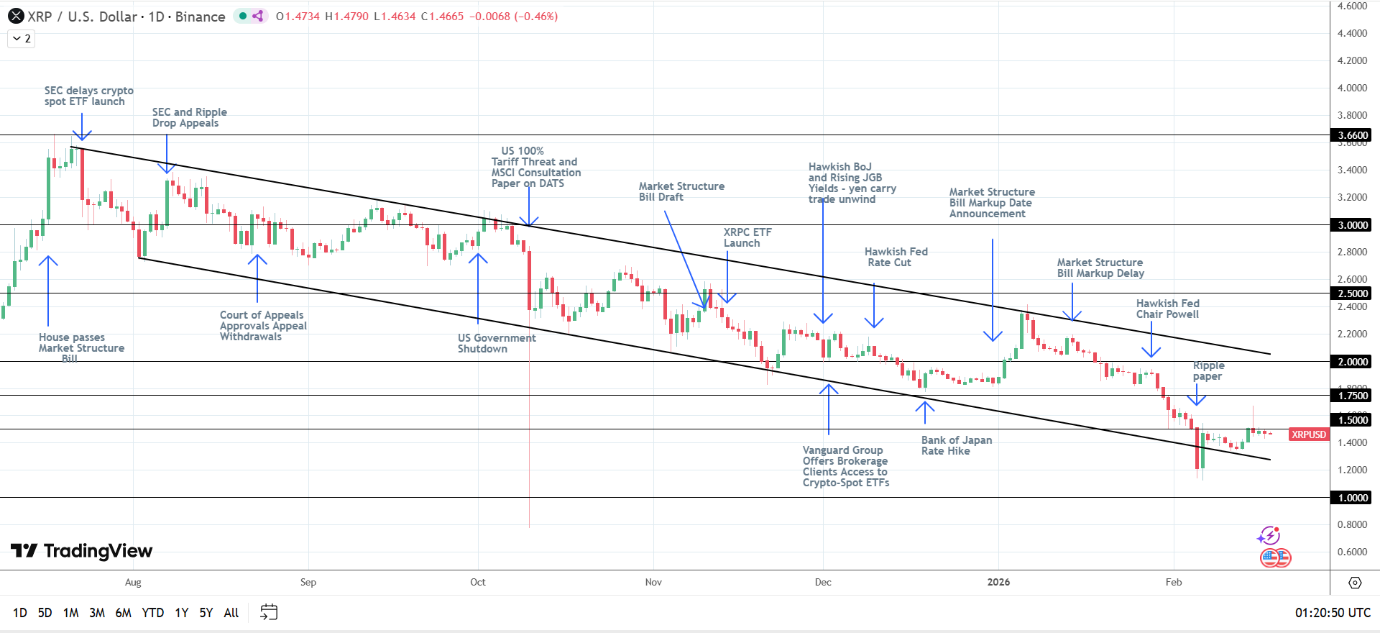
XRP’s Tuesday loss affirmed the existing bearish trend. A drop below the lower trendline would expose the February 6 low of $1.1227. If breached, $1.0 would be the next key support level. A sustained fall through $1.0 would reinforce the cautiously bearish short-term outlook and further validate the bearish structure.
However, breaking above $1.5 would pave the way toward $2.0 and the upper trendline. A sustained move through the upper trendline would invalidate the bearish structure and signal a bullish trend reversal, reinforcing the constructive medium-term bias.
- Short-term (1-4 weeks): $1.0.
- Medium-term (4-8 weeks): $2.5.
- Longer-term (8-12 weeks): target of $3.0.
XRP Outlook: Crypto Regulations, ETF Flows, and the Fed in Focus
Looking ahead, regulatory developments on Capitol Hill remain crucial to XRP’s price outlook. An agreement on stablecoin yields would boost hopes that the Senate will pass the Market Structure Bill, fueling XRP demand.
However, central bank rhetoric and XRP-spot ETF flows will also influence XRP’s price projection.
A more dovish Fed and a lower BoJ neutral rate (potentially 1%-1.25%) would lift sentiment. Strong demand for US XRP-spot ETFs and crypto-friendly legislative developments would reinforce the positive medium-term outlook.
In summary, these positive scenarios would support a medium-term (4–8 weeks) move to $2.5. The US Senate passing the Market Structure Bill would affirm the longer-term (8-12 weeks) price target of $3.0.
Beyond 12 weeks, these events are likely to drive XRP to its all-time high of $3.66 (Binance). A break above $3.66 would reinforce a 6- to 12-month price target of $5.