


Market Overview
The US dollar kept its upward momentum going and looked strong around 97.20 – a lot of people’s money is just piling in there. But the thing is, those gains only came about because investors aren’t so sure about US interest rate cuts happening anymore.
Moreover, the US dollar is getting a boost from the economy looking better, businesses getting more confident, and the feeling that President Trump won’t be so trigger-happy before the midterm elections.
Looking ahead, though, everyone is just waiting for the publication of the minutes from the Federal Reserve’s January policy meeting. It’s going to be a big clue about what’s coming next with interest rates.
US Dollar’s Gains Won’t Get Too Big as Positive U.S.–Iran Nuclear Talks Keep People Feeling Good About the Market
The markets have been looking pretty rosy all week and got a big boost from the progress in U.S.–Iran talks. On Tuesday, Iranian Foreign Minister Abbas Araqchi said that while the US and Iran have sorted out a lot of the basics, don’t expect a final deal just yet.
So, all this good news from U.S.–Iran talks kind of took a bite out of the safe-haven demand for the dollar, which meant US dollar gains haven’t been as big as they could have been, even though it is still heading upwards overall.
US Dollar Index Price Forecast: DXY Pressures $97.20 Resistance Zone
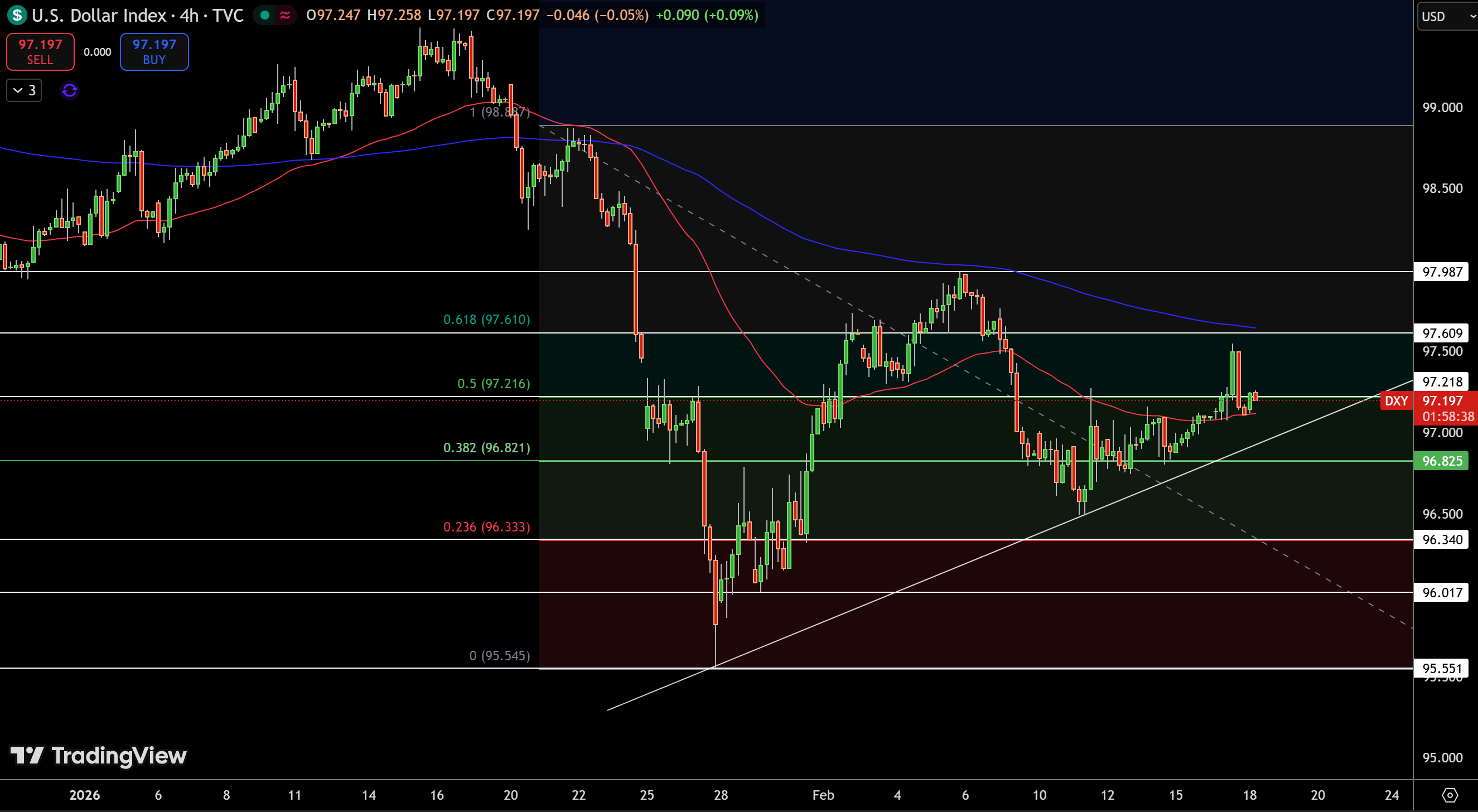
The US Dollar Index (DXY) is lingering around $97.19 on the 4-hour chart, still just about holding above the 0.382 Fibonacci level at $96.82 and eyeballing the 0.5 retracement level of $97.21. Despite price respecting that rising trendline from down at the $95.55 low, you can still see it wanting to test the resistance zone and we see small bodied candles with long wicks near $97.60 – all a bit of a mixed signal.
The 50 period Exponential Moving Average has gone flat around price, and the 200 period EMA sits higher at $97.98, and is acting like a pretty clear ceiling for now. There’s still that descending channel from the January high still very much intact.
GBP/USD Price Forecast
Every new GBP/USD analysis as it publishes, today's technical signal and key levels, live price — on one page.
See all GBP/USD forecastsTrade idea: Buy when the price gets above $97.62 and aim for $97.98, but $97.10 is the place to set your stop-loss.
GBP/USD Price Forecast: Triangle Squeeze Near $1.3570 – Break or Bounce?
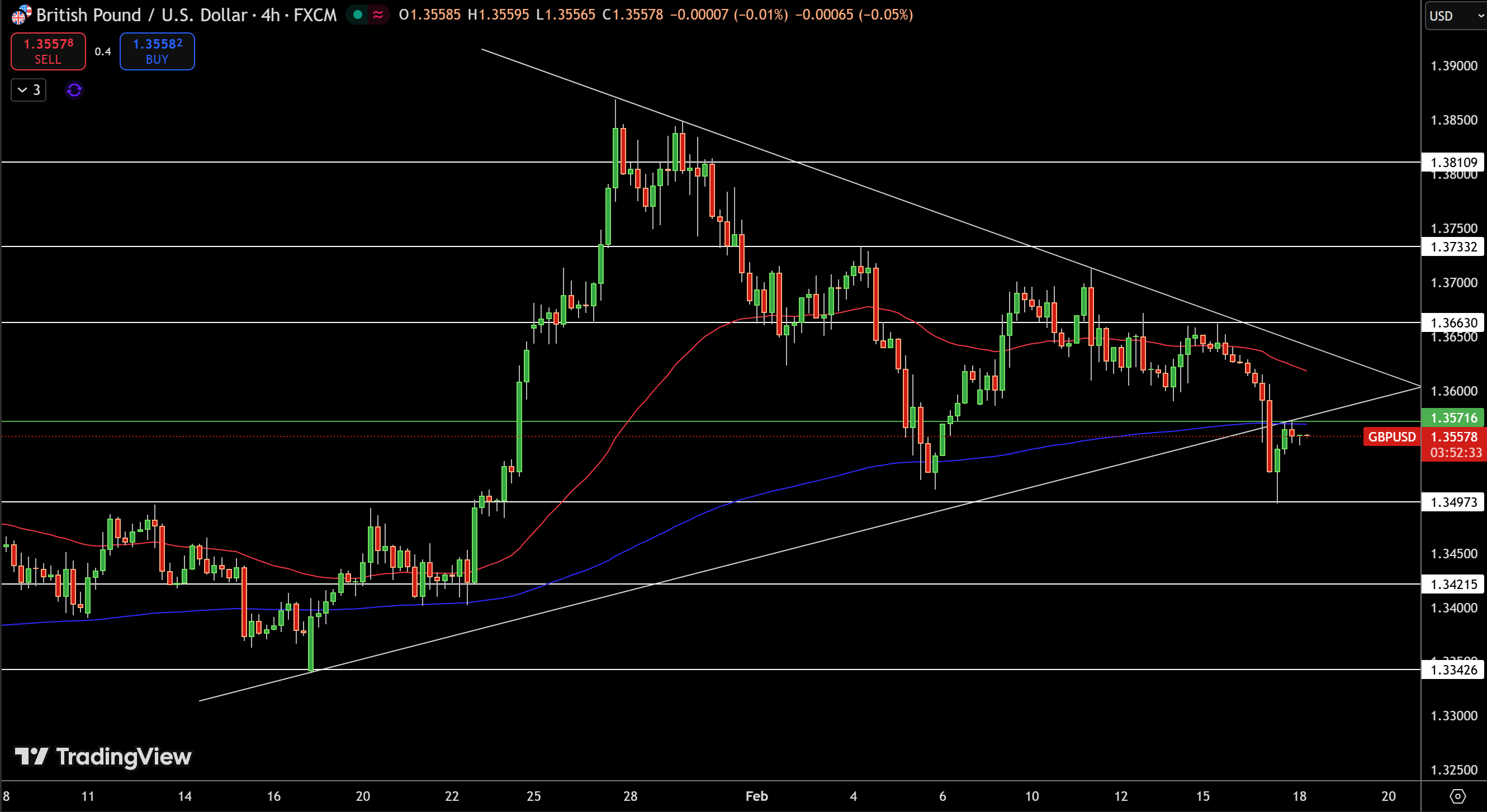
GBP/USD is trading just about at $1.3558 on the 4-hour chart, bouncing off against the intersection of a rising trendline from $1.3340 and a descending trendline from $1.3810, effectively forming a pretty tight triangle.
Price did pop down towards $1.3497 support for a brief second, before springing back up and printing a nice long lower wick, which suggests that the buyers are defending that level. The pair is just a stone’s throw from the 200 period Exponential Moving Average at $1.3570, but the 50 period EMA is actually trending a bit lower, around $1.3620 – all of which is pointing to some short term downward pressure.
The immediate resistance zone stands at $1.3663 and $1.3733. If you do see a sustained move below $1.3497, then we could see $1.3421 become the next support level to watch.
Trade idea: The idea is to capture a drop below $1.3495 with a take profit of around $1.3420 and a stop-loss of around $1.3585.
EUR/USD Price Forecast: Can $1.1820 Trendline Fuel a Fresh Push Higher?
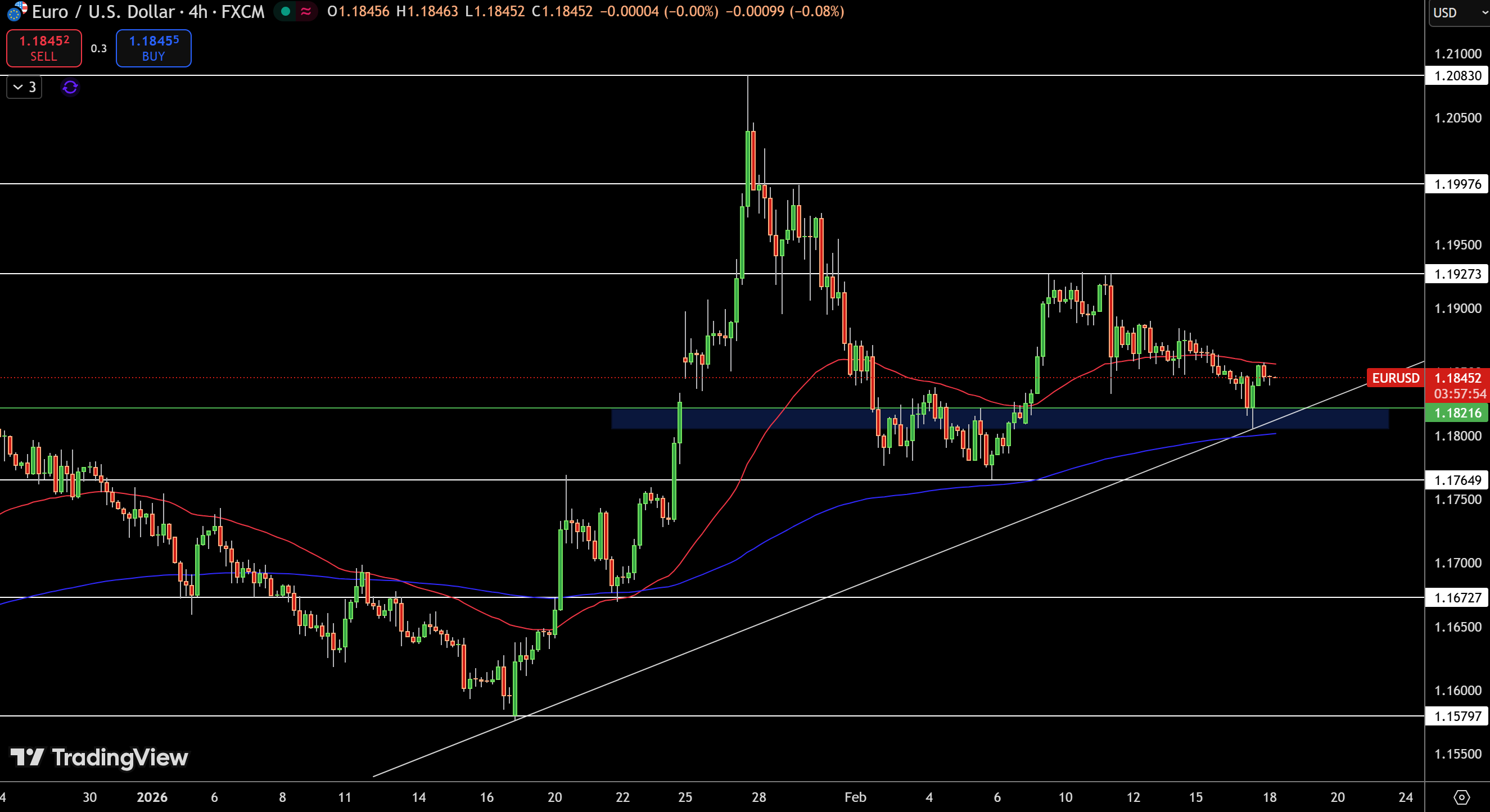
EUR/USD is currently trading at $1.1845 on the 4-hour chart, and has so far managed to stay above that rising trendline support from the $1.1580 low. Price recently bounced off the $1.1820-$1.1830 demand zone and – that’s an area that’s been attracting some buyer interest, as you can see from the small bodied candles that popped up in that region.
The pair is still sitting above the 200 period Exponential Moving Average, which is just about level with $1.1765 at the moment. The 50 period EMA has indeed flattened out around $1.1850 – that’s a pretty good sign of short term consolidation.
There’s the resistance at $1.1927 and $1.1997 to worry about, plus a bit of a broader ceiling further up at $1.2083. If you do see a break below $1.1820, then $1.1765 support will get exposed.
Trade idea: Buy once the price pops above $1.1870, aiming for $1.1927; if it doesn’t work out, set your stop-loss at $1.1815.