
Oil and Natural Gas Markets Adjust to Easing Geopolitical Tensions
Crude-oil fundamentals are in flux after President Trump announced he has struck a ceasefire with Iran and will work to restore oil transit through the Strait of Hormuz as of June 15, 2026. The bottleneck, through which ~20% of global seaborne oil typically has flowed, had been shut for weeks, inducing production curtailments in the Persian Gulf and large OECD draws of inventories.
Tanker movements in the region won’t pick up right away, with many industry players and analysts expecting it will take months to restart some field production and for tanker movements to return to normal, perhaps even into late 2026 or later. Given inventory draws, combined with how long it takes for a well or rig to be put back on production, it is likely that the tighter side of oil supply fundamentals will persist for some time. Steady production growth, including U.S. shale output, is expected to be a steady factor into next year, even in light of a potential ceasefire and reopening of a global shipping bottleneck.
Conversely, natural-gas fundamentals look balanced to ample. U.S. output remains near record levels on associated gas from oil-directed wells, and recent injections have put U.S. inventories above five-year averages at this time of year, even as LNG exports remain robust. With moderate demand and forecasted cooling weather, inventories are likely to remain balanced to ample into the second half of 2026.

Natural Gas Futures Slip to $3.051 – Descending Trendline Continues to Cap Recovery
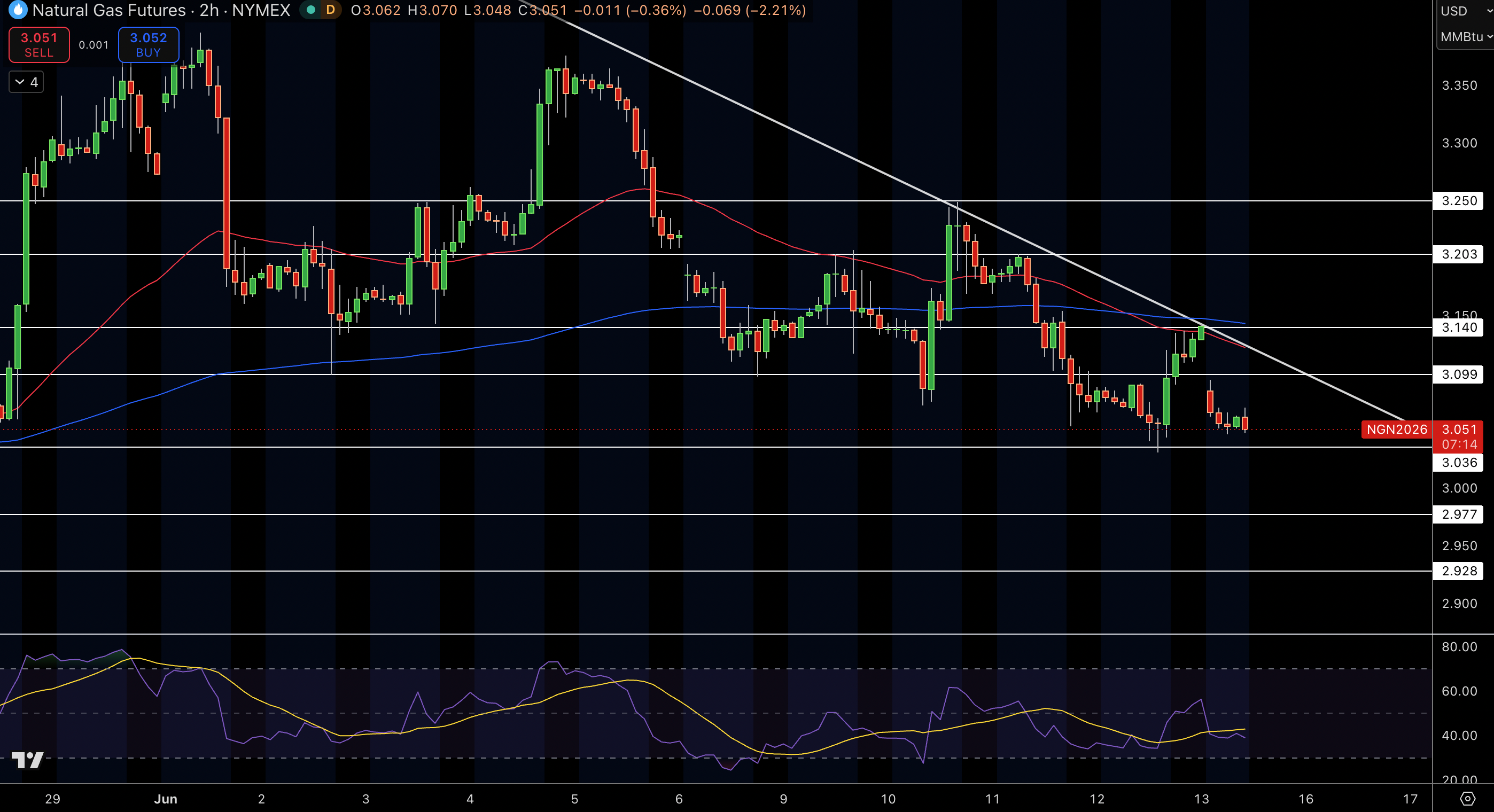
Natural Gas futures are now at $3.051 on the 2H NYMEX. Bearish continuation candles have been active on the descending trendline at $3.09 after a failed bounce above the 50MA (~$3.15) during the session. Bearish candle patterns have printed multiple lower highs and the price has seen rejection wicks on multiple occasions from $3.099. This indicates that the distribution activity continues and sellers are in control of the price.
The RSI sits just near 48 and $3.028 is where volume profile activity lies. The lower lows on the lower highs have printed a series of lower lows and the price is expected to see support at $2.977 and $2.924 (Fib extensions). The price below $3.099 remains structurally neutral or bearish below $3.099 (blue channel) and price continues to trade within the broader channel and sellers continue to dominate in the current rally and failed higher lows.
Trade Idea: Sell at $3.051, targeting $2.977, with a stop-loss at $3.099.
WTI Crude Oil Drops to $80.57 – Moving Average Rejection Weighs on Price Action
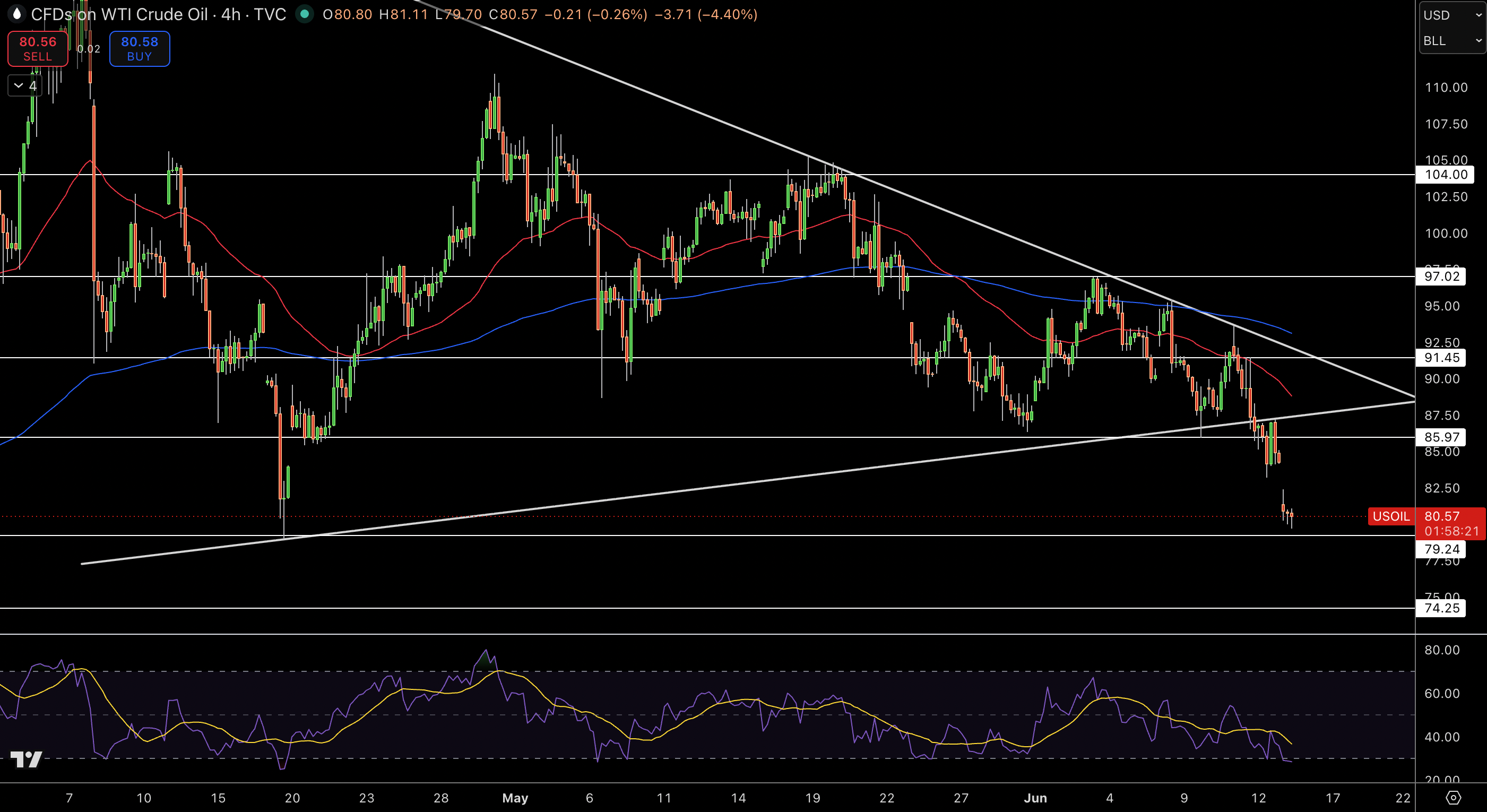
The price of WTI Crude Oil on the 4H is $80.57 and has been rejected near $85.97 (50MA), with bearish candles below the blue channel’s lower bound. Bearish candle patterns have printed multiple lower highs as it approaches the pivot at $79.24, which acts as support in the structure.
Natural Gas Price Forecast
Every new Natural Gas analysis as it publishes, today's technical signal and key levels, live price — on one page.
See all Natural Gas forecastsThe RSI remains just near 46 in the neutral space. $85 to 87 is where most of volume profile activity is located. The lower lows on the lower highs have printed a series of lower lows and the price is expected to see support at $77.50 to 75.00 (Fib confluence) from the volume profile. The price below $85.97 remains structurally neutral or bearish below $85.97 (blue channel from $104) and sellers are in control on every rebound. We’ve seen failed wicks on the lower highs near resistance.
Trade Idea: Sell at $80.57, targeting $77.50, with a stop-loss at $82.50.
Brent Crude Oil Crashes to $83.37 – Trendline Breakdown Signals Further Downside on the 4H Chart
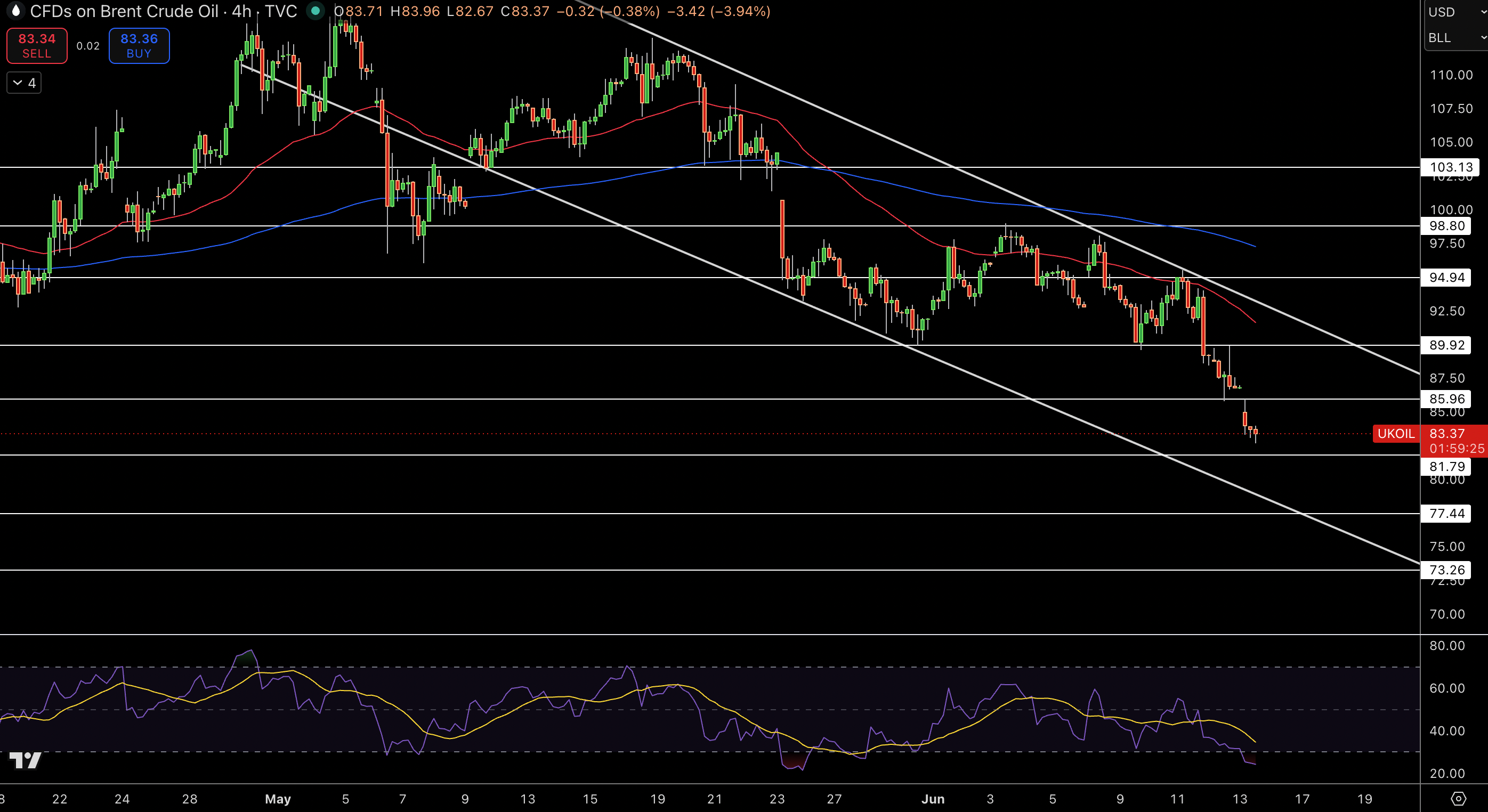
Brent Crude Oil is currently priced at $83.37 on the 4H. The price has rejected a descent around $89.92 (50MA) and has been bearish below the trendline near $85.96 and blue channel’s lower bound on the 4H. We have seen a series of large bearish engulfing candles and multiple lower lows from the $94.94 swing. A target range between $81.79 and $80.00 (Fib extension) is now in the sights of the price.
The RSI is down from 45 indicating a lack of power and strength. The price below $85.96, or within the channel, remains structurally bearish below $85.96 (blue channel from $103) and the range of lower highs and lower lows continues to be below the $85.96 price level and sellers are in control. $89 to 92 was a failed value area on the volume profile.
Trade Idea: Sell at $83.37, targeting $81.79, with a stop-loss at $85.00.