Oil and Natural Gas Markets Remain Balanced as Ceasefire Holds
Markets for crude oil were relatively quiet June 17, 2026, with the cease-fire conditional between the US and Iran persisting for more than 11 weeks. Tankers have gradually started to pass through the Straits of Hormuz again. The cease-fire has mostly removed the geopolitical risk associated with the region, which contributed to the high volatility early on during the year. The rest of the market has returned to being determined by supply and demand. Both WTI and Brent have seen less volatility from all the uncertainty that has gone on.
US production continues to be robust near record highs. OPEC+ has maintained discipline with output and there is solid growth outside of the alliance in countries like Brazil, Guyana and Canada. Iranian and regional supply are returning but not entirely at this point. Global demand is recovering albeit at a slower pace, particularly in Asian markets but the growth for 2026 is still expected to be modest as interest rates remain higher in developed countries and spending has slowed.
Natural gas was also moving quietly on healthy inventories in the US and Europe with mild spring weather so far this year. Cease-fire in the region eased concerns over shipping in the LNG sector, with spot prices soft. However, LNG demand is expected to remain solid in the long-term in Asia and Europe.
There is attention on US inventories as well as another OPEC+ meeting in the near future. There are still risks to the crude and natural gas markets, especially with the cease-fire remaining in the balance.
Natural Gas Futures Rise to $3.170 – Ascending Channel Supports Recovery
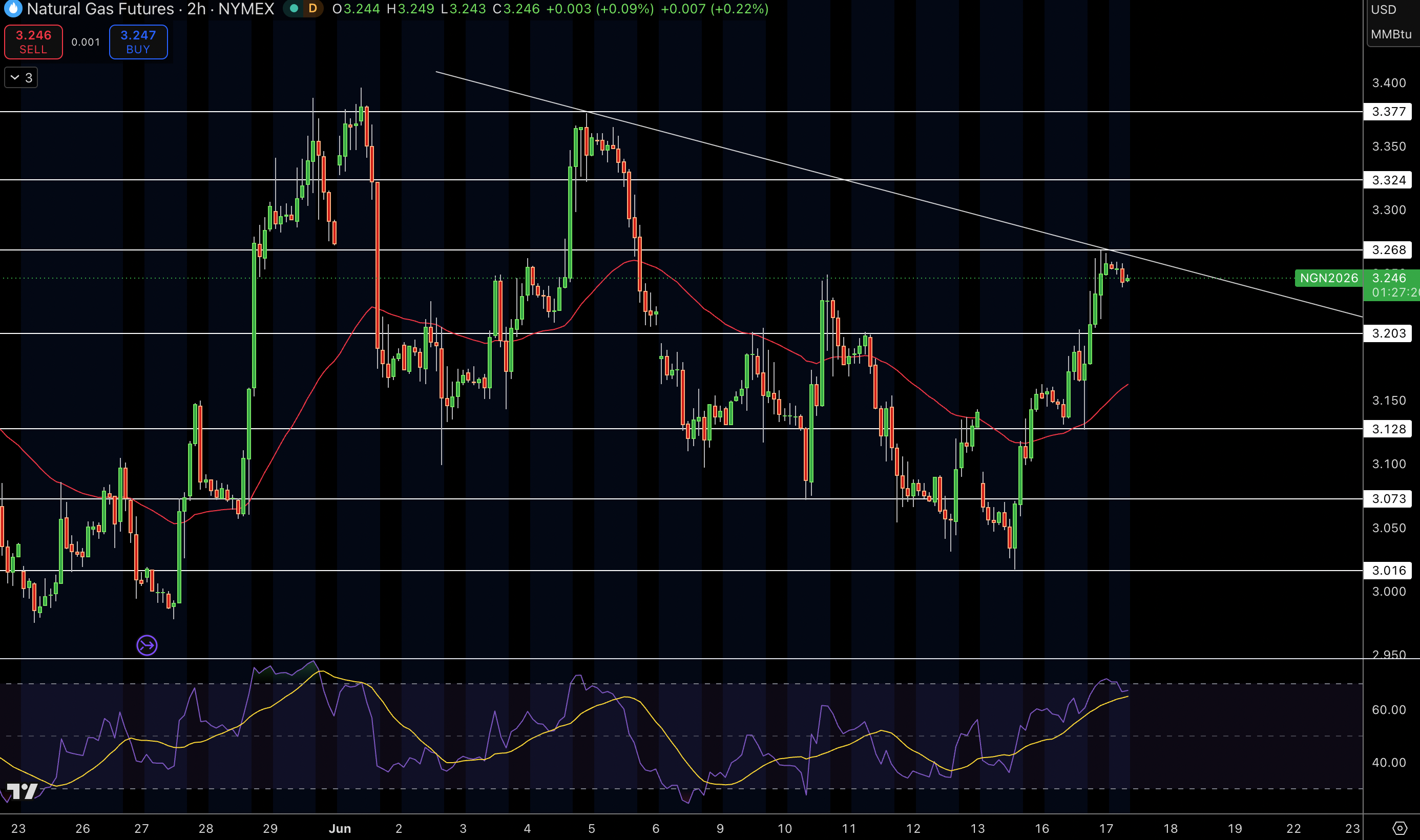
Natural gas futures are at $3.170. On the 2-hour chart, it has traded above resistance of the 50 moving average, currently around $3.15, and is trading up within an ascending channel. There has been a series of higher highs and higher lows in response to the $3.099 swing low. The buyers continue to defend pullbacks into the area of the ascending channel support. The RSI has traded back above 50, and the Volume Profile indicates that the $3.10 area is a support. It has reached $3.203 resistance, and the next area of upside target is the Fibonacci projection at $3.297.
Trade Idea: If gas continues to trade up, the next area of resistance to test is $3.203, with the next area of upside target at $3.297. It will likely hold support at the $3.10 area. If it is unable to maintain support of $3.099, it may trade down further and it will likely invalidate the current bullish outlook.
Natural Gas Price Forecast
Every new Natural Gas analysis as it publishes, today's technical signal and key levels, live price — on one page.
See all Natural Gas forecastsWTI Crude Oil Falls to $75.12 – Triangle Breakdown Reinforces Bearish Trend
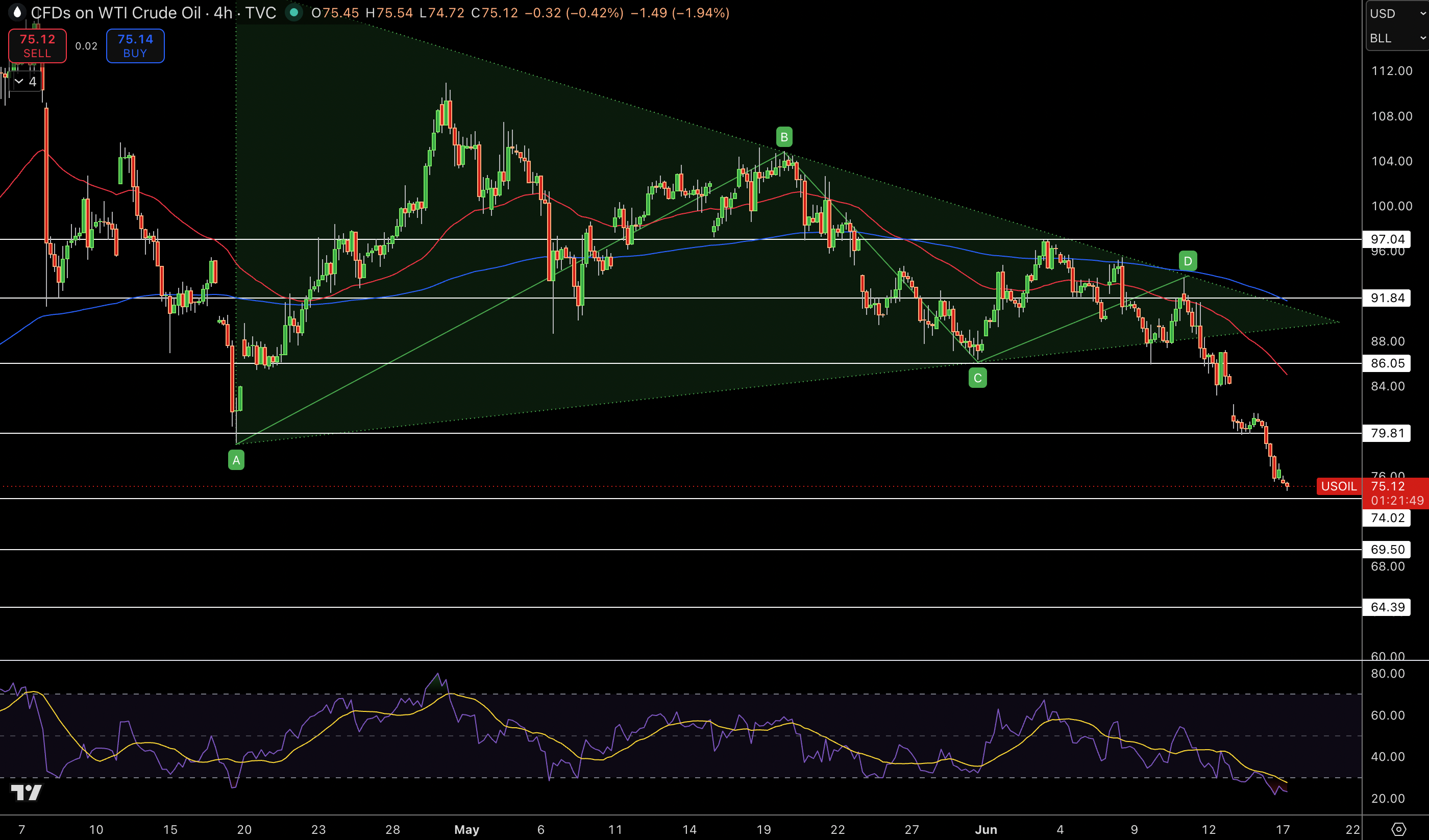
WTI is at $75.12 on the 4-hour time frame. It has recently broken support below $79.81 on its symmetrical triangle, which has maintained the downtrend. It also failed at resistance of the 50 moving average around $85.00. The failed test followed by strong bearish engulfing candles drove the price down to new lows from the $91.84 high.
It remains within the lower section of the downward channel from the $97 highs and is being suppressed by the white descending trendline, and the RSI continues below 40. The $79-$82 area is a failed value area where buyers were previously overwhelmed by sellers. WTI Oil is now supported around $74.02. If WTI continues down, it may next trade through the $68.50 Fibonacci extension area.
Trade Idea: WTI Oil will test $74.02 support or will extend lower down through the $68.50 area. If it moves up and through the $79.81 resistance level, it may then trade up further and may invalidate its bearish outlook.
Brent Crude Oil Slides to $78.60 – Bearish Channel Breakdown Keeps Pressure Intact
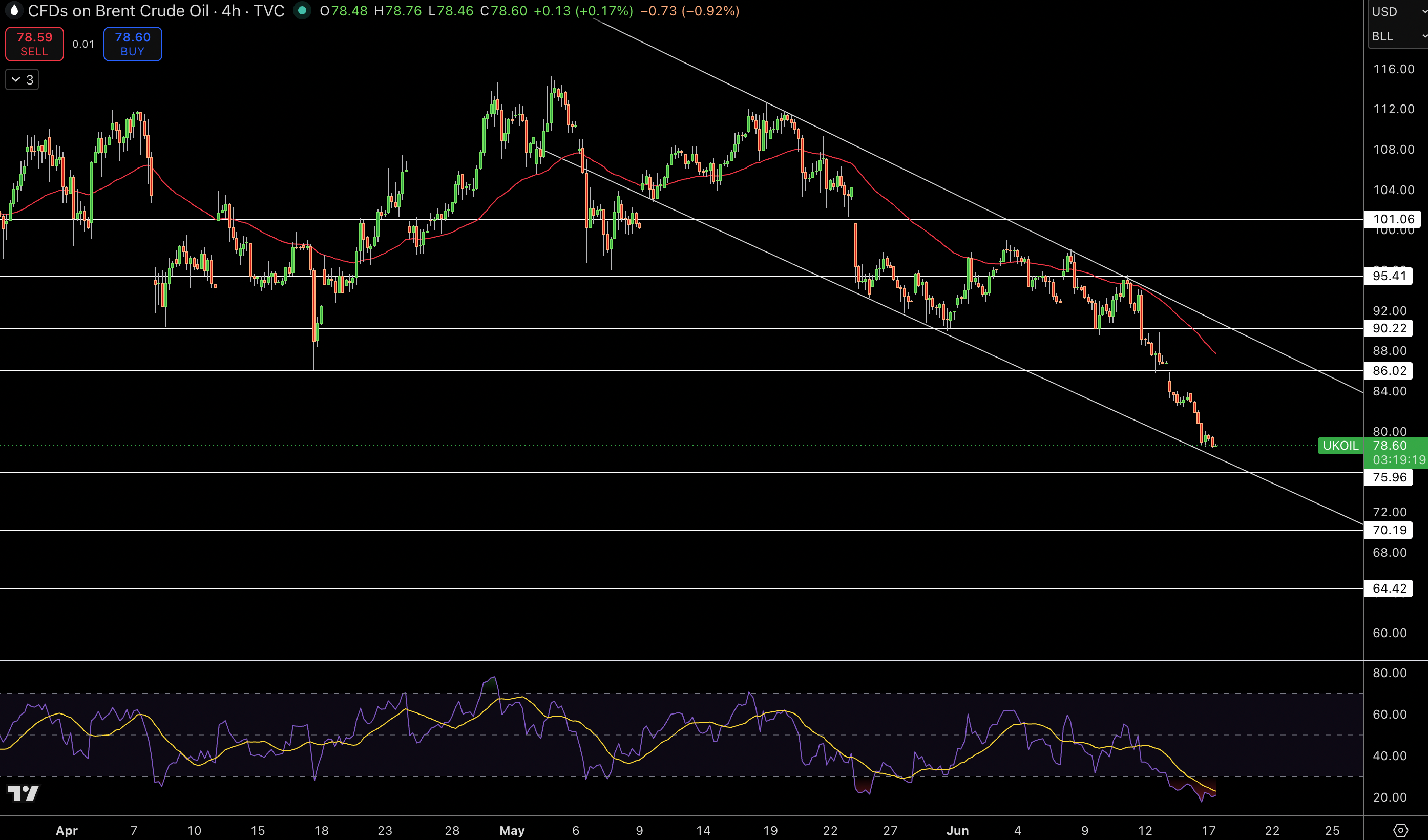
Brent Crude Oil is trading at $78.60. On the 4-hour time frame, after it rejected off of resistance of the 50 moving average at $86.02, it has broken the support below the rising channel. There is a continuous stream of lower highs and lower lows from the highs, implying a steady distribution. It is now trading at $77.88 support after it has broken the support below the rising channel, and it remains in the lower part of the declining channel. Its RSI is still declining and remains near 45. The $85-$88 range has emerged to be a resistance area where sellers have regained control. If Brent fails to trade up and through $80.65 resistance, it may continue to trade down to the next area of support.
Trade Idea: A test of $77.88 support is likely. Resistance lies around $80.65. Sustained trading below resistance would favor continued downside pressure toward $75.00.