Production Hit a Two-Month High and the Heat Could Not Overcome It
August natural gas futures fell nearly 3% Monday before recovering modestly early Tuesday, trading near $3.20. The market is holding above the 50-day moving average but it took a fight to get there. Lower-48 output climbed to nearly 114 Bcf per day over the weekend, the highest level in more than two and a half months. BloombergNEF had Monday’s dry gas production at 111.2 Bcf per day, up 2.3% from a year ago. Heat forecasts kept the selling from accelerating but they did not reverse it.
February futures held close to $3.95. That spread between August and February tells you where the real conviction is. The front month is fighting production. The winter strip is pricing in the LNG demand and seasonal tightening that the summer contracts cannot see yet.

Daily August Natural Gas Futures Technical Analysis
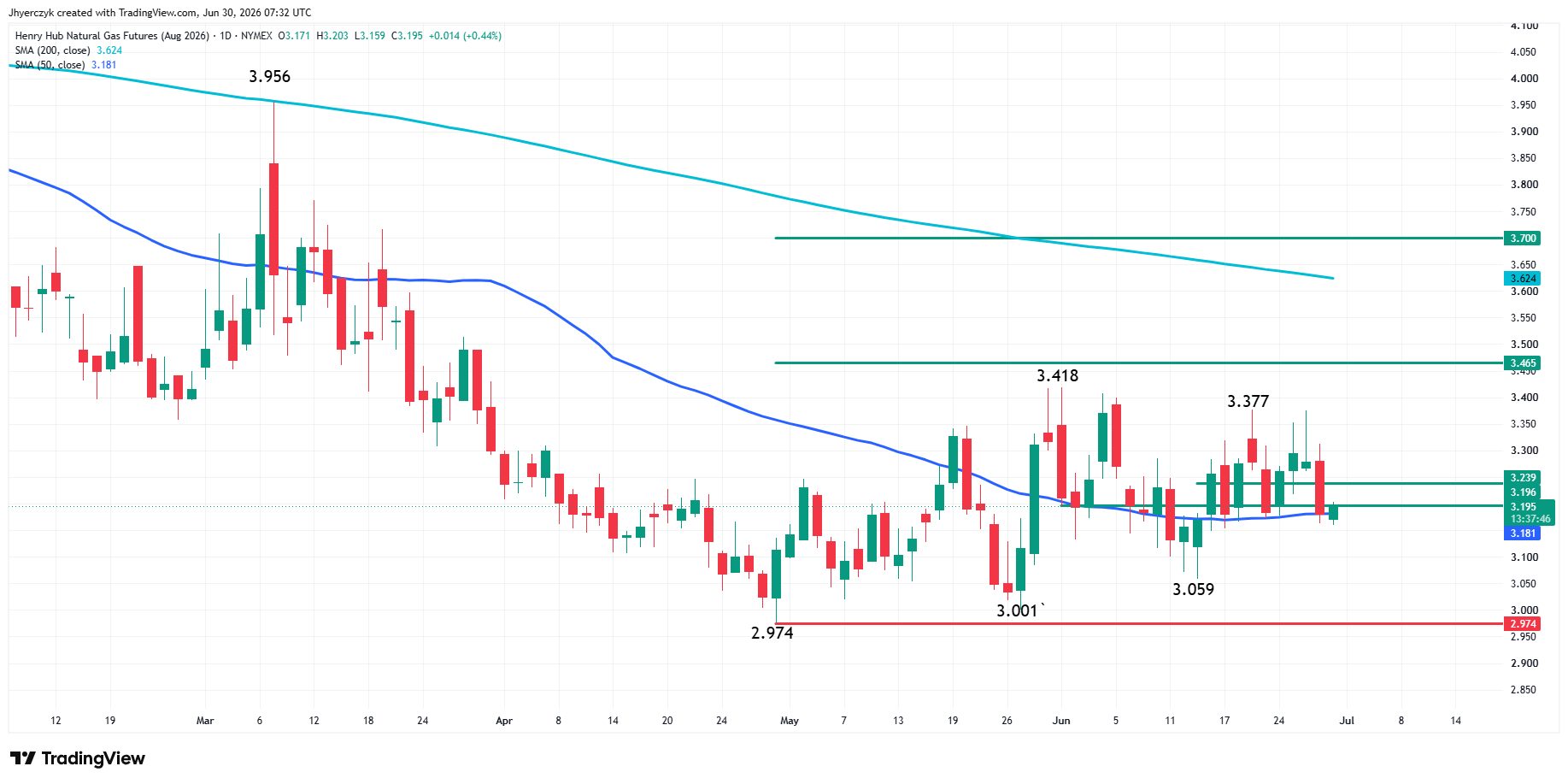
August natural gas futures are edging higher early Tuesday as bullish traders continue to defend the 50-day moving average at $3.181 against a steep decline. The daily chart indicates a sustained move under this indicator could target swing bottoms at $3.059, $3.001 and $2.974. We’re not going to call the market bearish if the market drops into this area because it’s hard to be bearish inside the $3.00 area in July. Let’s just say it would not be a particularly bullish situation.
A sustained move over the 50-day MA will keep hope alive for bullish traders, however. Nonetheless, they will face a number of pivot point headwinds at $3.205, $3.239 and $3.465 before spiking into the 200-day moving average at $3.624 and a long-term 50% level at $3.700.
Daily February Natural Gas Futures Technical Analysis
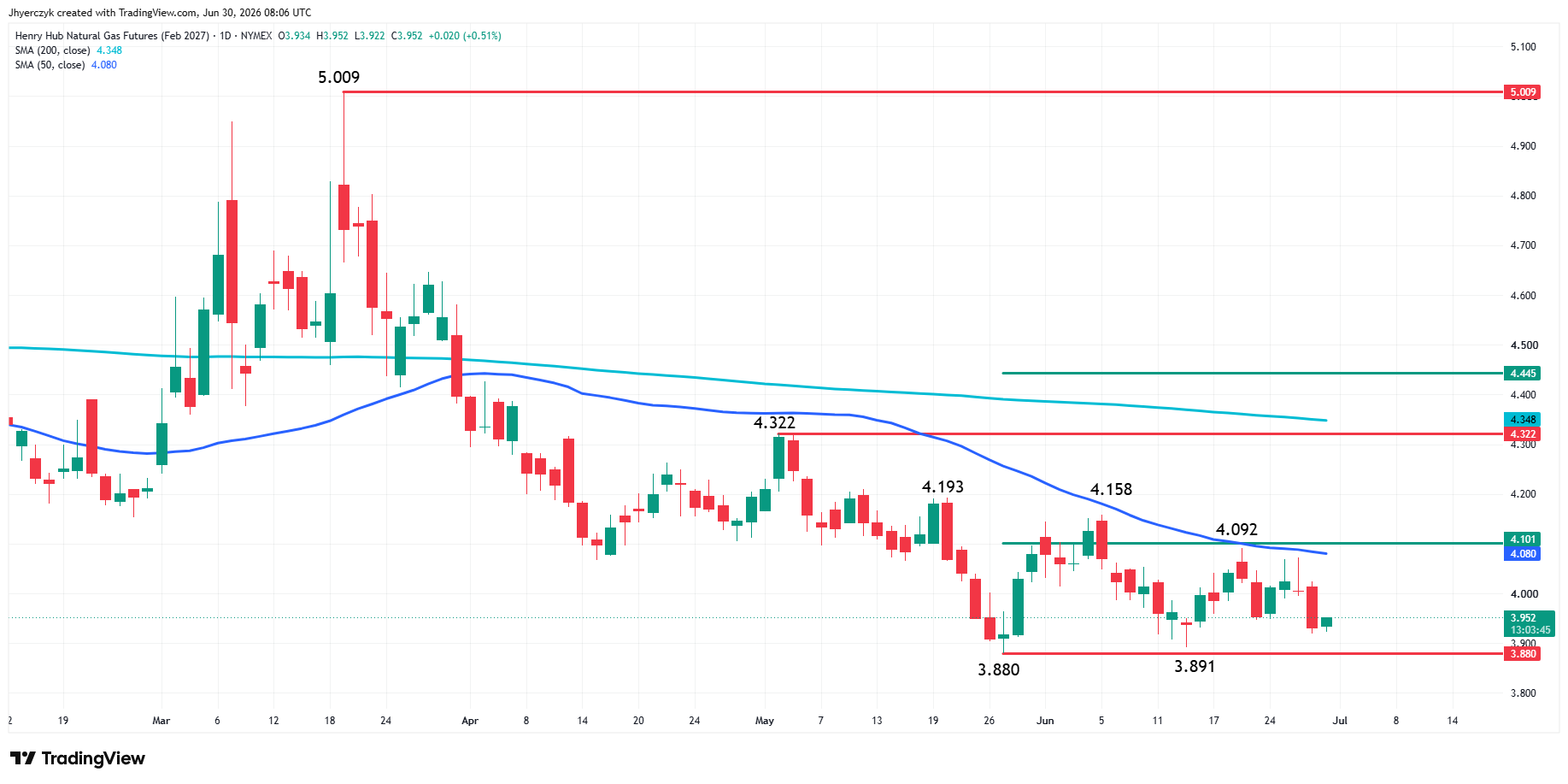
February natural gas futures are in a worse technical position than the August futures contract. Naturally, the price is higher, but the market is well under the 50-day moving average at $4.080, making its two bottoms at $3.891 and $3.880 vulnerable.
A drop below established support in July will indicate that traders believe there will be ample supply at the start of the winter heating season. It’s also a backdoor prediction that summer cooling needs will be normal. Essentially, this bearish picture assumes there won’t be any surprise, lingering heat domes this summer.
Natural Gas Price Forecast
Every new Natural Gas analysis as it publishes, today's technical signal and key levels, live price — on one page.
See all Natural Gas forecasts114 Bcf Per Day Is the Number the Demand Side Has to Beat
The EIA raised its 2026 dry gas production forecast to 111.0 Bcf per day earlier this month. Marketed gas production is expected to average 120.8 Bcf per day before reaching 122.3 Bcf per day the following year. Most of that growth is coming from the Permian, Appalachia, and the Haynesville as pipeline infrastructure gradually improves access to Gulf Coast markets.
Baker Hughes reported active natural gas rigs increased by three last week to 125. Still below February’s recent high but the direction is up. Producers are adding supply at the same time the EIA is telling the market that supply growth continues through next year. That is the wall the bulls are trying to climb through.
The Heat Is Real but Production Absorbed Monday’s Demand
Forecasts call for widespread heat across the eastern two-thirds of the country through early July with highs reaching the 90s and low 100s across major population centers. Commodity Weather Group shifted its outlook hotter through July 3. NatGasWeather classified national demand as high to very high over the next week.
Monday proved that heat alone is not enough when production is running at two-month highs. The weather support kept the market from breaking below the 50-day moving average but it could not overcome the supply headline. Weekly electricity generation recently dipped modestly from year-ago levels although the trailing 52-week average is still running above last year. The demand is there. It is not growing fast enough to absorb what the supply side is delivering.
LNG at 19.2 Bcf Per Day Is Reshaping How This Market Works
BloombergNEF estimated LNG feedgas deliveries at 19.2 Bcf per day Monday, near record territory. The EIA expects exports to average roughly 17.0 Bcf per day this year before climbing another 9% next year. Approximately 15% of all U.S. dry gas production is now committed to overseas buyers.
Qatar’s Ras Laffan damage keeps the pull on U.S. cargoes strong. Europe’s storage is below seasonal norms and needs to rebuild before winter. The structural demand from exports is the reason the August-to-February spread stays wide even when front-month production is running at highs. The summer contract sees the supply. The winter contract sees the export demand eating into it month after month.
Crude Oil Prices Create a Paradox for Natural Gas
Strong crude encourages more Permian drilling. More Permian drilling produces more associated gas whether gas prices justify it or not. Higher oil prices can actually increase natural gas supply even while gas-specific economics are not supporting the drilling on their own.
At the same time, strong global oil prices reflect healthy energy demand and support continued investment in LNG infrastructure. More LNG capacity eventually means more demand for U.S. gas. The crude oil relationship pushes supply and demand in opposite directions simultaneously. In the near term, the supply side of that relationship is winning because Permian associated gas is hitting the market now while the incremental LNG demand takes quarters to materialize.
Storage Is Comfortable and the Bears Know It
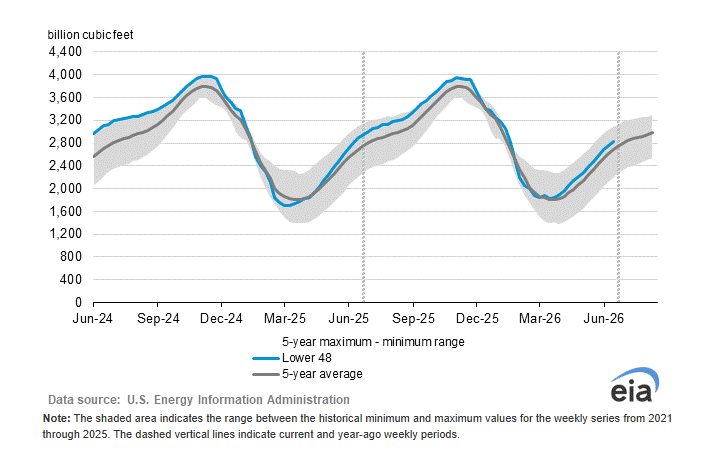
The latest EIA injection came in at 76 Bcf, above expectations, leaving inventories 5.7% above the five-year seasonal average. Storage is slightly below last year but the surplus over the five-year norm gives the bears their headline every Thursday.
The number matters less than the trend. If summer heat drives power burn higher and LNG stays near 19 Bcf per day, injections start coming in below the five-year average and the surplus narrows. If production keeps outpacing demand the way it did Monday, the surplus holds or grows and the front month stays heavy.
What to Watch
Production at 114 Bcf per day is the number that defined Monday’s session. The heat forecast through early July is the demand response. LNG at 19.2 Bcf per day is the structural pull that keeps tightening the longer-term picture even while the front month struggles.
August is defending the 50-day moving average. February is under its own 50-day and vulnerable to a break below the $3.891 to $3.880 support. The spread between the two contracts is the market’s way of saying the short-term supply story and the longer-term demand story are pointing in different directions. The heat has to start showing up in smaller injections and rising power burn data before August can break through the resistance overhead. Until then, production wins the daily battle and LNG wins the seasonal argument.
More Information in our Economic Calendar.