



Currencies Shaped by Monetary Policy Divergence and Economic Conditions
By June 30, the dollar, euro, and pound had all been driven by different central bank stances and economic fundamentals. The dollar’s relative strength reflected continued concern about core inflation in the U.S. economy, keeping the Federal Reserve less inclined to cut rates and maintaining expectations of a relatively more hawkish path of monetary policy. The U.S. domestic economy also supported the currency given its underlying resilience and the dollar’s status as the world’s primary reserve currency.
The euro, by contrast, had faced mixed growth prospects across the euro zone and was subject to pressure from the ECB, which had been striving to ensure price stability in the euro area. The divergence in underlying fiscal positions and inflation across the euro zone would also continue to affect policy transmission. The euro’s performance would hinge on subsequent economic data around growth prospects and wage increases across the euro zone.
Meanwhile, the pound had been grappling with inflation concerns, given sticky services inflation, and the Bank of England had been monitoring growth prospects. Pound’s prospects would be driven by domestic fiscal policy decisions, as well as the Bank of England’s stance on inflation and economic growth and its relative stance compared with the Fed and the ECB.
Underpinning this was the divergence in underlying fundamental conditions, such as inflation and domestic growth, which was a key determinant of relative exchange rates. This fundamental divergence would continue to create two-way risks for the USD, EUR and GBP exchange rates, given different paths of inflation, divergent fiscal settings and domestic growth prospects, and different trade balances and capital inflow/outflow patterns, all of which would drive the currencies’ outlooks in the future.

DXY Holds $101.31 – Triangle Breakout Retest Supports Bullish Momentum on the Daily Chart
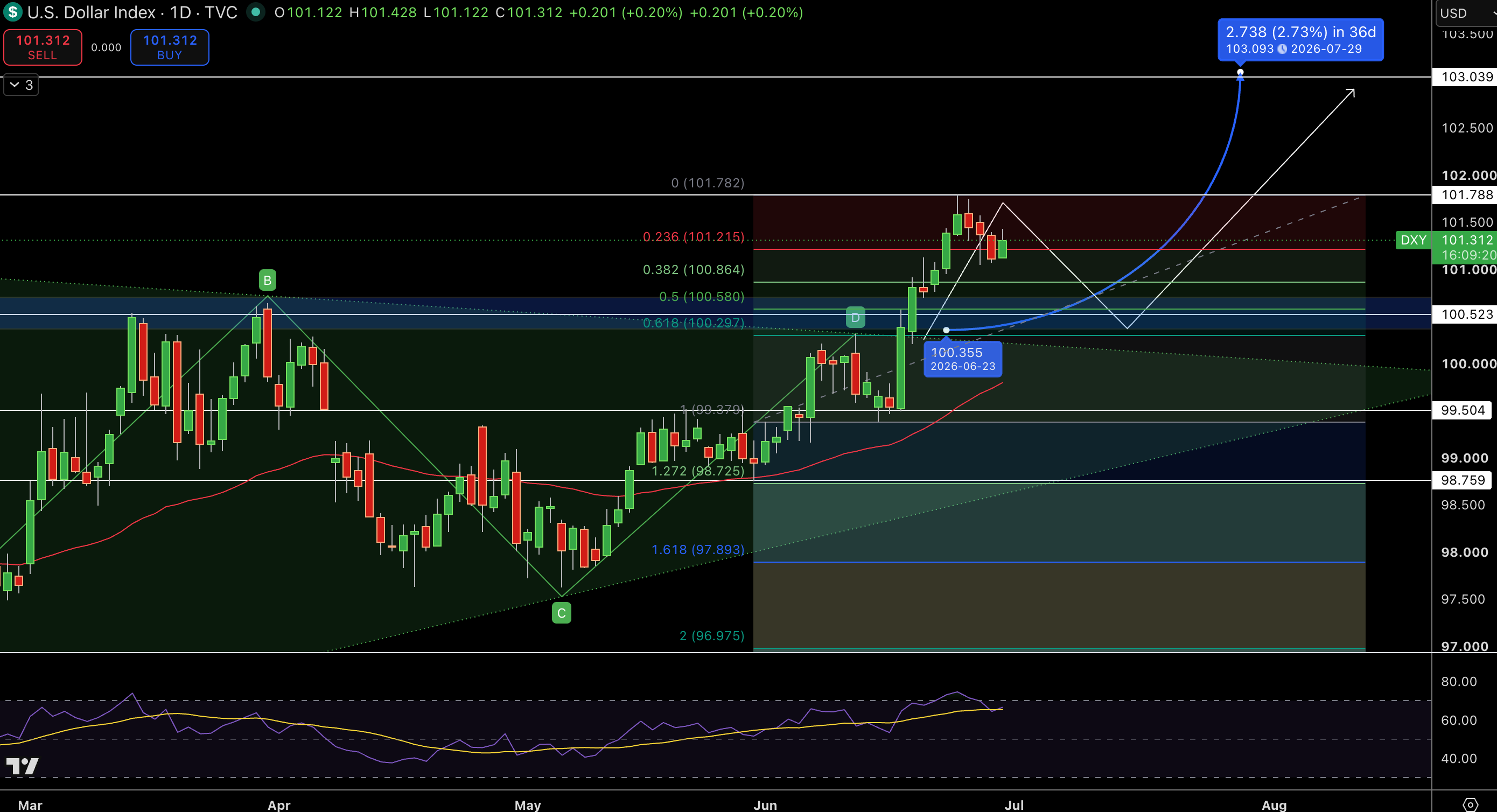
DXY is trading around $101.31 on the daily timeframe. Bullish continuation candles are retesting a former triangle resistance at $100.36 after a sharp breakout from a swing low of $97.67. Consistent higher highs are still in play, and the price is supported by an ascending trendline.
The RSI has broken over 55, signaling bullish momentum is increasing. The volume profile notes $100.36 as an important breakout level that is now acting as support. Future upside projection is around $103.09 using Fibonacci tools in the short term.
The price is bullish overall, as the price is above $100.36 and is part of an ascending channel. The higher highs and higher lows is still present.
Trade Idea: Buy $101.31, targeting $103.09, with a stop-loss at $100.36.
GBP/USD Price Forecast
Every new GBP/USD analysis as it publishes, today's technical signal and key levels, live price — on one page.
See all GBP/USD forecastsGBP/USD Holds $1.3240 – Ascending Trendline Support Maintains Bullish Bias on the Daily Chart
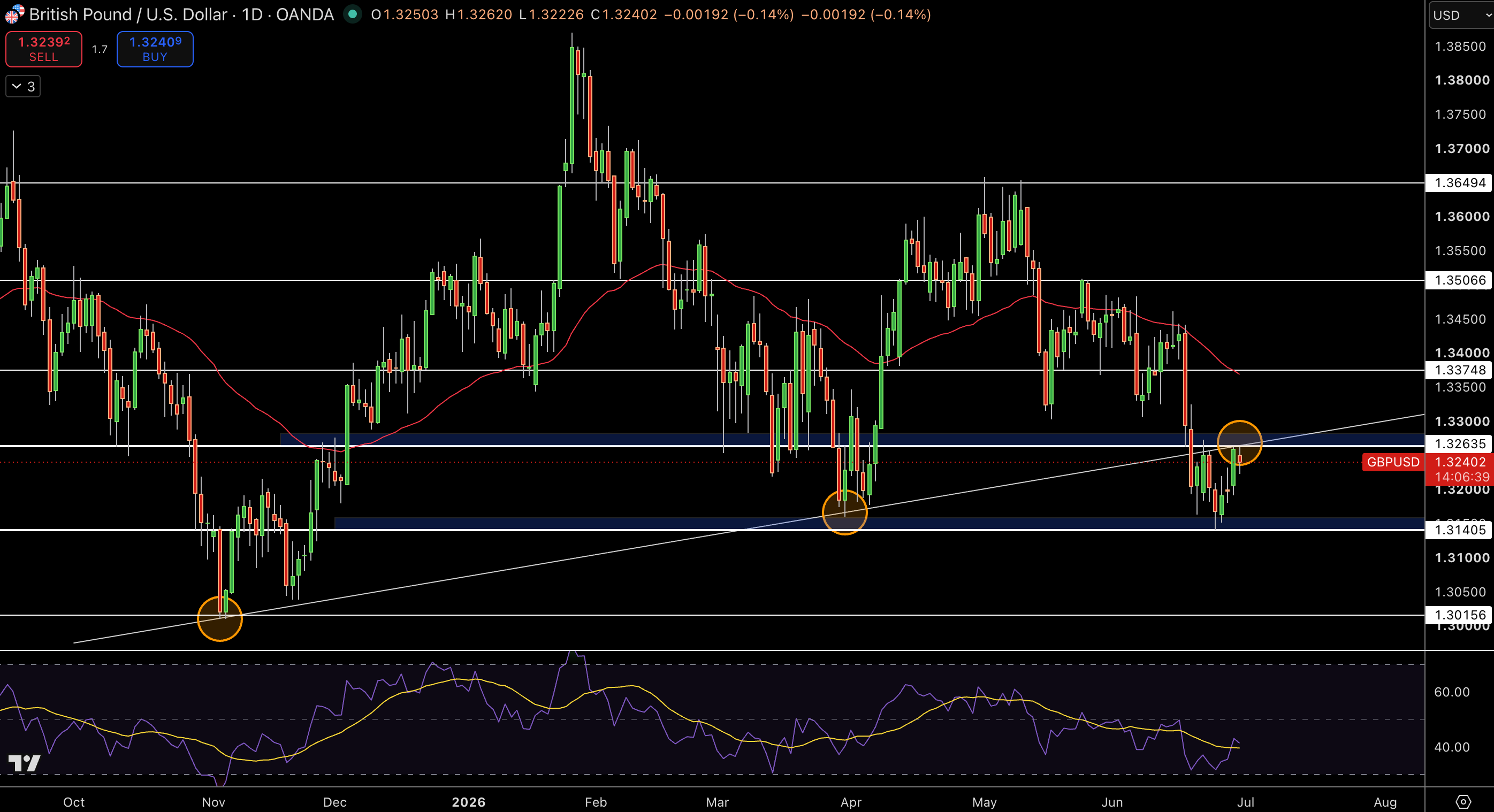
GBP/USD is trading at $1.3240 on the daily timeframe. The price is bouncing off a rising white trendline around $1.3206, which occurred after price tested a red 50 moving average around $1.337. A bullish wick is still in play, which means the price is bouncing off the rising trendline, and higher lows remain in play. The RSI is hovering at 50, indicating neutral momentum.
A pivot area is present on the volume profile at $1.320 to $1.325. An important resistance level is around $1.337 to $1.345. The price is bullish, since the price is above the trendline and is part of the overall market range. Higher lows are still in play.
Trade Idea: Buy $1.3240, targeting $1.337, with a stop-loss at $1.314.
EUR/USD Dips to $1.1399 – 0.236 Fibonacci Support Holds on the Daily Chart
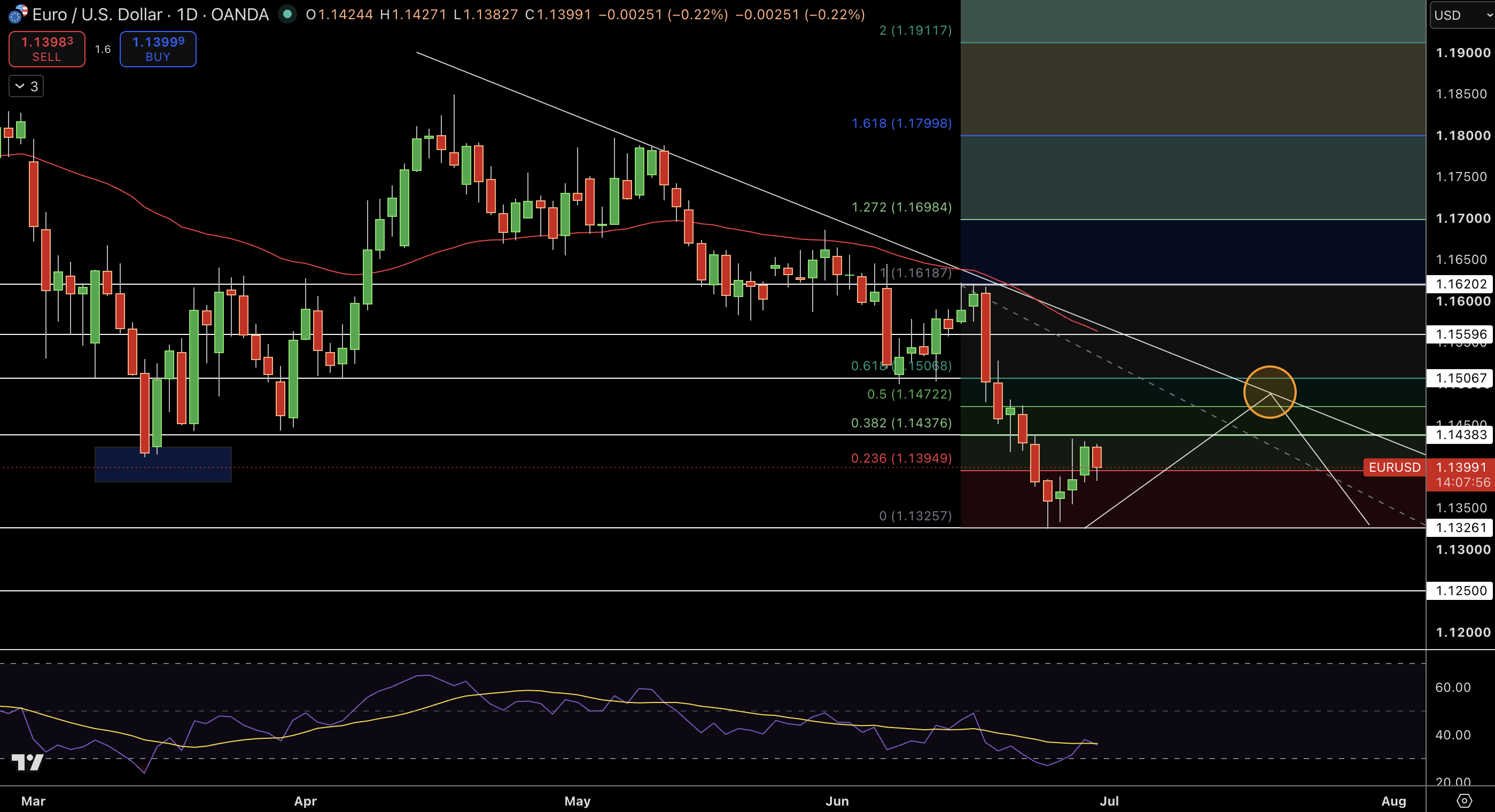
EUR/USD is trading at $1.1399 on the daily timeframe. Bearish continuation candles are testing a 0.236 Fibonacci level at $1.1438, which occurred after a drop from a swing high of $1.1799. A series of lower highs is still in play, but the price continues to be supported at the 0.236 Fibonacci level. The RSI is around 45, showing bearish momentum is declining.
The volume profile marks a support range at $1.143 to $1.147. There is a descending trendline near $1.162. The price is neutral or bearish overall, since the price is below $1.162, although it remains supported by a 0.236 Fibonacci level. There are bullish rejection wicks off the recent lows.
Trade Idea: Buy $1.1399, targeting $1.162, with a stop-loss at $1.132.


