Why is SYN Price Going Up Right Now?
Synapse originally gained traction as a cross-chain bridge, allowing users to move assets between different blockchains. But its bridge activity remains relatively muted.
Synapse holds about $11.17 million in total value locked, with 30-day bridge volume of roughly $295,000, according to data resource Defi Llama.
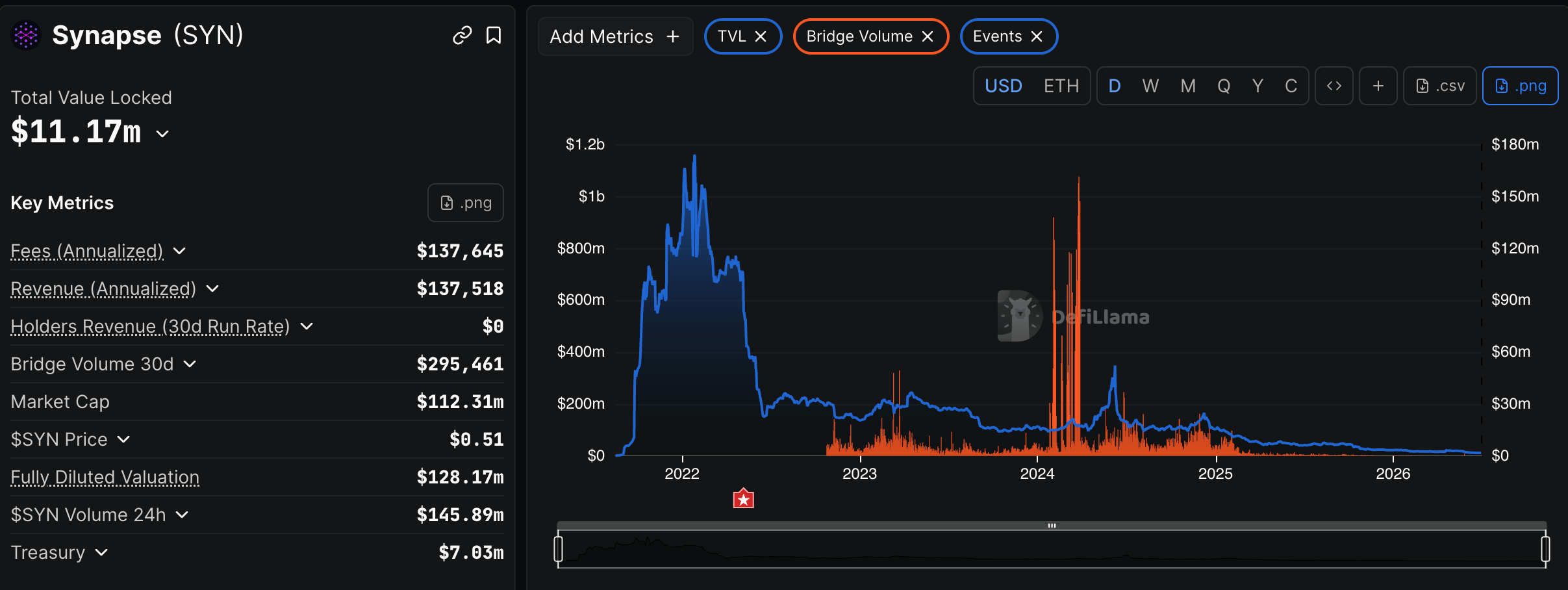
That is small compared with larger cross-chain peers such as Hyperlane, NEAR Intents and Stargate V2, which hold about $94.7 million, $78.7 million and $71.1 million in TVL, respectively.
Traders appear to be looking past Synapse’s quieter bridge metrics and focusing instead on its pivot toward newer interoperability products such as Hypercall.
Hypercall is a fractional options platform settled on Hyperliquid (HYPE), allowing users to trade defined-risk options on crypto and stock-linked assets with smaller position sizes and no liquidation risk beyond the premium paid.
The project says Hypercall is live on mainnet and uses SYN as part of the broader Synapse ecosystem rather than launching a separate token.
That narrative received a major boost after BitMEX co-founder Arthur Hayes disclosed a roughly $2.2 million purchase of SYN in a Monday post.
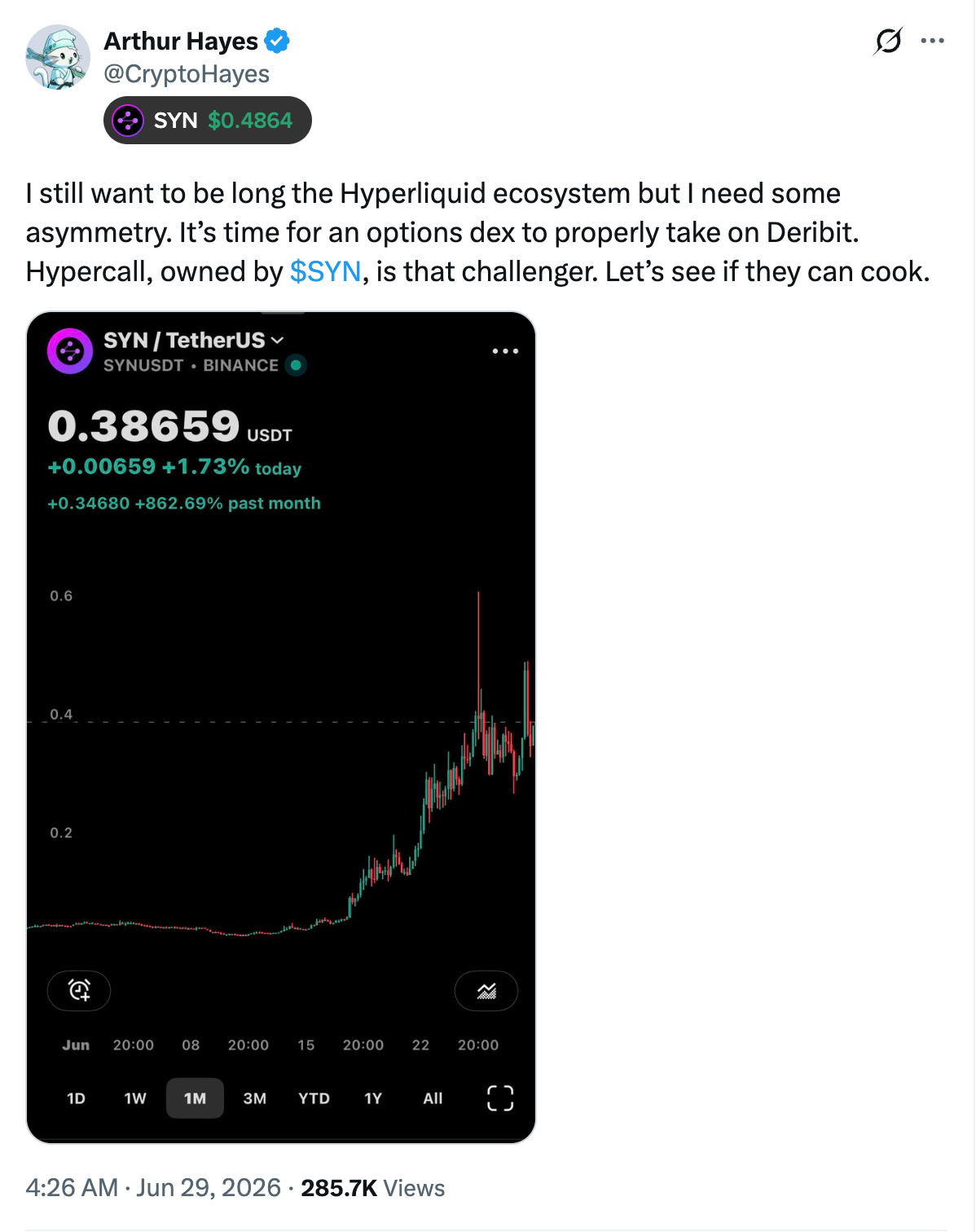
Hayes said he wanted “asymmetry” within the Hyperliquid ecosystem and described Hypercall as an options DEX that could challenge Deribit, the dominant crypto options venue.
Bitcoin Price Forecast
Every new Bitcoin analysis as it publishes, today's technical signal and key levels, live price — on one page.
See all Bitcoin forecastsArthur Hayes Has Bad Reputation, Though
Hayes’ SYN mention may have fueled fresh buying, but traders are also treating the call with caution.
A timeline shared by Chainink on Monday showed that Hayes has made several high-profile token calls this year, including HYPE, ZEC, NEAR, and WLD, before later exiting or reversing some positions.
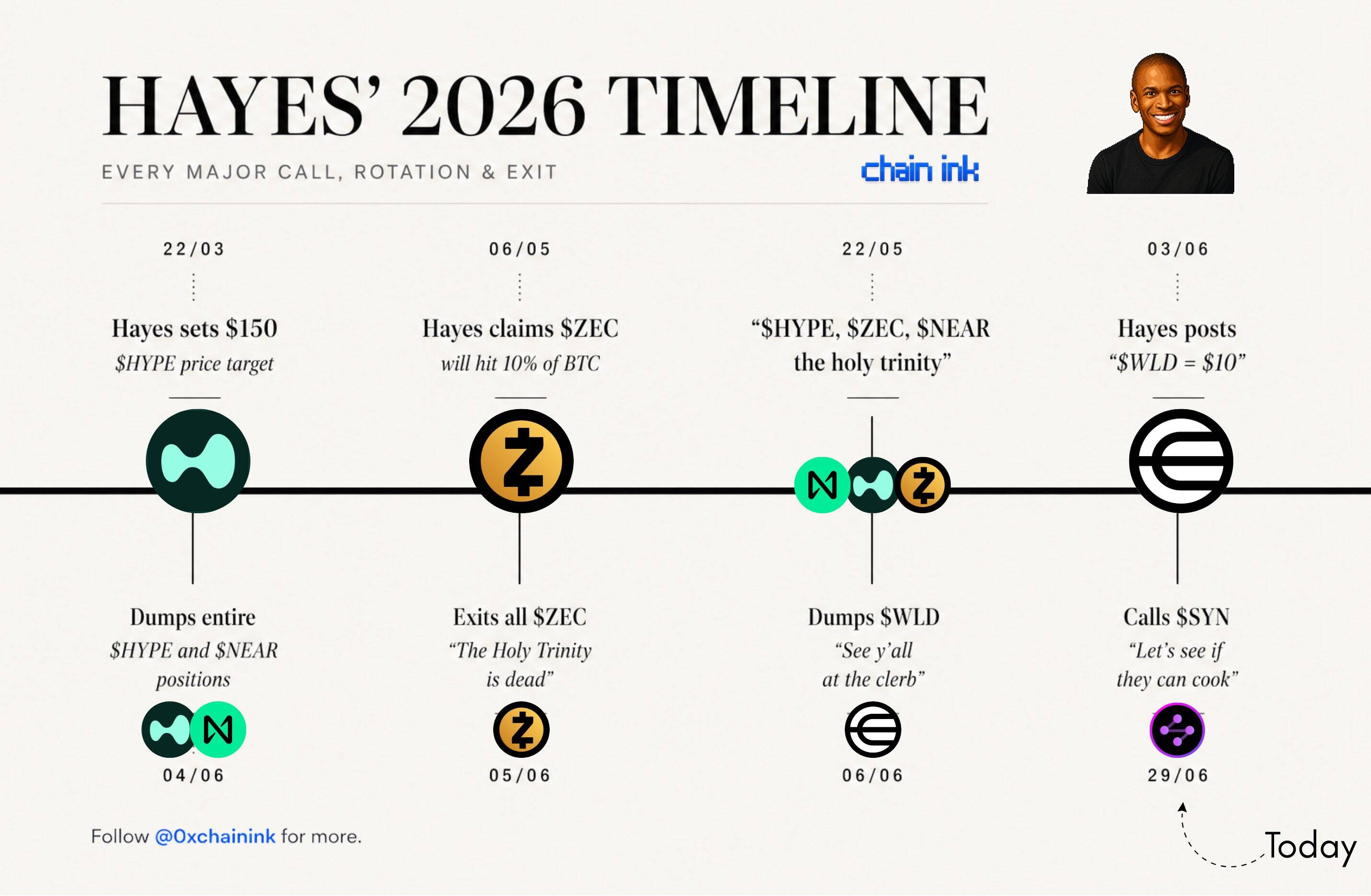
That history has made his endorsements controversial, especially among traders who fear late entries after a sharp pump.
In SYN’s case, the token had already rallied aggressively before Hayes’ post, meaning the endorsement may add momentum, but also increases the risk of a crowded, sentiment-driven trade.
SYN Price May Plunge 25%, Per Rising Wedge Setup
SYN’s four-hour chart shows a rising wedge forming after its explosive June rally, a structure that often signals weakening bullish momentum.
Price is still making higher highs and higher lows, but the narrowing range shows buyers are losing follow-through near the upper trendline. A break below the wedge’s lower trendline, currently near the 20-4H EMA around $0.42, could confirm a bearish reversal setup.
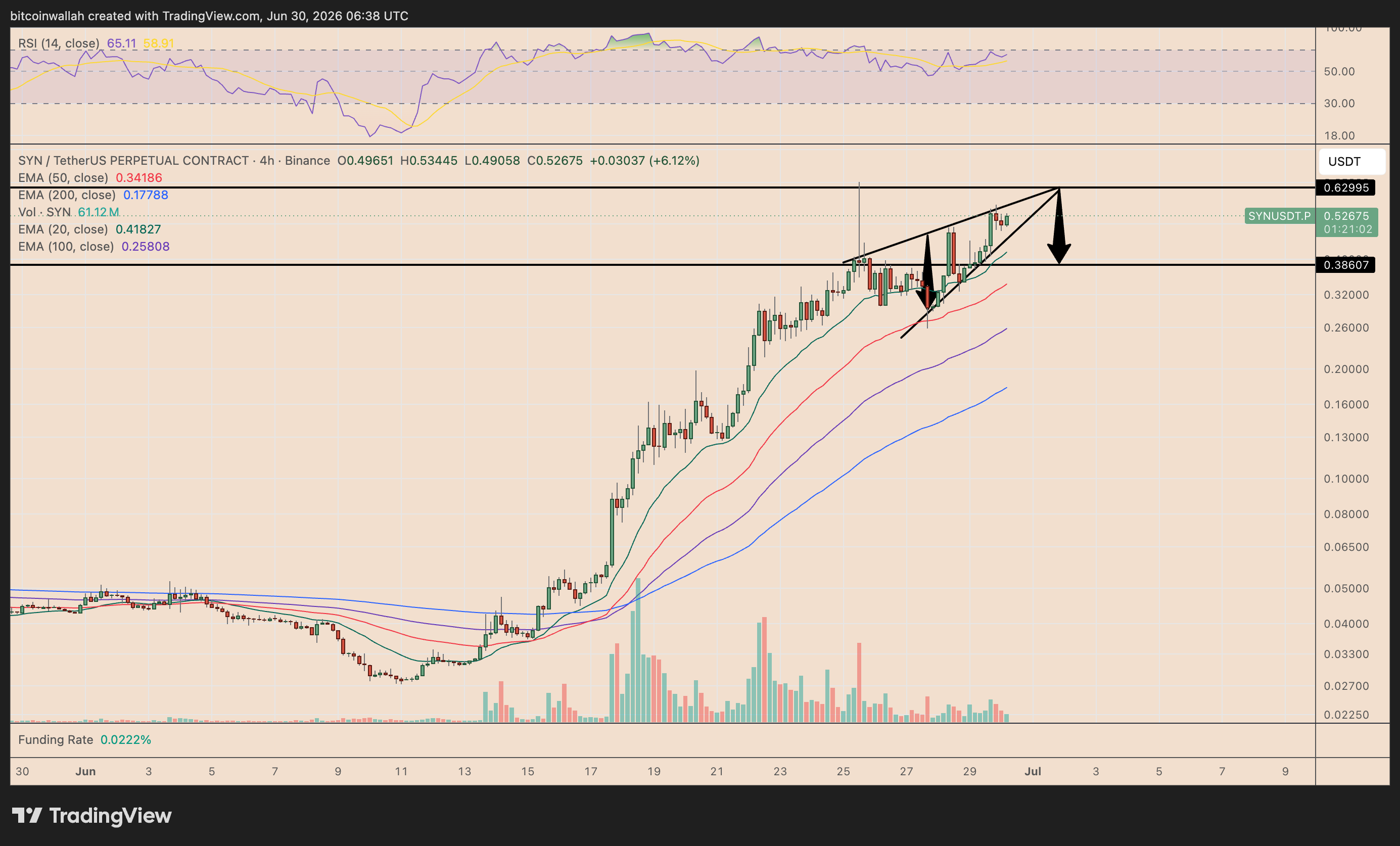
That would put the $0.386 support area back in focus, with deeper downside risk toward the 50-4H EMA near $0.34. However, a breakout above $0.63 would invalidate the bearish wedge setup.