
Storage Surplus Is Shrinking and Short Sellers May Be on the Wrong Side
July natural gas futures spent most of this week on the bullish side of the 50-day moving average and the buying pattern keeps getting louder. Monday’s dip attracted new buyers immediately and the rally off that low pushed the market higher. That makes it four progressively higher lows since late April. The breakout has not happened yet but the base is built and the market is running out of reasons to stay down here.
The EIA storage report missed expectations again this week. Injections have been coming in below last year’s pace all season and the surplus that gave the bears their argument in March and April is getting smaller with every report.

Daily July Natural Gas Futures Technical Analysis
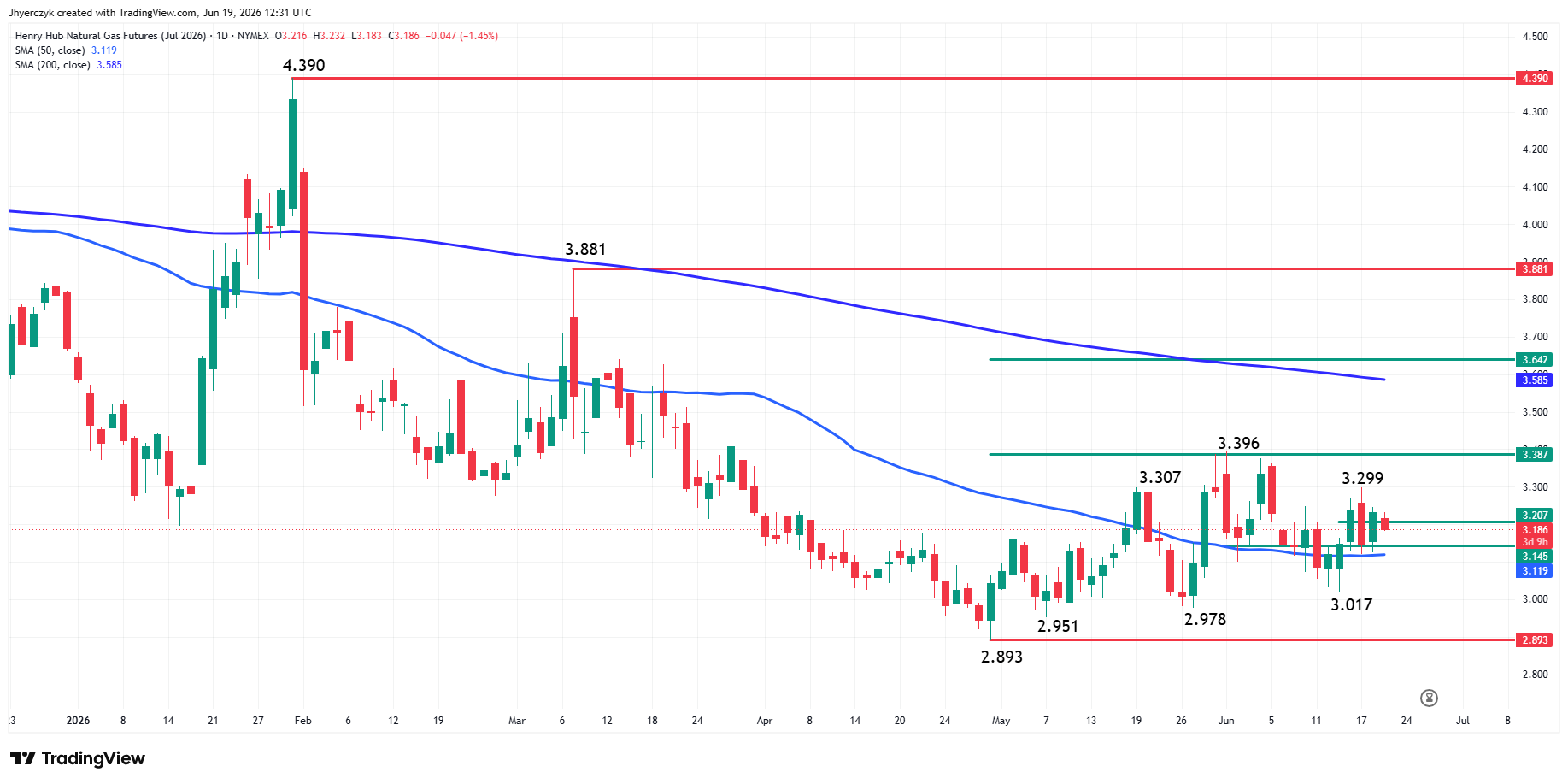
After a weak start on Monday, July natural gas futures once again attracted new buyers on the dip back to $3.017. The subsequent rally drove the market to $3.299, making $3.017 another higher bottom to go along with previous bottoms at $2.978, $2.951 and $2.893. That’s one-half of an uptrend with the other half, higher tops.
The market spent most of the week on the bullish side of the 50-day moving average at $3.120. This is another sign that the market appears to be setting up for an upside breakout.
Holding on the strong side of the 50-day MA will indicate buyers are accumulating while building a support base. If they get the right bullish catalyst, prices could take out the minor top at $3.299, leading to a test of the critical resistance at $3.387 to $3.396. I believe that this area is the potential trigger point that launches the acceleration into the 200-day moving average at $3.586.
The Storage Cushion Is Not What It Was Two Months Ago
Natural Gas Price Forecast
Every new Natural Gas analysis as it publishes, today's technical signal and key levels, live price — on one page.
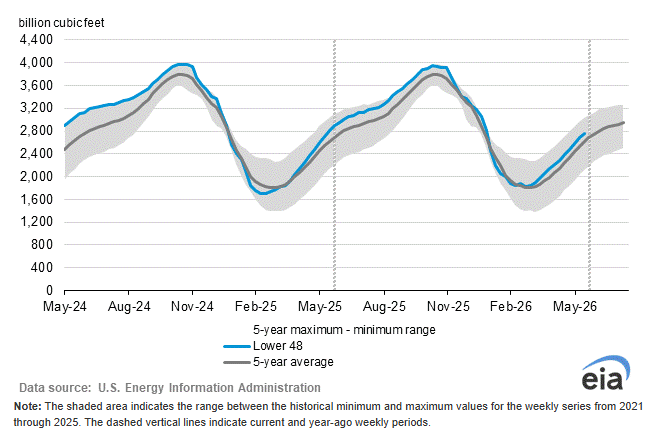
See all Natural Gas forecastsWorking gas stands at 2,759 Bcf, still 151 Bcf above the five-year average but now 29 Bcf below last year’s level. A few months ago the year-over-year surplus was the reason this market could not rally. That advantage has been shrinking with every report and the 73 Bcf print accelerated the trend.
The East and South Central regions are both below year-ago levels already. Those are the regions that matter most when summer heat builds because they feed the population centers with the highest cooling demand. A storage surplus that is shrinking every week at the front end of summer with LNG pulling nearly 20 Bcf a day out of the domestic supply does not support the bearish thesis anymore. It challenges it.
If injections keep coming in below last year’s pace through July and August, the surplus above the five-year average can disappear fast. The market is not trading where storage is today. It is trading where storage will be at the end of October and that number is getting smaller with every report.
LNG at 19.2 Bcf and Europe Needs the Gas
LNG feedgas flows reached approximately 19.2 Bcf per day this week and that demand is not seasonal. It is structural. Every Bcf that goes to an export terminal is a Bcf that does not go into storage and at nearly 20 Bcf a day the impact on domestic balances is substantial even with production running at 111.4 Bcf per day.
Europe entered summer with storage roughly 45% full against a five-year seasonal average near 60%. That shortfall keeps U.S. export demand strong through the summer.
The bears keep pointing to 111.4 Bcf per day of production as the reason this market cannot sustain a rally. That number is real. But 19.2 Bcf per day leaving the country is also real and the net balance is what matters. Production minus LNG exports leaves a smaller domestic supply pool than the headline number suggests.
Summer Heat Has Not Arrived Yet and the Base Is Already Built
Weather demand through June 24 is expected to be light to moderate with cooler systems crossing the northern United States and hotter conditions across the South and West. That is not the setup that drives a breakout. But Vaisala is forecasting above-normal temperatures across much of the Lower 48 between June 28 and July 2 and that is when the demand picture starts to change.
The higher bottoms all formed before the worst of summer demand. Buyers have been building this base on relatively mild weather. Verified heat is the catalyst this base has been building toward.
Hedge Funds Are Betting Against the Buyers
Hedge funds added to their bearish bet again this week. The net-short position in natural gas is above 34,000 contracts now, the most aggressive short exposure in more than two years. Meanwhile the market has not broken below its April 30 low once. Four higher bottoms and the largest short position in two years on opposite sides of the same trade.
Short positions of that size become fuel when sentiment shifts. A couple of below-consensus storage prints paired with verified heat forecasts and this short-covering rally does not stop. The exit for the net-short contracts is narrow and the buying that comes from forced covering is the kind of volume that triggers the acceleration into the 200-day moving average.
What to Watch
Storage injections and weather forecasts are the two variables that determine whether the base-building phase ends and the breakout begins. The weekly storage print came in below consensus and below last year. Another below-consensus injection next week paired with verified heat forecasts and the supply-demand balance tilts further toward the bulls. LNG at 19.2 Bcf per day is pulling gas out of the country at a pace that offsets a significant portion of the production gains.
July natural gas is holding above the 50-day moving average at $3.120 and the progression of higher lows is intact. The trigger is $3.387 to $3.396 and a move through that zone on volume opens the 200-day at $3.586. The 34,000 net-short contracts are the accelerant. The storage trend and summer heat are the match.
More Information in our Economic Calendar.