
Contract Expiration Drove Friday’s Selloff, Not the Fundamentals
August natural gas settled at $3.279 Friday, down 1.6 cents or 0.49%. The expiring July contract took the real hit, falling 11.2 cents or 3.35% as traders closed positions ahead of expiration. That kind of selling looks dramatic on the tape but it is mechanical. Long liquidation into expiration increased the volume without changing the reasons the market rallied to a three-month high earlier in the week.
August is now the front-month contract and it finished on the strong side of the 50-day moving average. The pullback stayed above every support level that matters. The setup going into Monday is the same one that produced this week’s rally. It just got cheaper.

Daily August Natural Gas Technical Analysis
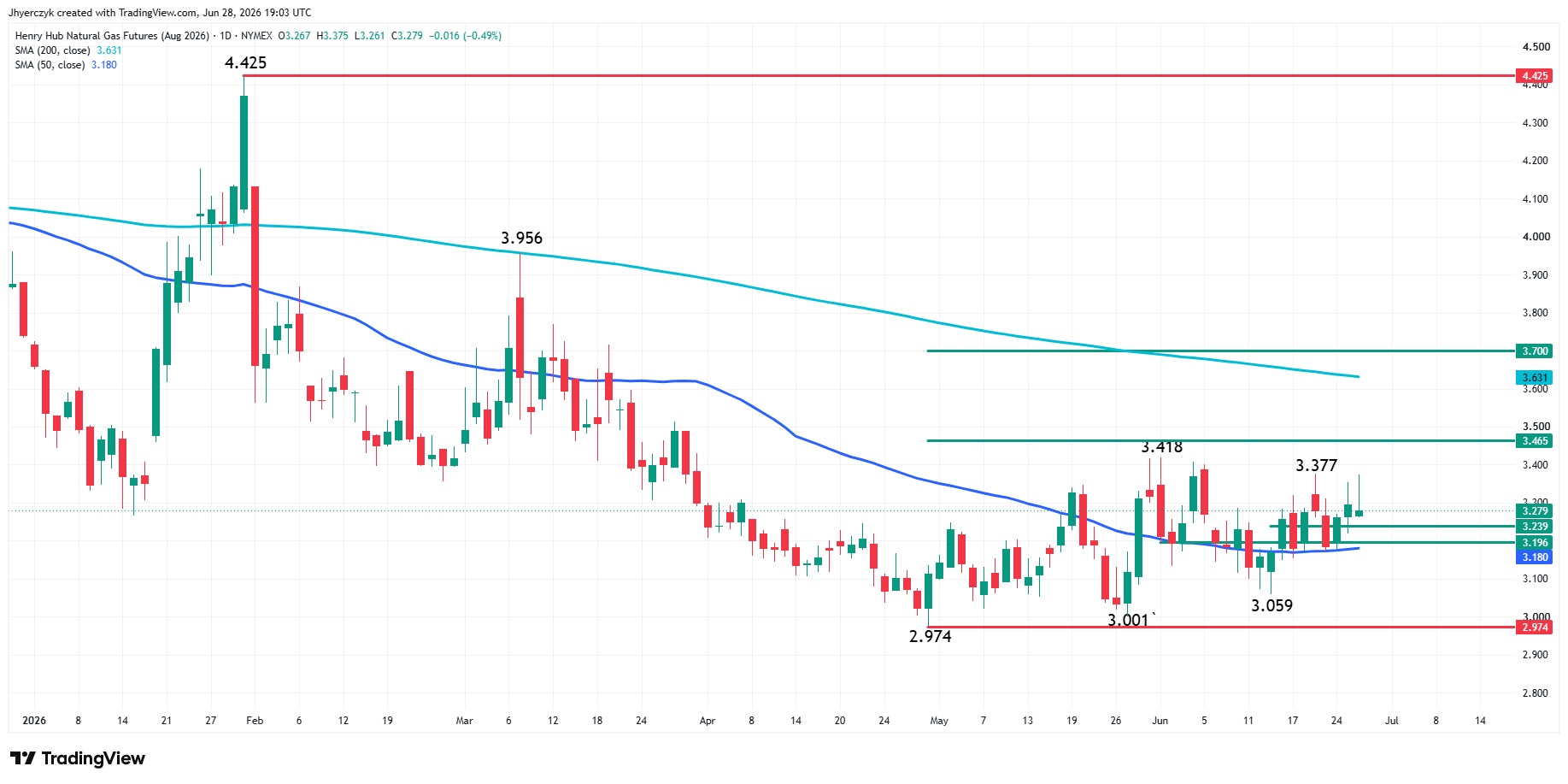
August natural gas is now the top-step futures contract. It closed Friday on a weak note, but held above a pair of 50% levels at $3.239 and $3.196, respectively. More importantly, it finished on the strong side of its 50-day moving average at $3.180. This is the indicator controlling the short-term direction of the market.
The set up is bullish, but without a major catalyst to shake out the shorts, it is likely to remain rangebound. Besides the 50-day moving average, it remains supported by swing bottoms at $3.059, $3.001 and $2.974. We could call them the LNG demand bottoms.
The two tops standing in the way of an upside breakout are $3.377 and $3.418. The 50% level at $3.465 is a potential trigger point for an upside breakout. However, unless the catalyst is a prolonged heat dome that lasts 7 to 10 days, fresh short-sellers are likely to re-emerge at the 200-day MA at $3.631 and the long-term 50% level at $3.700.
Sunday’s Heat Is the Catalyst This Market Has Been Waiting For
NatGasWeather expects moderate demand through Saturday before the pattern flips to high demand starting Sunday and lasting through next week. The eastern two-thirds of the country turns warm to hot with the Midwest and Northeast seeing above-average temperatures that push air conditioning load higher. The West and South are already running 80s, 90s and above 100 in parts of California, the Southwest and Texas.
Natural Gas Price Forecast
Every new Natural Gas analysis as it publishes, today's technical signal and key levels, live price — on one page.
See all Natural Gas forecastsThe timing matters. This heat is arriving as August takes over as the front-month contract with a fresh set of positions and no expiration pressure for a month. If the pattern holds into early July and power burn climbs on sustained above-normal temperatures, the weekly storage injections have to shrink. The market rallied to a three-month high this week on the forecast alone. Verified heat with actual demand prints behind it is a different trade entirely.
The Storage Build Was Bearish but the Trend Still Favors the Bulls
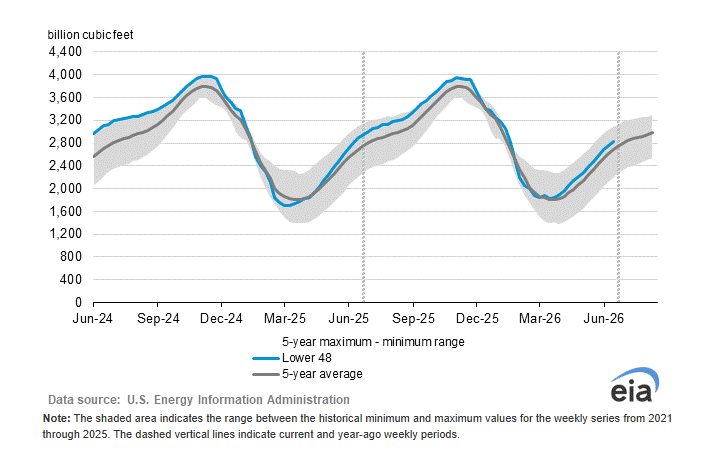
The EIA reported a 76 Bcf injection for the week ending June 19 against expectations near 69 Bcf. The five-year average for the period was 75 Bcf. Inventories sit 5.7% above the five-year seasonal average and 2.2% below last year.
The miss gave the bears a headline. The year-over-year comparison gives the bulls the trend. A year ago this market was oversupplied and that advantage has been narrowing with every report. If Sunday’s heat forecast verifies and demand jumps from current levels, next week’s injection could come in well below the five-year average and that surplus starts closing in a hurry.
Weekly Lower-48 power generation declined 2.17% from a year ago but the trailing 52-week average is still running 2.45% above last year. One cool week pulled the comparison down. The heat forecast for late June into early July should reverse that quickly.
Production Is Near Records and the Rig Count Just Ticked Higher
Lower-48 dry gas production reached 112.5 Bcf per day, up 4.7% from a year ago. Baker Hughes reported the rig count increased by three to 125. The EIA raised its 2026 production forecast to 111.0 Bcf per day. The supply side of this market is not tightening. The bears can point to those numbers and make a legitimate argument that production is running fast enough to absorb whatever demand the summer produces.
LNG feedgas deliveries at 19.1 Bcf per day, up 4.5% from the prior week, are working the other side. Domestic demand measured 71.2 Bcf per day, down 7.0% from last year. The production number looks overwhelming until you subtract what is leaving the country through export terminals every day. Net domestic supply after LNG exports is a smaller number than the headline suggests and it gets smaller every time feedgas flows climb.
Europe’s storage at 47% full against a 62% five-year average keeps the pull on U.S. cargoes strong through the summer. Qatar’s Ras Laffan damage and Strait of Hormuz disruptions are not resolved. U.S. export demand is structural and growing.
207,000 Net Short Contracts Are Sitting on a Bullish Setup
The Commitment of Traders report showed managed money holding 23,100 long contracts against 230,417 short contracts as of June 23. That is a net short position of more than 207,000 contracts. Money managers trimmed 3,332 longs and covered 3,085 shorts during the reporting week. The adjustments were small and the positioning remains overwhelmingly bearish.
207,000 contracts short on a market that held the 50-day moving average through a contract expiration selloff, rallied to a three-month high during the week, and is heading into verified summer heat. That is the kind of positioning that turns into fuel. A few below-consensus storage prints paired with sustained heat and the covering does not happen gradually. It accelerates through the resistance levels the technicals already mapped out.
The shorts need production to keep overwhelming demand and storage builds to stay above average every single week. One disruption to that pattern, whether it is a heat dome, an LNG export surge, or an injection miss, and the exit for 207,000 contracts gets very crowded very fast.
What to Watch
Sunday’s heat forecast is the near-term catalyst. If the pattern verifies and holds into early July, next week’s storage injection tells the market whether the demand is actually tightening balances or whether production is absorbing it. LNG feedgas at 19.1 Bcf per day keeps the structural demand story intact. Europe’s storage gap at 15 points below the seasonal average means that export pull is not fading.
August natural gas held the 50-day at $3.180 and the support at $3.239 and $3.196 through contract expiration selling. The resistance overhead at $3.377 and $3.418 is the first test. A move through $3.465 is the trigger for acceleration. 207,000 net short contracts are the accelerant and sustained heat is the match. The technicals call them the LNG demand bottoms for a reason. This market keeps finding buyers on every dip and the shorts are running out of time to be right before the hottest stretch of summer arrives.
More Information in our Economic Calendar.