



Storage Report Could Light the Fuse on a Massive Short Squeeze
July Nymex natural gas futures are trading at $3.156 early Thursday, up $0.011 or 0.35%, sitting right on top of the 50-day moving average at $3.116. The market has been building a base of higher lows since April 30 and the professionals have been accumulating. What they do not have yet is a catalyst. Today’s EIA Weekly Storage Report could be it.
Hedge funds are holding a net-short position of 34,059 contracts, the largest bearish bet in more than two years. That is a loaded spring. A storage number below 80 Bcf on a consensus estimate of 80 to 82 Bcf and this market does not walk higher. It runs. Two years of short exposure does not unwind in an orderly fashion.

Daily July Natural Gas Futures Technical Analysis
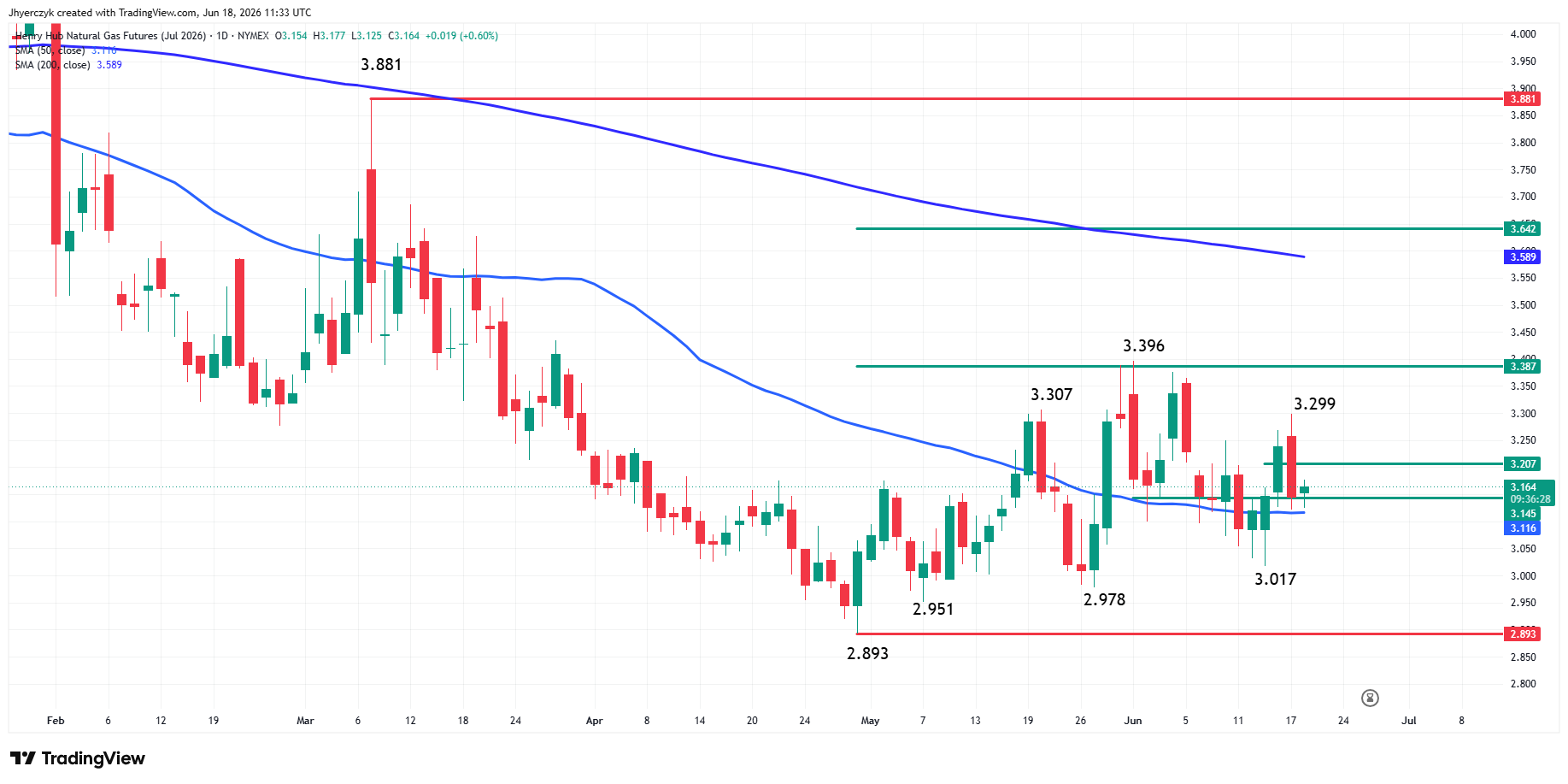
July natural gas futures are nearly flat early Thursday, ahead of the weekly storage report. The key indicator on the chart that most traders are watching is the 50-day moving average at $3.116. Trader reaction to the 50-day MA should set the tone today. This is the line in the sand and the storage report is the catalyst.
A sustained move over the 50-day MA will indicate the presence of buyers. Overtaking a pair of 50% levels at $3.145 and $3.207 will indicate the buying is getting stronger. However, potential headwinds at $3.299 and $3.396 still need to be overcome to fuel a breakout to the upside. The major target is the 200-day MA at $3.589 and a long-term pivot at $3.642.
On the downside, if the market sustains a move under the 50-day MA then prices could weaken, but I believe it’s a dangerous short. Since bottoming at $2.893 on April 30, buyers have stepped in on breaks to $2.951, $2.978 and $3.017. That’s a progression of higher bottoms, which suggests accumulation. I think that bullish traders have determined that $3.017 to $2.893 is a value area, but without a catalyst the rallies have been limited by renewed selling pressure.
Clearly, this market needs a bullish catalyst. The professionals seem to be positioned for a breakout to the upside. They just need bullish news and speculators to chase higher prices in order to fuel an acceleration over $3.396. Without it, the market will remain rangebound with bears selling rallies and bulls buying the dips.
Natural Gas Price Forecast
Every new Natural Gas analysis as it publishes, today's technical signal and key levels, live price — on one page.
See all Natural Gas forecastsThe Storage Number That Changes Everything
Consensus is calling for an 80 to 82 Bcf injection for the week ended June 12. Last week came in at 108 Bcf which blew past expectations and gave the bears their headline. The five-year average for this week is 73 Bcf. Working gas inventories are sitting approximately 6% above the seasonal five-year average.
On the surface that looks comfortable. But the market is not trading where storage is today. It is trading what happens to the surplus over the next 10 weeks. A print below 80 Bcf starts narrowing the gap against the five-year average and that is the first thing the short-covering crowd looks for. A number near 73 Bcf or below and the 34,059 net-short contracts become a problem for every fund holding them.
A print above 90 Bcf and the bears keep control. The surplus stays intact and rallies keep getting sold. But 90 Bcf requires weak demand and the demand picture is not cooperating.
LNG Is Pulling 19.5 Bcf a Day and Tropical Storm Arthur Is a Wild Card
LNG feedgas flows hit 19.5 Bcf per day Wednesday, up nearly 13% from the prior week. Export terminals are coming back from maintenance and the volumes are climbing at the worst possible time for anyone betting on storage builds staying fat.
Tropical Storm Arthur is the variable nobody has priced yet. A direct hit on Gulf Coast LNG facilities temporarily shuts down export demand and leaves more gas available for domestic storage. That is bearish in the short term. But the shutdown is temporary and the volumes come right back once operations resume, usually with a surge to make up for lost cargoes.
Global LNG fundamentals are working in favor of sustained U.S. export demand. The damage to Qatar’s Ras Laffan complex and ongoing disruptions to Middle Eastern energy flows have made U.S. cargoes more important to the global market. That pull on domestic supply is not going away even if Arthur slows it for a few days.
Production Is Strong but the Rig Count Says Something Different
Lower-48 dry gas production averaged 110.1 Bcf per day this week, up 2.2% from a year ago and sitting near record levels. The EIA raised its 2026 forecast to 111.0 Bcf per day. Strong associated gas from oil-directed drilling keeps adding molecules to the market whether gas prices justify it or not.
The rig count tells a different story. Baker Hughes reported active natural gas rigs fell by three last week to 121, the lowest in eight months. Production is still riding momentum from earlier drilling but the pipeline of new wells is shrinking. At some point the production curve flattens and if demand is still climbing from LNG and power burn when it does, the supply side of this market tightens in a hurry.
The bears point to 110.1 Bcf per day and call the supply argument settled. I would point to 121 rigs and call it a lag.
Weather Pulled the Rug on Wednesday but Summer Is Not Over
July natural gas settled Wednesday at $3.146, down 2.9% after giving back an early rally to a one-and-a-half-week high. The selloff came after Commodity Weather Group shifted its forecast cooler across the Midwest through June 26. That pulled expected power-sector gas consumption lower and gave sellers an excuse to push the market back to the 50-day moving average.
One forecast revision does not kill the summer heat thesis. June is not July and August. When sustained heat builds across the major population centers and air conditioning load runs for weeks instead of days, power burn becomes the demand story that overwhelms even 110 Bcf per day of production. Wednesday’s cooler revision took the urgency out of the near-term trade but did nothing to change the second-half-of-summer setup.
What to Watch
The EIA number hits this morning and 34,059 net-short contracts are waiting on it. A build below 80 Bcf on a consensus of 80 to 82 Bcf starts the squeeze conversation. A print near or below the five-year average of 73 Bcf and the short covering accelerates through the 50% levels at $3.145 and $3.207 with $3.396 as the breakout trigger toward the 200-day at $3.589.
A build above 90 Bcf keeps the surplus intact and the bears in control, but they are holding the largest short position in two years on top of a market that has built a floor of progressively higher lows since April. The 50-day moving average at $3.116 is the line. The storage report is the catalyst. And the short side of this market is crowded enough that the exit is going to be narrow if the data goes against them.
More Information in our Economic Calendar.


