


Natural Gas Reverses as Supply Comfort Caps Rally
Natural gas gave back everything Wednesday. Heat and Iran headlines drove an opening rally, but sellers took it apart by the afternoon and the contract settled right back where supply says it belongs. The August contract faded from a high of $3.355 to trade at $3.213, down 5.2 cents, or 1.59%.
87 Bcf Injection Killed the Buying Urgency
Last week, the EIA came in at 87 Bcf. Storage climbed to 2,922 Bcf, 175 Bcf above the five-year average heading into peak cooling season. I keep looking for a reason to get bullish on these weather pops and the storage picture keeps taking it away. Nobody chases a heat rally with that kind of surplus sitting in the ground, and Wednesday proved it again.
Production near 109 Bcf/day is working against the bulls from the other side. Output has slowed from its highs but not fast enough to make a dent in the overall balance. The supply side is more than adequate, and the combination of strong production feeding into above-average storage keeps putting a hard ceiling over every attempt to extend higher.
LNG feed gas at 18.1 Bcf/day during early July is the one thing keeping the bears from pressing harder. Export demand is pulling solid volume out of the domestic market and it has been the most consistent source of support all summer. That floor is real. But 18.1 Bcf against 109 Bcf of daily production and a comfortable storage surplus is not going to flip the balance on its own. The ceiling is just as real.
Later Model Runs Pulled the Rug on Longs
Heat got the market moving early. Widespread above-normal temperatures through the first half of July kept the opening bid alive, and power burn forecasts for the cooling season are still strong enough to prevent a deeper correction even with the bearish supply picture working against the contract.
Natural Gas Price Forecast
Every new Natural Gas analysis as it publishes, today's technical signal and key levels, live price — on one page.
See all Natural Gas forecastsWhat changed Wednesday was confidence in the duration. Later forecast updates cooled temperatures for portions of the eastern United States beyond mid-July. The adjustments were modest, but they landed at the worst possible time for longs already struggling to hold gains. Buyers stepped aside and profit-taking accelerated through the close.
The bigger problem for the bulls is that forecasts alone are not getting the job done anymore. Wednesday’s session made that clear. The heat was in the models, the rally was on, and it still collapsed. Confirmed power burn data showing actual demand drawing down that storage surplus is what this market needs before it pays up for weather again.
Iran Tensions Never Reached Henry Hub
Renewed U.S.-Iran uncertainty pushed crude higher and supported global LNG benchmarks Wednesday. Henry Hub didn’t flinch. Production near record levels, comfortable storage, and zero disruptions to export operations gave the domestic market every reason to wave off the international story. Until Strait of Hormuz uncertainty directly changes U.S. flows, it is not in the trade.
50-Day Moving Average Still Sets the Tone
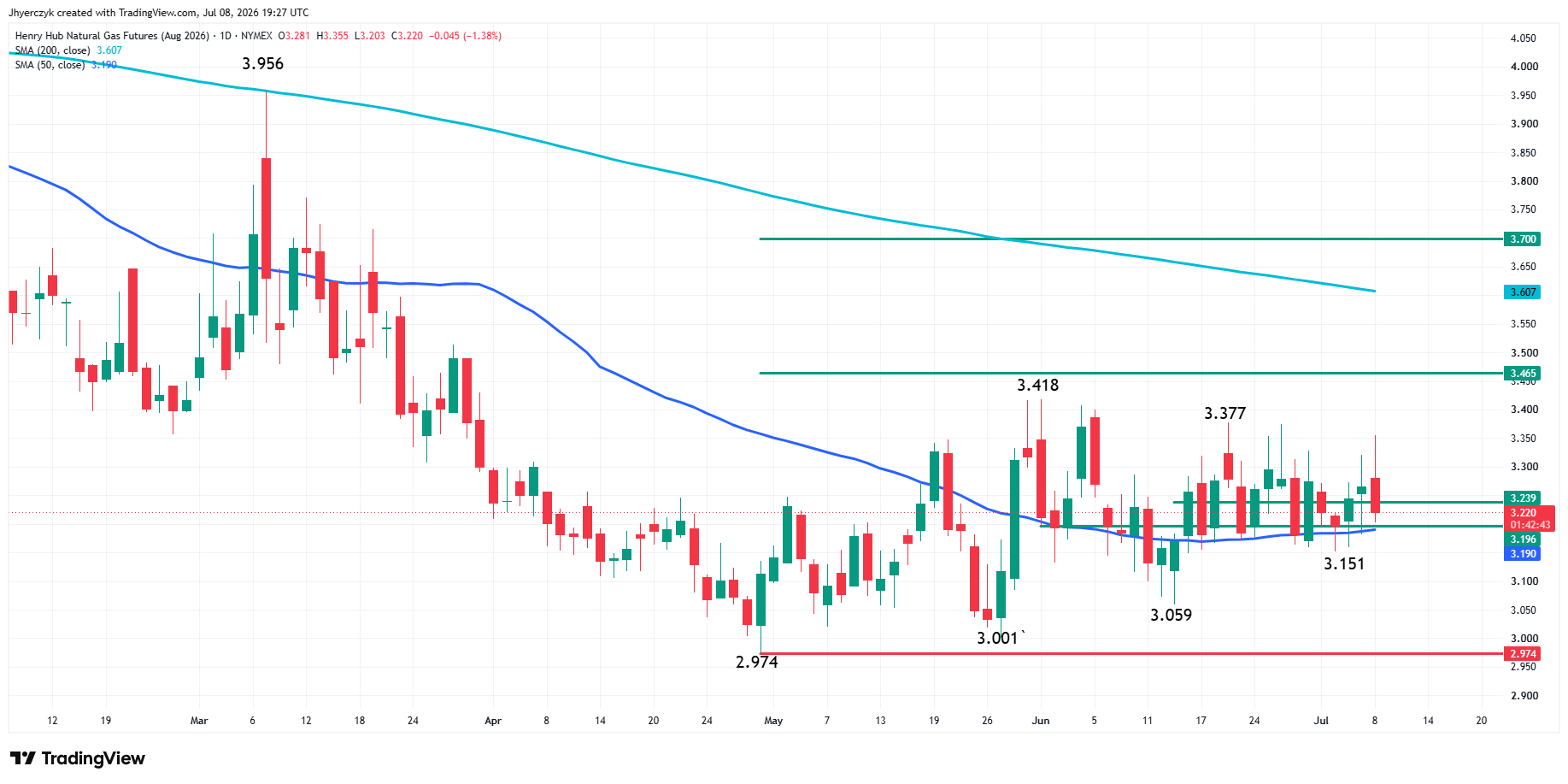
It’s been a volatile session in the August natural gas futures market from a technical perspective. However, it held its monthlong structure, which means traders are respecting the numbers and the key points. Essentially, LNG demand is providing support and the weather is giving us the volatility. If we ever get the “lingering” heat dome story to line up with strong LNG support base, we could get our breakout to the upside. Until then, consolidation and waiting will be the theme.
The consolidation on the strong side of the 50-day moving average at $3.190 is what I’m paying close attention to. As long as that remains intact, the breakout to the upside play remains in play. In addition to the potentially bullish setup formed by the 50-day MA, the market is also well-supported by the series of bottoms at $3.151, $3.059, $3.001 and $2.974.
Short-sellers continue to defend against an upside breakout with today’s high coming in at $3.355. The next two tops are $3.377 and $3.418. The barrier blocking the upside breakout into the 200-day moving average at $3.607 is the intermediate 50% level at $3.465.
Continue to monitor the price action and order flow around the 50-day MA. That sets the tone. Traders continue to buy against it in hopes of a weather rally. If it fails, I don’t think new speculative traders are going to short aggressively because it’s still July and things can turn around quickly. However, established shorts may press it lower. Additionally, the bullish LNG story makes the downside potential limited.
For retail traders, the play is still for the summer breakout rally to lift prices to the 200-day MA and maybe beyond, but all bullish cylinders have to be working at the same time. Also, keep in mind that summer rallies are different than winter rallies. The idea is to catch the breakout and play for the fast price spike, not to hang on forever.
What to Watch
The next EIA print decides whether this surplus keeps growing or starts to narrow. A build near last week’s 87 Bcf pace keeps buyers sidelined through the rest of July. A draw closer to seasonal norms, especially if power burn confirms the heat forecasts, forces shorts to reconsider how much room they have left. LNG feed gas near 18.1 Bcf/day is quietly tightening the domestic balance, and the real question is whether sustained export flows at that rate can close the 175 Bcf storage gap before fall injections slow down.
The 50-day moving average is the line. Holding above it keeps the summer breakout trade alive with the 200-day as the upside target. Losing it gives established shorts room to press, but the LNG floor limits how far they can take it in the middle of July.
More Information in our Economic Calendar.


