


July Natural Gas Slides on Cooler Forecasts
July Nymex natural gas fell 8.2 cents on Monday. Down 2.54%. Hit a one-week low. Weather killed last week’s rally. Cooler revisions in the 8-to-13-day forecast window gave sellers everything they needed. Production is still running near records. Storage is comfortable. The only thing holding this market up was heat. The forecast pulled it back and the floor moved with it.
At 07:00 GMT Tuesday, July Nymex natural gas was trading at $3.147. Unchanged in the pre-market.
Daily July Natural Gas Futures Technical Analysis
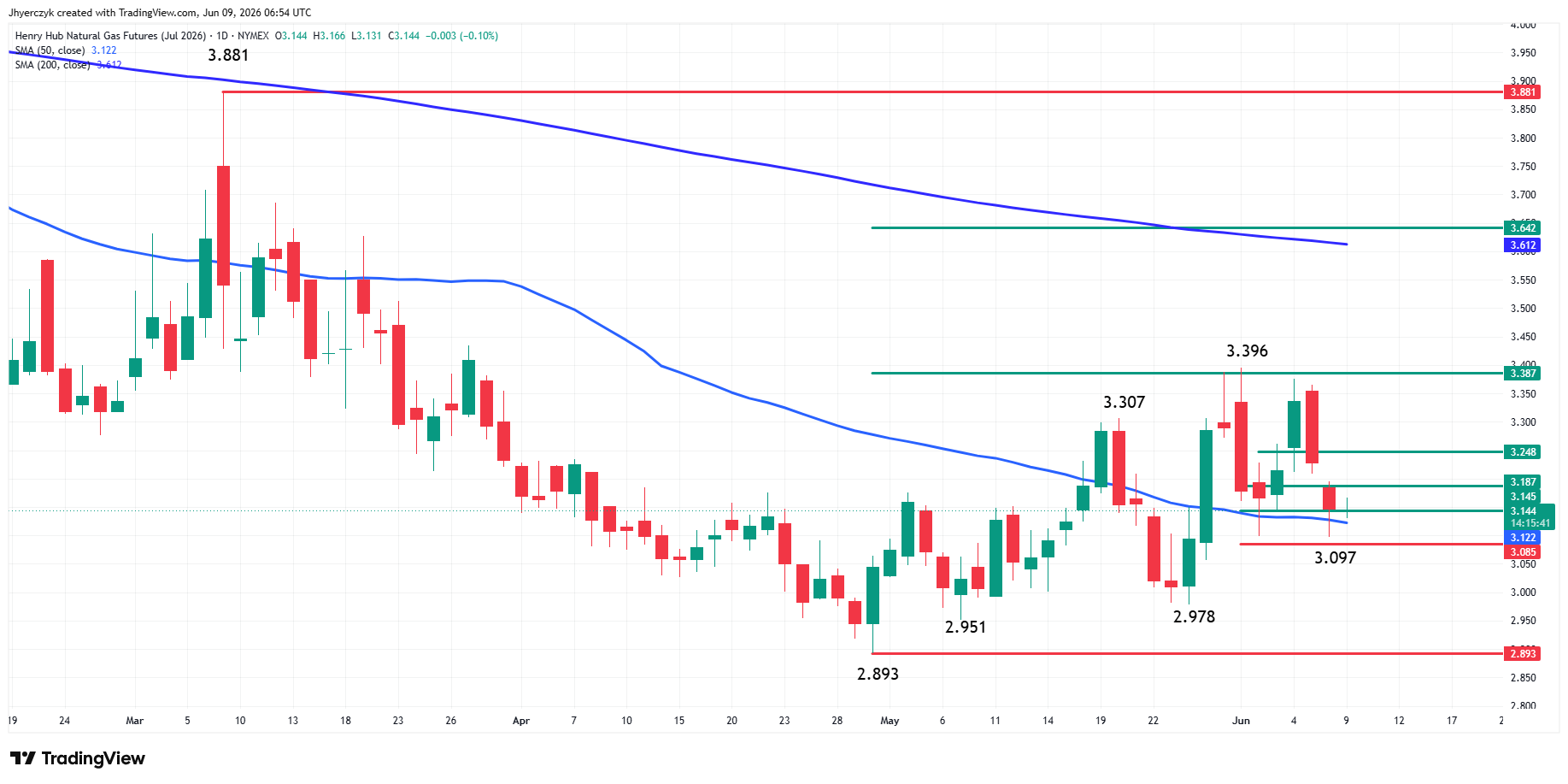
July natural gas futures are unchanged early in the session on Tuesday. Yesterday’s price action suggests traders are still showing respect for the 50-day moving average at $3.122.
The higher-top, higher-bottom chart pattern suggests there is still an upside bias, but the weakness in the minor trend is pressuring momentum. This type of set-up usually leads to a sideways trade. It will be sideways to higher if heat returns to the forecast, but sideways to lower if temperatures remain comfortable and supply rises.
As for today, trader reaction to the 50-day moving average at $3.122 sets the tone.
The swing chart has also created a support zone at $3.145 to $3.085. If the latter fails then look for support at $2.978, $2.951, and $2.893 to come into play. On the upside, pivot prices at $3.187 and $3.248 are potential headwinds but also trigger points for accelerations to the upside.
The major breakout price is $3.387. A sustained move over this level will put the 200-day moving average at $3.612 on the map.
Natural Gas Price Forecast
Every new Natural Gas analysis as it publishes, today's technical signal and key levels, live price — on one page.
See all Natural Gas forecastsThe Forecast Cooled Where It Counted Most
Vaisala revised the outlook Monday. Cooler temperatures across the eastern two-thirds of the country for June 13-17. The June 18-22 window lost heat too. Those are the exact weeks this market was leaning on for strong cooling demand. The bid disappeared the moment that revision hit.
This week is still hot. NatGasWeather has a ridge building across the southern, central, and eastern United States. Highs in the 80s and 90s for most of the country. The Southwest pushes into the 100s. Chicago and the Ohio Valley could touch the 90s by mid-week. That is real air conditioning load. The Edison Electric Institute backs it up. U.S. Lower-48 electricity output for the week ended May 30 climbed 6.4% from a year earlier to 81,619 GWh. Power demand is not the problem. The problem is that none of this week’s heat is a surprise. Traders already own it. They sold Monday because the weeks they did not own yet got cooler. The June 13-22 revision is the trade. Not this week’s thermometer.
Storage Build Came in Light but the Cushion Is Still There
The 95 bcf build for the week ended May 29 came in below what anybody expected. The Street had 99. The five-year average was 101. That is a bullish print on paper. The problem is what sits underneath it.
U.S. inventories are still 5.7% above the five-year seasonal average. Down just 0.8% year-over-year. Nobody is worried about running short domestically. The cushion is real. Europe does not have that luxury. European gas storage stood at 42% full as of June 6. Should be closer to 57% by now based on seasonal norms. Fifteen percentage points below where they need to be heading into summer restocking. That gap is why U.S. LNG cargoes keep moving at strong rates. Europe is buying everything it can get. Domestic storage tells one story. The European deficit tells the opposite one. Both are trading at the same time.
Ras Laffan Keeps the LNG Floor in Place
LNG feedgas demand is doing the work that weather is not. Estimated net flows to U.S. export terminals hit 17.6 bcf per day Monday. Up 4.0% from the prior week. Every barrel of gas that goes onto an LNG tanker is a barrel that does not sit in domestic storage. At 112 bcf per day of production that matters.
The global shortage is real. The Strait of Hormuz closure has choked off Middle Eastern natural gas exports. Europe and Asia are scrambling for replacement cargoes. Qatar reported extensive damage at Ras Laffan Industrial City on March 19. The world’s largest natural gas export plant. Iran’s attacks took out 17% of the facility’s LNG export capacity. Repairs could take three to five years. Ras Laffan handles roughly 20% of global LNG supply. That outage is not a headline anymore. It is a structural hole in the global market. U.S. exporters are filling it. That floor underneath July Nymex natural gas is not going away even on cooler domestic forecasts.
112.1 Bcf per Day Is a Heavy Number
Production keeps growing into a market that needs heat to absorb it. BNEF had Lower-48 dry gas output at 112.1 bcf per day Monday. Up 3.7% year-over-year. Near record territory. The Energy Information Administration made it worse. Raised the 2026 production forecast to 110.61 bcf per day from the April estimate of 109.60. The supply side is not cooperating with the bulls.
Baker Hughes reported one rig came off the count last week. Total active natural gas rigs dropped to 124 for the week ending June 5. Down from the 2.5-year high of 134 in late February. Still sitting well above the 94-rig low from September 2024. One rig does not change the supply picture. Output this heavy means every rally that is not driven by sustained heat runs out of room fast. Sellers know that. It is why follow-through on hot weather spikes has been short-lived all year.
What to Watch
Weather is the only variable that moves July Nymex natural gas this week. The current heat is priced. What matters is whether the cooler revisions for June 13-22 hold or reverse. Hotter revisions flip the bid back on fast. Cooler revisions keep sellers in control. Production at 112.1 bcf per day caps every rally that is not driven by sustained heat. The Ras Laffan outage and strong LNG flows give the market a floor underneath the selling. Last week’s light storage build helps but domestic inventories are still 5.7% above the five-year average. The cushion is there. Traders are watching the forecast models daily and trading every revision in real time.
My read on this is the 50-day moving average at $3.122 is the line. The market respected it Monday. Below $3.085 the selling picks up speed toward $2.978. Above $3.248 the bulls take the wheel and the conversation shifts toward the breakout level at $3.387. The 200-day moving average at $3.612 is the upside target if a sustained heat event takes hold. Until the June 13-22 forecast window settles, July Nymex natural gas trades sideways between the 50-day and the $3.248 pivot. The forecast models decide the direction. Not production. Not storage. The weather.
More Information in our Economic Calendar.


