Quiet Session Extends Consolidation
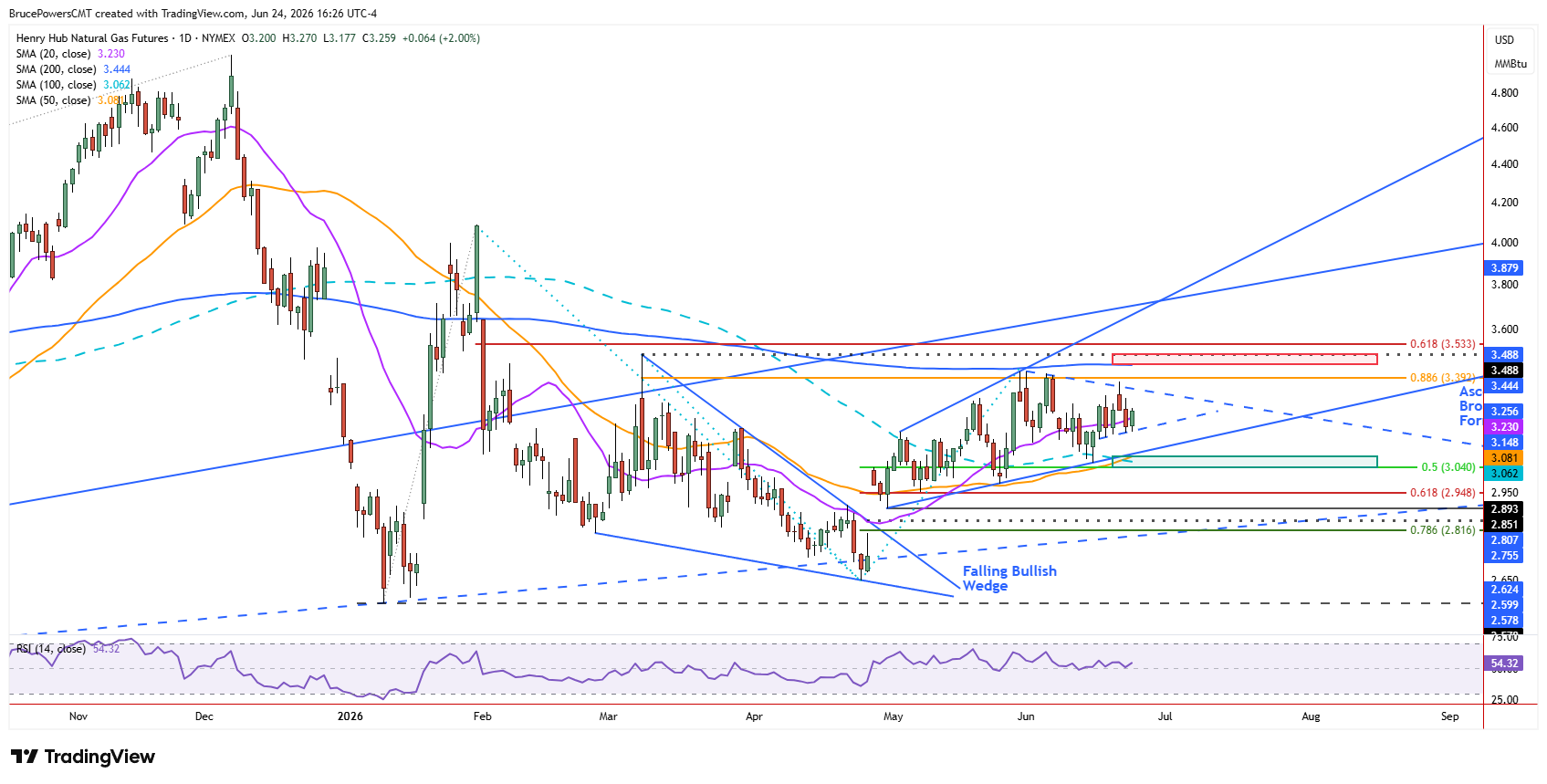
There was little change in natural gas prices on Wednesday, as the day’s range was contained within Tuesday’s trading range. This essentially extends a short-term consolidation range around the 20-day moving average as the process of price discovery continues.

Lower High Signals Pressure Toward Support
A rejection from a high of $3.38 on Monday produced a lower swing high and suggests that an eventual decline toward the lower trendline support and related dynamic support indicators may follow. There is a range of confluence from around $3.08 to $3.04, consisting of the 50-day moving average and the 50% Fibonacci retracement of the prior advance. Further reinforcing the support range is the 100-day moving average at $3.06 and the most recent higher swing low at $3.06, which is part of the bullish trend structure.
Key Short-Term Support Zone in Focus
Near-term support is at Tuesday’s low of $3.17, although recent daily price action has defined a broader support zone extending down to last Tuesday’s low of $3.15. That price zone is marked with a short trendline, which gives greater significance to the $3.15 level, as a drop below it would also trigger a trendline break.
Resistance Levels Define Breakout Threshold
Since an upside breakout of a short downtrend line was solidly rejected, further downside seems more likely than upside. Nonetheless, that could start to change quickly with a rally above Tuesday’s high of $3.31. If strength continues, the downtrend line may be challenged again and potentially lead to a break above Monday’s high of $3.38.
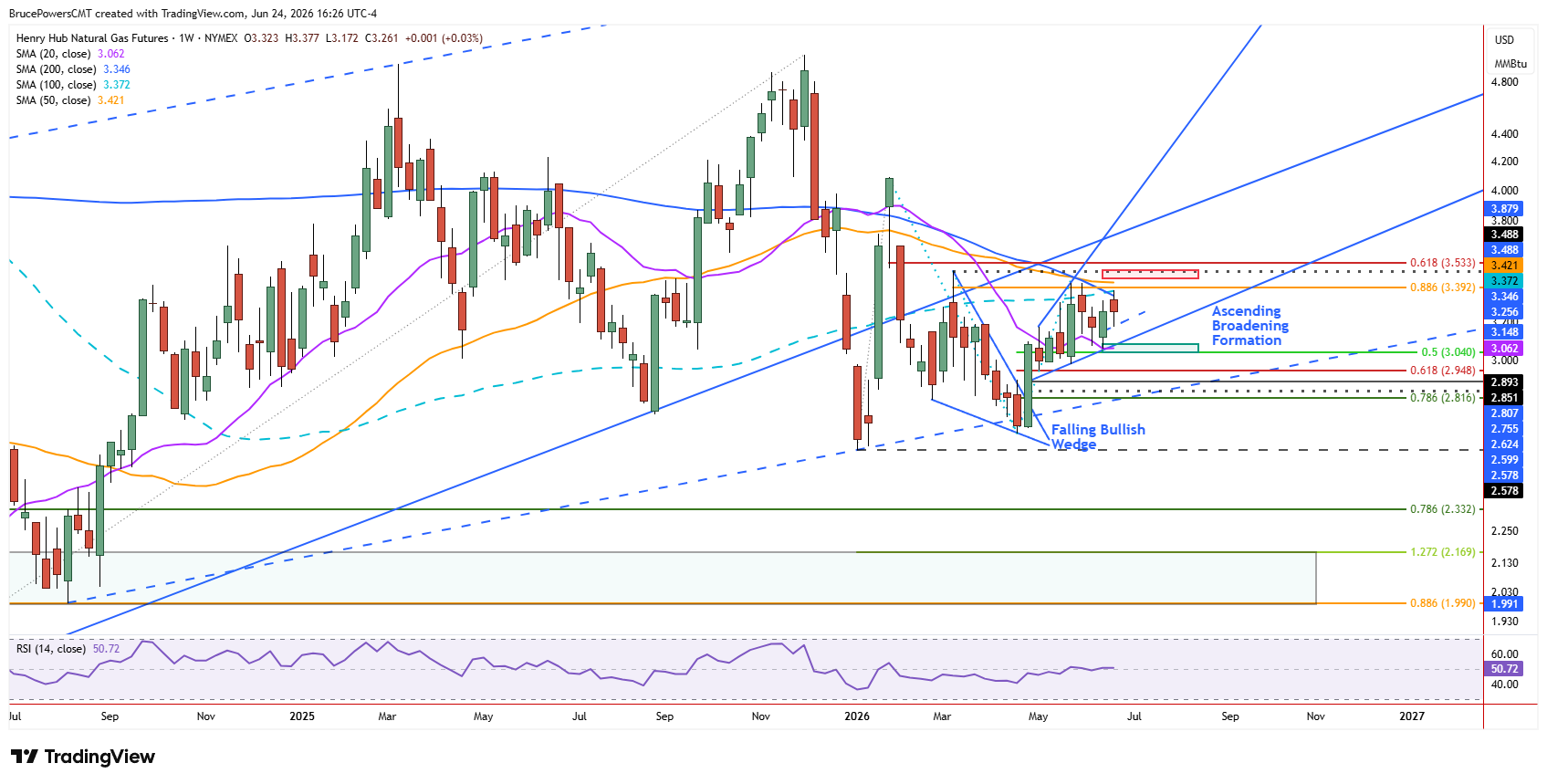
Nonetheless, potentially significant resistance remains near the recent high of $3.42 and up to the 200-day moving average resistance zone, now near $3.44.
Natural Gas Price Forecast
Every new Natural Gas analysis as it publishes, today's technical signal and key levels, live price — on one page.
See all Natural Gas forecastsBroadening Wedge Structure Near Completion Zone
During the advance that followed the April low, natural gas has formed an ascending broadening wedge. Since the boundaries of the pattern have not been violated, it may continue to develop and support higher price extensions in the near term. However, as this advance is occurring within a broader consolidation phase, an eventual test of the upper boundary would not necessarily imply continuation; rather, it would suggest that natural gas is approaching conditions consistent with a potential medium-term exhaustion zone.
If you’d like to know more about how to trade natural gas, please visit our educational area.