
WTI and Brent Search for a Floor as OPEC+ Meets
July West Texas Intermediate crude oil closed the week straddling $87.76 and Spot Brent crude oil broke below its minor bottom at $99.77. Both contracts are trying to build a base but neither one has confirmed it. The week ending June 5 comes down to two events. OPEC+ has to deliver a clean extension of its 2.2 million barrel per day voluntary cuts and the first real summer driving data has to show gasoline demand is actually picking up. One without the other leaves the floor unfinished.

OPEC+ Has Already Been Priced
Everybody expects the extension. That is exactly why it is dangerous. The 2.2 million barrels per day of voluntary cuts getting rolled into the second half of the year is already in the price. A clean decision with full compliance from every member tightens global supply heading into peak seasonal demand and July West Texas Intermediate crude oil and Spot Brent crude oil hold their bids. But a consensus trade only pays if the consensus is right. The market is not positioned for a surprise.
Members pushing to unwind cuts earlier or any visible disagreement inside the alliance would change the tone immediately. OPEC+ discipline has been the one constant holding supply off the market. Traders who smell a crack in that unity will not wait for confirmation. They will sell first and ask questions later.
Does the Driving Data Confirm?
Memorial Day started the clock on summer driving season. The first batch of government data will show whether gasoline consumption is matching the seasonal forecasts. Strong numbers would mean refiners keep running at elevated utilization rates and crude gets pulled from storage to meet real demand. That is the confirmation the bulls are waiting for.
The other side of that trade is uncomfortable. Fuel costs are high. If consumers are pulling back because the price at the pump is cutting into discretionary spending, the demand forecasts that have been built into the second half of the year start looking generous. Refiners do not keep running full when product is not moving.
Brent Oil Price Forecast
Every new Brent Oil analysis as it publishes, today's technical signal and key levels, live price — on one page.
See all Brent Oil forecastsCrude Draws Need Product Confirmation
A crude inventory decline means nothing by itself. Refiners have finished maintenance and they are running hard. Crude is getting processed. The question is whether the fuel coming out the other end is getting consumed or sitting in tanks. A crude draw paired with rising gasoline and distillate inventories means refiners are overproducing. That eventually compresses margins and forces crude purchase cutbacks. The only bullish inventory print is a crude draw with flat or declining product stocks.
Permian Keeps Producing
OPEC+ can hold barrels off the market but it cannot control what comes out of the Permian Basin. U.S. crude output is sitting near record levels. Well productivity improvements and better technology have kept production elevated even without adding rigs. Guyana and Brazil are ramping on top of that. Every non-OPEC barrel offsets part of the production cut and that is why cuts alone have not been enough to push prices meaningfully higher.
The West Texas Intermediate to Spot Brent crude oil spread is worth watching. A wider gap makes U.S. crude cheaper for international buyers and pulls more barrels out of domestic storage through exports. That helps the U.S. balance sheet but adds supply globally and leans on Brent.
Jobs Number Moves the Dollar
The U.S. Dollar Index is already doing damage to crude demand globally and Friday’s Non-Farm Payrolls report decides whether that pressure gets worse. Borrowing costs have been dragging on manufacturing and freight for months. Nobody is arguing that demand is collapsing but nobody is arguing it is growing either. That is the backdrop OPEC+ is cutting into. A hot jobs print locks in a restrictive Federal Reserve, firms up the U.S. Dollar Index further, and every barrel gets more expensive for every buyer outside the United States. OPEC+ could deliver a perfect extension and the dollar alone would cap the upside.
A soft payroll number or cooler wage growth would crack the rate story open. The Federal Reserve has had no reason to move and one weak employment print gives them one. That reprices the U.S. Dollar Index lower and takes the most persistent headwind off crude since the start of May.
Weekly July WTI Crude Oil Futures Technical Analysis
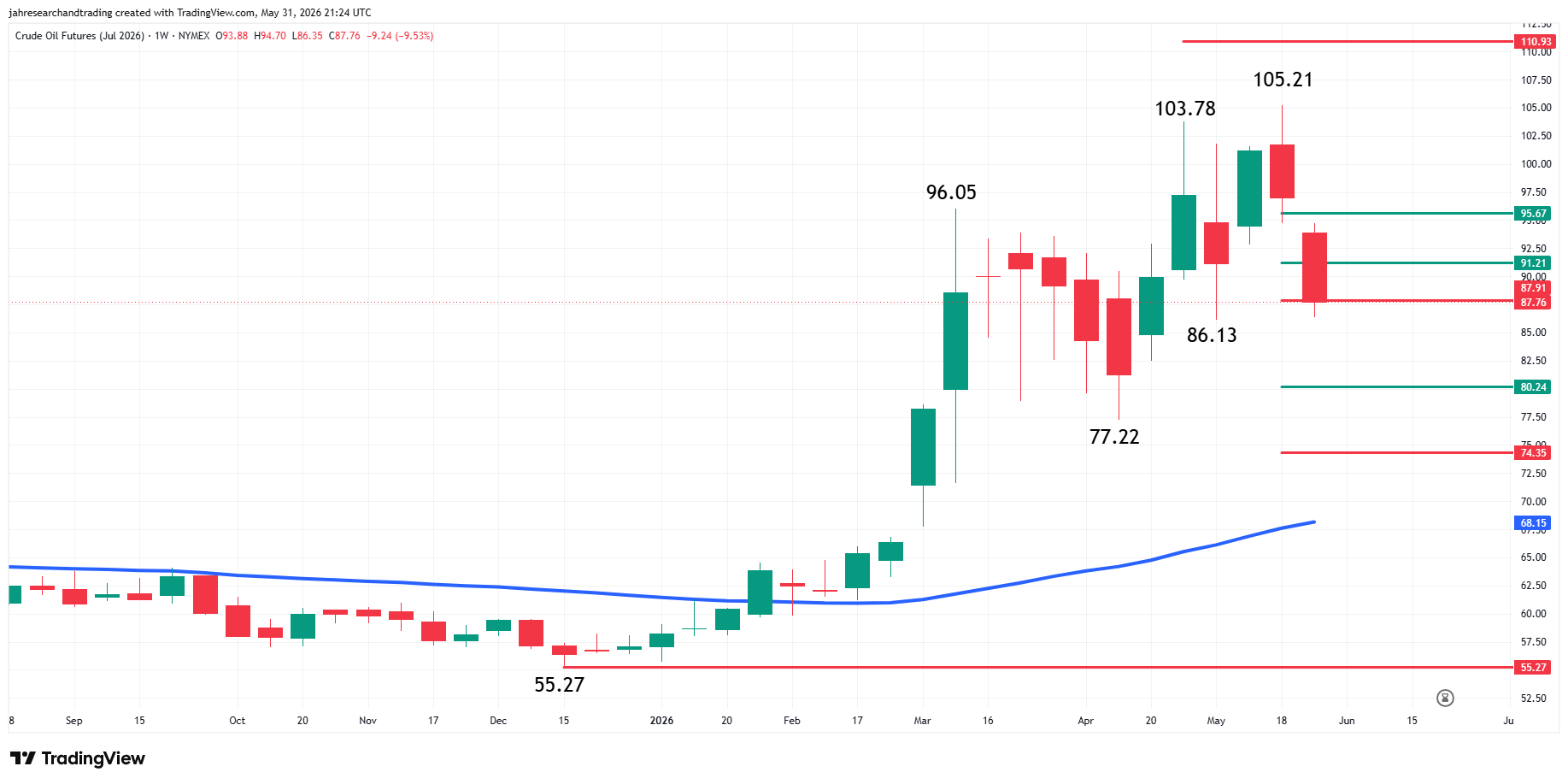
July WTI crude oil futures are still in an uptrend on both the minor and major swing chart charts, but the weak close should have it facing early downside pressure this week.
The first downside target is the minor swing bottom at $86.13. Taking out this level will shift momentum to the downside. The second downside target is the main swing bottom at $77.22. A trade through this level will change the main trend to down and shift the market into “sell the rally” mode.
The market closed the week straddling a pivot at $87.76. Holding this area could trigger rebounds into $91.21 and $95.67, where traders could face selling pressure. Overcoming $95.67 could trigger an upside breakout, while putting $105.21 back on the radar.
A sustained move under $87.76 will indicate the presence of sellers. If this weakness gains traction, then we can anticipate a potential dump into $80.24 to $74.35. Buyers could step in on the first test of this area since they will likely be defending the 52-week moving average at $68.15.
The chart indicates the tone of the market this week will likely be determined by trader reaction to $87.76.
A sustained move over $87.76 will indicate the return of buyers, but a rally won’t be easy with potential targets $91.21 and $95.67. Overcoming, the latter will be the key to extending the rally.
A sustained move under $87.76 will signal that sellers are still in control. And depending on the headlines, they could try to take out $86.13 early in order to set up a flush to $80.24 to $74.35 later in the week.
Looking at the long-run, traders appear to be positioned to wipe out all the weak longs from $77.22 to $68.15 before value buyers return to fuel a strong rebound rally.
Weekly Spot Brent Crude Oil Technical Analysis
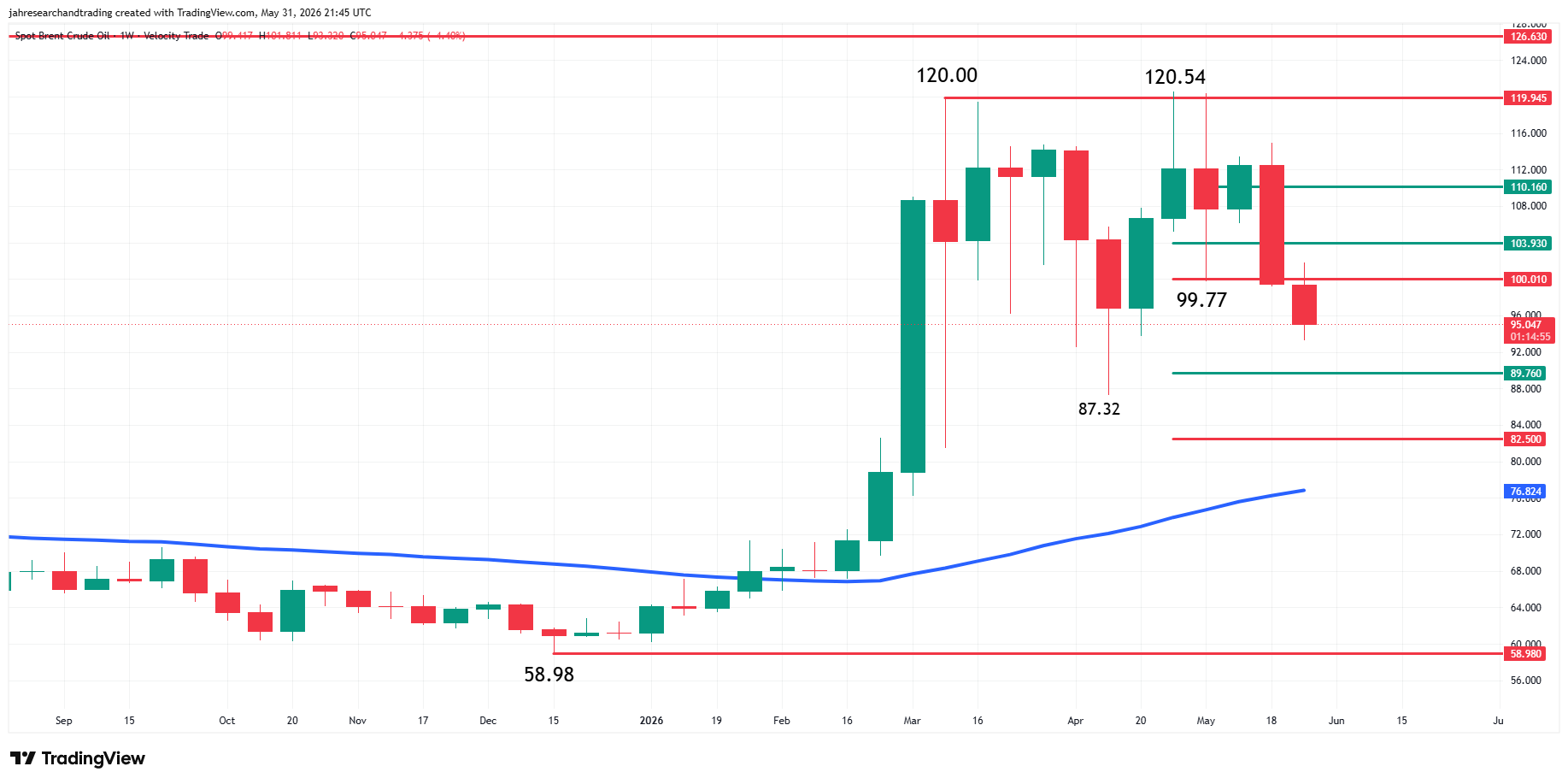
Spot Brent crude oil closed in a weak position last week after taking out the minor bottom at $99.77. This shifted momentum to the downside. The next downside target is $87.32. A trade through this bottom will change the main trend to down. On the upside, strong resistance remains $120.00.
With the weak close, any attempt to rally is going to be labored since the market is facing potential resistance at $100.01, $103.93 and $110.16. With the minor trend down, we’re likely in sell the rally mode unless buyers can overtake $110.16 convincingly.
On the downside, the first major area to watch for the return of buyers is the long-term retracement zone at $89.76 to $82.50. The main bottom at $87.32 also falls inside this zone, making it a key value area. Buyers are likely to come in on a test of this area in an effort to defend the long-term 52-week moving average at $76.82.
Weekly Outlook
OPEC+ and driving season data are the two gates this week. A unified extension of the 2.2 million barrel per day cuts combined with strong gasoline consumption numbers would tighten the supply picture heading into June and give crude buyers a reason to hold. If OPEC+ cracks or the demand data disappoints, selling pressure builds quickly. The Non-Farm Payrolls report on Friday adds another variable. A strong dollar on top of weak demand confirmation would accelerate the downside.
July West Texas Intermediate crude oil lives and dies at $87.76 this week. Holding it keeps $91.21 and $95.67 in play. Losing it opens the flush toward $80.24 to $74.35 where value buyers will be watching the 52-week moving average at $68.15.
Spot Brent crude oil already broke its minor bottom at $99.77 and momentum has shifted to the downside. Rallies face resistance at $100.01, $103.93, and $110.16. The value zone on Brent sits at $89.76 to $82.50 and sellers will be looking to test it if the headlines cooperate.
If you’d like to know more about how to trade crude oil, please visit our educational area.