



The death of Iran’s Supreme Leader and the declared closure of the Strait of Hormuz mark the most serious energy disruption since 1979. While OPEC+ raised output by 206,000 bpd, the increase falls well short of offsetting potential transit risk if Hormuz flows remain impaired. The oil market has entered full price discovery mode, with freight, insurance and geopolitical escalation now driving front-end volatility.
Structurally, the market was already tight in non-sanctioned “mainstream” barrels, as sanctions and trade pressure shifted demand away from Iranian, Russian and Venezuelan crude. China’s reserve policy and Iran’s succession process now sit at the center of the duration question.
Updated Status (as of Monday, March 2 — midday GMT)
- Iranian state media has confirmed the death of Supreme Leader Ayatollah Ali Khamenei following coordinated U.S.–Israeli strikes.
- The Strait of Hormuz remains effectively closed to commercial navigation amid risk avoidance and war-risk insurance withdrawals, with shipping data showing a sharp decline in tanker traffic as carriers anchor rather than transit.
- Major tanker operators and trading houses have suspended crude, fuel, and LNG transits through the Gulf chokepoint, and insurers such as Gard, Skuld and MS&AD have pulled coverage for Gulf waters effective March 5.
- Oil prices have surged, with Brent briefly above $80/barrel and prices widely seen as headed toward triple digits if flows remain impaired.
- UAE stock markets and regional exchanges have halted trading, reflecting broader financial spillovers from the conflict.
- Fresh Iranian missile and drone strikes have hit U.S., Israeli and Gulf-aligned targets, with multiple vessels struck or damaged, and casualties reported among merchant crews.
- Diplomatic negotiations have collapsed and an IAEA crisis session is underway as formal talks have been cancelled.
- OPEC+ has formally approved a 206,000 bpd output increase for April but it is widely viewed as insufficient against transit risk; earlier market chatter of 411–548 kb/d did not materialise.
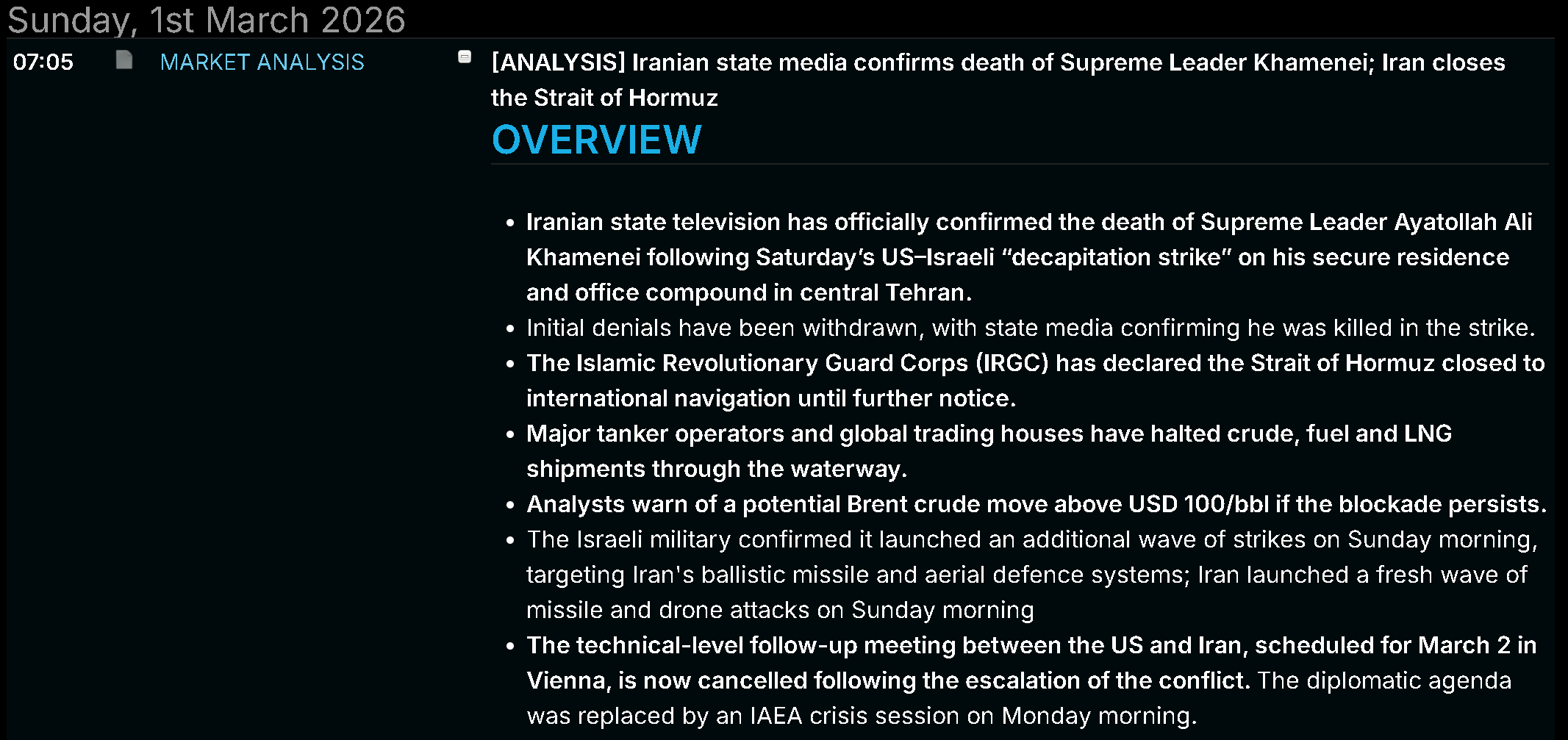
Figure 1. Newsquawk market analysis overview summarizing Khamenei’s death, the Strait of Hormuz closure, shipping disruption, and upside Brent risk. Source: Newsquawk.com
Situational Awareness
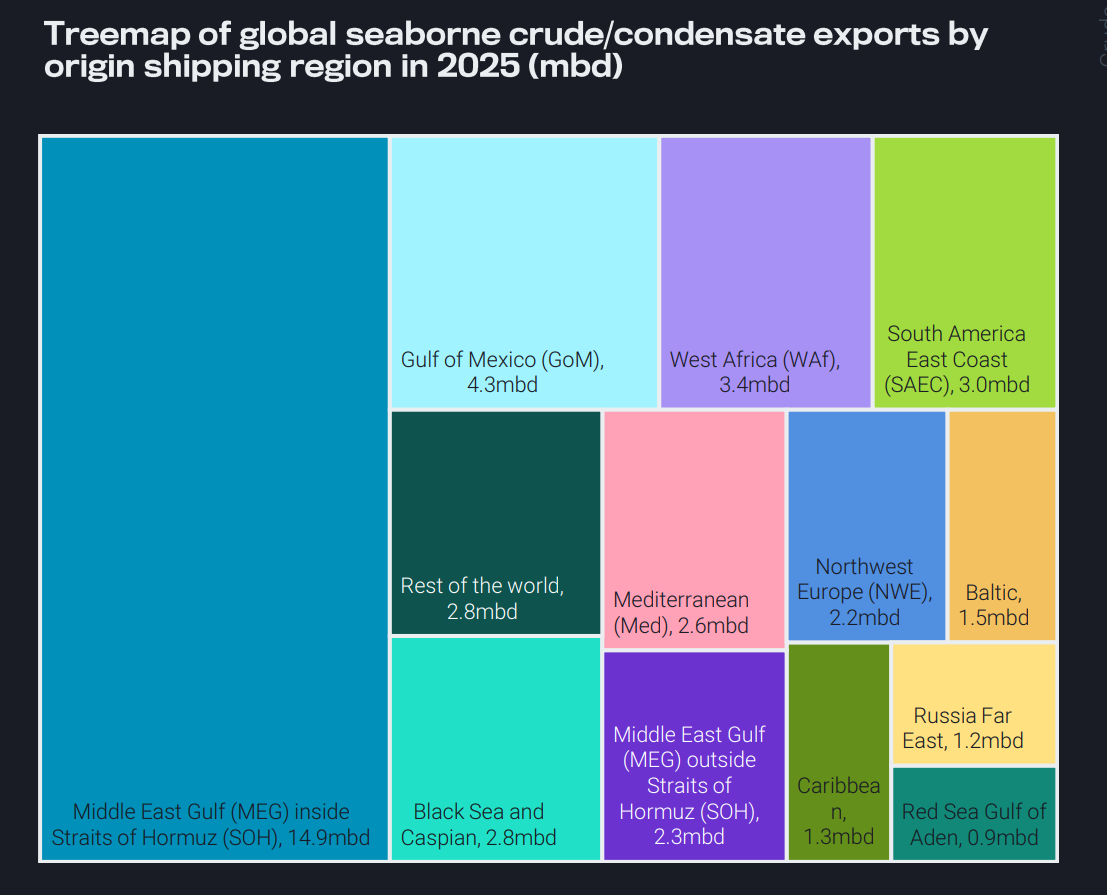
This is now a live transit disruption scenario. The Strait of Hormuz has reportedly been declared closed by the IRGC, major tanker operators have halted sailings, and OPEC+ hiked above its planned 137k bpd to 206k bpd. That buffer is politically significant but mechanically insufficient if Hormuz remains shut. This is no longer a 1–2 mb/d export risk — it is an 18–20 mb/d transit choke.
Brent Oil Price Forecast
Every new Brent Oil analysis as it publishes, today's technical signal and key levels, live price — on one page.
See all Brent Oil forecastsFigure 2. Treemap of seaborne crude and condensate exports by origin region, highlighting the scale of Middle East flows moving through the Strait of Hormuz. Source: Vortexa monthly crude report
The Market Will Open in Full Price Discovery Mode
This is an extremely dynamic situation that currently pivots on who will replace The now confirmed dead Supreme Leader Ayatollah Khamenei- (covered in a supplemental report here). This has tipped the geopolitical risk framework into a regime-risk valuation, which is forcing producers to reconsider output strategy. OPEC are convening today-more below -as was previously scheduled (Sunday 1st March). What matters now isn’t just short-term risk premium- it’s whether sustained flows and spare capacity deployment can offset elevated freight cost, potential transit instability, and policy shifts.
Below, I will cover where the market currently sits on each of these components.
Prior Structural Backdrop
Going into 2026, the consensus oil balance was soft. Inventory builds were projected, and many analysts expected a modest surplus in 2026. OPEC+ had embarked on phasing out previous voluntary reductions, with planned modest monthly hikes of 137,000 bpd and expectations of a gradual unwind. There was a meeting scheduled anyway for today March 1st 11am, where they were expected to hike again 137k bpd. Ahead of the meeting, there was talk of them doing up to 538k bpd. The actual has become 206k bpd. This will in no way be enough, but does give the group room to do a lot more if and when needed. OPEC hands are tied however.
Saudi Arabia and UAE exports largely transit Hormuz. Spare capacity does not equal deliverable capacity if the route is blocked. Even a 25% blockage is a deficit of 5mpb.
There are limited bypass pipelines:
- East–West Saudi pipeline capacity helps 5mbpd
- UAE Fujairah outlet provides some relief. Storage cap 70mb. Transit cap 1.5mbpd.
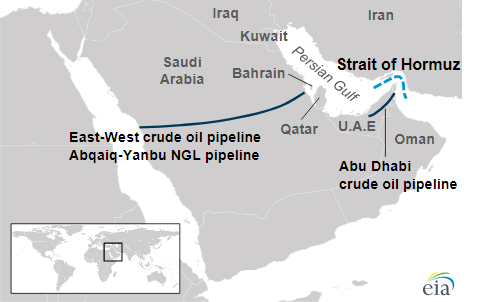
Figure 3. Map of the Strait of Hormuz and alternative export routes, including the East-West Saudi pipeline and the Abu Dhabi crude oil pipeline. Source: U.S. EIA
Oil exports HAVE been rising into this conflict and Iran, Saudi, UAE and Brazil have all been ramping up recently.
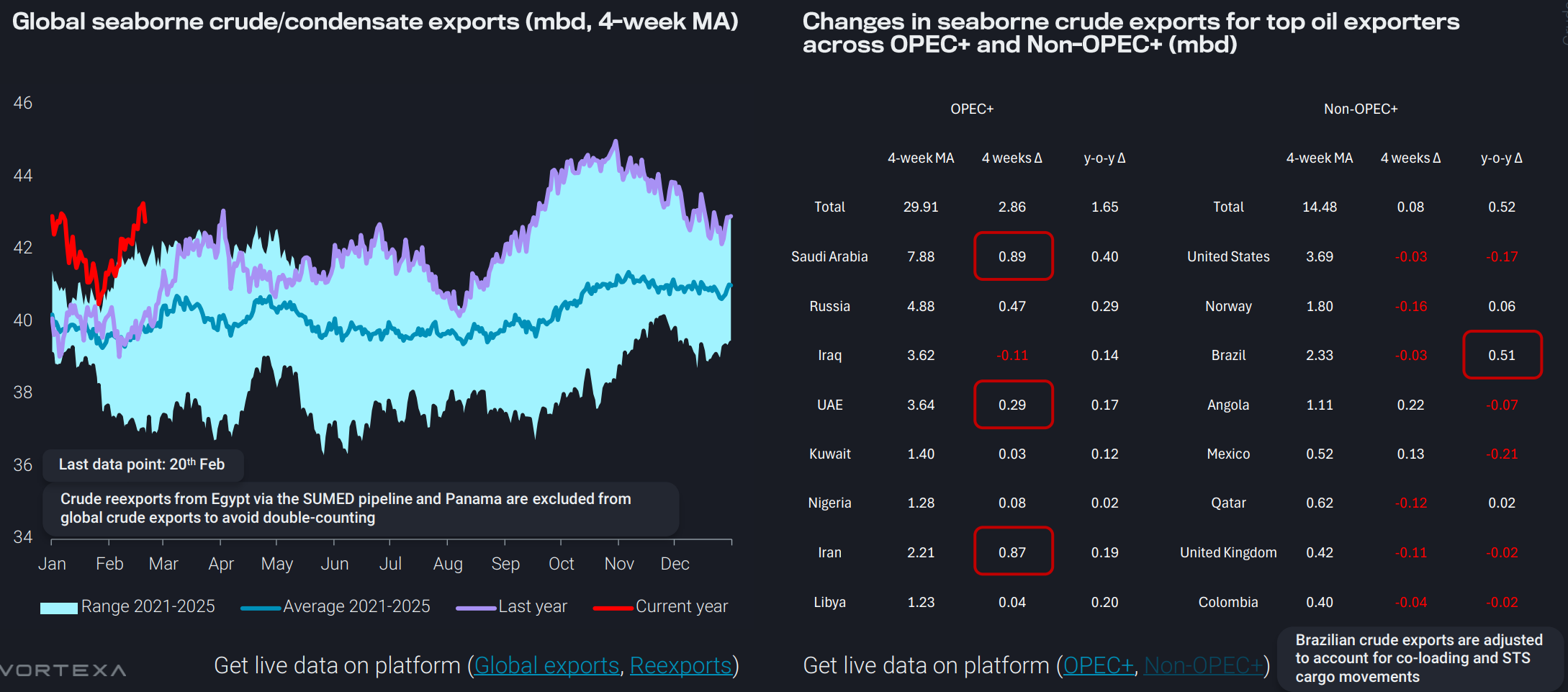
Figure 4. Global seaborne crude and condensate exports and recent changes among major OPEC+ and non-OPEC+ exporters. Source: Vortexa monthly crude report, Feb. 2025
Sanctioned vs. Non-Sanctioned Oil
Hopefully through this report, I have been able to highlight the truth of ‘The Glut’, with the Glut being sanctioned barrels only. The global market place, China, India, Europe have over the past 6 months come to heal at Trumps threats and largely ceased buying sanctioned oil. This has therefore put a pressing demand on non-sanctioned ‘mainstream’ cargos. Example in my prior report ‘Tight n Risky’ Feb 9th 2025.
‘‘The signal some might take on as tightness of ‘mainstream’ oil last week, was Vitol and Total taking 17 of 20 tankers worth of Brent last week. This was the fastest pace of purchasing for them EVER RECORDED!’’- Tight n Risky report- Tim Duggan
China’s Role
China is the swing stabiliser in this crisis. It buys most Iranian crude, is heavily exposed to Hormuz transit, and holds meaningful strategic reserves, as covered in several prior Oil reports. If Beijing draws down on its stocks and pushes de-escalation, the oil spike compresses. If it panic-buys alternative barrels, ie. mainstream, then Brent holds above $120 for longer. Watch Chinese refinery runs, SPR behaviour, and diplomatic signalling. Beijing’s reaction will shape the duration of the shock and they have been preparing.
There is a situation however where I see they now take the bulk of sanctioned floating storage oil ie. The Glut.
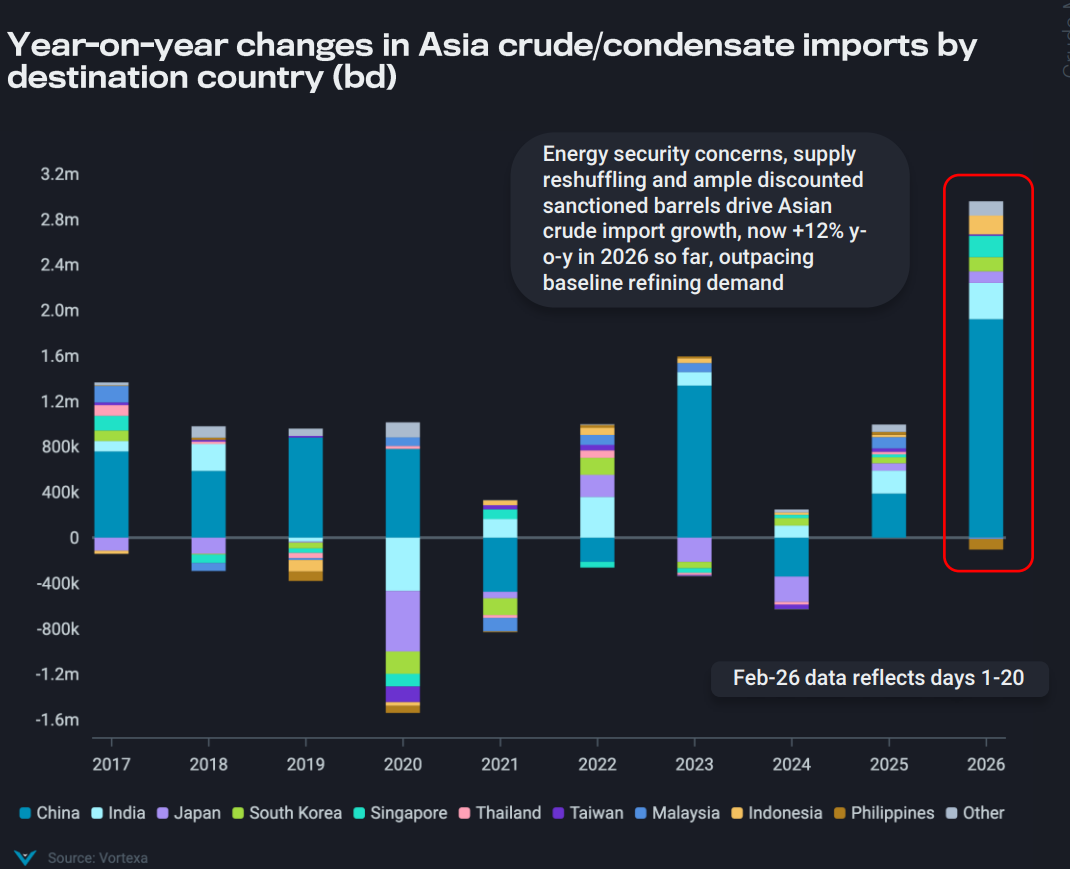
Figure 5. Year-over-year changes in Asia crude and condensate imports by destination country, illustrating where replacement demand could emerge if sanctioned supply disappears. Source: Vortexa
It is my view that China will drain the entire glut of unsanctioned oil currently floating. This will then allow the supply shock to be extremely softened. Couple this with a potential raising of OPEC production further and we could see a short extreme contango situation go into backwardation by October. From a trade perspective, scenario, this sets up incredible spread trading conditions for Q3, Q4.
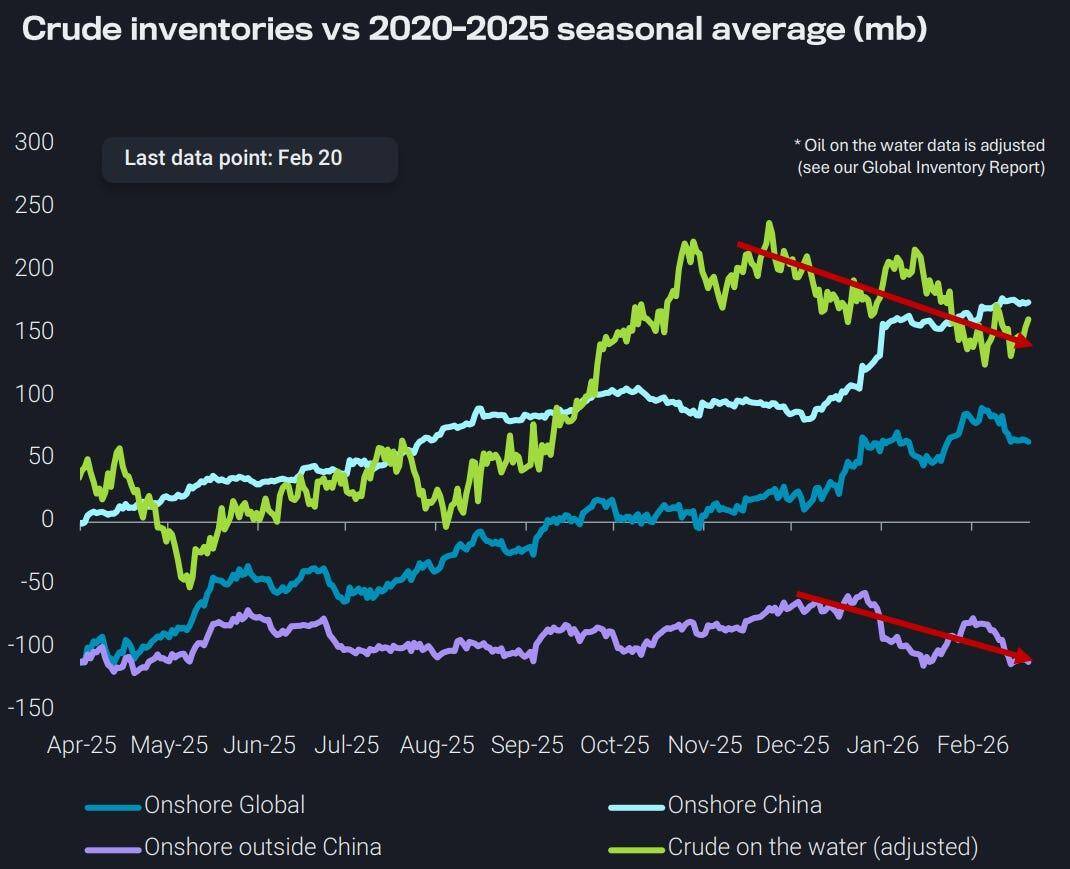
Figure 6. Crude inventories versus the 2020-2025 seasonal average, showing onshore builds, adjusted on-water stocks, and China crude on the water. Source: Vortexa
Succession: The Internal Power Question
Under Article 111, an interim leadership council is active. The assembly of Experts must appoint a permanent Supreme Leader. I have broken the analysis of candidates out into a separate report here.
- Rapid institutional succession = escalation stabilises.
- Factional fragmentation = maritime leverage escalates.
Let’s see how this unfolds.
Military Escalation
Fresh missile waves have widened the perimeter of the war. Iranian sources claim 27 US bases were targeted; Israeli military assets have been struck; explosions have been reported in Doha, Dubai and Manama The worst-case scenario here is broader regional escalation that steps up outside focused attacks on US regional bases. This would serve as a catalyst for Brent to potentially hit $150 over the next 10 trading sessions. The US MUST contain this.
What is no broadly covered are two elements.
An Overview of Current U.S. Hypersonic Missile Developments
1 The US currently does not have hypersonic missile capability. The only hypersonic capability they have are with the longer range nuclear missiles that only achieve high mach speeds on atmospheric re-entry (mach 23), like the Minuteman series or Titan. These are the biggest of big boy deployment missiles. They also do not have glide adjustment vehicles ie. steering wile in mid air. They are literally like a stone you throw and hit a target.
On the other side, Iran does have hypersonic missile capability. These missiles far out match any Iron dome missile defence systems-moving at Mach 3+ ie. 2300mph or 3300 feet per second like the new CM302. If any of these weapons are directed at US warships, it is game over-there are currently no onboard systems on US carries that can deploy suitable defence to these missiles.
Missile economics.
Sustained War With Iran Could Drain U.S. Missile Stockpiles
The US can escalate fast, but sustaining a long war is another question. Tomahawks cost roughly $1–2 million each and production runs in the hundreds per year, not thousands. High-tempo operations burn through precision munitions in weeks, not months, while a carrier strike group can cost $6–8 million per day to operate. Stockpiles, procurement lead times and budget optics all argue against an open-ended campaign. Washington can shock; it is less well positioned to grind.
My Base Case Scenario
This is a short, violent disruption. The US naval pressure reopens the passage within days. Brent spikes above $100, then consolidates in $80-90 range. China starts to draw on reserves.
The tail risk for me is in insurance. If commercial insurance collapses for a week or more, Brent tests $130+ rapidly. Structural reset only occurs if flows remain materially constrained beyond two weeks.
See main report published tomorrow morning for updated trade charts and C.O.T analysis.
As a short guide to price action, here is what I see on front prices happening. From a Kplr call Sunday at 2pm GMT, there are re-open estimates for Brent to hit $85 to $90 Approx a +20% reopen. This puts WTI at $80. Based on 12 day war risk, this has to be considered as entirely different. This situation is fully now hot from both sides. I see we can hit at least $85 on Monday. There is a lot of conversation from the Kplr call that this was already largely priced in.
The question on my desk is to be, where do we see it make sense to re-enter longs. The way this plays through the week will tell.
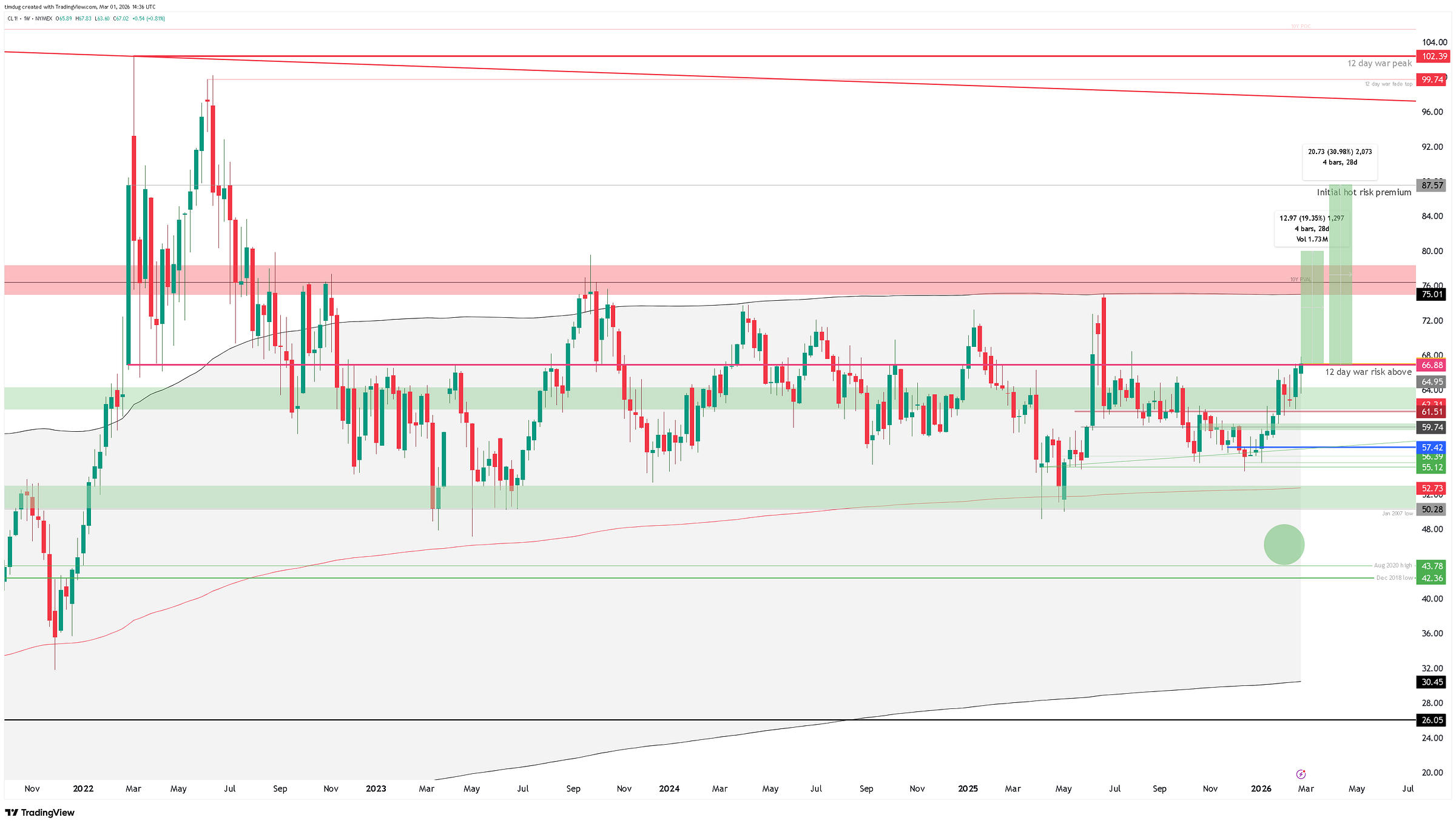
Figure 7. TradingView chart showing the WTI crude oil setup, key support zones, and upside targets under a renewed war-risk premium. Source: TradingView
Trading is waiting. Waiting is trading.


