
Oil prices rose again from their sharp decline in the prior trading session. The price movement was based on market reassessments of the potential for conflict in the Middle East with regard to the recent ceasefire. Brent oil (BCO) and WTI oil (CL) trade above $98.70 and $96.70, respectively and show strong volatility due to doubt on the sustainability of the ceasefire deal.
As the initial concerns surrounding the impact on global supply were alleviated by the agreement of a ceasefire. However continued attacks and logistical issues have contributed to caution among traders. This movement indicates that oil markets are vulnerable to geopolitical changes in the areas of major supply channels.

Oil Supply Risks Remain as Ceasefire Fails to Restore Flows
Oil prices have fallen recently based on expectations of the reopening of the Strait of Hormuz, an important waterway through which a large percentage of the world’s oil is transported. The prospect of a peaceful ceasefire allowing for safer and less interrupted transit could help alleviate some of the concerns related to the flow of supplies. But there is a lot of uncertainty as shipping companies are waiting for firm guarantees before resuming operations. Thus, there will be limited immediate return of supplies to world markets.
Iran has also introduced controlled navigation routes and safety measures. But risks remain elevated. I think that the security concerns, high insurance costs and operational constraints will limit oil supply flows in the near term. Therefore, while the ceasefire may hold on paper, actual increases in oil supply will not happen quickly which supports a higher price in the short term.
Middle East Tensions Keep Oil Prices Volatile and Uncertain
The ceasefire is experiencing increasing strain from the continuing conflict in the regions. The conflict between Israel and Lebanon demonstrates that many of these issues have yet to be resolved. As such, attacks on energy related infrastructure across the Middle East will create an additional layer of volatility. This continued uncertainty regarding the stability of the Middle East has created a fragile environment for oil pricing. Therefore, any increase in tension and subsequent disruptions to oil delivery routes can easily lead to increased prices.
On the other hand, when tensions ease and international shipping resumes, prices can come under pressure and break below $90. Currently, the price of oil is being influenced primarily by uncertainty surrounding the ceasefire and the safety of energy related infrastructure.
Brent Oil Price Forecast
Every new Brent Oil analysis as it publishes, today's technical signal and key levels, live price — on one page.
See all Brent Oil forecastsWTI Oil Technical Analysis – Strong Support Holds
The long-term outlook for WTI crude oil remains strongly bullish. The price has hit the resistance of $120 in March 2026. After the ceasefire deal between the U.S. and Iran, oil prices dropped from $120 and hit the orange zone at $90. This orange zone remains the key support zone that is defined by the September 2023 highs.
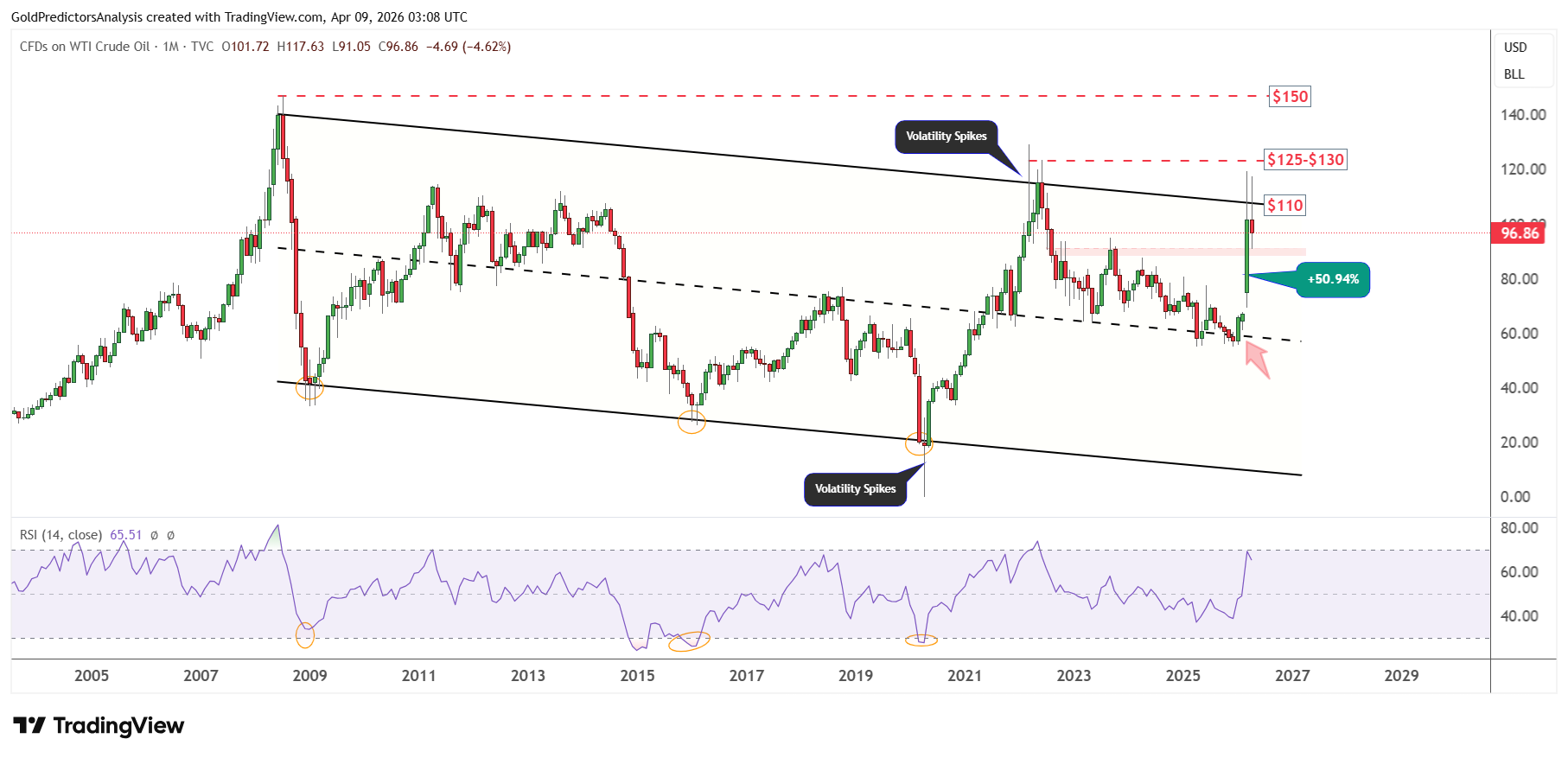
The price is rebounding higher after hitting the support zone as the ceasefire deal is now in question following the tensions between Israel and Lebanon. If the monthly candle for April 2026 closes above the $120 area, it will break the descending channel pattern. If this channel breaks, then prices will likely trade higher due to the supply disruptions of March 2026.
Brent Technical Analysis – Key Levels Signal Breakout or Breakdown
Brent crude oil shows the same pattern, dropping to $92.50 on Wednesday and now rebounding back above the $100 area. The $100 remains the key level in the oil market. During the past four weeks, Brent crude oil has also shown uncertainty in prices between $90 and $120. If the ceasefire deal holds, then crude oil prices will continue to trade within the $80 to $100. However, if further escalation remains, then prices will likely surge towards $130.
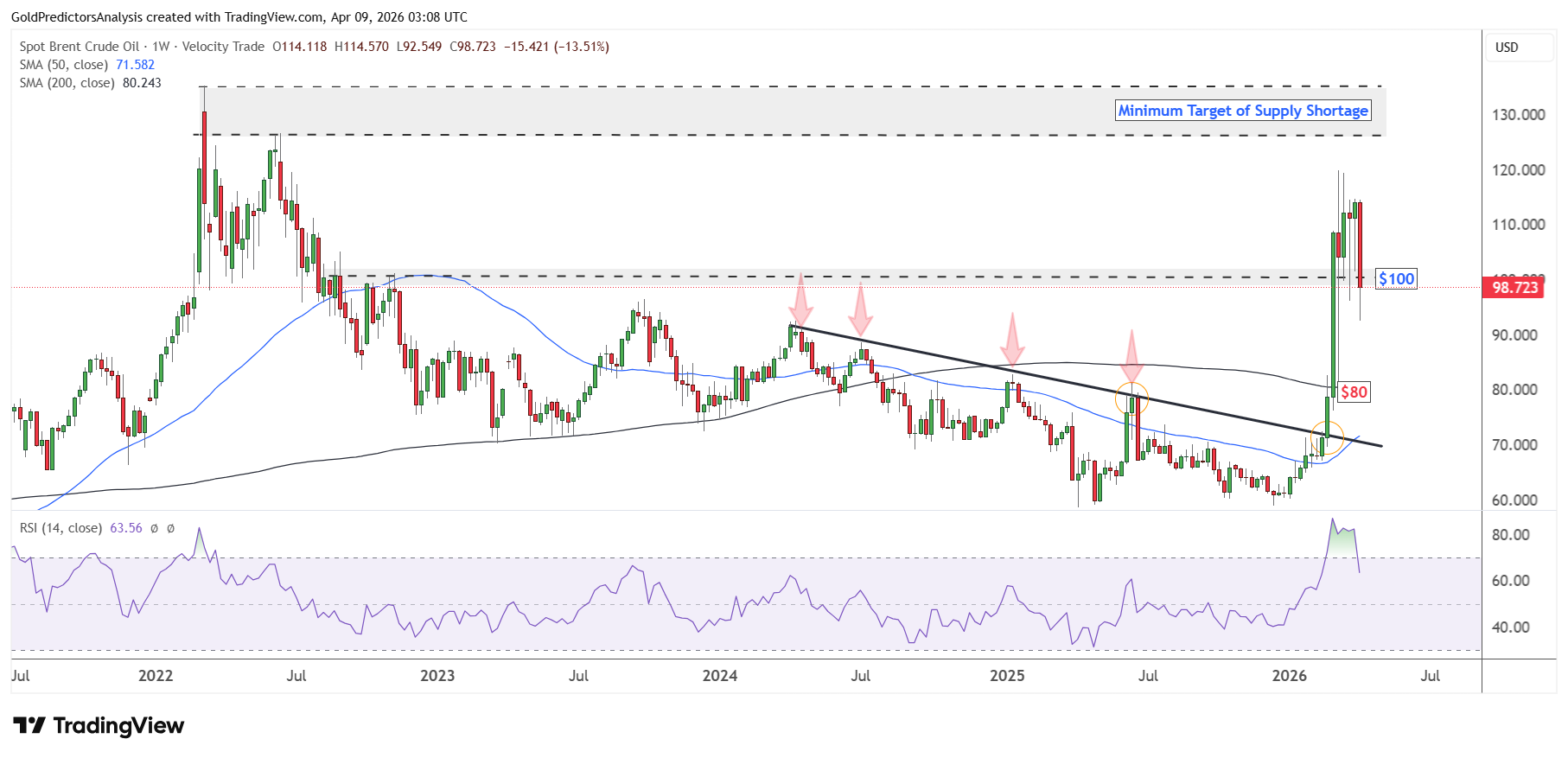
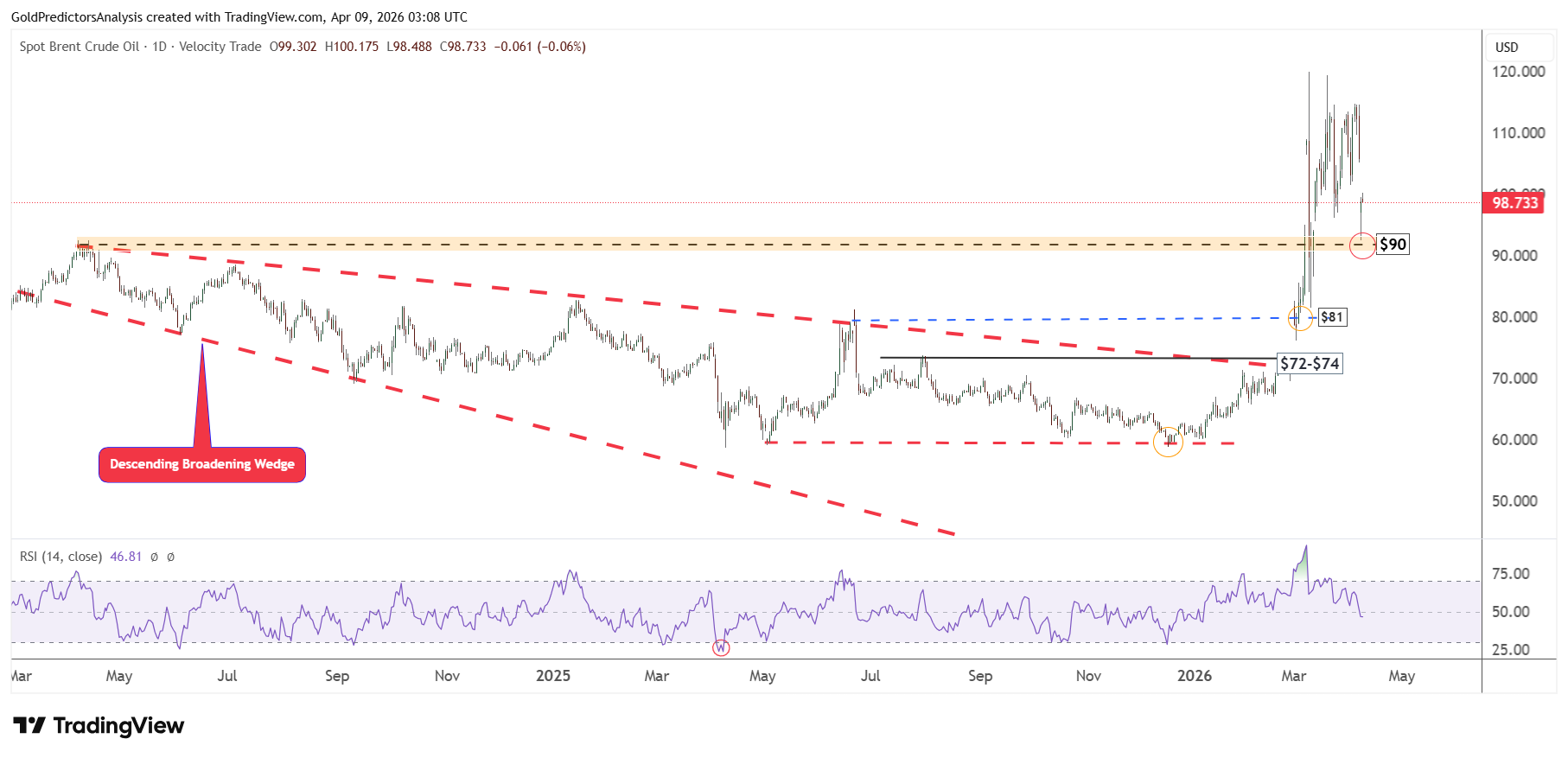
The recent correction towards $92.50 is also seen in the short-term chart of Brent crude oil. The $90 area is a strong support level for the descending broadening wedge pattern, which was developed from the April 2024 highs.
After hitting this support, Brent crude oil initiated a strong rebound towards $100. A break above $100 will indicate further upside towards $110. However, a break below $90 will indicate further downside towards $85 to $80.
Bottom Line
Oil prices are sensitive to geopolitical events because volatility will persist until there is some level of certainty regarding the ceasefire. Disruptions that create supply risk are the main driver of price volatility in today’s market. The delays, disruptions and increased security concerns are limiting the flow of oil.
Meanwhile, the technical setup also has a potential upside if major resistance levels are broken. Nonetheless, the increase in stability and a more favorable supply situation might drive the prices down once again. Currently oil price direction remains uncertain as it will depend on how tensions escalate or de-escalate over the next few weeks.
If you’d like to know more about how commodity markets work, please visit our educational area.