
The preliminary deal between White House and Iran has cooled oil markets. Brent crude and WTI oil dropped to $84.60 and $80.70, respectively. This drop indicates that some of the war premium has been removed from oil markets. The main reason for this drop is the possible reopening of the Strait of Hormuz. The Strait transports approximately 20% of the global oil and LNG imports. Any improvement in shipping security may have a swift effect on the prices.
But oil prices may not recover quickly to pre-war levels. Ship tracking data confirms very little shipping activity through the Strait of Hormuz. Shipping companies are not yet completely out of the woods regarding insurance premiums, threats from drones and potentially from mines. There are still many tankers stuck in the Gulf. The oil production and refining plants may require time to resume full production. That will allow supply flows to pick up gradually, helping to maintain prices above their support levels.
The next price action in oil will depend on whether this deal is a permanent truce or a temporary one. If the Strait opens and traffic flow returns to normal, the Brent oil may drop below $80 in the short term. But volatility will likely persist until the supply volumes become stable. The political risk also persists in the market as Iran may introduce new conditions such as tolls, which may push prices higher from their support zones.

WTI Oil Technical Analysis – $80 Support in Focus After Breakdown
WTI oil prices remain bearish in the short term as the price broke the support of $87, as seen on the 4-hour chart below. This support was defined by the triangle pattern that formed within the broader consolidation of the $80 to $120 region since March 2026.
A breakdown below $87 has pushed oil prices toward the main support of $80. The price is now consolidating around the $80 region.
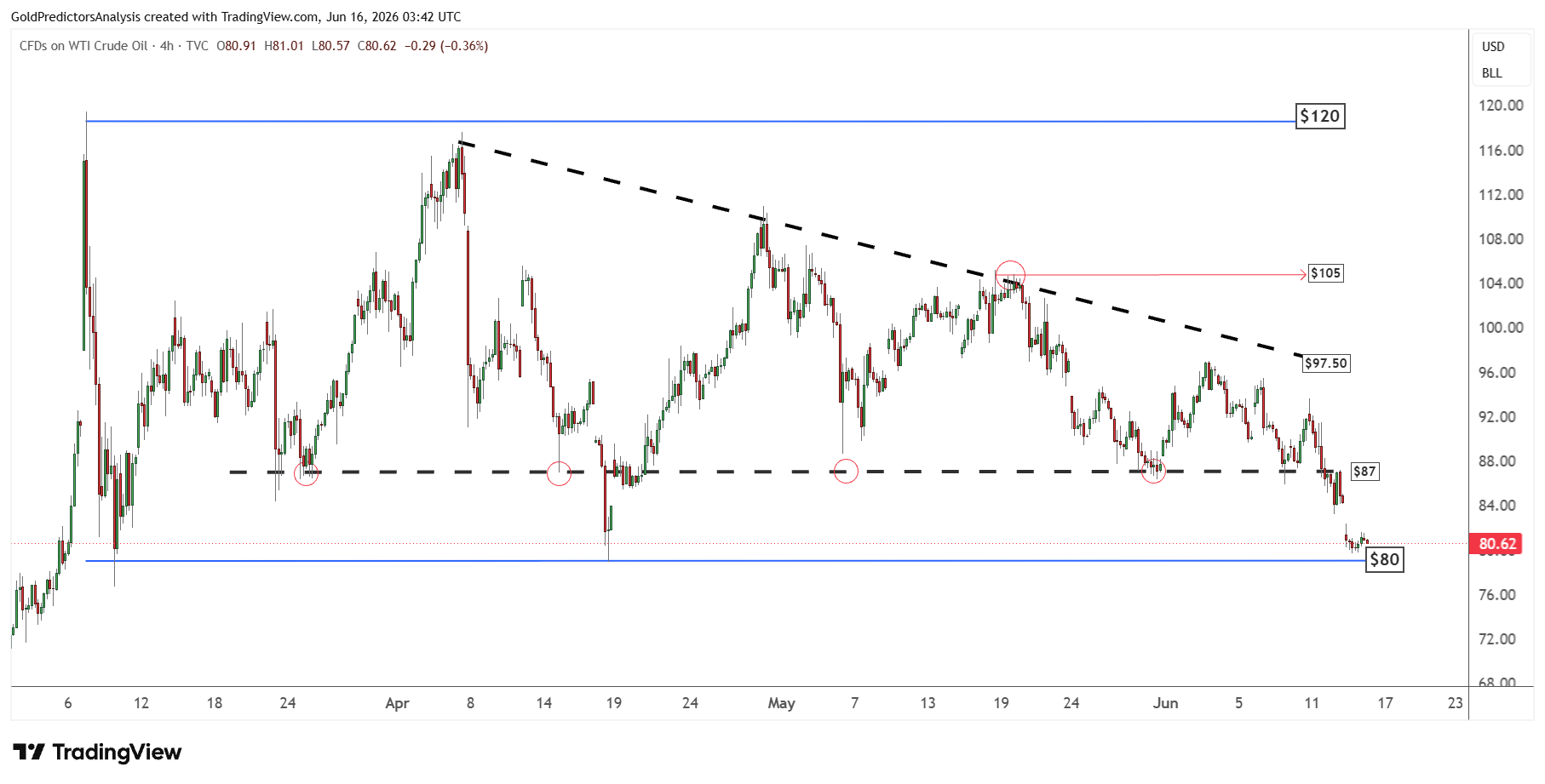
If WTI crude oil rebounds from $80, it will likely move toward $87. But a break above $87 will likely push prices back toward $100. On the other hand, a break below $80 will likely push WTI crude oil back toward $70.
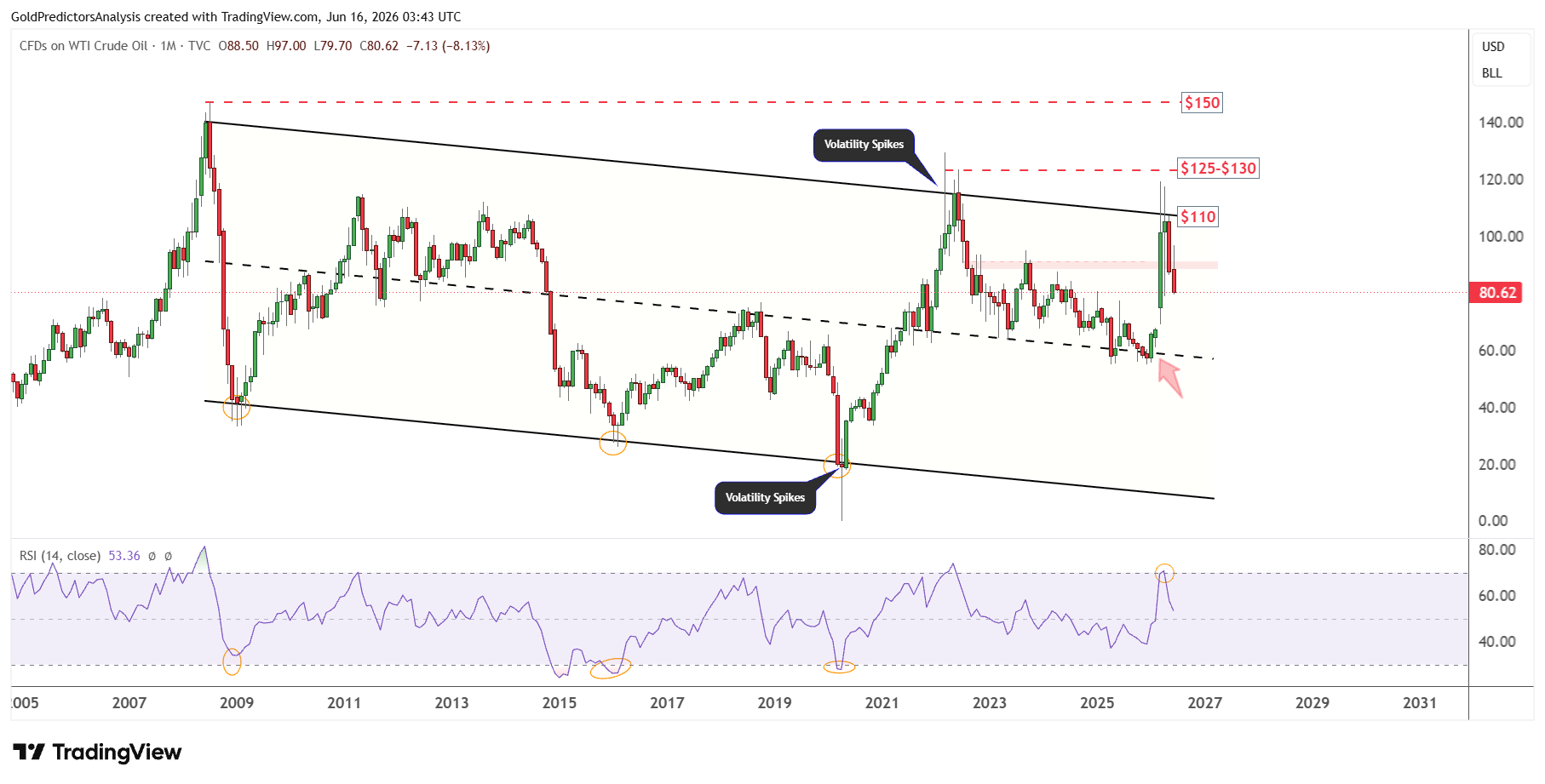
The strong drop from $120 in WTI oil is due to strong technical resistance on the monthly chart. This resistance was defined by the descending channel pattern, which has formed since the July 2008 highs.
The chart below shows that the price touched the resistance of this descending channel for the third time since 2008. The negative price action from this resistance area indicates a decline.
The immediate short-term resistance remains $87 in WTI crude oil, while the immediate support remains $80. A break below $80 will likely push WTI crude oil toward $77 to $78.
Brent Oil Price Forecast
Every new Brent Oil analysis as it publishes, today's technical signal and key levels, live price — on one page.
See all Brent Oil forecastsBrent Oil Technical Analysis – $80-$82 Support Zone Could Trigger Rebound
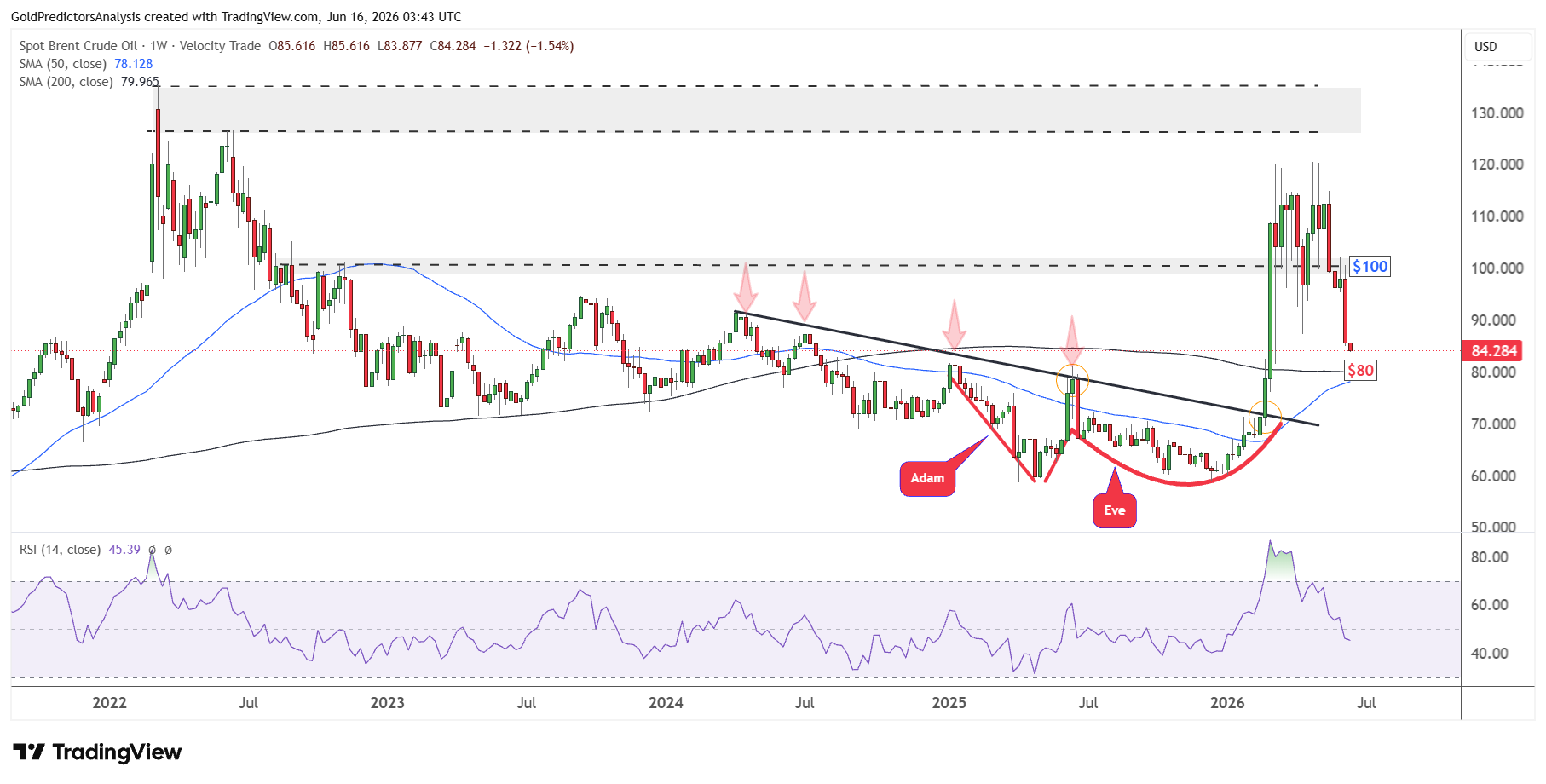
Brent crude oil also failed at $100 and is now dropping toward the 200-week SMA on the weekly chart. Now, the 50 SMA is approaching the 200 SMA on the weekly chart.
If support of $80 holds in Brent crude oil, it will likely initiate a strong rebound back toward $100. But the RSI has already fallen below the midline, which suggests that oil prices may consolidate near current levels around $80 to stabilize the recent drop.
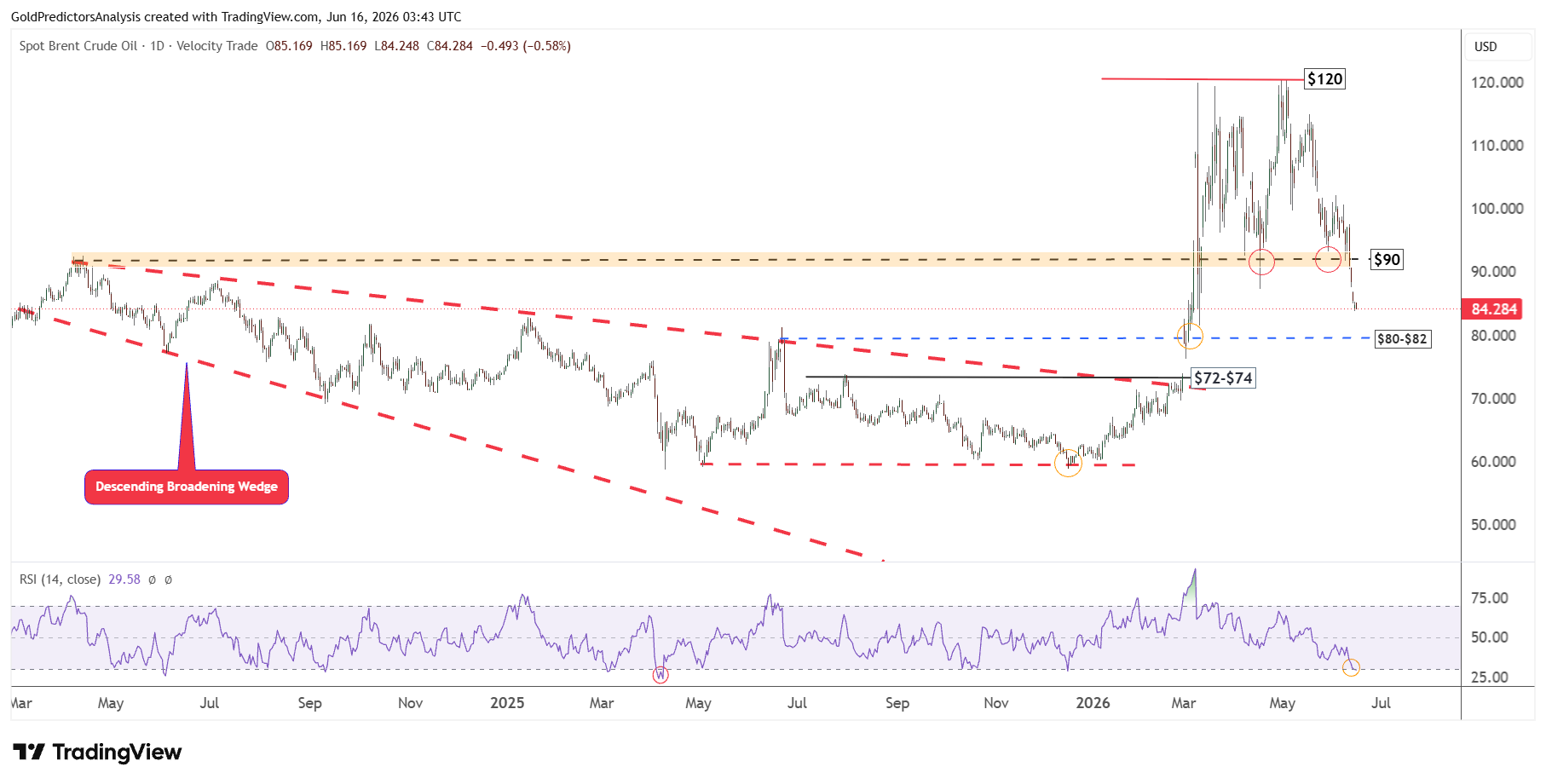
The short-term price structure for Brent crude oil also shows that the price remains under pressure. The next immediate support in Brent crude oil is the $80 to $82 area, where a strong rebound may develop.
If the rebound from $82 develops in Brent crude oil, the next resistance will likely be $90. The RSI is also approaching oversold, which indicates that a rebound in Brent crude oil could occur at any time.
Bottom Line
Oil prices remain at critical point after the preliminary US-Iran deal reduced part of the geopolitical risk premium. Both WTI and Brent have fallen back significantly from recent peaks due to the reduced fears of the supply from the Strait of Hormuz. If the shipping activity picks up and supply flows recover, oil prices could remain low around the support regions. But if the deal does not go through, insurance risks remain high, or if Iran imposes new conditions, prices could rebound from the the $80 level. WTI needs to hold $80 to avoid a further decline to $77 to $78. On the other hand, Brent needs to hold the $80 to $82 zone to support a rebound to $90.
If you’d like to know more about how to trade crude oil, please visit our educational area.