



Oil prices have rallied strongly due to disruption in global energy supply that has been caused by the conflict between the US, Israel and Iran. The Strait of Hormuz has experienced disruptions of exports as war worsened in the region. Production across parts of the Middle East has also fallen which has tightened the global market. Since beginning of the war, the price of oil has gone up by almost a quarter as traders adjust for the possibility of long term disruption. Governments and energy agencies are trying to stabilize markets as the supply uncertainty spreads through oil and gas sectors.

Emergency Oil Release Aims to Stabilize Markets
Due to emerging supply issues, the International Energy Agency (IEA) and its partners agreed to release a record 400 million barrels of oil from emergency reserves. All 32 IEA member countries backed the decision. These countries account for about two-thirds of world’s energy production and about 80% of the consumption of world. Therefore, this move will have significant influence on markets.
However, the influence may be limited. The amount of oil released is only three to four days of global demand or two weeks of normal shipments through the Strait of Hormuz. IEA member countries hold strategic reserves that are equivalent to at least 90 days of domestic oil consumption. Collectively they contain more than 1.2 Billion barrels in government stockpiles and another 600 million barrels in industry reserves.
Structural Supply Problems Keep Prices Elevated
The release of emergency reserves does not imply sudden release of a wave of new oil to the market. Oil is stored in a lot of places including terminals and refineries operated by oil companies. When governments allow a release, producers simply make more oil available to be bought by refineries. Therefore, the physical flow of oil into the market increases over time.
On the other hand, Refining capacity is tight in many regions which limits the speed at which crude oil can be processed into usable fuels. At the same time, the worldwide gas market is also under pressure. Liquefied natural gas supplies have been down by about 20% since the conflict started. This causes benchmark UK LNG prices to rise by about 70%.
Brent Oil Price Forecast
Every new Brent Oil analysis as it publishes, today's technical signal and key levels, live price — on one page.
See all Brent Oil forecastsOil Price Volatility After War Shock Signals Strong Bullish Structure
Triangle Breakout and War-Driven Price Surge
The crude oil prices show strong volatility after the U.S.–Iran war started. The WTI crude oil price spiked to hit $119 and then corrected lower to mark a low at $76.73. The effects of war are serious and this would likely trigger positive behavior in oil despite the government’s efforts to control prices.
From technical perspective, the U.S.–Iran war started when the price was trading around $67, which was the critical breakout level from the triangle pattern. When the war started, the price opened with a gap higher and continued to surge to mark a high of $119. The breakout from this triangle has a minimum target of $120, as discussed earlier, which is defined by the March and June 2022 highs.
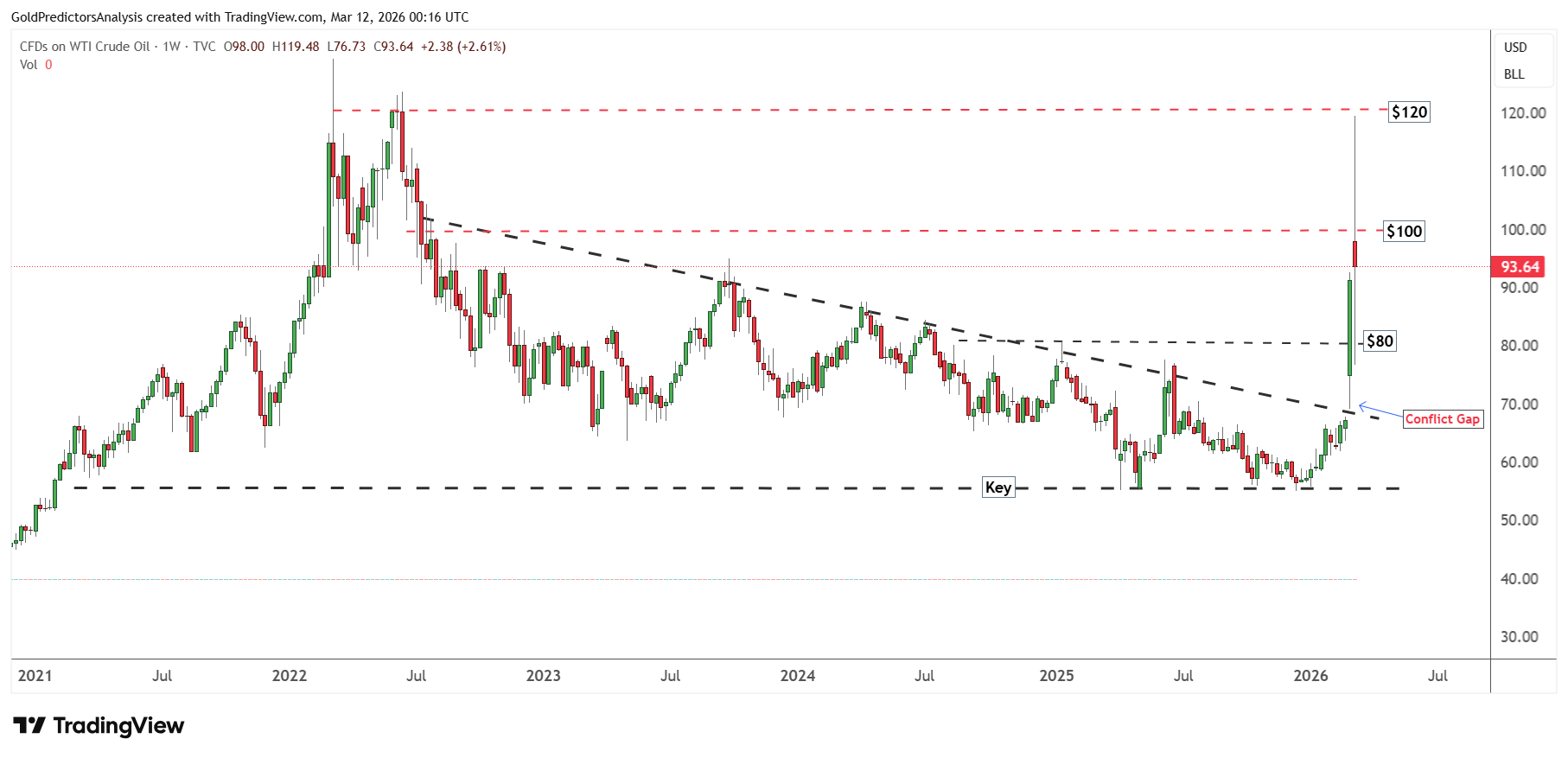
A break above $120 will indicate further buying interest and trigger a strong surge in oil prices towards $150 and $200. However, strong volatility during the next few days is possible as agencies try to control the prices.
Rounding Bottom Formation and Short-Term Bullish Structure
The short-term price structure of the oil market shows that oil prices formed a rounding bottom pattern above the long-term support region of $55. A breakout from $62 and then the buildup of positive consolidation between $66 and $62 indicates strong bullish momentum. Once the prices broke above $68 at the red dotted trend line, it spiked to $119. However, the prices have not shown any daily close above $119 due to high volatility.
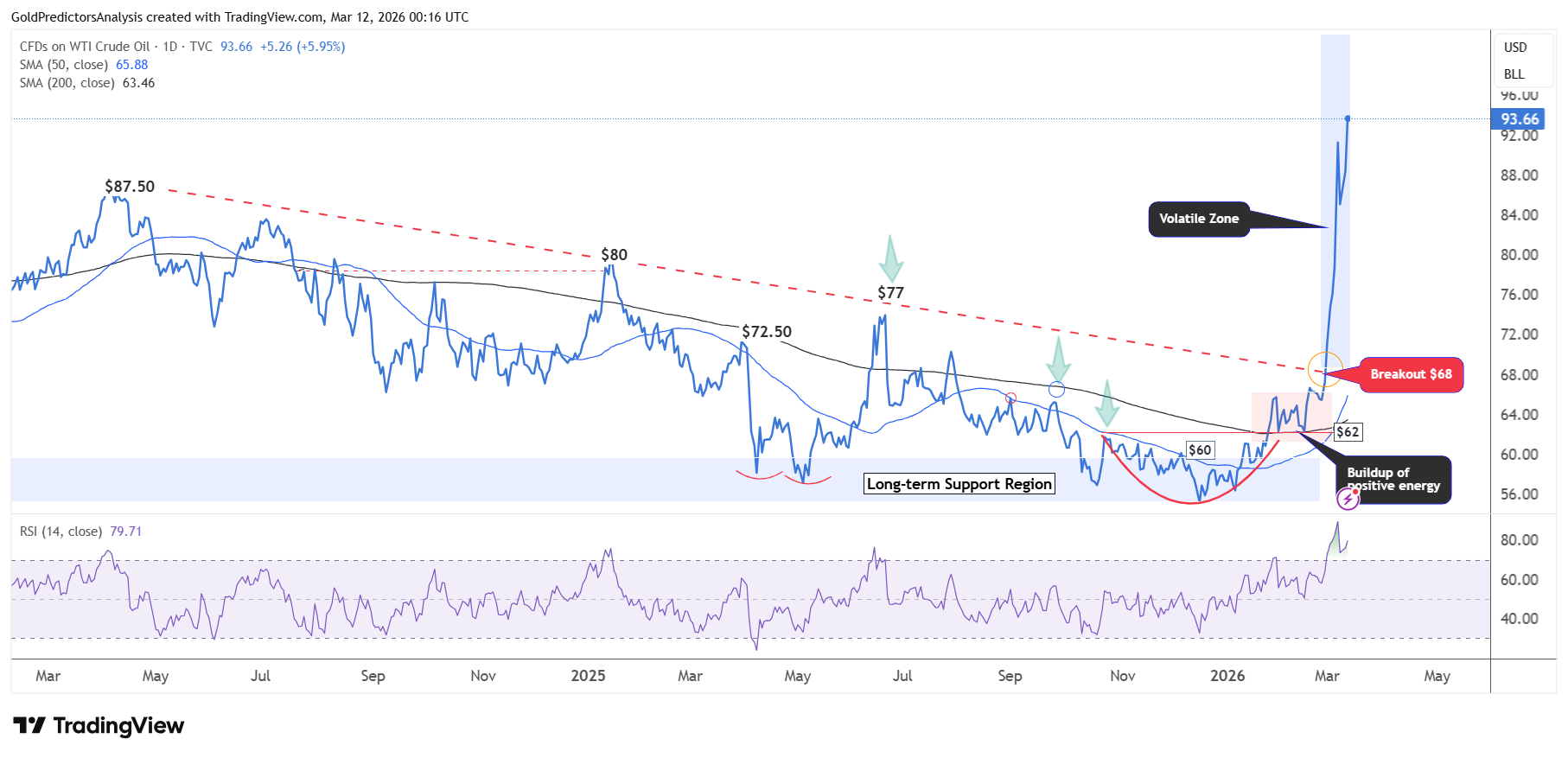
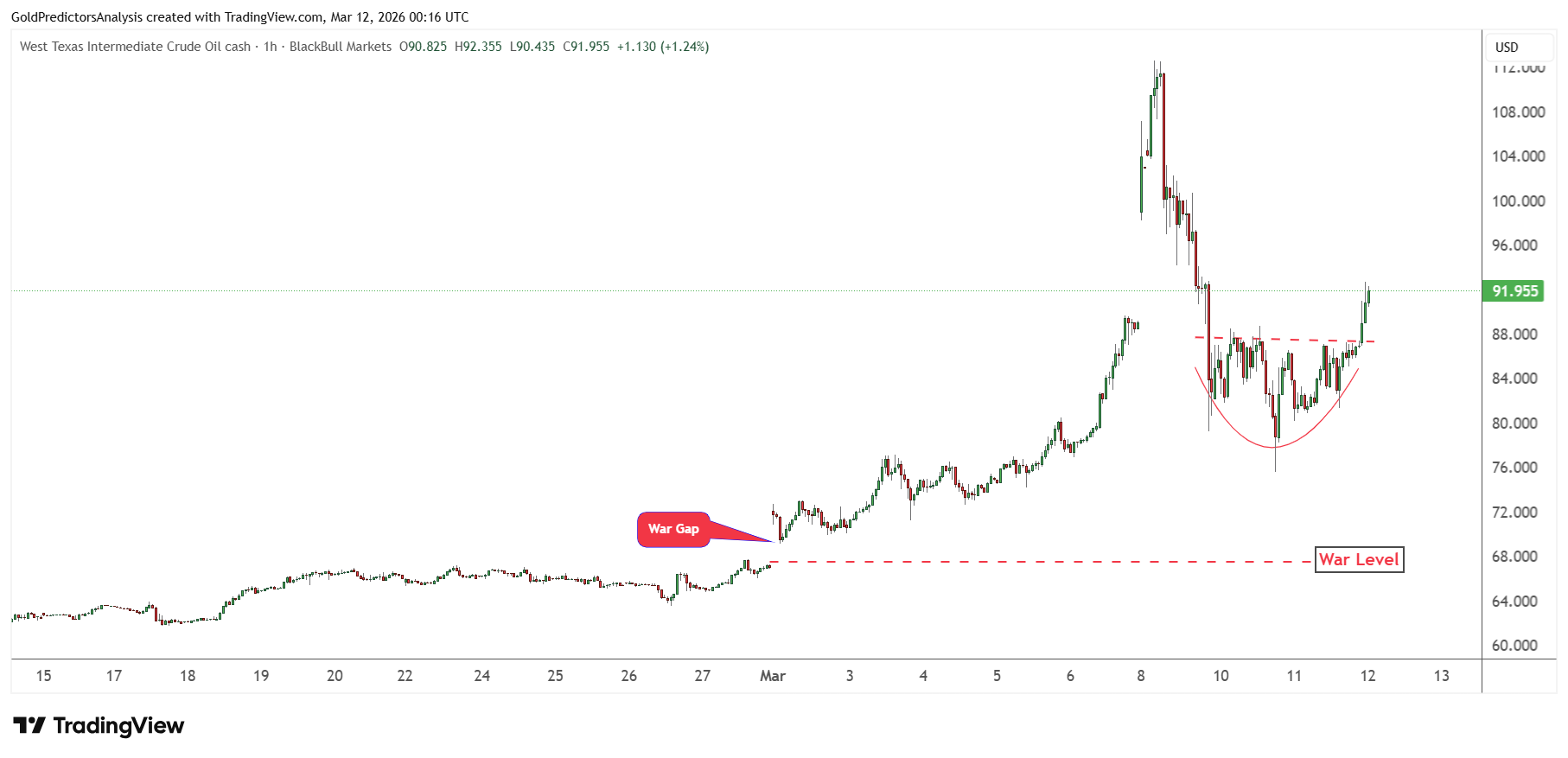
As President Trump mentioned the release of sanctions on Russian oil, prices dropped from $119 to a low of $75.58 on 10 March 2026. Despite this strong correction, oil prices remain above the war level of $68.
This correction from $119 has produced a rounding bottom pattern, and prices again broke above the neckline of this cup at $88 on the hourly chart. Now the prices again remain in surge mode as the weekend approaches. The short-term price action for WTI crude oil remains strongly bullish with strong volatility.
What Comes Next for Oil Prices
Oil markets are now in a time of high uncertainty. The war in the Middle East has caused a major shock to supply around the world, and disruptions in the Strait of Hormuz have kept traders on their toes. Emergency releases from strategic reserves may have an impact on calming the market in the short term but cannot completely make up for lost production nor address structural constraints to supply. Tight refining capacity and pressure in the global gas market are also risk for prolonged volatility.
From technical perspective, oil is in a strong bullish structure, despite the recent corrections. As long as prices continue to hold above the key breakout levels, buyers may continue to support the market. However, sharp swings are likely to happen as geopolitical developments play out. If the geopolitical tensions are not resolved, oil prices will likely move towards $150-$200.
If you’d like to know more about how to trade crude oil, please visit our educational area.


