


Markets Catch Their Breath After Rollercoaster Week
The major U.S. stock indexes are putting in a mixed performance as we head into the mid-session on Friday. Investors seem to be taking a breather after a volatile week which began with two days of steep selling pressure, followed by a day and a half of strong buying.
All three indexes are lower for the week, despite the rebound, with investors still needing to do some work before the close to erase the earlier losses. The Dow moved back into the red on Friday while the S&P 500 and Nasdaq are on track for their second negative week in a row.
At 17:15 GMT, the Dow is trading 49162.62, down 221.39 or -0.45%. The S&P 500 Index is at 6924.98, up 11.63 or +0.17% and the Nasdaq Composite is trading 23565.39, up 129.37 or +0.55%.
Energy and Tech Lead While Financials Lag
The sectors are reflecting the mixed trade in the broad-based indexes with only six out of the 11 posting modest gains. Energy (+1.17%), Technology (+0.86%) and Consumer Discretionary (+0.82%) are the biggest winners. Financials (-1.18%) and Health (-0.56%) are the weak links.
Intel Plunges 16% on Supply Concerns and Soft Guidance
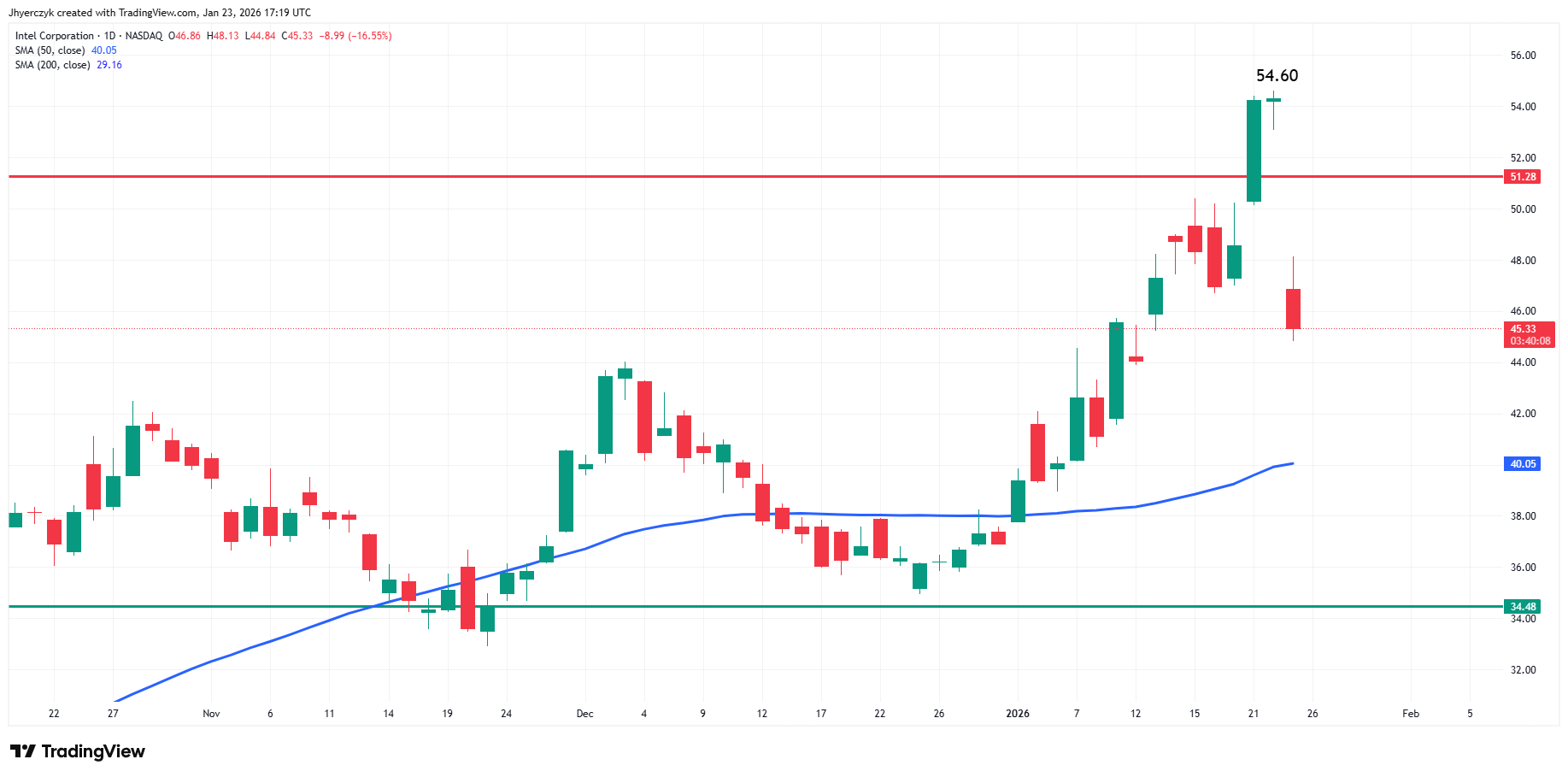
Intel is making headlines on Friday with a 16% drop, after releasing mixed results for the fourth quarter, in addition to issuing softer guidance than expected for the current three-month period. The company also said it doesn’t have the supply it needs for seasonal demand for the first quarter, disappointing investors.
Nvidia Climbs as CEO Plans China Visit
Chipmaker Nvidia’s shares rose about 1.5% after CNBC reported that CEO Jensen Huang plans to visit China in the coming days ahead of the mid-February Lunar New Year. The report comes as questions swirl over the U.S. chip giant’s ability to sell in the crowded Chinese market.
Winners and Losers: Booz Allen Surges, Capital One Dips
Technology consulting and engineering stock Booz Allen Hamilton rose nearly 6% after it hiked its earnings forecast for the first quarter. Its earnings estimates topped analysts’ consensus first quarter forecasts for earnings per share.
Dow Jones Price Forecast
Every new Dow Jones analysis as it publishes, today's technical signal and key levels, live price — on one page.
See all Dow Jones forecastsCapital One dipped more than 2% after the bank announced on Thursday that it agreed to acquire startup Brex for $5.15 billion, in a deal consisting of 50% cash and 50% stock.
Consumer Sentiment Improves Despite Economic Headwinds
In economic news, consumer sentiment improved in January as near-term inflation expectations eased and geopolitical turmoil failed to dim confidence, according to a University of Michigan survey Friday. The one-year outlook on inflation slipped to 4%, down 0.2 percentage point from the prior month and the lowest level since January 2025. However, the five-year outlook increased to 3.3%, up 0.1 percentage point.
Manufacturing and services activity both were positive in January but reflected a slower growth pace for the U.S. economy, according to a report Friday from S&P Global.
Technical Analysis: Can the Market Recover Last Week’s Close?
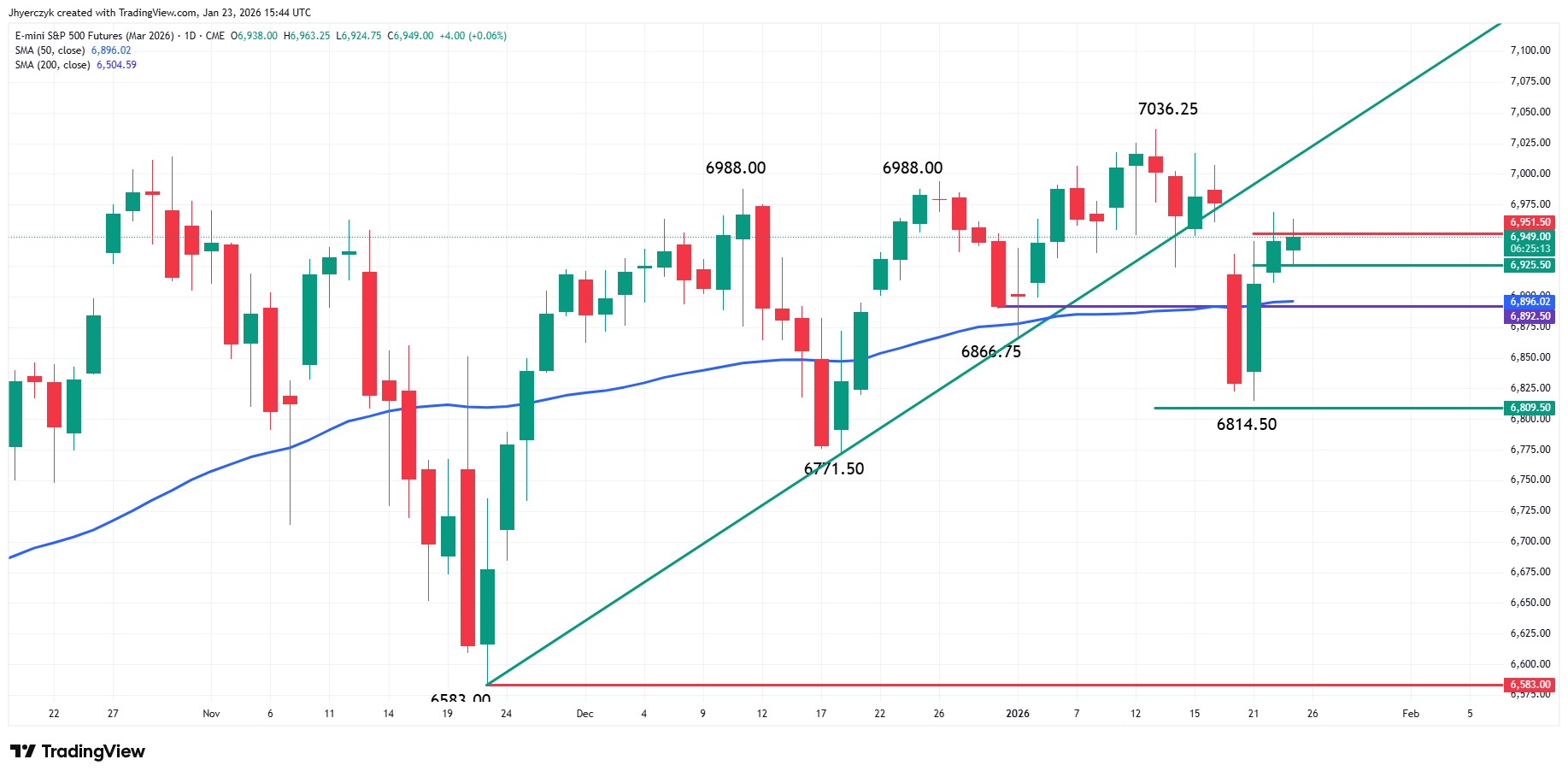
Our technical focus today is on the March E-mini futures contract. The primary objective today is to recover last Friday’s close at 6,976.75. A move above this level will improve investor sentiment since it will erase all of this week’s losses.
The short-term range is 7,036.25 to 6,814.50. Currently, the market is struggling with its retracement zone at 6,925.50 to 6,951.50.
Overcoming 6,951.50 could create the upside momentum needed to reach 6,976.75. The bigger picture has an uptrend line at 7,014.50 as a target.
If 6,925.50 fails as support later in the session, we could see a further decline into the 50-day moving average at 6,896.25. The overall tone will remain bullish as long as the 50-day moving average holds as support. Steep losses are possible under this indicator.
More Information in our Economic Calendar.