Part Two: What Comes After the Storm
The metal has spent centuries earning its reputation as a refuge from instability, and that reputation has not been built without reason. But as the first weeks of the Iran conflict have demonstrated, the relationship between geopolitical risk and gold prices is neither simple nor automatic. It is mediated by interest rates, currency dynamics, investor positioning, and the specific stage of the economic cycle at which a shock arrives.
For a deeper dive into why the gold market is currently prioritizing liquidity and interest rate expectations over its traditional safe-haven role, see the first part of our analysis.

The Current Episode Mirrors Patterns Seen During Previous Conflicts
As Mark Haefele, chief investment officer at UBS Global Wealth Management, has noted, gold’s behavior during both Russia’s invasion of Ukraine in 2022 and earlier Middle East crises followed a recognizable pattern.
First, an initial price jump driven by panic buying, followed by a retreat as investors sought liquidity and reallocated toward more directly conflict-linked assets. The metal is, in his framing, a hedge against the broader and longer-term consequences of conflict rather than a pure real-time war instrument.
This distinction matters for understanding what comes next.
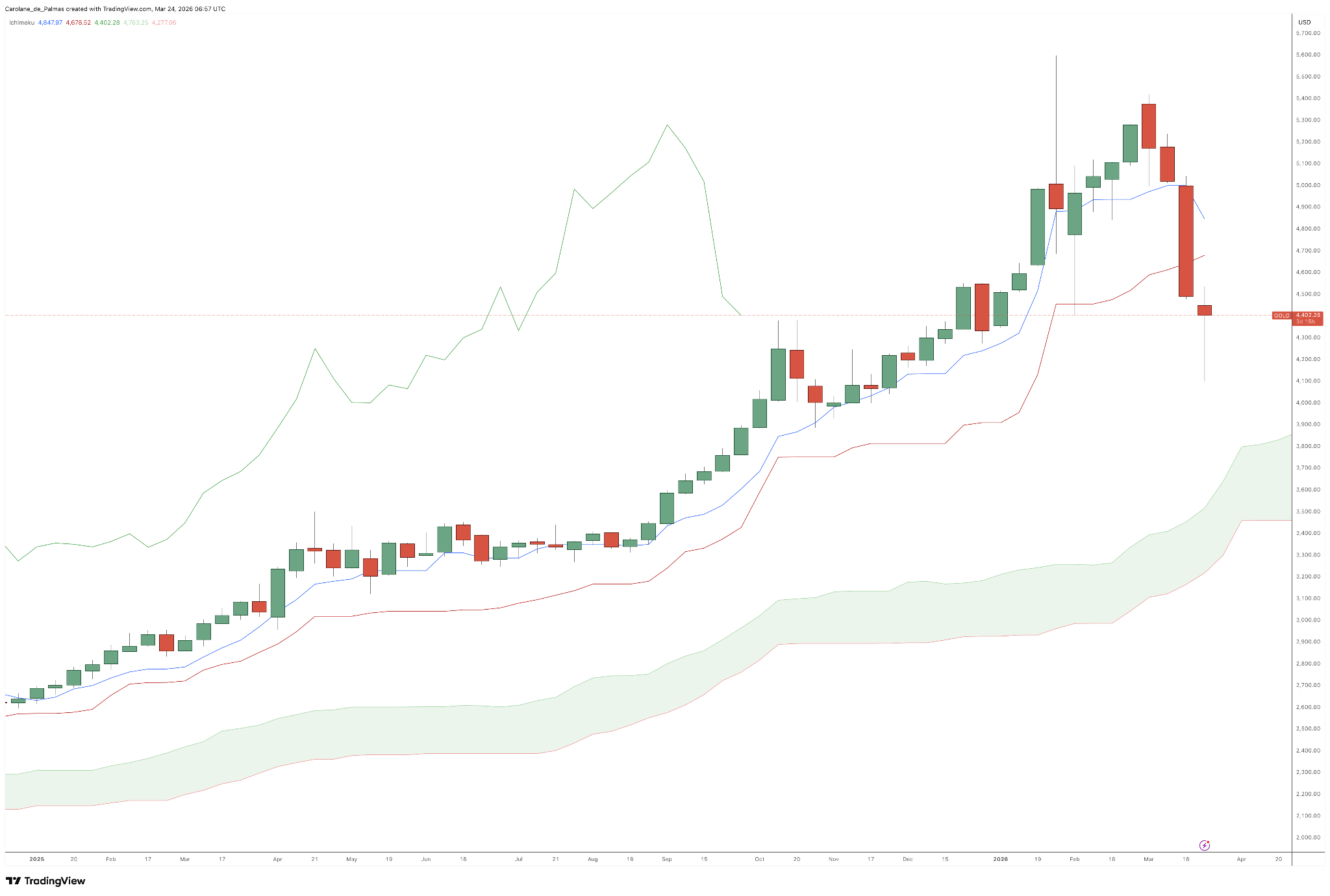
Gold remains, even at current prices, substantially higher than it was a year ago. As of Tuesday morning, gold was trading around $4,400 per ounce, representing a gain of more than $1,400 from the same moment twelve months earlier. The structural arguments that powered its extraordinary run — geopolitical fragmentation, the gradual erosion of confidence in the dollar-dominated financial system, elevated sovereign debt levels across the developed world, and persistent central bank buying — have not disappeared.
They have, if anything, intensified. A war in the Middle East, whatever its short-term impact on the gold price, does not resolve the deeper anxieties that drove investors toward the metal in the first place.
The major financial institutions are reflecting this view in their medium-term forecasts. They reflect a conviction that once the current wave of profit-taking and forced liquidation runs its course, the underlying thesis for gold ownership remains intact, and that a stagflationary environment — which is what a prolonged energy shock and simultaneous monetary tightening tends to produce — is historically one of the most fertile conditions for the metal.
If you believe it’s time to enter the gold market, there are different options.
Gold Price Forecast
Every new Gold analysis as it publishes, today's technical signal and key levels, live price — on one page.
See all Gold forecastsPhysical Gold
The most direct way is physical ownership: gold bars, coins, or other bullion products purchased outright and held in secure storage. Physical gold offers the purest expression of the safe-haven thesis, it is no one else’s liability, it carries no counterparty risk, and it has maintained purchasing power across centuries of monetary upheaval.
The trade-off is that it is illiquid compared to financial instruments, requires storage and insurance arrangements, and typically involves a premium above the spot price that can vary considerably depending on the dealer and the format. Coins issued by sovereign mints also often carry a larger premium than plain gold bars due to their collector appeal, but both forms provide genuine direct exposure to the metal.
Paper Gold
For investors who prefer a more liquid and administratively straightforward approach, gold-backed exchange-traded funds (ETF) offer an appealing alternative. These products hold physical gold on behalf of their investors and track the spot price closely. They can be bought and sold through an ordinary brokerage account during market hours, they require no storage arrangements, and they typically carry modest annual management fees.
It is worth noting, though, that outflows from these very instruments have been a significant driver of the recent gold price decline, which is a reminder that paper gold is only as stable as the collective conviction of its holders.
Derivatives on Gold
Gold futures and other derivative contracts — including contracts for difference, known as CFDs — provide a third way to gain exposure to gold prices, though these are more accurately described as trading tools than investment vehicles.
Rather than owning gold or a claim on physical gold, a trader using derivatives is simply ‘speculating’ on the direction of the price over a defined period. Futures contracts oblige the holder to buy or sell gold at a predetermined price on a specific future date, while CFDs, more commonly available to retail traders through online platforms, allow a position to be opened with only a fraction of the total trade value deposited as margin.
Both instruments offer leverage, meaning that a relatively small move in the gold price can generate a proportionally much larger gain — or loss — relative to the capital deployed. They are instruments built for those who want to trade the price, not those who want to own the metal.
Gold Mining Shares
Finally, there is the option of owning shares in gold mining companies — a way that has attracted considerable interest in recent years but which has recently illustrated its particular risks in stark terms.
Mining stocks traditionally act as a leveraged bet on the gold price: when bullion rises, miners’ revenues expand and their equity values tend to outperform the metal itself. But leverage cuts in both directions.
Since the outbreak of the Iran conflict, mining companies have faced a double squeeze: the gold price decline has eroded their revenues while the oil and gas supply shock has driven up their energy costs, since mines are intensive consumers of fuel and electricity. Before the conflict, many of these companies had reached extraordinary valuations on the back of gold’s record highs. That premium is now being unwound.
As Michael Field, chief equity strategist at Morningstar, has observed, miners are acutely exposed to economic shocks, which explains the investor pullback in the sector. A meaningful recovery in mining stocks is likely to require both a stabilization of the gold price and a restoration of broader confidence in global economic growth — neither of which appears imminent while the conflict and its inflationary consequences remain unresolved.
Sources: Reuters, CNBC, The Wall Street Journal, Fortune, Yahoo Finance, MorningStar
The information provided does not constitute investment research. The material has not been prepared in accordance with the legal requirements designed to promote the independence of investment research and as such is to be considered to be a marketing communication.
All information has been prepared by ActivTrades (“AT”). The information does not contain a record of AT’s prices, or an offer of or solicitation for a transaction in any financial instrument. No representation or warranty is given as to the accuracy or completeness of this information.
Any material provided does not have regard to the specific investment objective and financial situation of any person who may receive it. Past performance is not a reliable indicator of future performance. AT provides an execution-only service. Consequently, any person acting on the information provided does so at their own risk. Forecasts are not guarantees. Rates may change. Political risk is unpredictable. Central bank actions may vary. Platforms’ tools do not guarantee success.