For years, traders were conditioned to believe every shock would pass, every supply disruption would normalise and every inflation spike would eventually fade. That assumption now looks dangerously outdated. The world is no longer facing isolated disruptions. It is entering an era of recurring economic shocks, resource nationalism, geopolitical fragmentation and scarcity premiums.
This is COVID Playbook 2.0 – but this time, the shock is not temporary. It is structural.
The Market Is Still Misreading the Signal
The biggest mistake traders are making today is analysing tariffs, sanctions, trade wars, energy disruption, food insecurity and supply-chain stress as separate headlines. They are not separate. They are symptoms of the same regime shift.
Financial markets are still behaving as though one or two major economic shocks per decade is normal. That world may be over. The next decade could deliver multiple shocks every year – each one feeding directly into the price of energy, metals, agriculture and strategic raw materials.
As Lars Hansen, Head of Research at The Gold & Silver Club, explains: “Markets are still trying to price these shocks as temporary disruptions. That is the misread. We are seeing a repeated pattern of supply stress, policy intervention and resource competition. In that environment, Hard Assets can reprice much faster than consensus expects.”
That is why Commodities are no longer just cyclical trades. They are becoming the pressure valves of a fractured global economy.
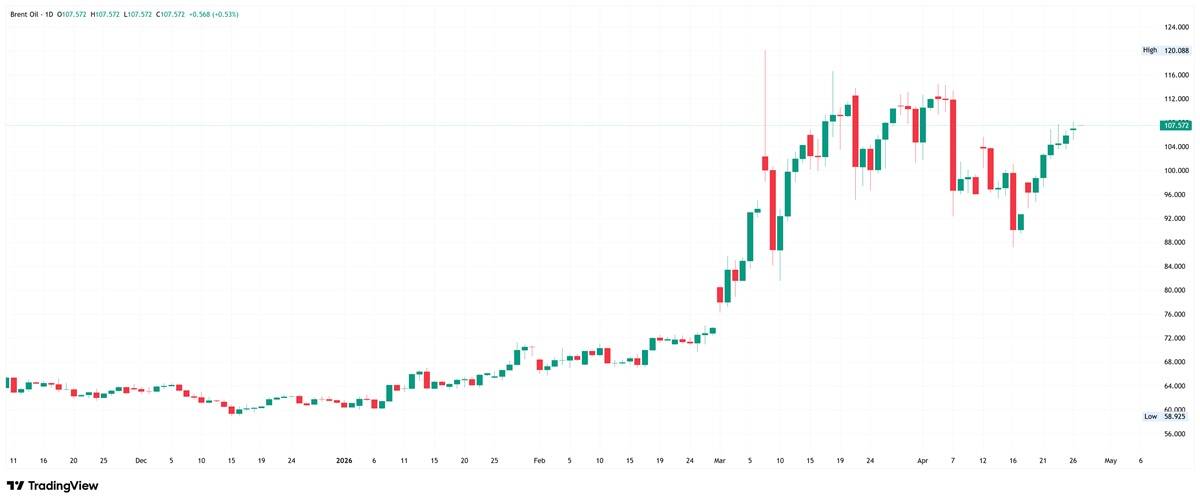
Brent Oil Price Forecast
Every new Brent Oil analysis as it publishes, today's technical signal and key levels, live price — on one page.
See all Brent Oil forecastsThe Scarcity Shock Is No Longer Theoretical
During COVID, markets learned how quickly shortages can spread when inventories are thin, supply chains fracture and governments scramble to secure essential goods. Prices moved violently.
Inflation accelerated. Energy, food, freight, metals and industrial inputs became the fault lines of the global economy almost overnight.
Now, the same playbook is returning with a more powerful structural driver.
Governments are stockpiling resources, restricting exports, subsidising domestic production, rebuilding industrial capacity and weaponizing trade flows. Supply is no longer just an economic issue. It is a national-security issue.
“The COVID shock showed markets how quickly scarcity can reprice essential assets,” says Hansen. “The difference today is that scarcity is no longer simply a disruption. It is becoming a strategic policy choice.”
That changes the entire investment map. Oil, Natural Gas, Copper, Uranium, Gold, Silver, Agricultural Commodities, Fertilizer and Rare Earths are no longer merely inputs. They are strategic Hard Assets.
From Efficiency to Security
For three decades, globalisation rewarded efficiency. Production was concentrated where costs were lowest. Inventories were kept lean. Supply chains were built for speed, not resilience.
A multipolar world reverses that logic.
Governments are reshoring industry, competing for critical minerals, expanding defense capacity, and paying up for domestic supply. That means more duplication, more infrastructure spending, more strategic reserves and more demand for the building blocks of the real economy.
“In a multipolar world, Commodities stop being treated purely as cyclical assets and start being viewed as instruments of national security,” Hansen says. “Governments do not secure Oil, Copper, Uranium or Gold the way speculators do. When supply is tight, they secure access almost regardless of price.”
This is why the Commodity thesis is no longer just about Gold, Oil or Copper in isolation. It is about the revaluation of Hard Assets in a world where security of supply now matters as much as cost.
Scarcity Premiums Could Ignite the Next Bull Market
Supply does not need to disappear for prices to move sharply higher. It only needs to become less secure, less efficient or more politically controlled.
That is how structural bull markets begin.
Oil shocks do not stay in Oil. They feed into freight rates, food prices, inflation expectations, central-bank policy, corporate margins and consumer confidence. Higher Diesel costs hit transport. Rising Fertilizer prices pressure agriculture. Energy shortages restrict petrochemical production. Metals disruptions threaten construction, defense, electrification, and manufacturing.
“The smarter read is that energy scarcity can become food scarcity, metals scarcity and ultimately inflation persistence,” Hansen adds. “Once that chain reaction starts, markets often move faster than investors are prepared for.”
For traders, urgency matters. By the time the pattern is obvious, the best entries are usually gone.
The Repricing May Only Be Beginning
The winners of the last cycle were long-duration financial assets built on low rates, low volatility and abundant liquidity. The winners of the next cycle may be the real assets the world cannot function without.
Gold benefits from reserve diversification and geopolitical risk. Oil benefits from underinvestment and supply insecurity. Copper benefits from electrification, defense demand and grid expansion. Uranium benefits from the nuclear revival. Agricultural Commodities benefit when Energy and Fertilizer shocks collide with food-security fears.
This is not a side trade. It is a regime trade.
At The Gold & Silver Club, our view is clear: this is not the time to sit on the side-lines. This is the time to recognise the pattern, understand the regime shift and position with discipline before the wider market fully prices what is unfolding.
Because Commodities are no longer just a sector.
They are the inflation story. The food story. The supply-chain story. The national-security story. The scarcity story. And potentially, the winning macro trade of the next decade.
The question is no longer whether Hard Assets matter.
The question is whether you are positioned before the next supply shock turns today’s opportunity into tomorrow’s missed fortune.
Because once scarcity becomes consensus, capital will not wait for permission.
It will move fast. It will move aggressively. And by the time the crowd finally understands why Commodities are being repriced, the most powerful gains may already belong to those who acted early.
2020 created millionaires and billionaires out of ordinary people who recognised the shift before the crowd.
For those who missed it, this may be your second chance.
Do not waste it.