
Dollar Slips as Traders Brace for a Dovish Fed Despite Rising Yields
The DXY finished Friday at 98.986 after a quiet session that felt like positioning ahead of next week’s FOMC rather than active price discovery. The range — 99.125 to 98.807 — reflected hesitation, but sellers still had the upper hand with the market leaning hard into expectations for a December rate cut.

Rate-Cut Bets Stay Firm as Weak Labor Data Keeps Pressure on the Dollar
The dollar’s tone stayed soft because traders see an 87% chance of a 25 bp cut next week. That kind of conviction usually weighs on the greenback since lower policy rates reduce the relative appeal of U.S. assets. The week’s labor signals only strengthened that view. ADP disappointed, and unemployment claims held near four-year highs — a combination that made it easy for sellers to stay engaged.
The delayed September PCE release didn’t help the dollar either. Core PCE rose 0.2% m/m and 2.8% y/y, matching expectations but still sitting above the Fed’s target. Income rose 0.4%, spending 0.3% — a touch soft, hinting at moderating consumer momentum. Traders read the mix as supportive of easing rather than anything remotely hawkish.
EUR/USD Price Forecast
Every new EUR/USD analysis as it publishes, today's technical signal and key levels, live price — on one page.
See all EUR/USD forecastsSentiment Improves — but Not Enough to Support the Greenback
Michigan sentiment ticked up to 53.3 from 51.0, slightly above expectations, and inflation expectations cooled at both the one-year and five-year horizons. Encouraging, yes — but not enough to meaningfully shift dollar flows. Pessimism remains deep, and in a week dominated by Fed expectations, sentiment data simply didn’t carry the same weight.
Yields Climb, Yet the Dollar Doesn’t Follow
Treasury yields kept pushing higher — the 10-year up nearly 3 bps to 4.137% and the 30-year up over 2 bps to 4.791%. It was the worst week for Treasuries in six months. Normally that kind of move would offer the dollar some backing, but the divergence told the story: traders see near-term cuts even as longer-term concerns around inflation and fiscal conditions push yields up. That split kept the DXY from finding footing.
The chatter about Kevin Hassett possibly replacing Powell added even more pressure, with traders reading it as a signal of easier policy ahead.
50-Day Moving Average Still Acting as a Ceiling
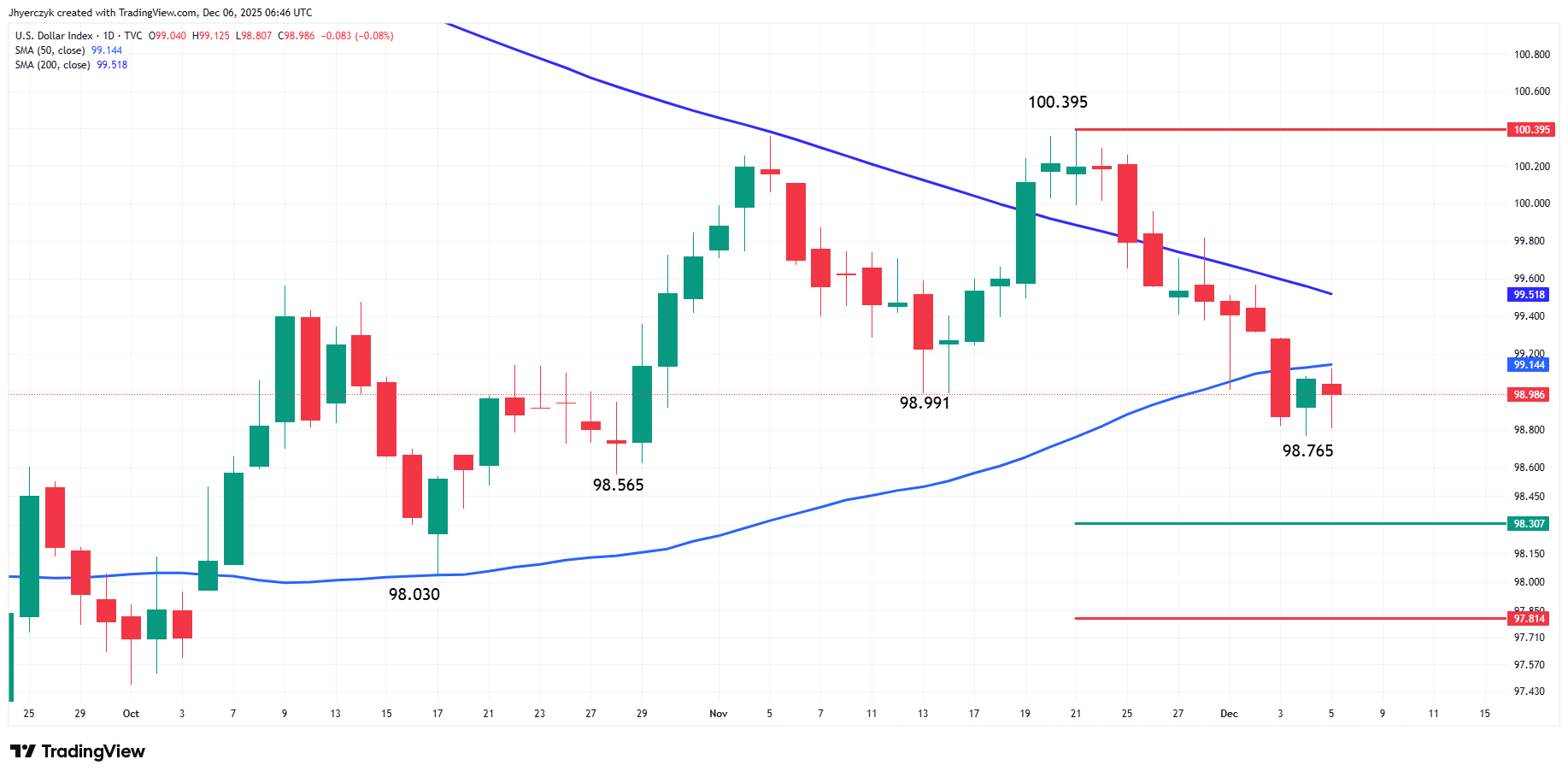
The index held above Thursday’s 98.765 low and the October 28 bottom at 98.565, keeping key support intact. The main downside marker remains the 98.307–97.814 retracement zone. Overhead, the 50-day moving average at 99.144 capped every bounce, while the 200-day at 99.518 sat as the next major barrier. Friday’s close under 99.00 reinforced the bearish tone.
Bears Still Control the Trend Into FOMC
As long as price stays below the 50-day, the short-term view stays bearish, with sellers comfortable pressing weakness heading into the Fed.
More Information in our Economic Calendar.