
USDJPY 2026 Forecast: Policy Divergence, Political Risk, and the Limits of Yen Weakness
The USDJPY enters 2026 at a pivotal point, shaped by a Federal Reserve that is close to ending its easing cycle and a Bank of Japan that is only cautiously exiting decades of ultra-loose policy. With interest-rate differentials still heavily in the dollar’s favor and Japan’s political environment complicating monetary tightening, the coming year is set to test how far yen weakness can reasonably extend—and where policy makers may feel compelled to intervene.
The Federal Reserve’s final meeting of 2025 delivered a third straight 25 bp cut, bringing the funds rate to 3.50–3.75%. The 9–3 split vote underscored the committee’s uncertainty about inflation durability and labor-market cooling. Chair Jerome Powell signaled a pause, stressing that the Fed is “well positioned to wait and see,” but the late-2025 government shutdown left the central bank with an unusually thin data set. The Fed begins 2026 needing confirmation that inflation continues trending toward target without a deeper deterioration in employment.

Policy Divergence: The Core FX Driver
The primary anchor for USDJPY in 2026 remains the policy gap between the U.S. and Japan. While the Fed is nearing the end of its cutting cycle, the BoJ is only beginning its path toward normalization. Markets broadly expect a December 2025 BoJ hike to 0.75%, with potential for one additional move in late 2026 that could bring the policy rate to 1%. Even then, Japan would remain highly accommodative relative to global peers.
Governor Kazuo Ueda has referenced rising confidence that medium-term inflation projections can be met, but political conditions complicate the BoJ’s room to maneuver. Prime Minister Sanae Takaichi’s administration favors fiscal expansion and remains sensitive to the risk of repeating past tightening errors. As a result, investors largely expect a gradual, risk-managed approach to rate hikes, not a decisive campaign to realign real yields in favor of the yen.
The durability of the interest-rate differential—still one of the widest in the G-10—continues to support USDJPY through carry-trade demand and sustained foreign appetite for U.S. yields. Even with the Fed cutting again in early 2026, the terminal U.S. rate is likely to remain meaningfully above Japan’s, anchoring upward pressure on the pair.
Strategist Views: Divergent but Tilted Toward Dollar Strength
J.P. Morgan: Structural Yen Weakness
USD/JPY Price Forecast
Every new USD/JPY analysis as it publishes, today's technical signal and key levels, live price — on one page.
See all USD/JPY forecastsJ.P. Morgan offers the most dollar-bullish view, projecting USDJPY at 164 by end-2026. The bank cites persistent negative real rates in Japan, limited scope for aggressive BoJ tightening, and concerns about fiscal sustainability under Takaichi. Chief strategist Junya Tanase argues that as G-10 central banks near the end of their easing cycles, markets may struggle to find a catalyst for sustainable yen appreciation.
Goldman Sachs: Yield Differential Still Dominant
Goldman Sachs expects USDJPY to remain above 150 through much of 2026 under current rate and yield conditions. While the bank acknowledges scenarios in which yen strength returns—such as if U.S. growth slows sharply—its baseline maintains that Japanese rates will remain too low to engineer a meaningful reversal. Goldman expects the Fed to cut again in early 2026 but sees the U.S. terminal rate remaining structurally higher than Japan’s.
Independent Forecasts: Moderate Dollar Gains
Consensus forecasting services project a trading range of roughly 146–154 for 2026, with year-end expectations clustering around 151–157. Technical models identify support near 145–150 and resistance around 160, with seasonal volatility likely in the spring and summer months. These projections suggest continued but moderate dollar appreciation—less dramatic than 2024–2025 but still upward-biased.
MUFG: Expect a Correction
MUFG offers a contrarian view, arguing that the late-2025 yen selloff was excessive relative to actual BoJ policy risk. Their December outlook argues for a correction as markets reassess expectations for Japanese tightening and as global risk appetite moderates. MUFG sees potential for dips if U.S. data weakens or risk-off flows return.
ING: Range-Bound With Upside Risks
ING forecasts USDJPY probing the 155–160 area in 2026, though not necessarily holding those levels. The bank expects one BoJ hike in 2025 and possibly another in late 2026, taking the policy rate to around 1%. ING highlights the ongoing appeal of yen-funded carry trades in a low-volatility environment but warns that Japanese officials will likely increase verbal intervention above 155 and could intervene directly if USDJPY approaches 160.
Technical Analysis: Strong Uptrend but Vulnerable to Near-Term Pullback
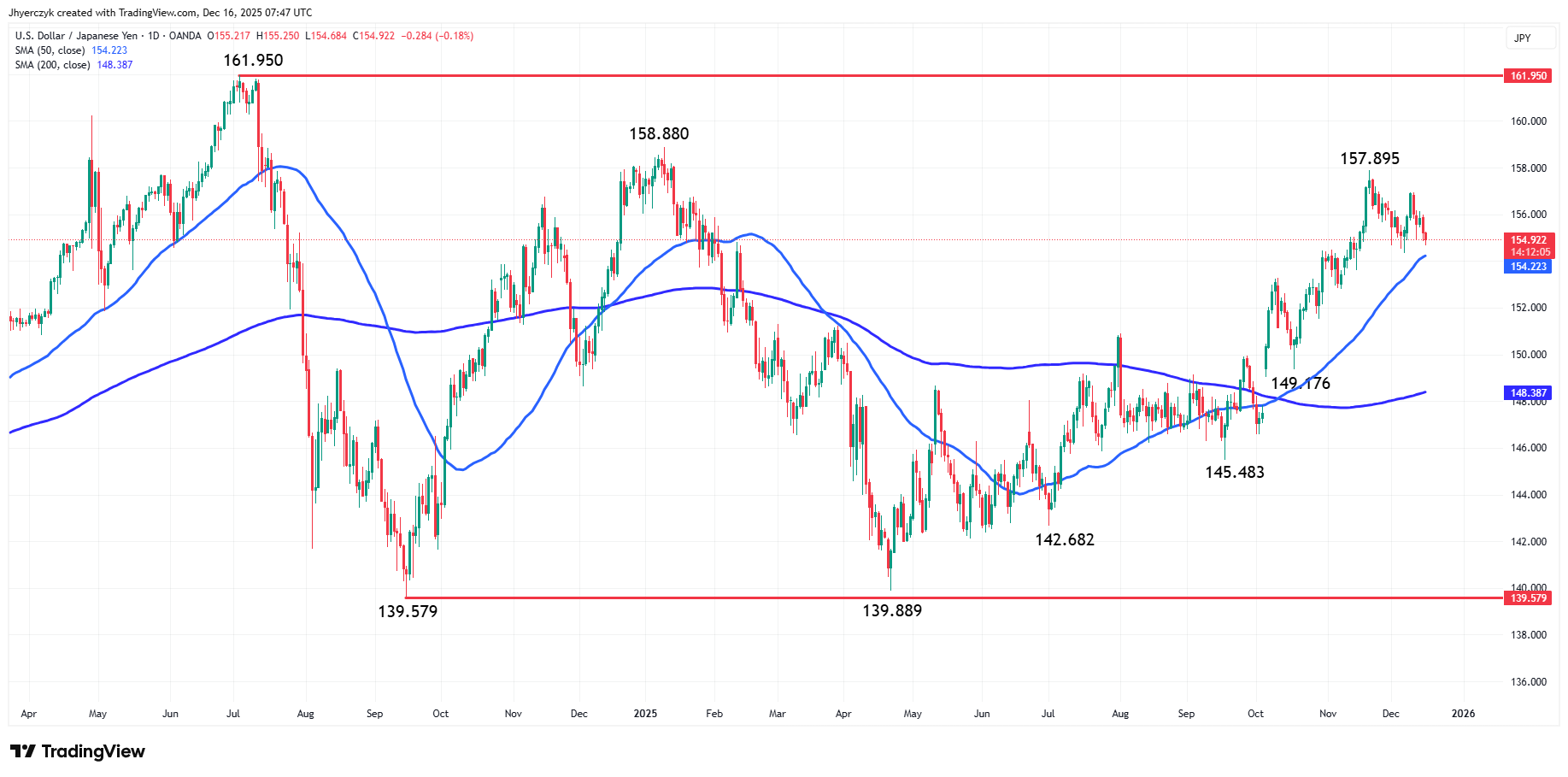
The daily chart indicates short-term weakness as we begin 2026. The first key test will be the reaction to the 50-day moving average at 154.223, which has been guiding the Forex pair higher since October 2025. Although a breakdown under the 50-day MA will create some downside momentum, it should eventually lead to a “buy the dip” opportunity because the 200-day MA at 148.387 is likely to remain intact, preserving the longer-term uptrend.
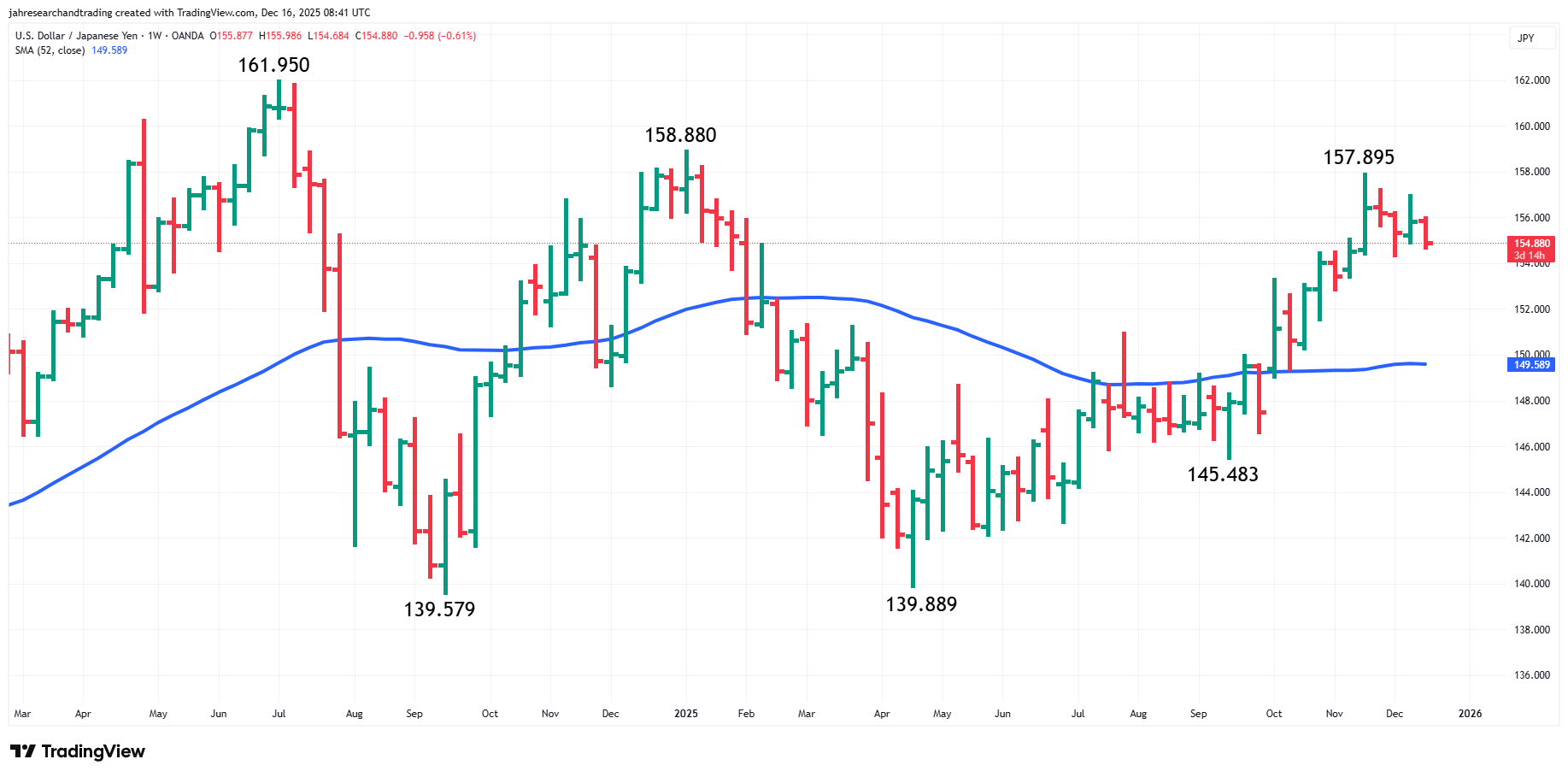
The weekly chart shows the USD/JPY well above the 52-week moving average at 149.589. This is creating a mixed signal, however. While it is indicating a solid uptrend, it is also showing a “hot” market, which may need a short-term correction to alleviate some of the upside pressure.
Like the daily chart, as long as the 52-week MA remains intact, any meaningful correction should create a buying opportunity.
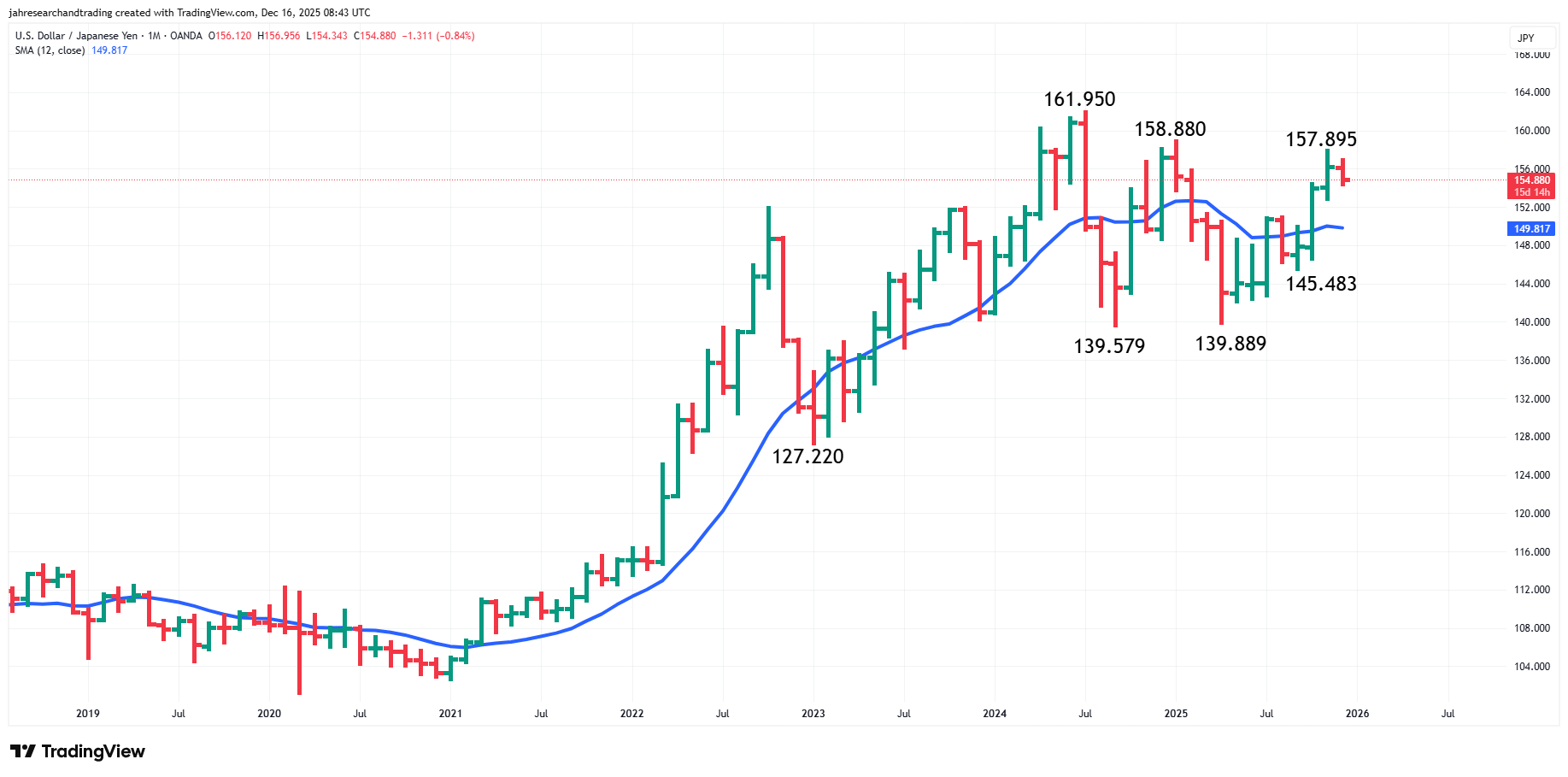
The monthly trend is also up with the 12-month moving average at 149.817 controlling the long-term trend and providing support. However, the three-descending tops at 157.895, 158.880 and 161.950 are creating major headwinds, which could be a problem throughout 2026.
Holding the 12-month MA will indicate the presence of buyers, but it may just be enough to hold the Forex pair in a trading range if upside momentum can’t take out those tops.
Meanwhile, a failure at the 12-month MA will signal building selling pressure which will put 145.483 and 139.579 on the radar.
Key Risks: Intervention, Labor Markets, and Global Sentiment
- Intervention Threat
A central theme for 2026 is how far Japanese authorities will allow yen weakness to go. Interventions in 2024 set a precedent, and officials have noted the inflationary contribution of a weak yen—estimated at 0.3–0.5 percentage points over 12 months. Markets expect stronger warnings above 155 and a high likelihood of direct intervention near 158–160.
- U.S. Labor Market Weakness
The unemployment rate’s rise to 4.4% late in 2025 raises the possibility of a sharper cooling in early 2026. If job losses accelerate, the Fed may resume cutting more aggressively than currently projected, narrowing yield spreads and weakening the dollar. Labor performance is now the most sensitive factor for the Fed’s early-2026 path.
- Global Equity Correction
USDJPY retains a strong correlation with global risk appetite. A correction in AI-driven equities or a broader defensive shift could generate yen strength, particularly versus high-beta currencies. Cross-yen pairs such as EURJPY and AUDJPY would likely respond quickly, with spillovers into USDJPY depending on the depth of the market move.
- Political Transition at the Fed
With Chair Powell’s term ending in mid-2026, markets face uncertainty around his successor. A Trump-appointed chair inclined toward faster rate cuts could alter expectations for U.S. yields, although institutional constraints limit how dramatic a shift could reasonably be. Even moderate differences in communication could influence spreads and FX pricing.
Investment and Hedging Implications
For corporates and institutional investors, 2026 calls for flexible hedging approaches. The baseline market view remains a strong dollar, but the risks around policy changes and intervention require scenario planning.
Japanese hedging costs should fall meaningfully as U.S. yields move lower—possibly by 100–125 bps—reducing the burden on domestic investors. This could gradually soften demand for USDJPY carry exposure but is unlikely to reverse flows on its own.
U.S. corporates with Japanese revenue exposure should prepare for another year of favorable FX translation but maintain contingency plans in case yen strength returns due to Fed dovishness or a risk-off shock.
Conclusion: A Dollar-Bias With Non-Trivial Risks
The USDJPY outlook for 2026 is defined by a tension between yield-differential support for the dollar and rising political and intervention risks that could cap gains. Strategist forecasts span from J.P. Morgan’s bullish 164 target to more moderate expectations around 151–157. The most plausible path is a year characterized by episodic volatility but a prevailing bias toward higher levels—so long as U.S. labor markets avoid a sharper downturn.
Market participants should monitor Fed communication closely, BoJ commentary on the pace of normalization, and any indication from Japanese authorities about tolerable yen levels. With intervention risks elevated and global sentiment fragile, 2026 may reward traders who prepare for a wider distribution of outcomes rather than relying on the recent trend alone.
More Information in our Economic Calendar.