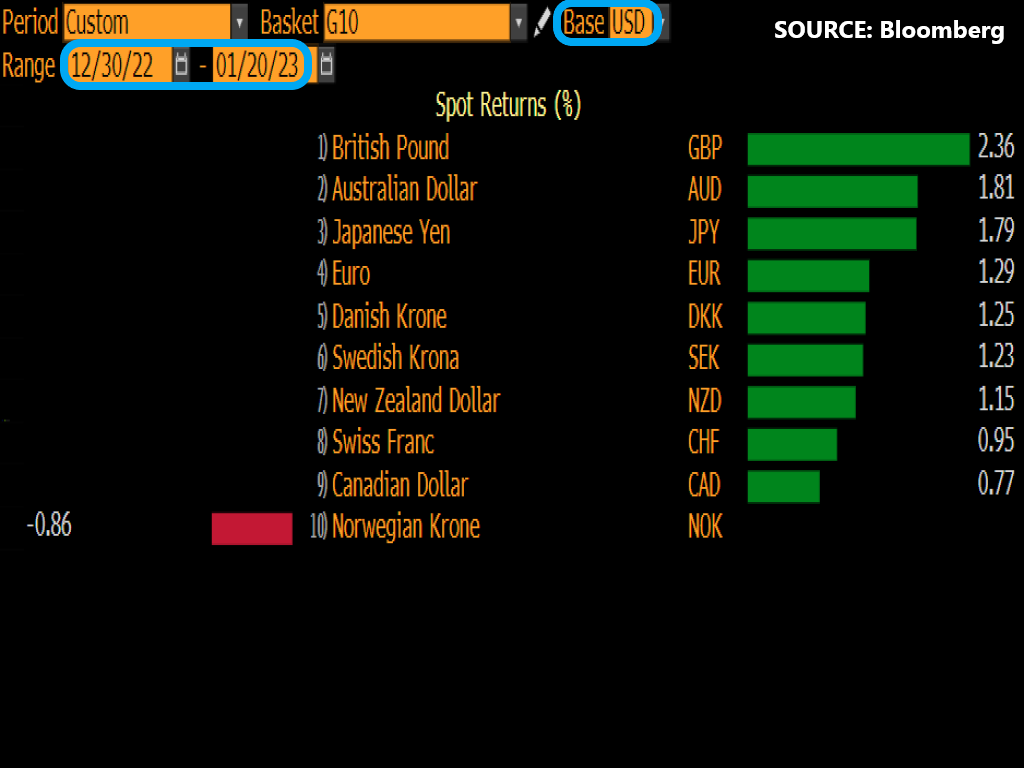
Only the Norwegian Krone, another oil-linked currency, has had it worse so far in 2023, with a 0.86% percent year-to-date decline versus the greenback at the time of writing.

Calendar for Next Week
CAD traders will be paying close attention to the Bank of Canada’s rate decision due in the coming week, alongside these major economic data releases and events:
Monday, January 23
- JPY: Bank of Japan December meeting minutes
- EUR: Eurozone January consumer confidence; ECB President Christine Lagarde speech
Tuesday, January 24
- AUD: Australia January PMIs, December business confidence
- EUR: Eurozone January PMIs
- GBP: UK January PMIs
- USD: US January PMIs
- Microsoft earnings
Wednesday, January 25
- NZD: New Zealand 4Q CPI
- AUD: Australia 4Q CPI
- JPY: Bank of Japan to announce amount of outright purchases of government securities
- EUR: Germany January IFO business climate
- CAD: Bank of Canada rate decision
- S&P 500: Earnings from Tesla, NextEra Energy, IBM
Thursday, January 26
- USD: US 4Q GDP; weekly initial jobless claims
- S&P 500: Earnings from Intel, American Airlines, Southwest Airlines, Mastercard, Visa
Friday, January 27
US Dollar Index Price Forecast
Every new US Dollar Index analysis as it publishes, today's technical signal and key levels, live price — on one page.
See all US Dollar Index forecasts- NZD: New Zealand January business confidence
- JPY: Japan Tokyo CPI
- USD: US December PCE deflator, personal income and spending; January consumer sentiment
Possible Scenarios at the BoC Meeting
The Bank of Canada (BoC) is expected to hike its benchmark rate by another 25 basis points (bps), with markets allocating a 74% chance of such an event occurring this Wednesday.
Alternative scenarios:
- If the BoC surprises with a larger-than-expected 50bps hike, that could send the Canadian dollar soaring, which would drag USDCAD lower.
- If the BoC surprises by pressing pause on its rate hikes, given that Canada’s inflation has been easing lower, that could pull the loonie lower while boosting USDCAD.
USDCAD: Key levels and Forecasts
RESISTANCE
- 1.35 area – where this pair’s 50-day and 100-day simple moving averages are currently converging alongside the 23.6% Fibonacci level from USDCAD’s runup between June 2021 – October 2022.
- 1.36 area – upper boundary of the downward slope from October’s high
- 1.37043 – mid-December high, though the path up to these levels could be choppy, given that it features varying price action throughout last month.
SUPPORT
- 1.332 – previous cycle low
- 1.322 – November low/38.2 Fibonacci level from USDCAD’s June 2021 – October 2022 runup
- 1.320 psychologically-important region – 200-day SMA/early-September cycle highs
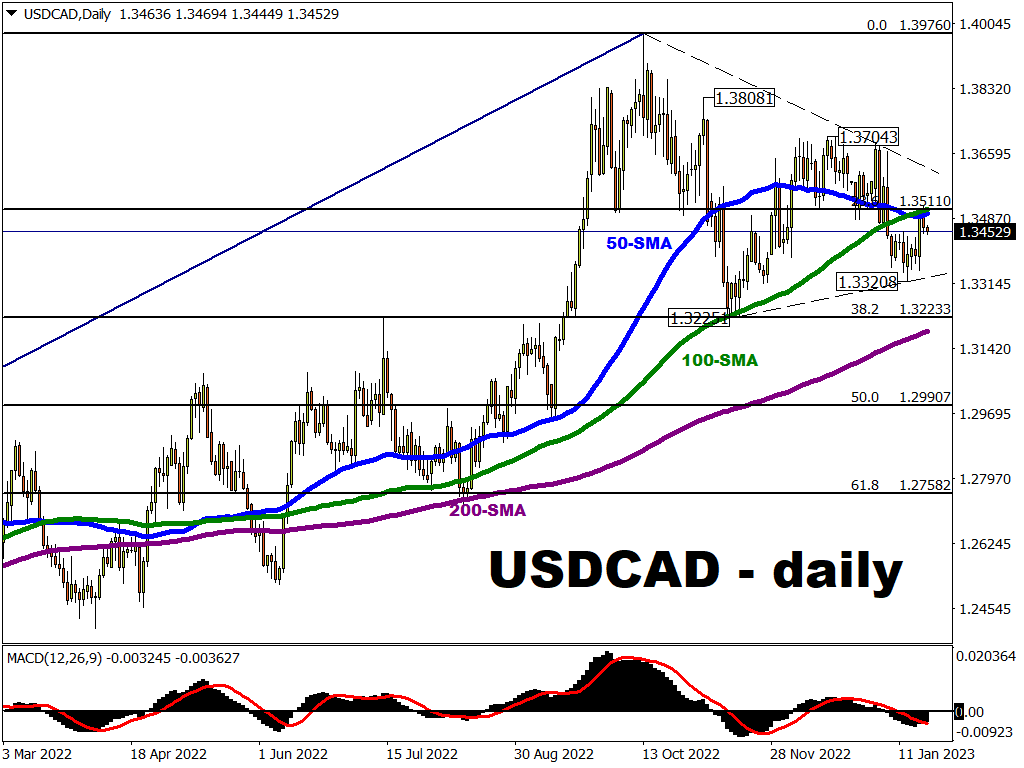
At the time of writing, markets are giving a slight edge for a downside move rather than an upside move for USDCAD.
Here are some forecasts for the next one-week period (from levels at the time of writing):
- 39% chance that USDCAD may touch 1.332 previous cycle low for support
- 35% chance that USDCAD will touch 1.360 resistance at upper boundary of downtrend
USDCAD: Fundamental Analysis
Next week’s BoC hike is expected to be the final such move in its policy tightening cycle.
The central bank’s rate hikes have already sent its overnight lending rate soaring by a cumulative 4 percentage points throughout all of last year, with this policy tightening campaign also featuring that gargantuan 100 basis point hike last July.
Why Had the BoC Been Hiking Rates So Aggressively?
Those aggressive hikes were done to quell a near 40-year high in inflation back in the summer of 2022. Canada’s recent bout of red-hot inflation peaked at 8.1% in June, which marked its highest print since January 1983!
However, since then, the consumer price index (CPI) has cooled down to 6.3% year-on-year for December 2022. On a month-on-month basis (comparing the Dec’22 figure with that of Nov’22), the CPI actually fell by 0.6% – its biggest drop since April 2020, at the onset of the pandemic.
BoC Forecasted to Pause After January Hike
Although CPI still remains far above the central bank’s 2% target, moderating inflation may soon bring the curtains down on the Bank of Canada’s rate-hike campaign.
And such dovish expectations have dampened the Canadian dollar’s performance, as cited at the top of this article.
After all, markets are forward-looking in nature. That means today’s prices for USDCAD are reflecting market expectations for what the respective central banks may or may not do in the future.
Also Focus on the USD Side of the USDCAD Equation
The US dollar is set to continue reacting to expectations surrounding the US Federal Reserve’s own rate decision due February 1st, exactly one week after the BoC’s rate decision.
As that keenly-awaited FOMC meeting looms closer, keep a close watch on:
- PCE Deflator – the Fed’s preferred inflation gauge – due Friday.If the December PCE deflator does not ease lower from November’s prints, pointing to stubborn inflation in the world’s largest economy, that could force the Fed to persist with a bigger rate hike than the mere 25bps liftoff currently priced in by the markets.
- Other key US economic data due in the coming week: US GDP, weekly initial jobless claims, and consumer income/spending/sentiment.Further signs of waning US economic growth momentum should weigh on the US Dollar, and drag USDCAD lower.
How Do Market Expectations Surrounding Fed vs. BoC Impact USDCAD?
And as an oversimplified breakdown:
- Fed to keep hiking rates while BoC slows down/pauses= stronger US dollar + weaker Canadian dollar
= USDCAD to move higher
- Bank of Canada to keep hiking rates while Fed slows down/pauses= stronger Canadian dollar + weaker US dollar
= USDCAD to move lower
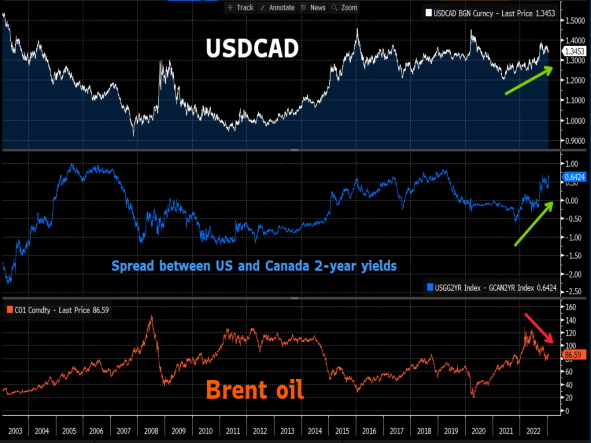
For added reference, here are two other markets that have a major bearing on USDCAD:
- The difference in yields between US and Canadian 2-year bonds
(Rising US vs. Canada spreads = weaker CAD = rising USDCAD; and vice versa) - Brent oil
(Lower oil prices = weaker CAD = rising USDCAD; and vice versa)
Here’s a look back at how these markets have moved largely in tandem over the past 20 years:
For more information visit FXTM.