Throw into that mix: the latest inflation data out of major economies such as the US and the UK.

All that could make for some spicy market action, with FX pairs involving the US dollar, euro, and the British Pound perhaps feeling the burn going into 2023.
Economic Calendar for Next Week
Here’s a list of the main economic data releases and events that could rock markets next week:
Monday, December 12
- JPY: Japan November PPI
- GBP: UK October monthly GDP, industrial production, manufacturing production
Tuesday, December 13
- AUD: Australia November household spending, December consumer confidence
- EUR: Germany November CPI (final print), December ZEW survey expectations
- GBP: UK October unemployment rate, November jobless claims
- USD: US November CPI – consumer price index
Wednesday, December 14
- GBP: UK November CPI
- EUR: Eurozone October industrial production
- USD: Fed rate decision
- Crude: EIA weekly oil inventories
Thursday, December 15
- NZD: New Zealand Q3 GDP
- AUD: Australia November unemployment, December inflation expectations
- CNH: China medium-term lending rate; November industrial production, retail sales, jobless rate
- CHF: Swiss National Bank rate decision
- NOK: Norway’s Norges Bank rate decision
- GBP: Bank of England rate decision
- EUR: European Central Bank rate decision
- USD: US weekly initial jobless claims, November retail sales, industrial production
Friday, December 16
- AUD: Australia December PMIs
- GBP: UK November retail sales; December PMIs and consumer confidence
- S&P 500: ‘Triple witching day’ for US markets
- USD: Deadline for avoiding US government shutdown
Markets are widely expecting a 50-bps hike respectively by the US Federal Reserve, the European Central Bank, and the Bank of England.
Anything other than a 50bps hike would be a surprise for markets, and likely translating into shock moves for USD, EUR, and/or GBP currency pairs.
A 50bps adjustment would also mark a “downshift” for these big 3 central banks, who had each hiked by 75bps at their previous meetings.
Focus on the Fed
As always, the Fed remains front and centre, given that it’s the most influential central bank in the world.
Consider how the rest of the FX world has found some relief from the US dollar’s declines over the past couple of months.
That’s largely due to markets becoming increasingly hopeful the eventual “downshift” (opting for smaller-sized rate hikes) by the Fed.
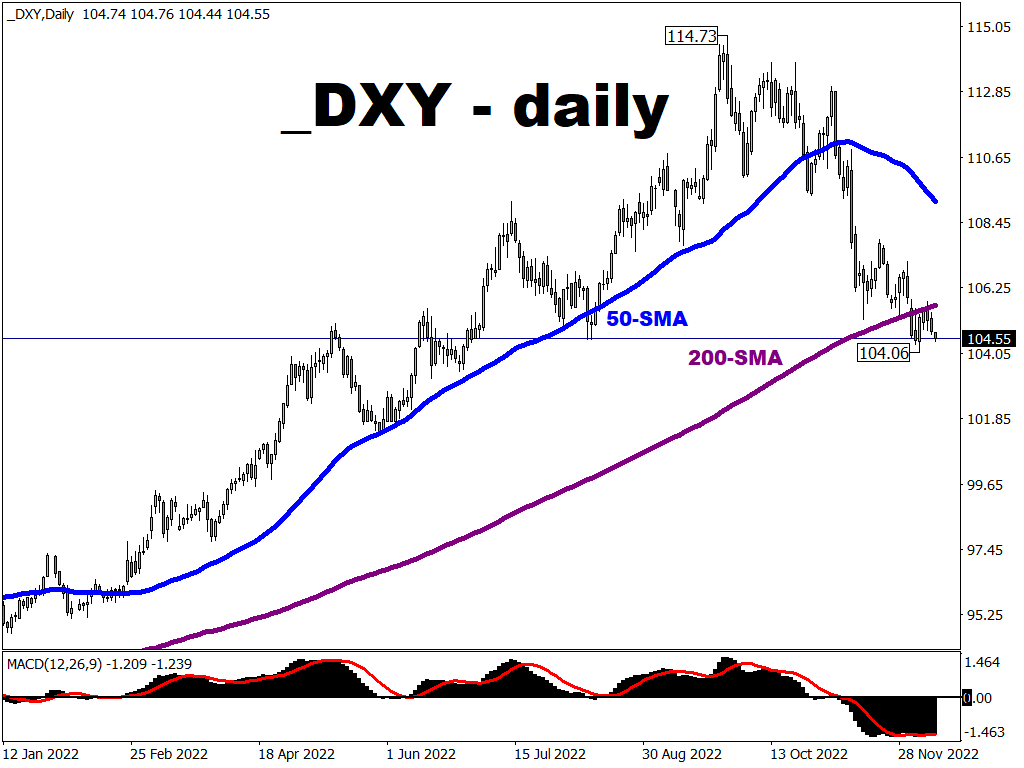
Such expectations have halved the benchmark US Dollar index’s year-to-date gains, from as much as 20% now down to 9.3% at the time of writing.
Watch What Central Bankers Say and Do
Markets are ready to react not just to what these central banks will do to their respective benchmark rates next week, but also to what each of these central banks say about their intentions on rate adjustments in 2023.
These policy outlooks will of course be informed by the latest figures on inflation, which we know is enemy #1 for these central bankers.
Hence, if we do see a higher-than-7.3% US CPI print next week, that should pave the way for the Fed to keep hiking its benchmark rates for longer.
Such a narrative could fuel a rebound for the US dollar, especially if Fed Chair Jerome Powell can convince markets once more of the central bank’s ultra-hawkish intentions.
Yet, we note that such a rebound for the greenback may prove limited and fleeting.
Looking back at the earlier DXY chart, the dollar’s rebound may be capped once more at its 200-day simple moving average (SMA).
From a fundamental perspective, the dollar’s rebound may run out of steam especially if markets persist with hopes on the eventual Fed “pivot”, despite what Powell may say to the contrary.
Brace for Potentially Imminent Volatility
Overall, it remains to be seen which central bank can sound the most hawkish (intend to send its own benchmark rate higher) between the Fed, ECB, or the BOE.
And it’s the currency of that more-hawkish central bank that may outperform next week, and through year-end.
For more information visit FXTM.