
XRP extends its losing streak to six consecutive sessions amid profit-taking as market focus turns to the upcoming Market Structure Bill markup.
Fading bets on a March Fed rate cut and news of a potential delay to the US Senate Agriculture Committee markup weighed on investor sentiment. However, increased XRP utility, demand for XRP-spot ETFs, and hopes that the US Senate Banking Committee will clear text for the Market Structure Bill cushioned the downside.
Despite a pullback from a January 6 high of $2.4151, XRP has gained 11.5% year-to-date, supporting a bullish medium-term price outlook.
Below, I will explore the key drivers behind recent price trends, the medium-term (4-8 weeks) outlook, and the key technical levels traders should watch.

Ripple CEO Signals Boost to XRP Real-World Utility
Brad Garlinghouse, Ripple’s CEO, reflected on a strong 2025, driven by the end of the SEC’s legal battle against Ripple. The Ripple CEO sent a positive message on X (formerly Twitter), stating:
“To say that 2025 (and Q4) were successful for Ripple feels like saying Tom Brady was just a great quarterback!!! (#theGOAT). Our two major acquisitions – Ripple Prime and GTreasury – greatly accelerated our ability to deliver on our vision, enabling the Internet of Value. XRP has been (and will continue to be) the heartbeat of that vision. With truly the most comprehensive licensing portfolio (and now today UK’s EMI license added) we are poised to make 2026 even more consequential.”
Garlinghouse continued to reiterate XRP’s crucial role in Ripple’s expansion plans, signaling increased real-world XRP utility. Analysts view XRP’s real-world utility as a key driver of institutional demand through the US XRP-spot ETF market.
Garlinghouse added:
“Building and using crypto infrastructure. Updating our global financial plumbing, and rethinking legacy systems – none of this happens overnight. At Ripple, we’re going to continue taking the long view of what crypto-based assets – like XRP and RLUSD – can do, rather than chasing cycles and hype. Bring on 2026. We are firing on all cylinders. It’s happening!”
Ripple Senior Executive Officer / Managing Director, Middle East & Africa, Reece Merrick, underpinned Garlinghouse’s message, stating:
Bitcoin Price Forecast
Every new Bitcoin analysis as it publishes, today's technical signal and key levels, live price — on one page.
See all Bitcoin forecasts“It’s hard to describe the energy at Ripple right now. 2025 was foundational, but with the acquisitions made, and now the UK EMI license in the mix, 2026 is looking like a total game changer.”
XRP-Spot ETFs Demand Underscores Positive Outlook
Ripple’s strides onto Main Street and XRP’s central role have bolstered demand for XRP-spot ETFs, tilting the supply-demand balance in XRP’s favor.
The US XRP-spot ETF market has seen $1.22 billion in net inflows since its launch in mid-2025. According to SoSo Value, the Canary XRP ETF continued to dominate, with $393.66 million in net inflows, benefiting from a first-to-market advantage. Nevertheless, Bitwise XRP ETF (XRP), Franklin XRP ETF (XRPZ), and Grayscale XRP ETF (GXRP) have also seen strong demand.
However, 21Shares XRP ETF (TOXR), the newest of the spot ETFs, reported net outflows of $7.77 million since launch, potentially delaying filings for new XRP-spot ETFs.

XRP Decoupling Underway Despite ETF Issuer Activity
Notably, WisdomTree withdrew its S-1 for an XRP-spot ETF last week, while Morgan Stanley filed S-1s for BTC-spot and SOL-spot ETFs. The ETF issuers’ stance on XRP came despite the XRP-spot ETF market outperforming the US BTC-spot and SOL-spot ETF markets.
For context, the US SOL-spot ETF market reported $816.92 million in net inflows since the October launch. Meanwhile, the US BTC-spot ETF market saw net outflows of $2.94 billion since the Canary XRP ETF launched on November 14.
Canary Funds CEO Steve McClurg expects XRP to diverge from BTC and the broader crypto market in 2026, stating:
“XRP, I believe, is going to be a divergent asset, actually. […] Altcoins typically follow Bitcoin, but there are a handful of assets that I do believe will diverge in this manner and just watching XRP perform as everything’s going straight down and we continue to get inflows every day and continue to hold up, I believe that it could look like another peak in XRP in 2026, when most of other crypto assets are going to be down.”
Notably, crypto market price trends in early 2026 suggest an XRP decoupling is already underway. While XRP has risen 11.5% year-to-date, BTC has gained 4.51%, while the total crypto market cap has increased 5.15%.
Increased XRP utility, strong demand for XRP-spot ETFs, and the Market Structure Bill’s progress on Capitol Hill continue supporting a cautiously bullish short-term (1-4 weeks) and bullish medium-term (4-8 weeks) price outlook.
Market Structure Bill Crucial for XRP Demand
While XRP-spot ETF demand and XRP utility are crucial for XRP’s price outlook, the Market Structure Bill’s progress on Capitol Hill remains key.
This week, the market focus will be on the US Senate Banking Committee’s January 15 Market Structure Bill markup. XRP remains highly sensitive to crypto-related regulatory developments, given the resolution of the SEC vs. Ripple case in August 2025.
Over the weekend, the US Senate Banking Committee fueled optimism over the Market Structure Bill, stating:
“Chairman Senator Tim Scott is moving forward on digital asset market structure legislation – delivering clear rules that protect Main Street, keep innovation here at home, and safeguard US national security.”
The approved draft text from the US Senate Banking Committee would shift the market focus to the US Senate Agriculture Committee, which also needs to clear text for merging.
A Senate floor vote on the merged text would be the next step. If passed, the US House of Representatives would need to then pass the Bill to President Trump. The timing of the rollout of crypto-friendly legislation may ultimately hinge on whether the House makes changes to the merged text.
Crypto in America host Eleanor Terrett recently commented on the timings, stating:
“And March is the absolute earliest. Could even be the summer if the House decided to make changes to what the Senate sends them.”
Importantly, delays to the Market Structure Bill’s progress would challenge XRP’s bullish outlook, given previous price action.
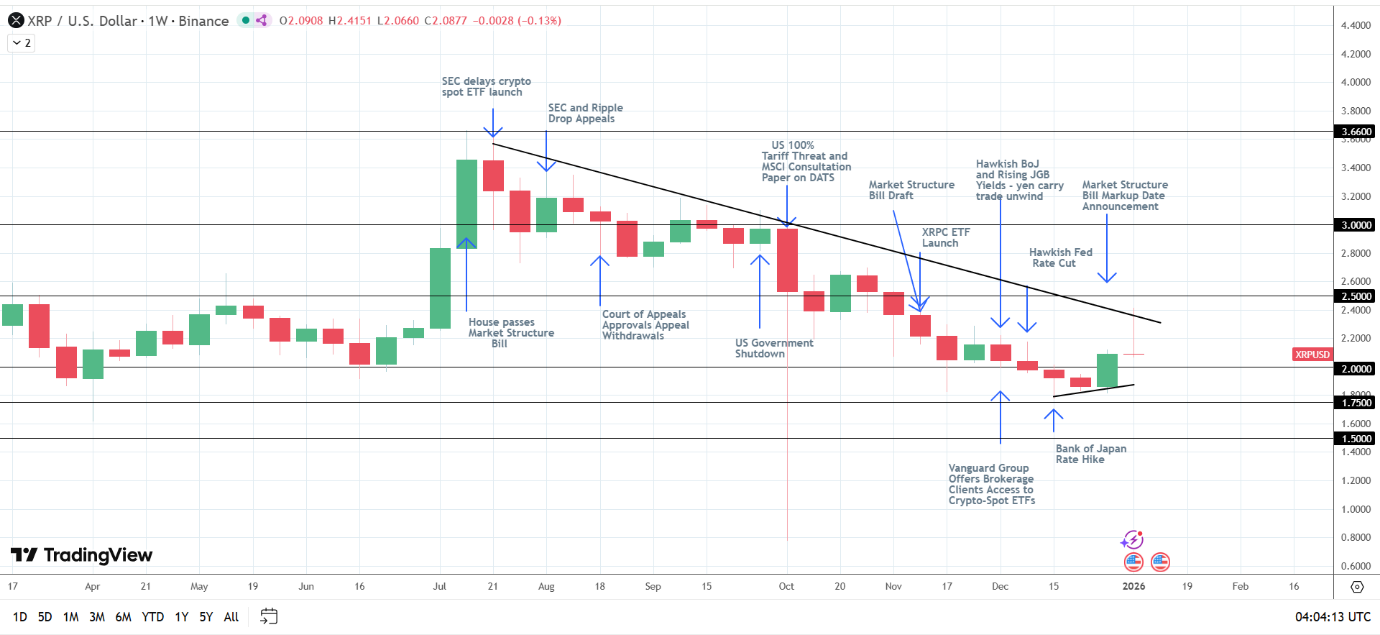
For context, XRP surged 14.69% on July 17 after the House passed the Market Structure Bill to the Senate. However, the US government shutdown stalled the Bill’s progress in H2 2025. XRP fell from a July 18 all-time high of $3.66 to a December low of $1.7712 before the January recovery.
XRP Bullish Price Outlook and Targets
Strong demand for XRP-spot ETFs, increased XRP real-world utility, and the progress of the Market Structure Bill reaffirm a cautiously bullish short-term (1-4 weeks) outlook, with a $2.5 price target.
Meanwhile, increased optimism over the Senate passing the Market Structure Bill reinforces the positive longer-term price targets:
- Medium-term (4-8 weeks): $3.0.
- Longer-term (8-12 weeks): $3.66.
Key Risks to Bullish Scenario
Several events could derail the positive outlook. These include:
- The Bank of Japan announces a hawkish neutral interest rate (1.5%-2.5%), signaling multiple rate hikes. A higher neutral rate would likely trigger a yen carry trade unwind, which would challenge the short-term outlook.
- US economic data and the Fed are tempering expectations of an H1 2026 rate cut.
- Market Structure Bill faces partisan opposition.
- XRP-spot ETFs report outflows.
These events would likely lead to a sharper decline, sending XRP below $2, which would indicate a bearish trend reversal.
Technical Analysis: Key Levels to Watch
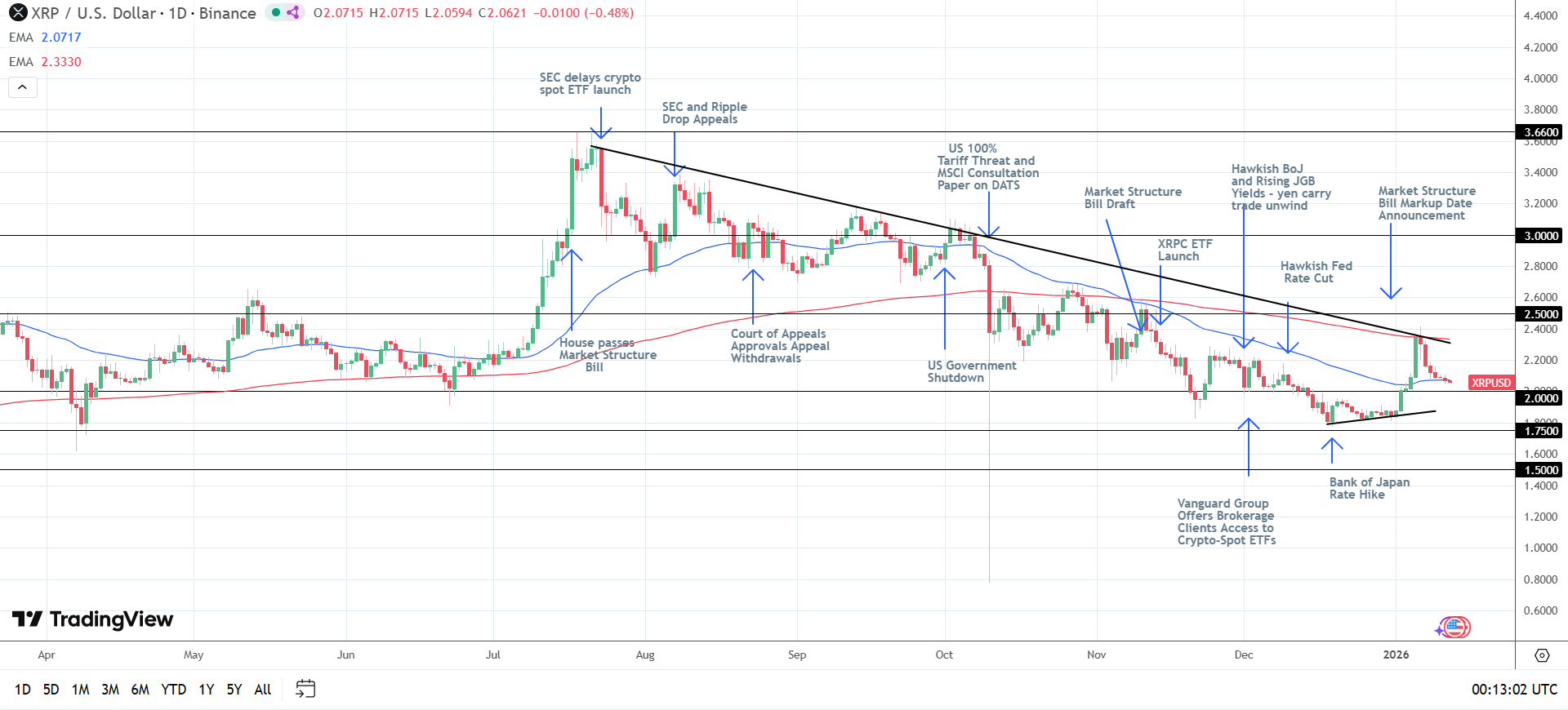
XRP fell 0.79% on Sunday, January 11, following the previous day’s 0.19% loss, closing at $2.0721. The token underperformed the broader crypto market cap, which gained 0.55%.
Six consecutive daily losses left XRP below the 50-day and 200-day EMAs, suggesting a bearish longer-term bias. Despite the technicals, the fundamentals remain bullish and dominate.
Key technical levels to watch include:
- Support levels: $2.0, $1.75, and then $1.50.
- 50-day EMA resistance: $2.0717.
- 200-day EMA resistance: $2.3330.
- Resistance levels: $2.5, $3.0, and $3.66.
Viewing the daily chart, a breakout above the 50-day EMA would open the door to testing $2.2. A move through $2.2 would bring the 200-day EMA into play. A sustained move through the EMAs would signal a bullish trend reversal, paving the way to the $2.5 resistance level.
Crucially, a breakout above the EMAs would reaffirm the bullish medium-term outlook and the longer-term (8-12 weeks) $3.66 price target.
Fundamental Drivers to Monitor
Near-term price drivers include:
- XRP-spot ETF flow trends.
- US economic indicators and the Fed’s policy stance.
- US crypto-related legislative developments.
Avoiding Sub-$2 Remains Crucial
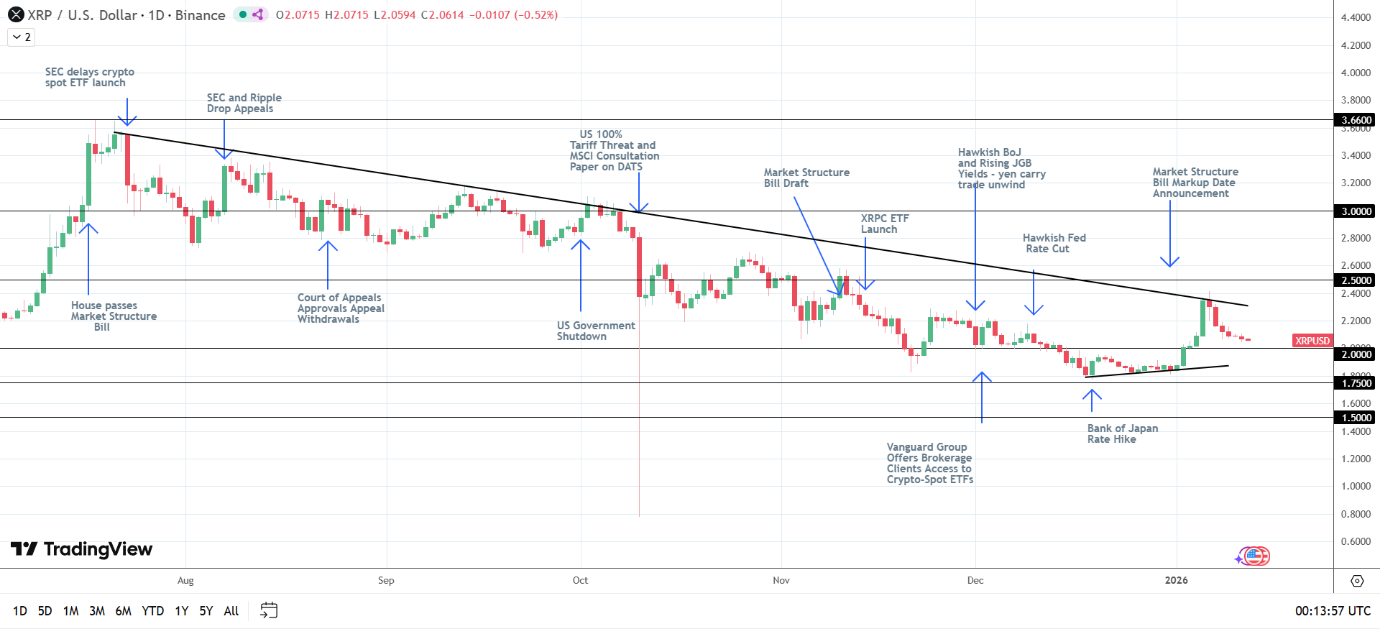
Holding above the $2 psychological support level will be key for the short- to medium-term outlook. Bullish fundamentals continue to counter bearish technicals, suggesting a rebound. Despite this recent pullback, January’s gains have affirmed the bullish structure and constructive short- to medium-term bias.
A break above $2.2 would bring the upper trendline into play. A sustained move through the upper trendline would affirm the bullish trend reversal and validate the bullish structure, supporting the price targets:
- Medium-term (4-8 weeks): $3.0.
- Longer-term (8–12 weeks): target of $3.66.
However, a break below $2.0 would expose the lower trendline. A breach of the lower trendline would invalidate the bullish structure, indicating a bearish trend reversal.
Outlook:
Looking ahead, this week’s US CPI report, central bank chatter, crypto-related regulatory headlines, and XRP-spot ETF flows will dictate the near-term price outlook.
Softer US inflation, rising bets on a March Fed rate cut, and a dovish BoJ neutral rate (1%-1.25%) would likely boost sentiment. Strong demand for XRP-spot ETFs and bipartisan support for the Market Structure Bill would reinforce the constructive bias.
In summary, institutional demand for XRP-spot ETFs and crypto-related legislative developments support a medium-term (4–8 weeks) move to $3.0. A March Fed rate cut and the Senate passing the Market Structure Bill would affirm the longer-term (8–12 weeks) price target of $3.66.
Looking beyond 12 weeks, these events are likely to send XRP above its all-time high $3.66. A break above $3.66 would reinforce a price target of $5 over a 6- to 12-month horizon.