
XRP resumes its downward trajectory as market focus shifts from Trump tariffs to crypto legislative developments.
On January 21, President Trump withdrew his threat of a 10% tariff on eight European NATO members, easing fears of an all-out trade war. XRP bounced off key support on the news, briefly reclaiming $1.98.
However, ongoing delays to much-needed US crypto legislation continued to weigh on sentiment. Last week, the US Senate Banking Committee postponed its markup vote, triggering an XRP pullback. This week, the US Senate Agriculture Committee released its draft text of the Market Structure Bill in the absence of bipartisan support, suggesting further delays to crypto legislation.
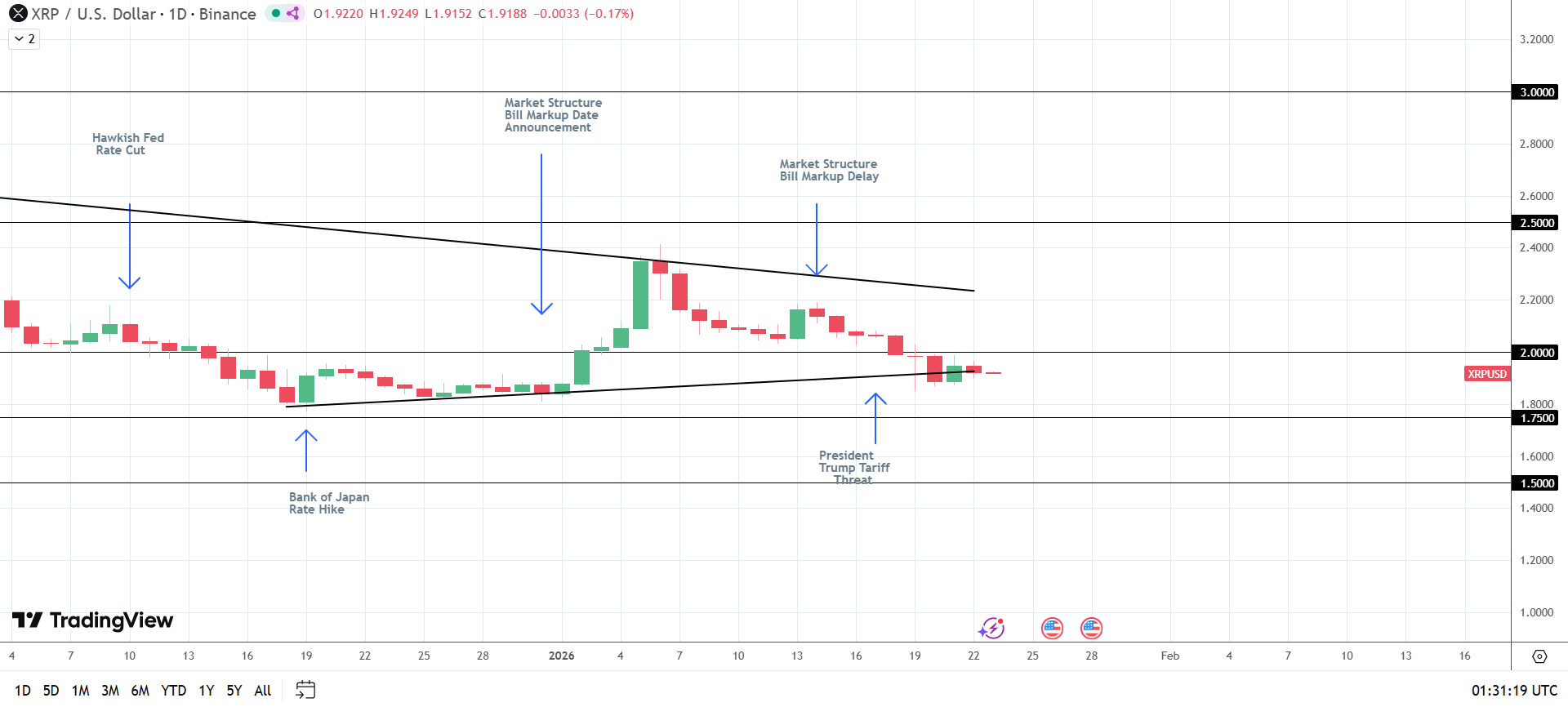
Despite headwinds from crypto-related legislative developments, the medium-term outlook for XRP remains bullish. XRP-spot ETF inflows, increased XRP utility, and expectations that the Senate will eventually pass the Market Structure Bill are key tailwinds.
Below, I will explore the key drivers behind recent price trends, the medium-term (4-8 weeks) outlook, and the key technical levels traders should watch.

US Senate Agriculture Committee Draft Text Fuels Legislative Uncertainties
The US Senate Agriculture Committee released its draft text of the Market Structure Bill on January 21, before the January 23 deadline. However, Committee Chairman John Boozman indicated that the draft text lacked Democratic Party support, stating:
“I appreciate Senator Booker and his staff for working with us and providing thoughtful additions as we advance consumer protections and provide new authority to the CFTC. While differences remain on fundamental policy issues, this bill builds on our bipartisan discussion draft while incorporating input from stakeholders and represents months of work. Although it’s unfortunate that we couldn’t reach an agreement, I’m grateful for the collaboration that has made this legislation better.”
Market disappointment over Chairman Boozman’s comments and the Democrats’ stance on the bill was evident. Bitcoin (BTC) investor Wayne Vaughan, with over 27,000 followers on X (formerly Twitter), quipped:
“Democrats are trying to kill crypto.”
Others noted that the January 27 markup is likely to be a non-event, given the lack of bipartisan support for the draft text.
Bitcoin Price Forecast
Every new Bitcoin analysis as it publishes, today's technical signal and key levels, live price — on one page.
See all Bitcoin forecastsSenate Banking Committee Delay Adds to US Crypto Regulatory Headwinds
Crypto in America host Eleanor Terrett shared the current state of play on crypto legislation, stating:
“So the text is now effectively a Republican product, with no Democrats on the committee publicly supporting it […]. This means that next Tuesday’s markup may result in the legislation passing out of committee on party lines, a stark contrast to the bill’s House Committee on Agriculture counterpart, where Clarity advanced with a heavily bipartisan 47–6 vote.”
Despite the party lines, Senator Cory Booker (D-NJ) reportedly stated that he will continue working with Boozman to get the legislation passed and signed into law.
While Senator Booker gave an optimistic spin on next week’s markup vote, the Senate Banking Committee’s postponement could prove lengthy. Eleanor Terrett stated:
“Unfortunately for the industry, it appears last week’s narrow window may have been the final chance to get a committee markup done before late February or early March. […] Both the White House and the Banking Committee have indicated that Coinbase and the banks need to reach a deal before formal talks can resume.”
For context, the Banking Committee postponed its markup after Coinbase (COIN) withdrew its support for the Banking Committee’s draft text of the Market Structure Bill. Coinbase CEO Brian Armstrong highlighted several issues with the draft text, including regulations for stablecoin yields. US banks have opposed legislation allowing stablecoin yields, given the risk of depositor outflows impacting net interest margins and profits.
Despite the delays, the progress of the Market Structure Bill remains key to XRP’s bullish short- to medium-term outlook.
XRP Price Forecast: Short-, Medium-, and Long-Term Targets
Robust demand for XRP-spot ETFs and increased XRP utility affirm a positive short-term outlook (1-4 weeks), with a target price of $2.5. Expectations that the Senate will eventually pass the Market Structure Bill continue to bolster demand for XRP. These tailwinds reaffirm the bullish longer-term price targets:
- Medium-term (4-8 weeks): $3.0.
- Longer-term (8-12 weeks): $3.66.
Key Downside Risks to the Bullish XRP Outlook
Several factors could challenge the positive outlook. These include:
- The Bank of Japan announces a hawkish neutral interest rate (potentially 1.5%-2.5%), indicating multiple rate hikes. A higher neutral rate may trigger a yen carry trade unwind, as seen in mid-2024. A yen carry trade unwind would invalidate the short-term outlook. The Bank of Japan will announce its monetary policy decision on January 23.
- Cooling bets on an H1 2026 Fed rate cut.
- Extended delays to the Market Structure Bill.
- XRP-spot ETFs report outflows.
These factors would weigh on risk assets, sending XRP below $1.85, which would signal a bearish trend reversal.
Technical Analysis: Levels to Watch
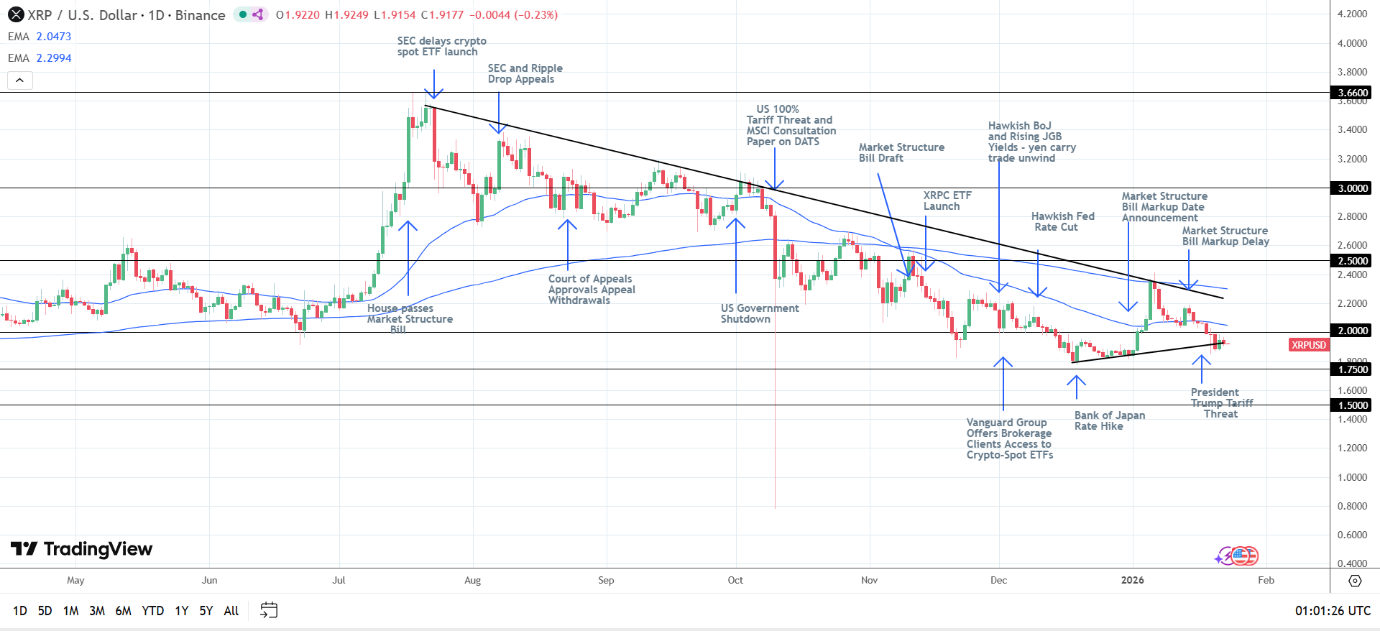
XRP fell 1.24% on Thursday, January 22, partially reversing the previous day’s 3.13% rally to close at $1.9221. The token saw heavier losses than the broader crypto market cap, which dropped 0.11%.
Recent losses left XRP trading below its 50-day and 200-day EMAs, signaling a bearish bias. However, the bullish fundamentals continue to offset bearish technicals, affirming the positive outlook.
Key technical levels to watch include:
- Support levels: $1.85, $1.75, and then $1.50.
- 50-day EMA resistance: $2.0473.
- 200-day EMA resistance: $2.2994.
- Resistance levels: $2.0, $2.5, $3.0, and $3.66.
On the daily chart, a break above $2.0 would enable the bulls to target the 50-day EMA. A sustained move through the 50-day EMA would indicate a near-term bullish trend reversal. Furthermore, a bullish trend reversal would bring $2.2 into play. A breakout above $2.2 would open the door to testing the 200-day EMA.
A sustained move through the EMAs would reinforce the bullish medium- and longer-term price targets.
Fundamental Events Driving Near-Term Price Action
Near-term price drivers include:
- XRP-spot ETF flows.
- US economic data and the Fed’s rate path.
- US crypto-related regulatory developments.
- The Bank of Japan’s rate path.
$2 Is Key for XRP’s Bullish Structure
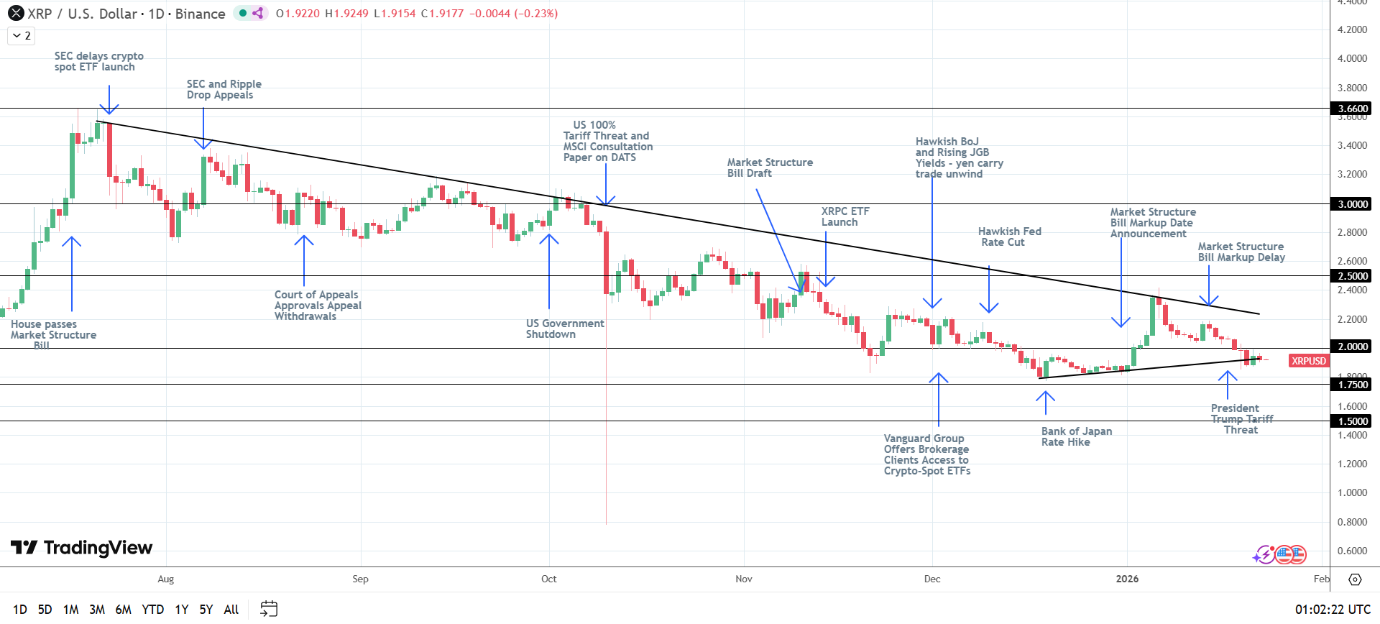
Reclaiming $2 will be crucial for the short- to medium-term outlook after avoiding sub-$1.85 in the January pullback. The bullish fundamentals, outlined above, continue to counter bearish technicals, indicating a near-term rebound. XRP’s recovery from a December low of $1.7712 and January gains of 4.23% affirmed the bullish structure and short- to medium-term price projections.
A break above $2.0 would pave the way toward the upper trendline. A sustained move through the upper trendline would affirm the bullish trend reversal and validate the bullish structure, supporting the price targets:
- Medium-term (4-8 weeks): $3.0.
- Longer-term (8–12 weeks): target of $3.66.
However, a sustained fall through the lower trendline to sub-$1.85 levels would invalidate the bullish structure, indicating a bearish trend reversal.
XRP Outlook Hinges on Crypto Regulations, ETFs, and Central Banks
Looking ahead, the market focus will be on the Bank of Japan’s looming monetary policy decision. A hawkish BoJ policy stance and rising 10-year Japanese Government Bond (JGB) yields would likely weigh on demand for XRP. Hints of multiple BoJ rate hikes would suggest narrower US-Japan rate differentials.
However, US economic data and XRP-spot ETF flows will also influence the near-term price outlook.
Rising bets on an H1 2026 Fed rate cut, and a dovish BoJ neutral rate (potentially 1%-1.25%) would lift sentiment. Strong demand for XRP-spot ETFs, increased XRP utility, and the progress of the Market Structure Bill would reinforce the constructive bias.
In summary, these scenarios support a medium-term (4–8 weeks) move to $3.0. Furthermore, the US Senate’s passing the Market Structure Bill would reinforce the longer-term (8–12 weeks) price target of $3.66.
Beyond 12 weeks, favorable developments are likely to send XRP to its all-time high of $3.66 (Binance). A breakout above $3.66 would support a 6- to 12-month price target of $5.