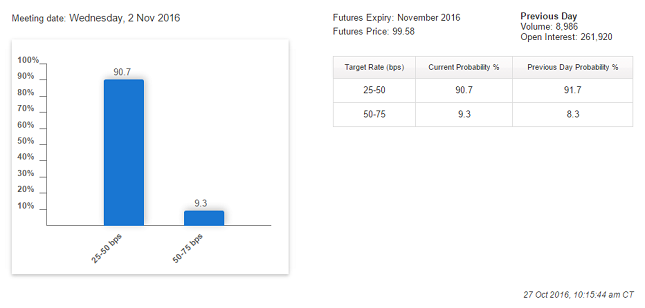
The Federal Open Market Committee (FOMC) will be meeting and deciding on U.S. monetary policy on November 1-2, 2016. Although the market is already pricing in a high probability of an unchanged Fed Funds target range in November, the Fed could surprise the markets. The CME Group 30-Day Fed Fund futures prices indicate a 90.7% probability that rates will be between 25 basis points (bps) and 50 basis points, unchanged from the previous meeting. Market participants are only placing a 9.3% probability of the Fed raising rates by 25 bps in its November meeting.
One thing’s for sure, whatever the FOMC says about interest rates, those statements could shake the gold market. If the FOMC is looking to raise rates in December 2016 and 2017, gold prices may fall.
Now, FOMC members have been suggesting an interest rate hike in December. Even doves are arguing for a possible December rate hike. For example, New York Fed President William Dudley, a dove, is looking to raise rates in December. Given the timing of the November meeting, which is six days prior to the U.S. Presidential election, the Fed could drastically change its monetary policy.
Fed is Looking for Reasons to Raise Rates
The U.S. Weekly Jobless Claims Report was released on October 27, 2016 at 8:30 AM ET, and new claims fell by 3,000, week over week. New claims for the week ending on October 22, 2016 came in at 258,000, which was slightly above the consensus estimate of 255,000. The trailing four-week average is 253,000. Jobless claims have been steadily trending lower over the past two years, indicating a strengthening job market.
Although the FOMC is closely following the trend in jobs numbers, it’s also focused on inflation. If inflation increases to the Fed’s target of 2% and the economy continues to strengthen, then the FOMC has strong arguments to raise rates.
How a Rate Hike Will Affect Gold Prices
If the FOMC decides to raise rates in December, the value of the U.S. dollar will be boosted. When the Fed raises the Fed Funds target range, it helps to reduce inflationary pressure, and consequently, this action appreciates the dollar.
The idea behind falling gold prices in a rising interest rate environment is simple. Investors and market participants will be more attracted to fixed income securities, and therefore, more money will flow into these higher yielding investments. Now, where will this money flow out from? A plethora of assets and securities, but gold may be one of the primary investments that investors are willing to sell due to its large capital drain. This will cause selling pressure in gold, and in turn, a fall in demand.
According to the most accurate bullion forecaster in the third quarter, Chinese Banking Corp., the Fed will most likely raise rates in December and two more times in 2017, which will strengthen the U.S. dollar and weaken gold.
Economist Barnabas Gan indicated that gold prices will fall each quarter next year, and ultimately fall to $1,100 per troy ounce in the fourth quarter of 2017. Gan stated, “With the strong correlation gold has with the dollar, the likely higher interest rate environment and the consequent firmer greenback should underpin a bearish case for gold next year.”
If the Fed decides to raise rates in December, or even surprises the markets by raising rates in November, gold prices should see a slight drop. However, the uncertainty of the outcome of the U.S. Presidential election should still bolster gold prices, for now.
According the Chicago Fed President Charles Evans, the Fed could raise rates three times between November 2016 and the end of 2017, as long as the labor market and inflation expectations continue to improve.
Joe Rundle, head of trading at ETX Capital noted, “Gold prices will most likely remain slightly above $1,250 per troy ounce until the end of 2016. However, looking at the current situation of the Fed and statements made by some Fed officials, gold will most likely fall near $1,000 per troy ounce by the end of 2017.”
The Bottom Line
You should keep an eye out on the Fed’s comments and monetary policy meetings over the next few months to get an idea on the timing of interest rates. Any statements made by the Fed could uncover trading opportunities in the FX and commodity markets.