


After years of dominance, it is our belief that the U.S. dollar is headed lower in 2026. Last year’s price action gave us a little taste of what is to follow when the greenback dropped 8%, its worst performance since 2017. We’re basing our assessment on not just one factor, but on multiple catalysts that could hit the dollar at the same time this year.
We’re not alone in our outlook either. We’ve discovered that most major banks also support our stance, along with billionaire hedge fund manager Ray Dalio, who continues to flag climbing debt as a major issue capping the dollar’s appreciation and weighing on support.
Jaime Martinez Medina, Global Market Strategist at PU Prime commented:
After several years of sustained strength, the U.S. dollar appears increasingly vulnerable heading into 2026. Following an 8% decline last year, its weakest performance since 2017, a growing set of macro and policy-driven forces suggest that the greenback’s long bull run may be nearing exhaustion. This view is now widely shared across the Street, with major investment banks and prominent investors pointing to a structural shift rather than a temporary correction.
A key driver is the Federal Reserve’s dovish pivot. After delivering three rate cuts in 2025, policy rates now sit well below their peak, and markets continue to price additional easing ahead. As the Fed prioritizes labor market stability over inflation risks, the interest-rate support that once underpinned the dollar is fading. In contrast, the European Central Bank has signaled that rates are close to their terminal level, setting the stage for a narrowing yield differential that favors the euro.
This yield convergence is already influencing capital flows. As U.S. growth momentum cools and European investment prospects improve, particularly amid renewed infrastructure spending in Germany, international investors are gradually reducing exposure to U.S. assets. Several banks now forecast EUR/USD moving toward the 1.20-1.25 range, with little conviction left in bullish dollar scenarios.
Structural concerns add further pressure. Rapid debt accumulation in the U.S. is raising long-term sustainability questions, a risk highlighted by Ray Dalio, who warns that rising deficits undermine confidence in dollar-based assets. At the same time, foreign demand for U.S. Treasuries is showing early signs of diversification, while central banks continue to increase gold allocations.
Finally, policy uncertainty around tariffs and questions surrounding Fed independence represent additional headwinds. From a technical perspective, the dollar index remains below key long-term support levels, reinforcing the bearish case.
Taken together, rate differentials, capital flows, debt dynamics, and policy credibility are all moving against the dollar, suggesting that 2026 may mark a broader reset after years of exceptional dominance.
The Fed’s Dovish Pivot: Rate Cuts Signal Dollar Weakness
The first bearish factor is expectations of dovish Fed policy. The Fed made three rate cuts in 2025, with 25-basis-point reductions coming in September, October, and December. We are entering the new year with federal funds sitting at 3.50%-3.75%. The current CME FedWatch tool is projecting roughly 3% downside by December. A move like that could exert significant pressure on the dollar.
Europe’s Rate Floor: The ECB Draws a Line
On the other side of the coin, the European Central Bank (ECB) appears to be finished with its rate cuts. ECB President Lagarde even went on the record stating that 2% is the terminal level.
US Dollar Index Price Forecast
Every new US Dollar Index analysis as it publishes, today's technical signal and key levels, live price — on one page.
See all US Dollar Index forecastsThe Great Yield Convergence: Capital Flows Reversing Course
What does this mean? It means the spread between U.S. Treasury yields and European yields is tightening, weakening the greenback and strengthening the euro. Whether the move leads to a divergence or U.S. yields falling below European yields, capital will move quickly out of the U.S. and into Europe. And how do they do that? They sell dollars and buy euros.
At this time, we’re standing with the Fed in calling for at least one rate cut in 2026; the market is pricing in two. This should have limited impact on the dollar during the first half of the year. Morgan Stanley, on the other hand, expects the Fed to cut more aggressively than current pricing implies. They’re even forecasting a 5% drop in the dollar in the first half of the year alone.
The First Key Takeaway: Rate Differentials Are Flipping
The first key takeaway: favorable rate differentials have carried the dollar for years, but are now preparing to flip, making the euro the more desired currency. Once the differential flips, it usually trends in the new direction, rather than moving back and forth.
Europe Is No Longer a Drag: Germany’s Infrastructure Awakening
Living in the United States, I’ve always been structurally bullish on the dollar over the euro. However, my thinking is shifting. Germany is finally spending on real infrastructure deals. This should lead to stable growth in the eurozone at a time when United States growth slows. Once again, advantage euro—with Goldman forecasting 1.25 EUR/USD by year-end. JPMorgan is eyeing closer to 1.20, along with Bank of America, but one should note that no one is making a bullish call for the dollar.
Goldman also brought up some interesting points, saying that European investors are reducing exposure to U.S. assets because they aren’t worth the risk. As I said before, capital outflows are not positive for the dollar.
The Debt Death Spiral: America’s $1 Trillion Problem
I also see U.S. debt as a major factor capping gains in the dollar and generating the pressure to drive the greenback sharply lower. According to government data, the U.S. is adding close to $1 trillion in debt every 75 days. This cannot be sustainable over the long run. Hedge fund manager Ray Dalio calls it the “debt death spiral.” He argues that the world is changing fast, with China rotating slowly out of U.S. Treasuries and into gold. Other countries may be following this strategy as well.
Foreign Demand Cracks: When Small Players Diversify, Bear Markets Form
China is the most visible country implementing this play, but the Council on Foreign Relations recently noted that while Treasury markets remain orderly, weakening foreign demand continues to appear as a recurring risk. Dollar bears begin to take notice when the smaller players start diversifying their portfolios.
The Vanishing Growth Premium: U.S. Exceptionalism Fades
A third factor that could weigh on the dollar in 2026 is the shrinking U.S. growth premium. For years, overperforming U.S. growth had carried the dollar, but conditions have changed. Manufacturing has been contracting for nine consecutive months. Services are cooling. Unemployment is rising, and inflation is hovering just under 3.0%. Some may argue that this is acceptable, but no longer exceptional.
Meanwhile, overseas growth is improving. Historically, the dollar weakens when global growth broadens. The growth premium is shrinking, and once it disappears, the currencies will adjust quickly—and it’s going to be difficult for the economy to dig itself out of the hole.
Tariffs and Stagflation: Policy Headwinds Mount
U.S. government policy is also a bearish factor influencing the outlook for the dollar. Tariffs appear to be the main drag on the economy, according to Goldman. The firm estimates that each 1% increase in tariffs adds 0.1% to inflation while cutting 0.05% from GDP. To the economist, that’s a mild case of stagflation.
Another expert, the Tax Foundation, estimates a $1,400 household cost in 2026. Higher prices, lower real incomes, slower growth—it all adds up to a weaker dollar.
The Fed Independence Question: When Politics Threatens Price Stability
The last factor and perhaps the most concerning is Fed independence. Global and domestic investors see Trump’s public pressure on Fed Chair Powell and discussion of replacements as a risk of a politicized Fed. If markets begin to price policy decisions driven by growth optics rather than price stability, confidence can erode quickly. Such a shift could undermine the monetary order, according to Dalio.
When Support Becomes Resistance: DXY’s Critical Break
One doesn’t have to be an expert chart reader to see the DXY is trading on the weak side of the mid-point of its 5-year range at 101.994. This area held as support for two years before finally being taken out with conviction in early 2025. We believe this move was the start of an even steeper break in 2026, with the 2025 low at 96.218 now in play. A break below this level could trigger an acceleration to the downside.
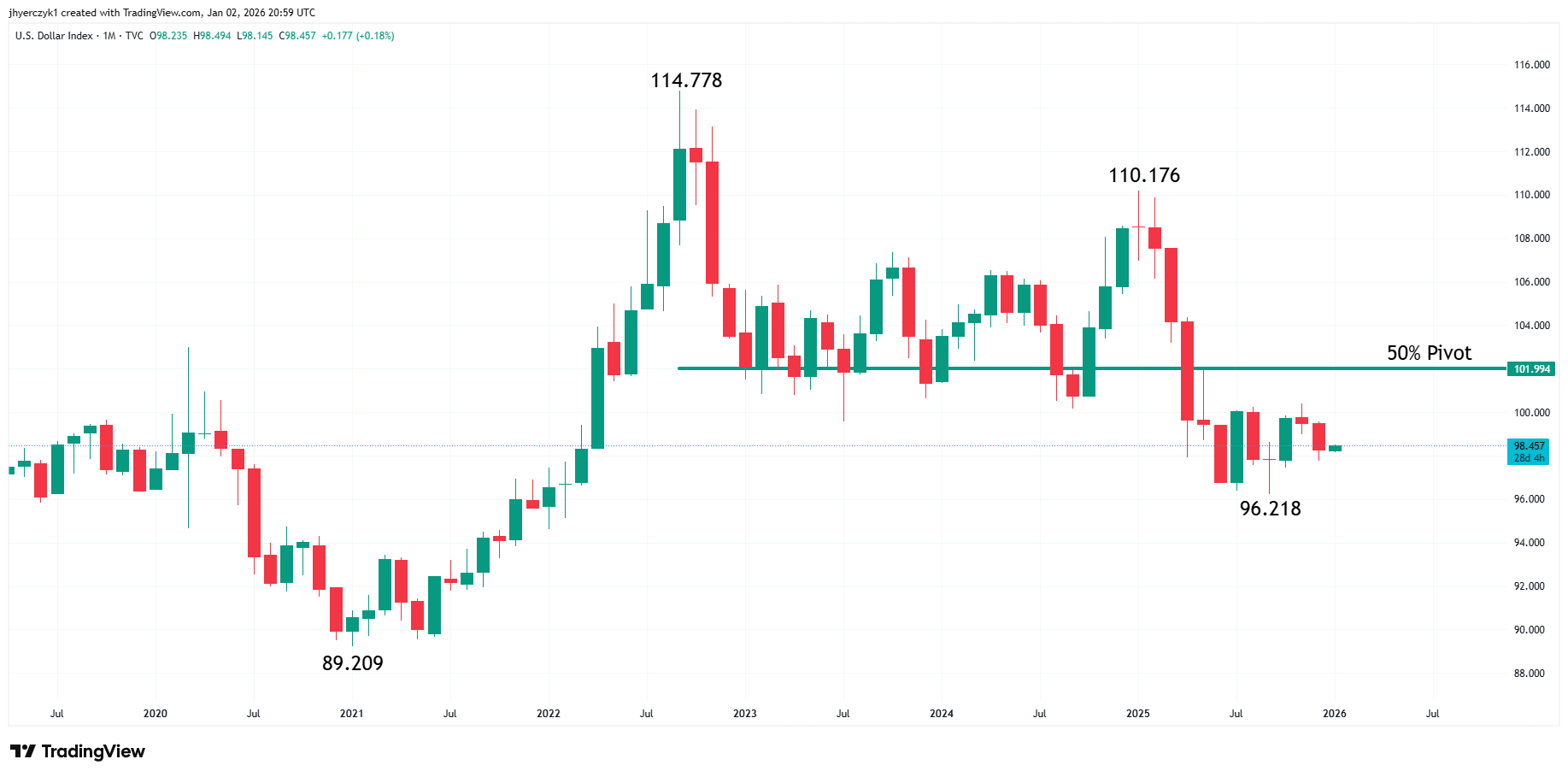
Monthly U.S. Dollar Index (DXY) Chart (Source: TradingView).
The Verdict: An Exhausted Bull Run Meets Consensus Bearishness
Looking ahead, the dollar’s bull run looks exhausted, which may mean that 2026 may be the year the rest of the market catches up. All major banks see further downside this year. Simply stated, debt, deficits, Fed credibility, and rate spreads are moving the wrong way to support the dollar.


