


The Australian share market had heavy losses during the start of the week as investors reacted to global economic uncertainty and rising tensions in energy markets. There was strong selling pressure in the S&P/ASX 200 during Monday’s session as investors rushed to hedge their risk after volatility of last week.
The index plunged 2.85% from 8,851 points on Friday to around 8,599 points. Weak sentiment from global markets also weighed on Australian equities following the lower end of last week on Wall Street.
Global Market Weakness Triggers Sharp Sell-Off
Global market conditions contributed significantly to sharp drop in Australian equities. Energy market disruptions and geopolitical uncertainty have raised fears for global economic stability. When investors are worried about the risks of economic growth and inflation, they tend to reduce their exposure to equities. This risk off sentiment spread rapidly through global markets and spilled over into the Australian trading session.
Weakness in US markets also contributed to negative momentum. The drop in the Dow Jones and Nasdaq showed that investors were already getting nervous before Australian market opened. When major global indexes are down, international investors tend to shift their portfolios across multiple markets. This tends to increase volatility in smaller markets such as Australia which is highly connected to global capital flows.
Sector Performance Shows Broad Market Weakness
The sell-off on Monday was broad based across most sectors of the ASX 200. Gold stocks suffered the most session decline. The All Ordinaries Gold Index dropped 5.18%, continuing the pessimism that had already set in last week. Mining shares were also heavily sold with the ASX 200 Materials Index falling 4.82%.
The chart below shows that the ASX 200 Materials Index dropped towards the strong support of 21,300. An ascending broadening wedge pattern formed since June 2025 lows. A break below 21,300 in Materials Index will trigger a strong drop in the ASX 200 due to the break of the ascending broadening wedge pattern.
NASDAQ 100 Price Forecast
Every new NASDAQ 100 analysis as it publishes, today's technical signal and key levels, live price — on one page.
See all NASDAQ 100 forecasts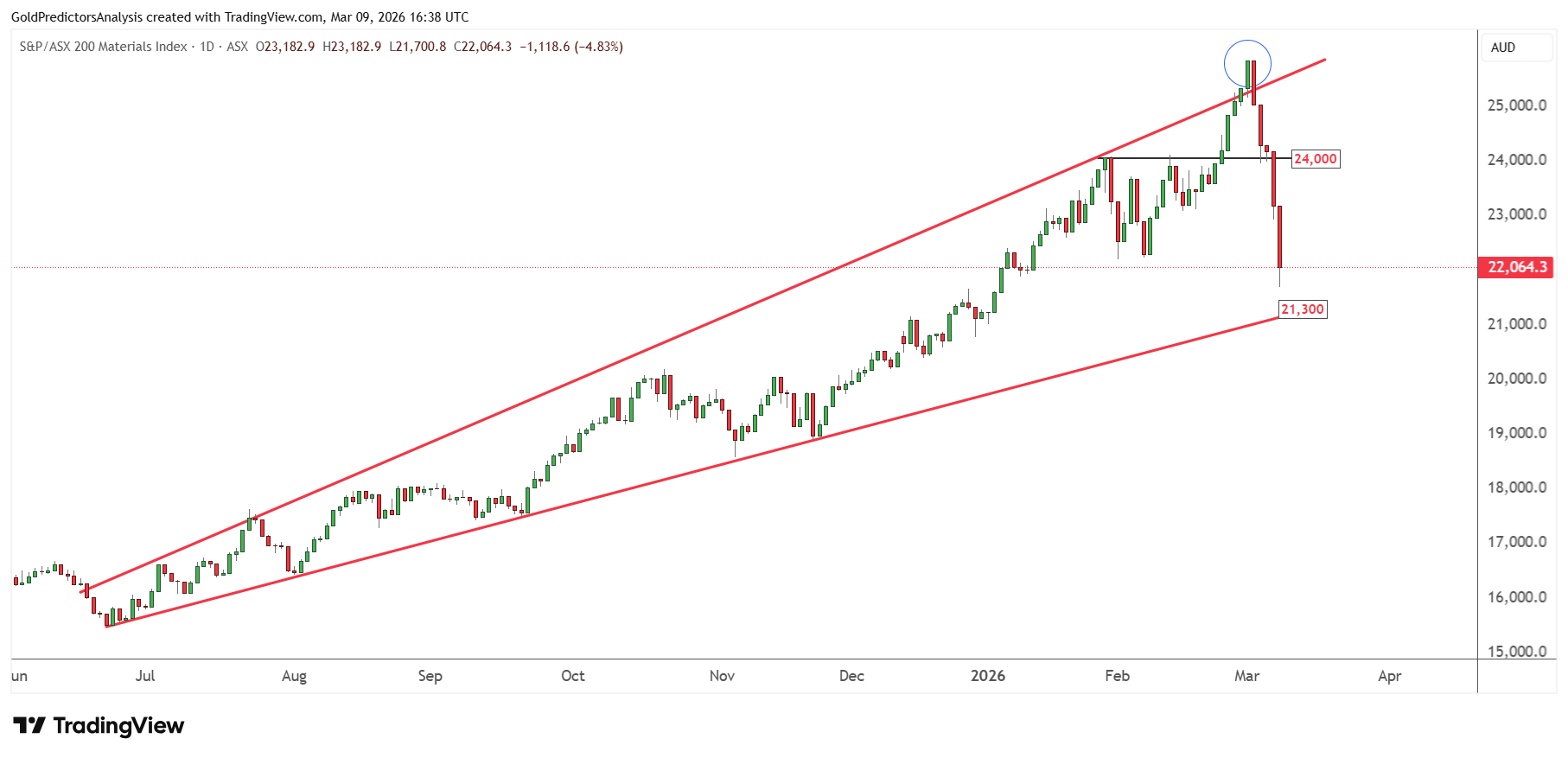
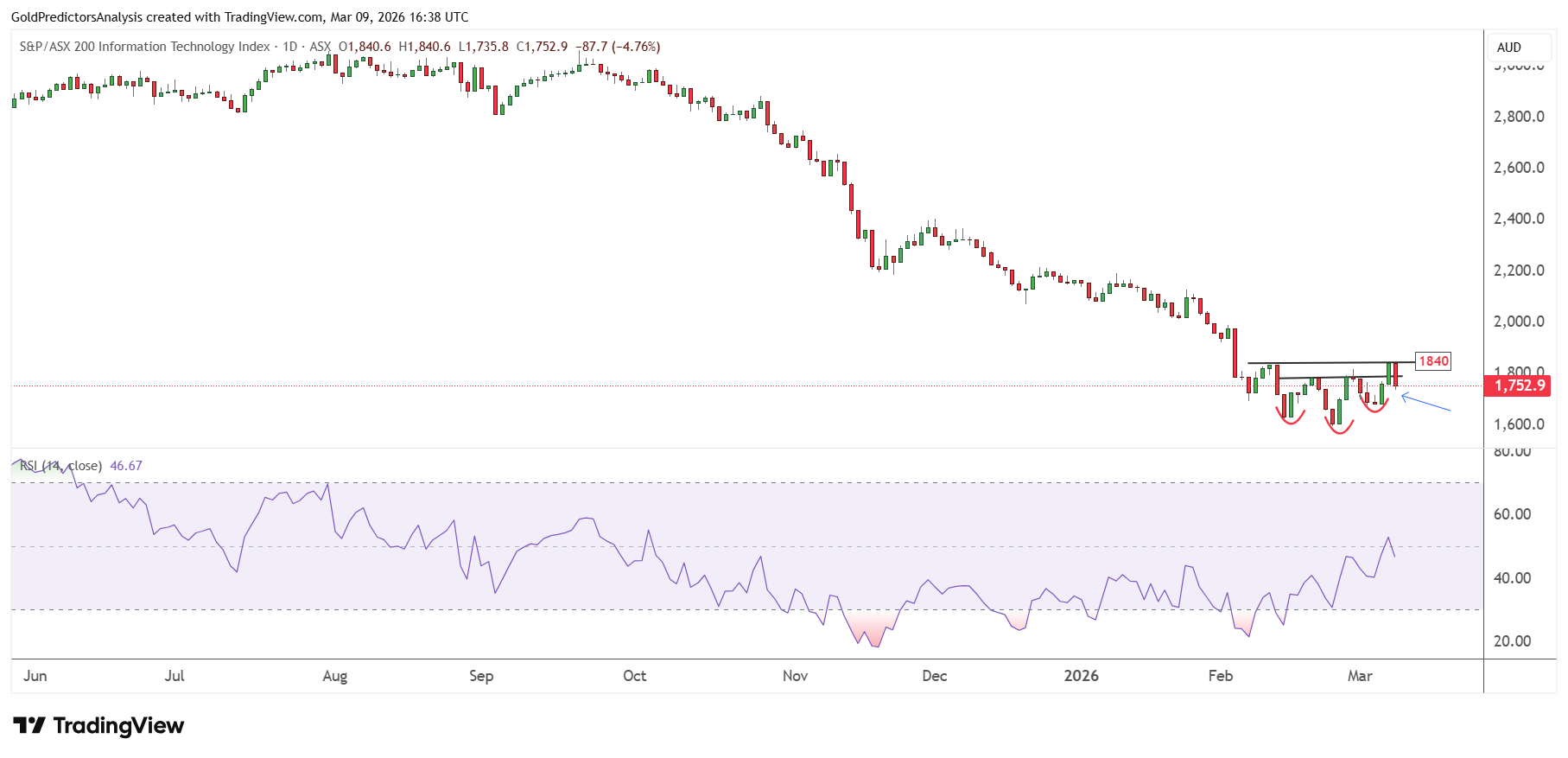
Technology stocks followed the downward trend with the ASX 200 Information Technology Index down 4.77%. According to the chart below, the Technology Index failed to break above 1,840 and continued downside following the broader weakness in the Australian share market. A beak below 1,600 in the Technology Index will further put downward pressure in ASX 200.
Other sectors also sent sharply lower as investors shied away from risk assets. The Industrials Index dropped 3.65%, and Healthcare Index dropped 3.24%. Consumer staples and consumer discretionary stocks dropped by more than 2% while financial shares fell by 2.06%.
Despite the sell-off in major sectors, the ASX 200 Energy Index increased 1.65% as higher energy prices favoured coal and energy producers. Yancoal Australia performed best on the index which gained 13.27% to $7.17 as investors moved towards energy companies amid the market turmoil.
ASX 200 Breaks Major Support as Bearish Pressure Builds
From technical perspective, the ASX 200 has broken the strong support of 8,700 and reached the 8,400 zone on Monday. This strong drop in the index has broken the 200-day SMA and has opened the door for further downside over the next few days as long as the index remains below 8,800. A break below 8,400 in the index will indicate further downside towards 7800–8,000.
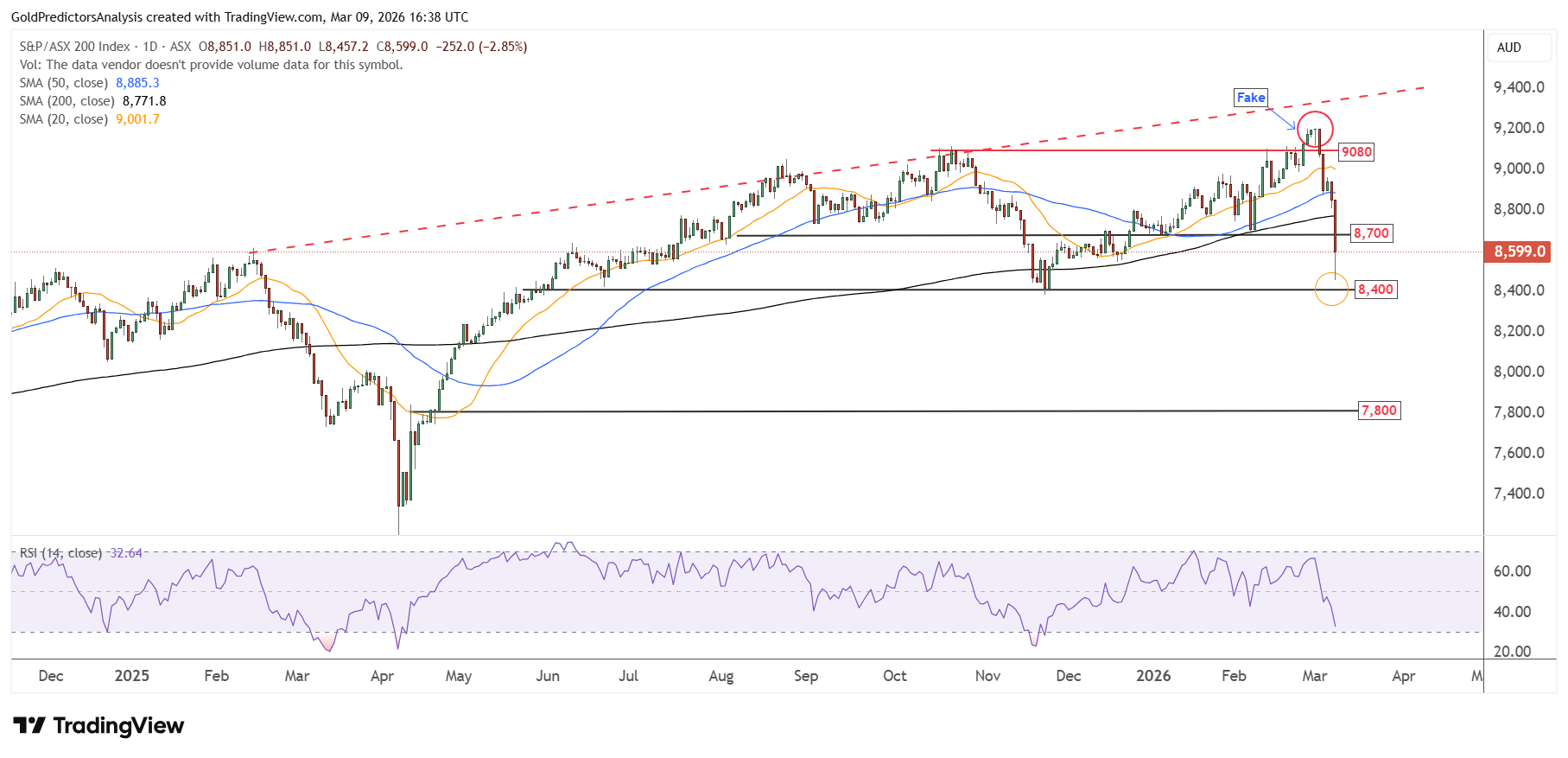
The breakout in the index above 9,080 was considered a false breakout. Therefore, the index remains under strong pressure to mark new lows. Investors should watch 8,400 for the next move.
On the other hand, the RSI is now approaching the oversold level but has not reached the extreme levels seen in November 2025, March 2025 and April 2025. Therefore, if the index drops towards 7,800 then this drop will not be a surprise.
Outlook: Markets Watch Key Support as Risk Sentiment Remains Fragile
The near-term outlook for the ASX 200 is uncertain with global risks still weighing on investor sentiment. The sharp decline below support levels indicates that markets are getting more cautious about economic growth. Investors will be closely watching if index can hold above 8,400 which has turned into important short term support. If this level breaks, selling pressure may gain momentum and push index to 7,800-8,000. At the same time, stabilisation in global markets or easing energy tensions could help index recover towards 8,800.