The Australian Dollar is showing more backbone than many traders expected right now. Yes, the US Dollar Index has ticked a little higher as markets brace for the April 22nd Iran ceasefire deadline, but AUD/USD is holding together remarkably well under the circumstances. The 0.7150 area is the number I’m looking at. It’s where the geopolitical anxiety in the room runs headlong into what’s been a genuinely solid technical picture for the Aussie.
There’s no question the greenback is picking up a few safe-haven flows ahead of the 8 p.m. Eastern Time ceasefire expiration. That’s normal. That’s expected. But the Aussie isn’t cracking, and that in itself tells you something. Traders are also keeping a close eye on Kevin Warsh’s Senate confirmation hearing. If he signals any comfort with productivity-driven rate cuts, the dollar could sell off quickly and that’s the kind of catalyst that could light a fire under AUD/USD in a hurry.

Weekly Structure Still Favors the Upside
Step back and look at the weekly picture, and it’s hard to be bearish here. AUD/USD is currently hovering around multi-year highs, sitting comfortably above both Supertrend layers. Below that, you’ve got a short-term floor near 0.6965 and a deeper structural base down at 0.6725 that’s a meaningful buffer for anyone running swing trades with a medium-term horizon.
What I find more interesting, though, is what happened at the 0.7060–0.7070 zone. For a long time that was a stubborn ceiling. It’s not anymore. Price punched through, consolidated, and has since been treating it as support. That’s a textbook flip, and it’s exactly the kind of sequence, higher lows, broken resistance becoming new floors, that marks a trend worth respecting. A few nervous headlines out of Islamabad aren’t going to undo that structure on their own.
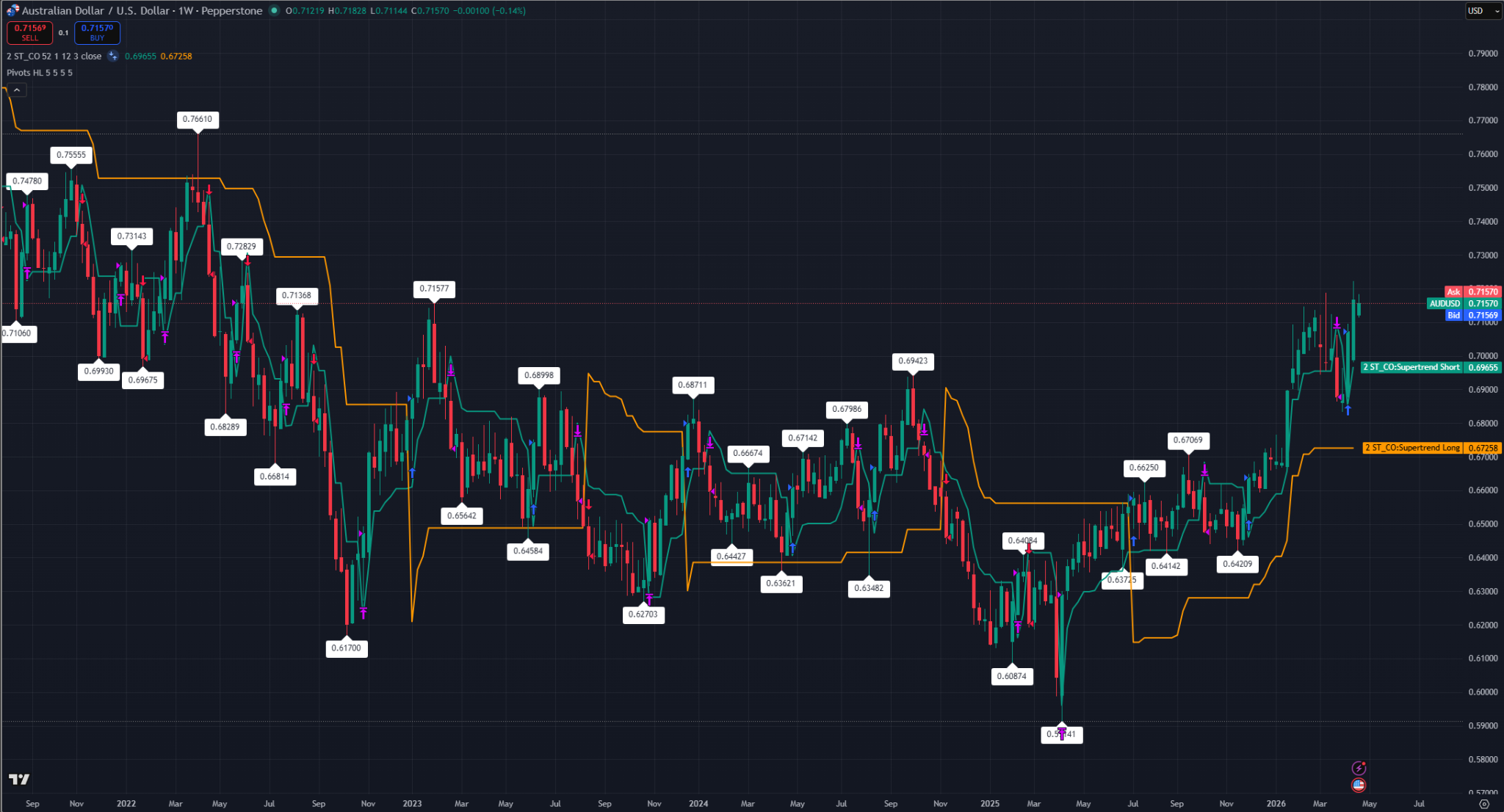
Weekly AUD/USD candlestick chart showing price holding above Supertrend support levels. Source: TradingView
Daily Momentum Resets for the Next Leg
On the daily timeframe, the bulls have clearly reasserted themselves. The recovery from the 0.6833 low was sharp and purposeful, and crucially it managed to reclaim the 21-day EMA at 0.7070. That level matters. Losing it would have changed the story; holding it keeps the narrative intact.
AUD/USD Price Forecast
Every new AUD/USD analysis as it publishes, today's technical signal and key levels, live price — on one page.
See all AUD/USD forecastsRSI is currently sitting above 60, which is about as useful a reading as you can ask for in a trending market. Strong enough to confirm real buying interest, but nowhere near the kind of overbought extremes that typically precede a rollover. If price can push through the 0.7147–0.7188 resistance band, the path to 0.7220 opens up pretty cleanly from there. Any pullback toward 0.7100 in the meantime? I’d treat that as an opportunity, not a warning sign.
Momentum Preps for 0.73 Move
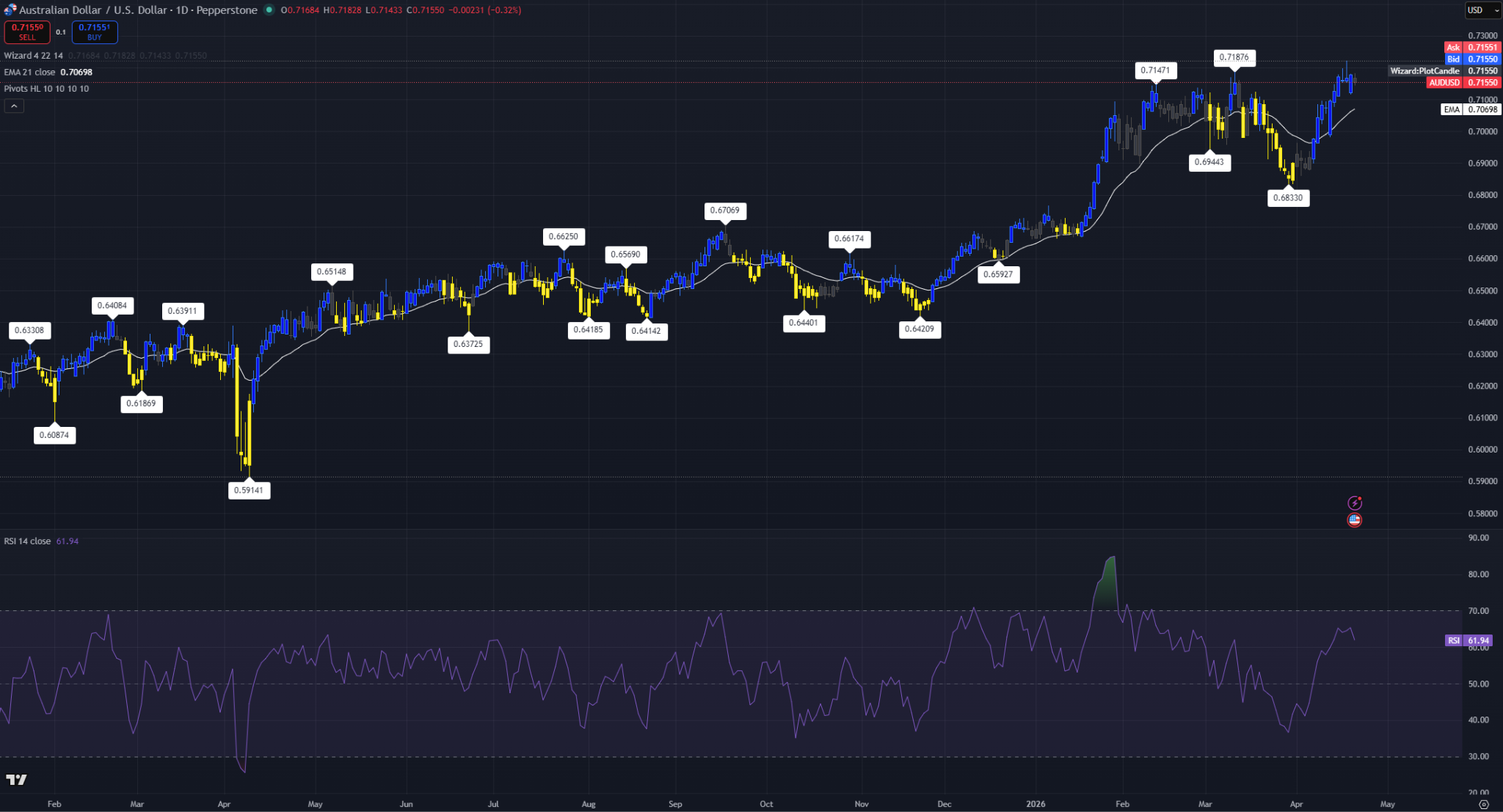
Daily AUD/USD chart showing price trading above the 21-EMA with RSI over 60. Source: TradingView
Renko Bricks Signal a Healthy Reset
The 0.001-brick Renko chart adds some useful colour to the intraday picture. After probing up to 0.7221, price has rotated lower, but the context here matters. We’re still holding above the short-term trend line at 0.7134, and the 500-SMA near 0.7029 remains a comfortable distance below.
The Z-score dipping slightly negative is worth noting, but not worrying about. That’s a mechanical reset, the kind of thing that happens when a short-term move gets stretched and the market naturally bleeds off some of that excess. RSI below 50 backs that up. The heat has been let out of the intraday move. From a positioning standpoint, that’s actually a cleaner setup going into the next potential push higher.
0.001-brick Renko Suggests Momentum Reset
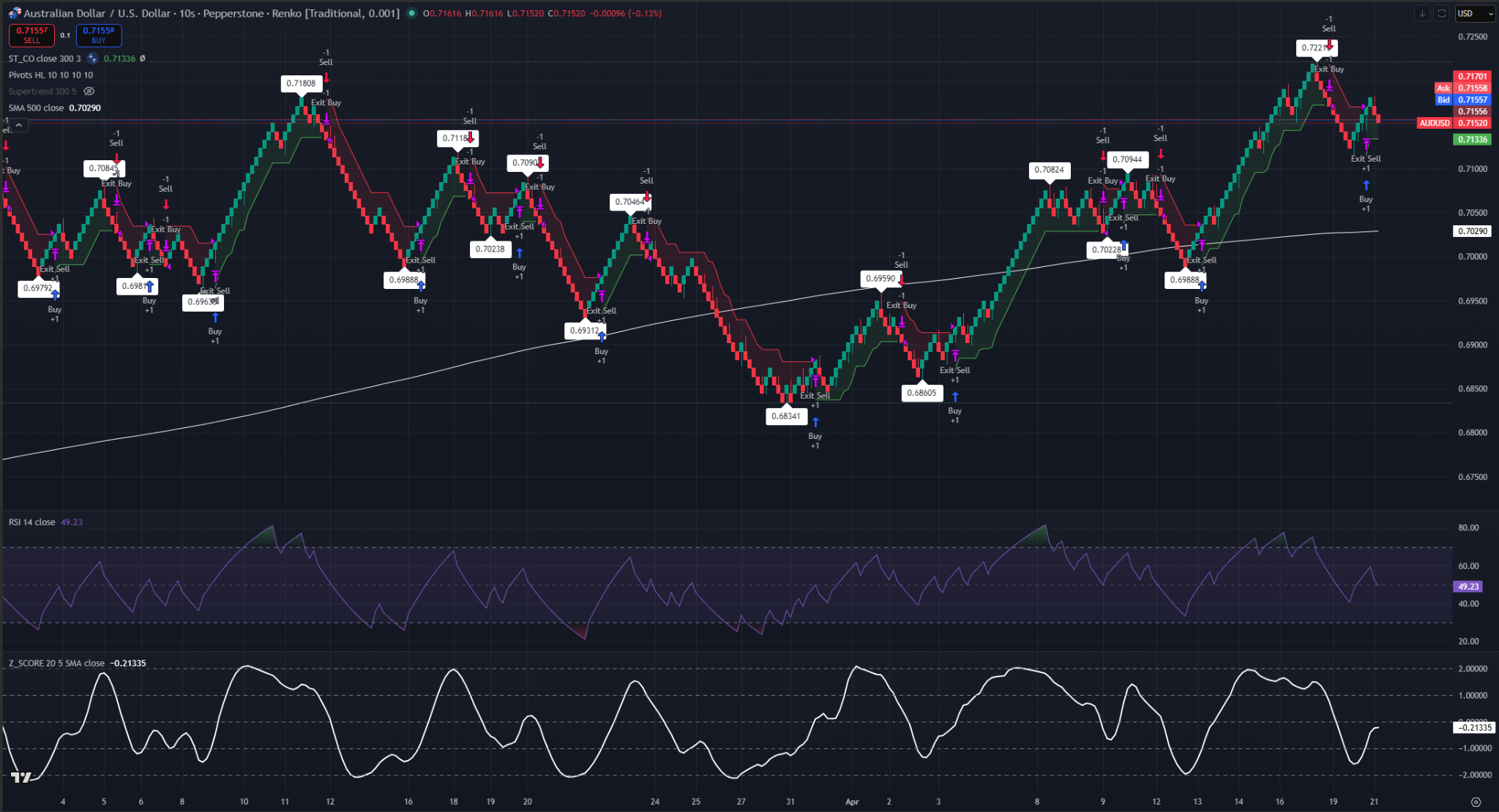
Key Resistance Levels: 0.7188, 0.7220
Medium-Term Path: AUD/USD is preparing for its next major push. While the ceasefire expiration might cause some 5-minute volatility, the weekly and daily structures are too strong to ignore. I expect a period of minor consolidation followed by a break above 0.7220, especially if the Islamabad talks yield even a hint of an extension. Buy the dips as long as we’re above 0.7070.