


AUD/USD still looks constructive in the medium term even with geopolitical tensions simmering and inflation concerns continuing to cloud the outlook. Despite the pair slipping into a short-term pullback, the broader setup still suggests this move looks more like a pause than a change in trend. That leaves room for AUD/USD to stabilize and gradually regain its medium-term upward momentum as the technical picture improves.
Year to date, the Australian dollar has been performing well. It is up close to 4% against the U.S. dollar, about 5% stronger than the euro, and roughly flat versus the Japanese yen. That broad-based strength makes the recent AUD/USD rally look more credible.
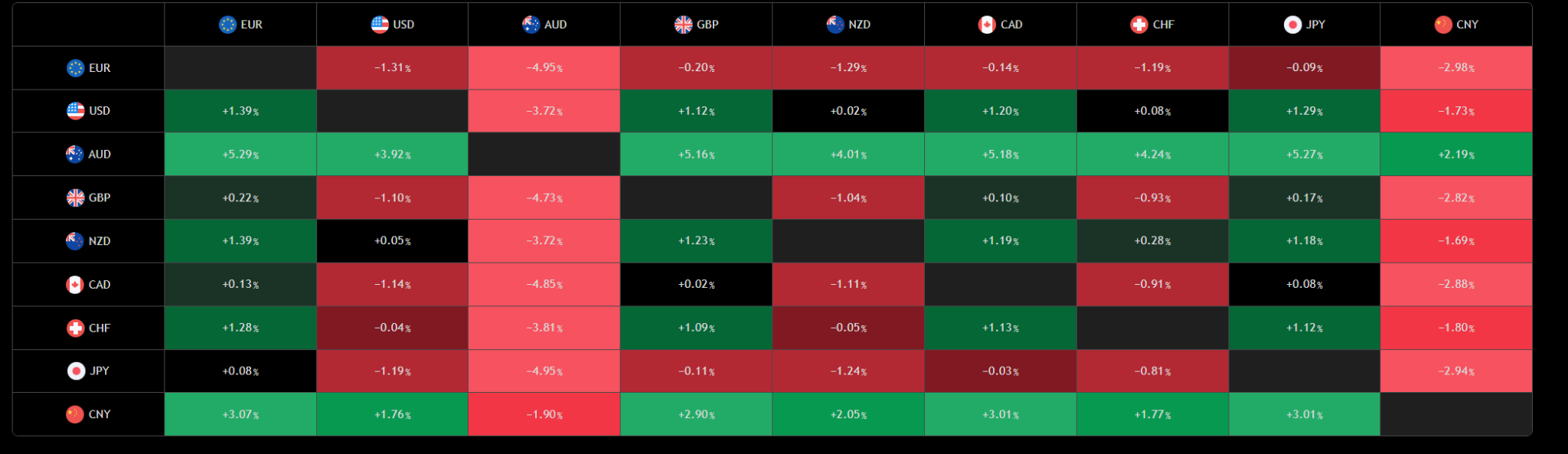
AUD strength heatmap shows the Australian dollar outperforming the U.S. dollar, euro, and yen on a year-to-date basis. Source: TradingView
AUD/USD Performance and April Seasonality Offer a Mixed Near-Term Backdrop
Looking at seasonality, AUD/USD has been more mixed in April over the last decade, with four advances and six declines. That does not rule out upside, but it does suggest traders may need stronger technical confirmation before chasing a breakout.
Australian Data Keeps the Macro Backdrop Supportive
Australia’s building approvals data pointed to a sharp rebound in residential activity, with total dwelling approvals rising about 29.7% month over month in the February 2026 release. Consensus stood at 6.5%, while the prior reading showed a 7.2% decline. The report indicated that the increase was driven predominantly by higher-density approvals, as private sector dwellings excluding houses surged 101.2% while private homes were broadly flat at 0.2%. Approvals can be lumpy month to month, but the data is still encouraging.
AUD/USD Price Forecast
Every new AUD/USD analysis as it publishes, today's technical signal and key levels, live price — on one page.
See all AUD/USD forecasts
Australian building approvals surged in February, driven by a sharp jump in higher-density dwellings. Source: TradingView

Australia’s trade surplus remains supportive for the Aussie, although the surplus has narrowed from earlier highs. Source: TradingView
Balance of trade data is expected on April 2, with a forecast of A$2.6 billion. Australia’s trade position remains supportive for the Aussie at a structural level because persistent surpluses reflect export income flowing into the economy. Still, as the chart shows, that support has softened materially as the surplus has narrowed.
AUD/USD Weekly Chart Keeps the Medium-Term Bullish Bias Intact
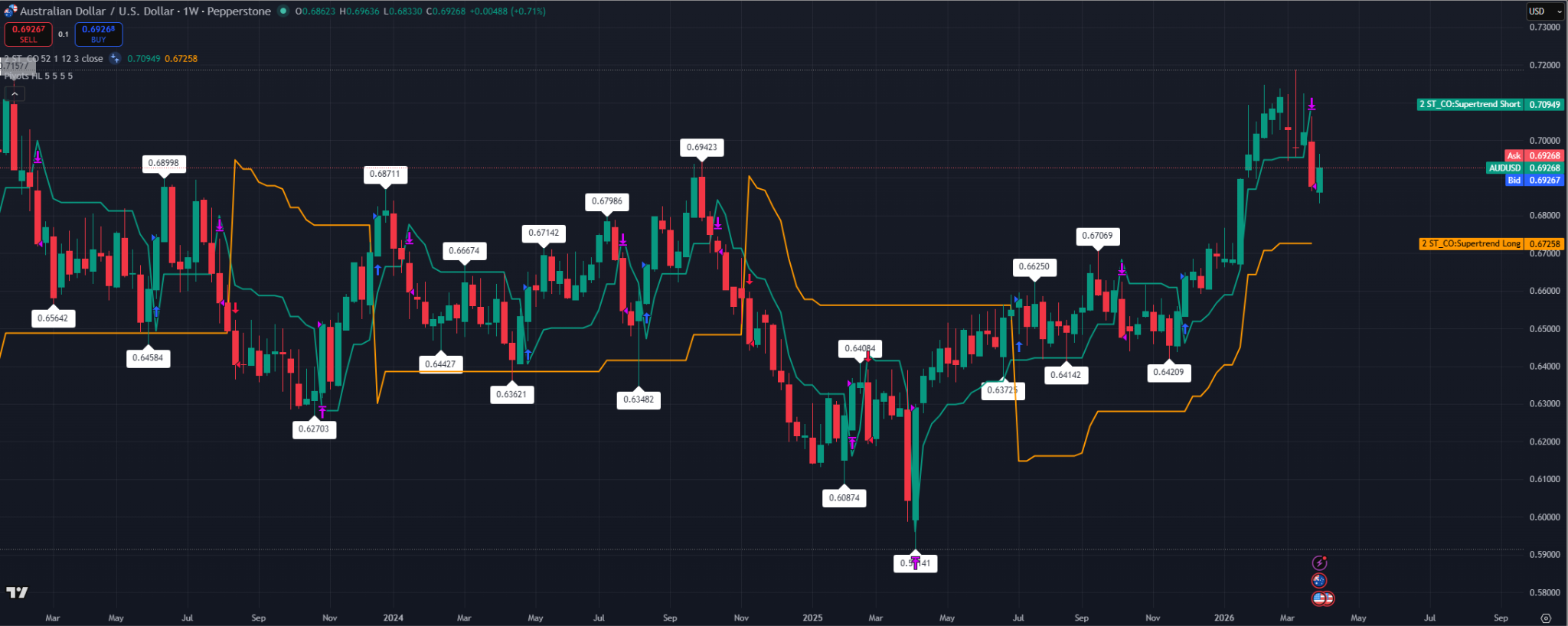
AUD/USD weekly chart shows the pair pulling back after its recent rally while longer-term support remains intact. Source: TradingView
On the weekly timeframe, AUD/USD has slipped below the shorter ATR-based support around the 0.6950 area. Longer-term support still comes in near 0.6725, although the initial expectation is that the current decline should not need to fall that far. The broader backdrop remains relatively constructive as Australian rates stay elevated and inflation risks linked to the Iran war remain in focus.
A reclaim of the shorter Supertrend near 0.7095 would strengthen the case for renewed upside.
Daily Chart Shows a Pullback, Not a Breakdown
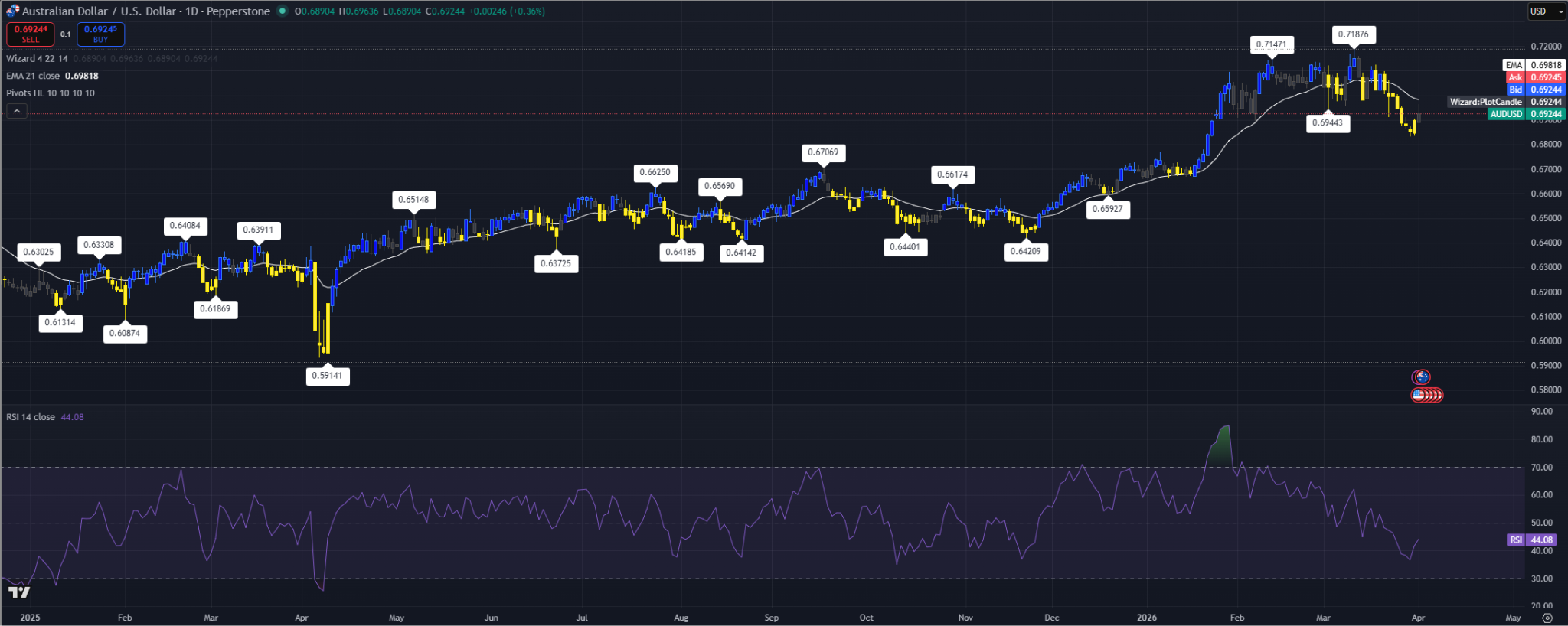
AUD/USD daily chart shows the pair below the 21-EMA after pulling back from the recent 0.7147 to 0.7188 highs. Source: TradingView
On the daily chart, AUD/USD remains in a near-term corrective phase, with the pair trading below its 21-EMA. It has pulled back from the recent 0.7147 to 0.7188 highs and is now testing the lower end of its recent range. Momentum is still not fully there, with the RSI trading below the 50 level.
Ultimately, a move back above the 50 mark on RSI, combined with a daily close above the 21-EMA, would signal that the pullback is likely ending.
Renko Chart Suggests the Rebound Is Starting to Build
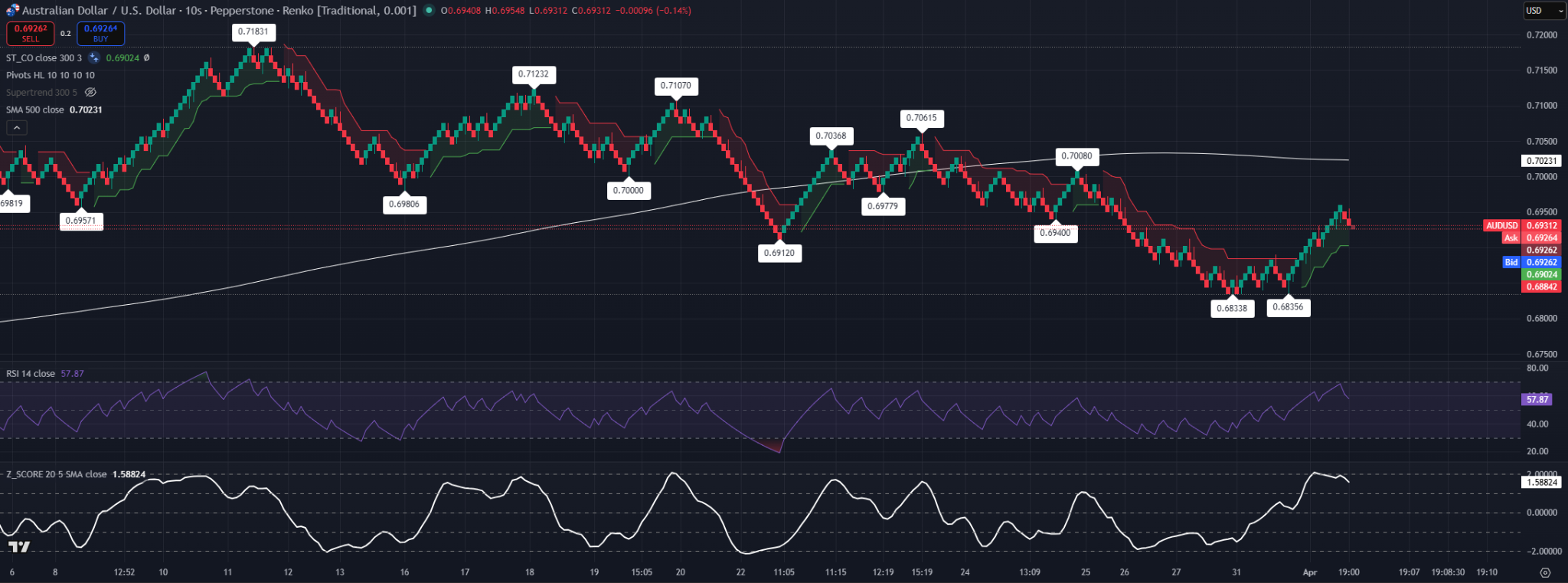
AUD/USD Renko chart points to an early rebound attempt, but price still needs a stronger push above longer-term resistance. Source: TradingView
On the 0.001-brick Renko chart, AUD/USD, like other risk assets, appears to be staging a short-term rebound, with support observed around the 0.6835 level. Even so, the pair remains below the longer-term moving average, which sits near 0.70225.
The RSI and Z-score both suggest that the rebound is beginning to build momentum, although it may already be a little stretched. AUD/USD may need to attract additional demand around the 0.6900 area before it has a stronger chance of pushing convincingly above the moving average.
AUD/USD Outlook and Key Levels
AUD/USD appears to be moving through a period of consolidation, but the broader backdrop still looks fairly supportive despite the recent pullback. Short-term signals are somewhat mixed, yet overall the downside appears limited before the pair attempts to regain its bullish footing.
Current trend: Neutral
Bias: Positive
Key support levels: 0.6835, 0.67075
Key resistance levels: 0.7095, 0.7188
Medium-term path: The pullback in AUD/USD still appears shallow, with the pair likely to stabilize around the 0.6835 level before attempting to rally back toward 0.7000. A break above that area would strengthen the case for a move toward 0.7188.