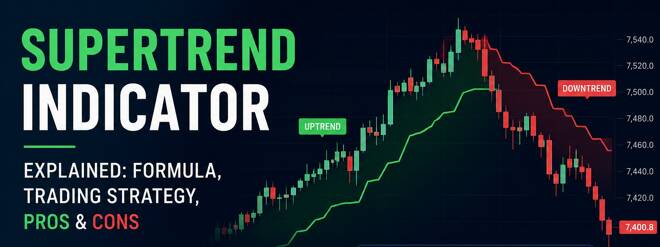
Sometimes in the quest of designing and building you come across certain tools and you wonder how you were working without them in your work. The Supertrend Indicator, to me, happens to be one of them. This volatility-adjusted tool simplifies the complex nature of the ATR and helps me to decide when to buy, when to hold and when to sell. It’s a visual bridge between raw price action and the underlying market.
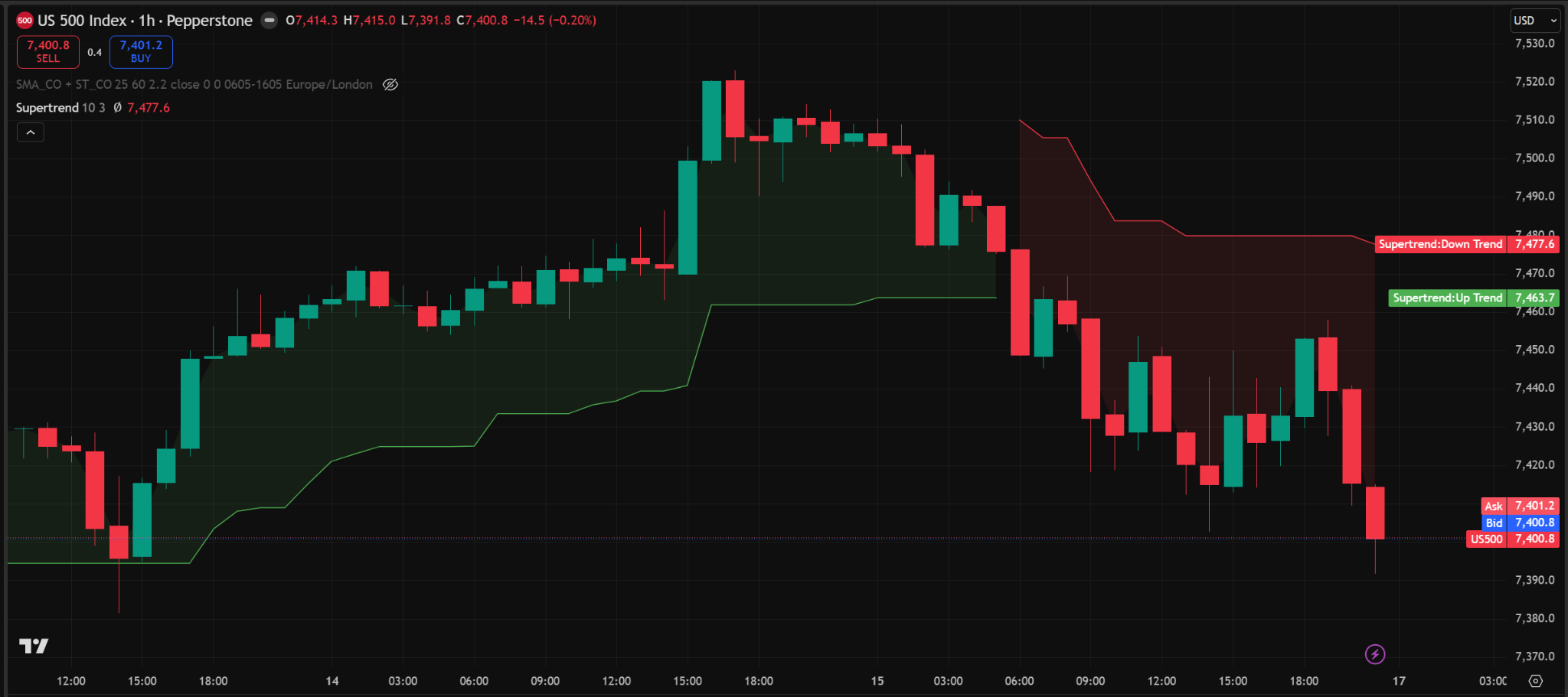
The Supertrend indicator is shown on the S&P 500 Index 1-Hour chart, highlighting a shift from an earlier uptrend into a fresh downtrend as price breaks lower toward the 7,400 Area. The red Supertrend Band now sits above price, suggesting momentum has turned defensive after the index failed to hold its recent advance above 7,500.

Brief History of the Supertrend Indicator
The indicator was introduced in 2009 by French trader Olivier Seban. This was right after the Global Financial Crisis so traders and investors were still reeling from the turmoil. I had just started in investment management, learning the ropes of stocks and bonds. During this time Seban built a simplified, volatility aware trend filter that worked across any liquid asset like forex, equities, treasuries etc. he wanted a straight talk signal that showed you the price relative to its own volatility. 15 years later the Supertrend has solidified itself as one of the go to indicators in trend following, amongst the moving average. At least to me.
Supertrend Formula
So the Supertrend Indicator incorporates volatility into its design and acts as a sort of a trailing stop. There’s the following:
Midpoint (HL2): This is the average of the candle’s high and low.
=> (High + Low) / 2
Average True Range (ATR): The ATR measures how much the price typically moves over a set period, with the default usually being 14.
The indicator has an Upper Band and a Lower Band.
=> Upper Band = HL2 + (Multiplier * ATR)
=> Lower Band = HL2 – (Multiplier * ATR)
There’s certain logic tied to the Supertrend. One is that it is path dependent. It remembers where the previous floor was and refuses to lower it during a trend, uptrend or downtrend. For example in a bullish trend, the final Lower Band is the max of the current calculation and the previous band. It should be noted that the line cannot move backwards. However, it does push upward during an uptrend or down during a downtrend. This is done to stop the Supertrend line from wiggling in response to minor price pullbacks, making it like a trailing stop rather than just another moving average or trend following indicator.
Another distinct logic of the Supertrend is the positive and negative flips. A flip happens when the price closes on the opposite side of the active band. This feature helps minimizing whipsaws (setting the multiplier aids in the frequency of the flips). You tend to wait for a confirmed momentum close before switching your position, long or short.
How Traders Use the Supertrend Indicator
Traders use the Supertrend to achieve three (3) objectives:
- Noise Filtration: It helps to mitigate the whipsaws in favour of sustained trend moves.
- Trend Confirmation: The Supertrend acts as a visual filter, ensuring you aren’t fighting the prevailing momentum.
- Dynamic Support/Resistance: The indicator adjusts based on the market moves. As volatility expands, the line moves away to avoid any premature exits. As it contracts, it hugs the price to lock in profit.
Combining the Supertrend With Other Technical Analysis Indicators
Ideally the Supertrend should be used with other indicators to help traders make the right decisions. It strengthens your trading decisions. Some general combinations include:
- Supertrend & EMA: You can combine the Supertrend with a long-period EMA such as the 200-EMA. You would only take the long position when the Supertrend flips positive and the price is above the 200-EMA. If the price is below the 200-EMA, a green flip would just be a pause in going short or a countertrend move.
- Supertrend & RSI: To avoid buying the exhausted top of a move, only take a Long if the RSI > 60. Conversely, only take shorts if RSI< 40. This ensures there is actual momentum behind the flip.
- Dual Supertrend: You can also use the multiple Supertrends. Combine a short, lower multiplier setting for a higher frequency signal while the long, higher multiplier setting sets the overall trend direction. Indeed, by requiring both the fast and slow Supertrend lines to confirm the same regime, you effectively filter out premature whipsaws and false flips.
Pros and Cons of the Supertrend Indicator
While the Supertrend delivers visual clarity, volatility awareness and versatility across timeframes, it suffers from its inherently lagging nature as well as its sensitivity to parameter overfitting and incapacity to deal with rangebound movements. The table below lists the Supertrend’s advantages and disadvantages.
| Pros | Cons |
|---|---|
| Visual clarity | Lagging nature |
| Volatility aware | Sensitive to parameter overfitting |
| Versatile across timeframes | Vulnerable to sideways movement |
| Filters market noise | Likely to produce false signals |
| Has a trailing stop feature |
Simple Supertrend Strategy
SMA and Supertrend Strategy is Shown on the S&P 500 1-Hour Chart, Using a 25-Period SMA and Supertrend Settings of 60/2.2 with a 06:05-16:05 London Trading Session. The Chart Highlights How the System Alternates Between Buy and Sell Signals as Price Moves Around the SMA and Supertrend Bands, with the Latest Price Pulling Back Sharply Toward the 7,400 Area After Failing Near the Recent Highs.
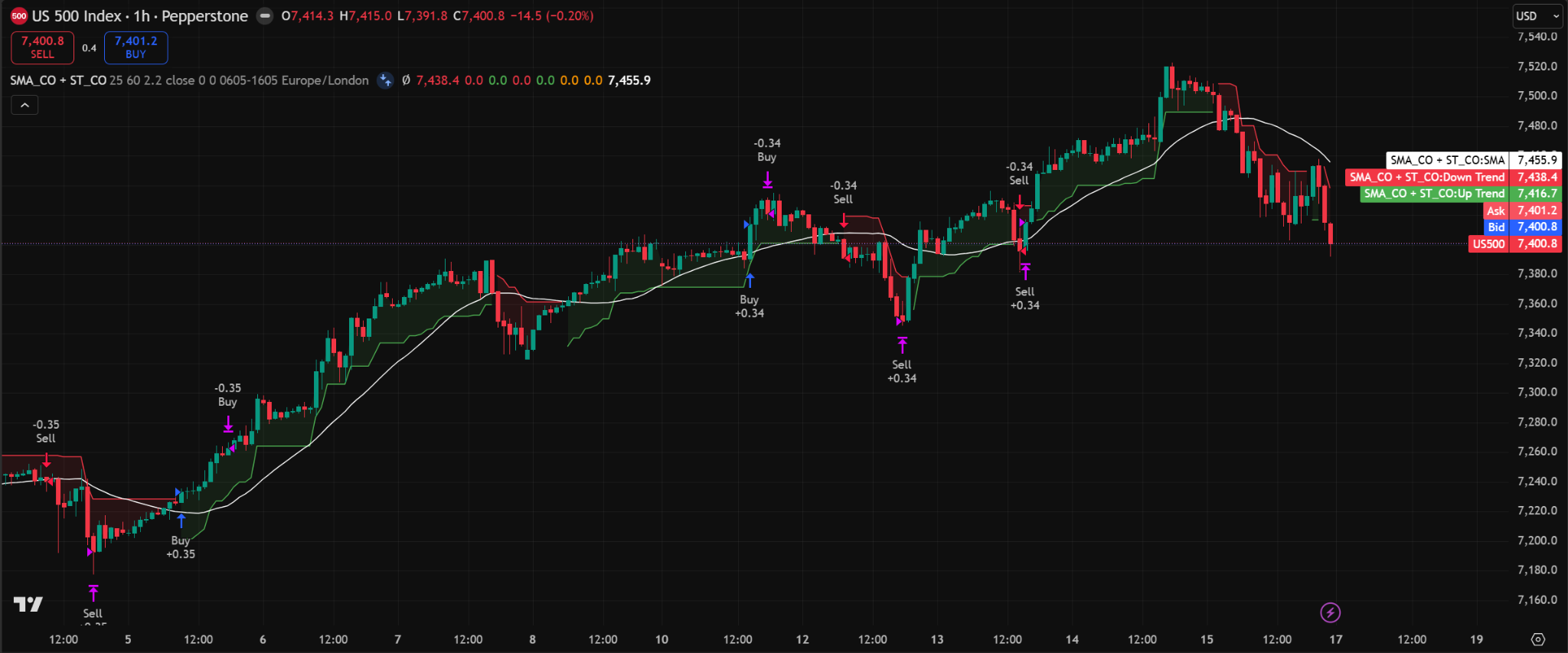
For this article I created a rather simple Supertrend strategy. It uses a 25-SMA and a Supertrend with a 60-ATR and 2.2-Multiplier. For longs, the strategy rule is either a positive crossover on the Supertrend with price above the SMA or a crossover on the SMA and the Supertrend is green. Shorts work the converse. To exit the position you had to have opposite crossovers of the existing position.
I had to incorporate a trading session filter which is from 06:05-16:05 London time everyday.
The capital was US$ 3,000 and the positions had 10% margin both long and short. One year backtested results on the strategy are observed below.
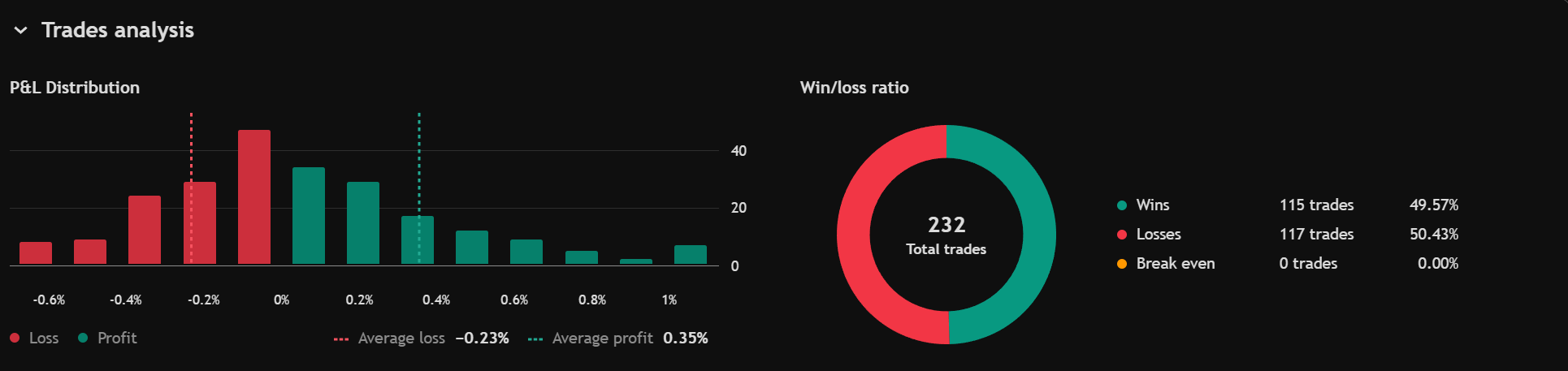
SMA & Supertrend strategy delivered a 14.36% total return across 232 trades with a 49.57% win rate, 1.503 profit factor, and 3.13% MDD.
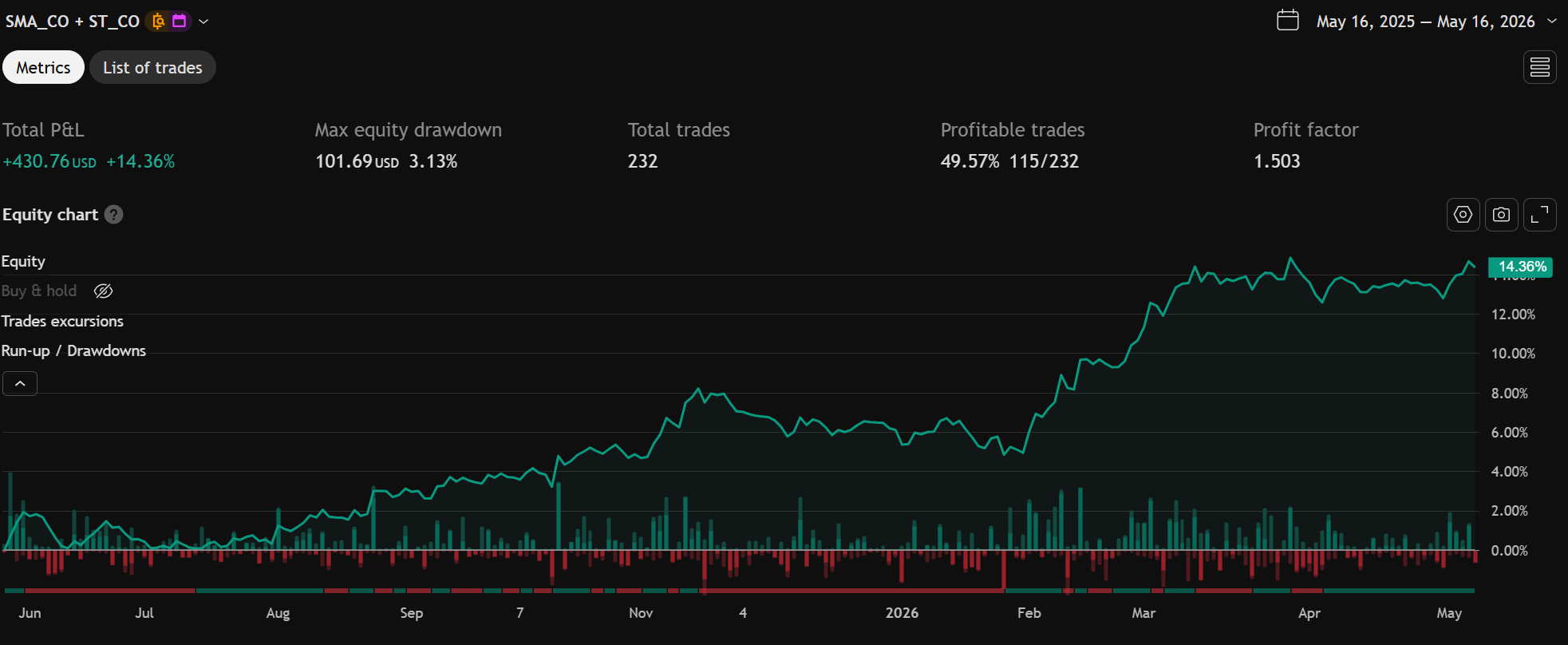
SMA & Supertrend strategy produced a nearly even win/loss split across, 232 trades, with 115 winners and 117 losers, but the average winning trade of 0.35% outweighed the average losing trade of -0.23%, helping support the strategy’s positive overall performance.
Final Thoughts
I’ve been impressed with the Supertrend since I began using it some time back. It has alot of value in giving price action structure, cutting out part of the noise, and helping traders stay on the right side of momentum when the market actually wants to trend. I would recommend to pair the Supertrend with something simple, like an SMA. Also use session filters if you are intraday trading. With that you’ve got a rules based framework that can hold its own without trying to be too clever.