
Brent crude has been in a sustained downward trend since reaching the $140 per barrel highs in March 2022. That peak was largely driven by an extreme geopolitical risk premium following the escalation of the Russia–Ukraine conflict, which began to unwind by mid-2022 as markets adjusted to new supply routes and policy responses. Since then, oil prices have remained under pressure, reflecting a prolonged corrective phase rather than a structural collapse in demand.
More recently, geopolitical tensions have again resurfaced as a key variable for oil markets. Episodes of heightened rhetoric and military posturing in the Middle East, alongside political developments in major oil-producing regions such as Latin America, have periodically injected volatility into prices. While headline risks have eased in recent weeks, history suggests that such phases of apparent calm often coincide with market complacency, leaving prices vulnerable to sharp repricing should risk premiums return.
At the same time, political shifts in oil-rich countries, including discussions around privatization frameworks and foreign participation in upstream assets, have the potential to reshape medium-term supply expectations. These developments do not represent a base-case disruption scenario, but they do increase uncertainty and contribute to a higher geopolitical floor under prices. With that broader backdrop in mind, it is essential to return to the chart to assess whether the technical structure is aligning with these underlying risks.

Fundamental Demand and Supply Snapshot (OPEC)
According to OPEC’s January 2026 Monthly Oil Market Report, global oil demand is forecast to grow by 1.4 million barrels per day year-on-year in 2026, followed by an additional 1.3 mb/d in 2027, with the bulk of growth coming from non-OECD economies, particularly Asia. OECD demand growth remains modest, while non-OECD demand is projected to expand by approximately 1.2 mb/d per year, underscoring the continued importance of emerging markets in supporting global consumption.

On the supply side, non-DoC liquids production is expected to grow by around 0.6 mb/d in 2026 and again in 2027, a pace that broadly matches demand growth but leaves little margin for unplanned outages. Meanwhile, OPEC-participating crude production declined month-on-month in December, and global inventories, while recovering, remain below longer-term historical averages. Importantly, forward curves across major benchmarks continue to trade in backwardation, signaling that physical market conditions remain tighter than futures prices alone might suggest .
This balance between steady demand growth and constrained spare capacity provides a supportive macro foundation for a medium-term recovery in prices, should technical confirmation materialize.
Technical Overview
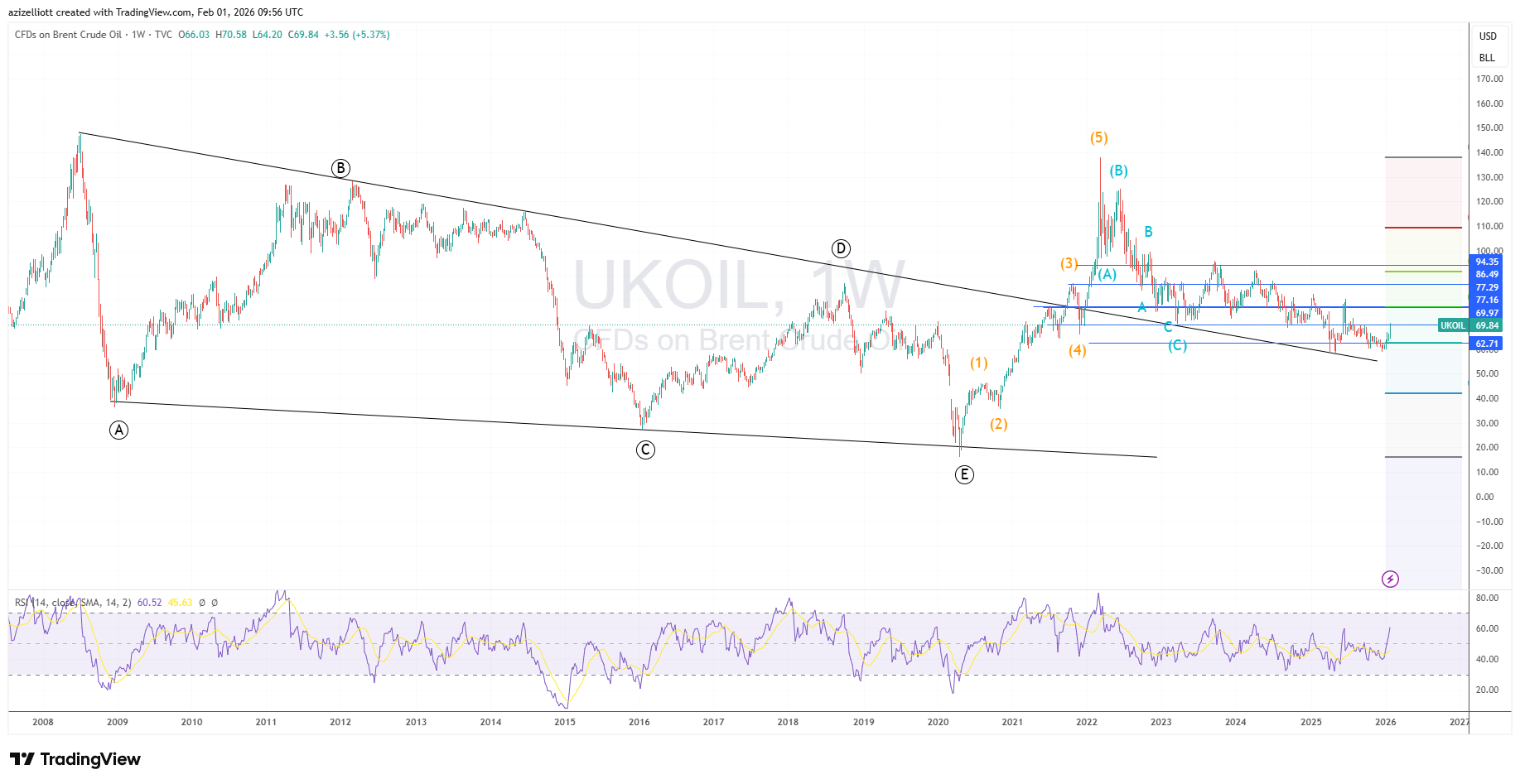
From a technical perspective, Brent has broken out of a prolonged corrective structure. The price action suggests that the market completed a multi-leg correction, forming a descending triangle consistent with an ABCDE corrective pattern. This structure typically precedes a trend reversal when accompanied by a decisive defense of key support levels.
Brent Oil Price Forecast
Every new Brent Oil analysis as it publishes, today's technical signal and key levels, live price — on one page.
See all Brent Oil forecastsThe chart identifies $58.7 as a critical zone, acting as both a dynamic and static support. This level has repeatedly absorbed selling pressure, reinforcing its significance as a long-term demand area.
Fibonacci Retracement
Fibonacci retracement levels further validate the current market structure. Major resistance zones at $77.5, $82, and $88 align closely with key retracement levels derived from the prior impulse and corrective moves. Each of these levels represents an important technical checkpoint, with a confirmed break above one opening the path toward the next.
The confluence between Fibonacci levels and historical price action strengthens the reliability of these resistance zones and supports a step-by-step upside scenario rather than an immediate vertical move.

Double Bottom Formation
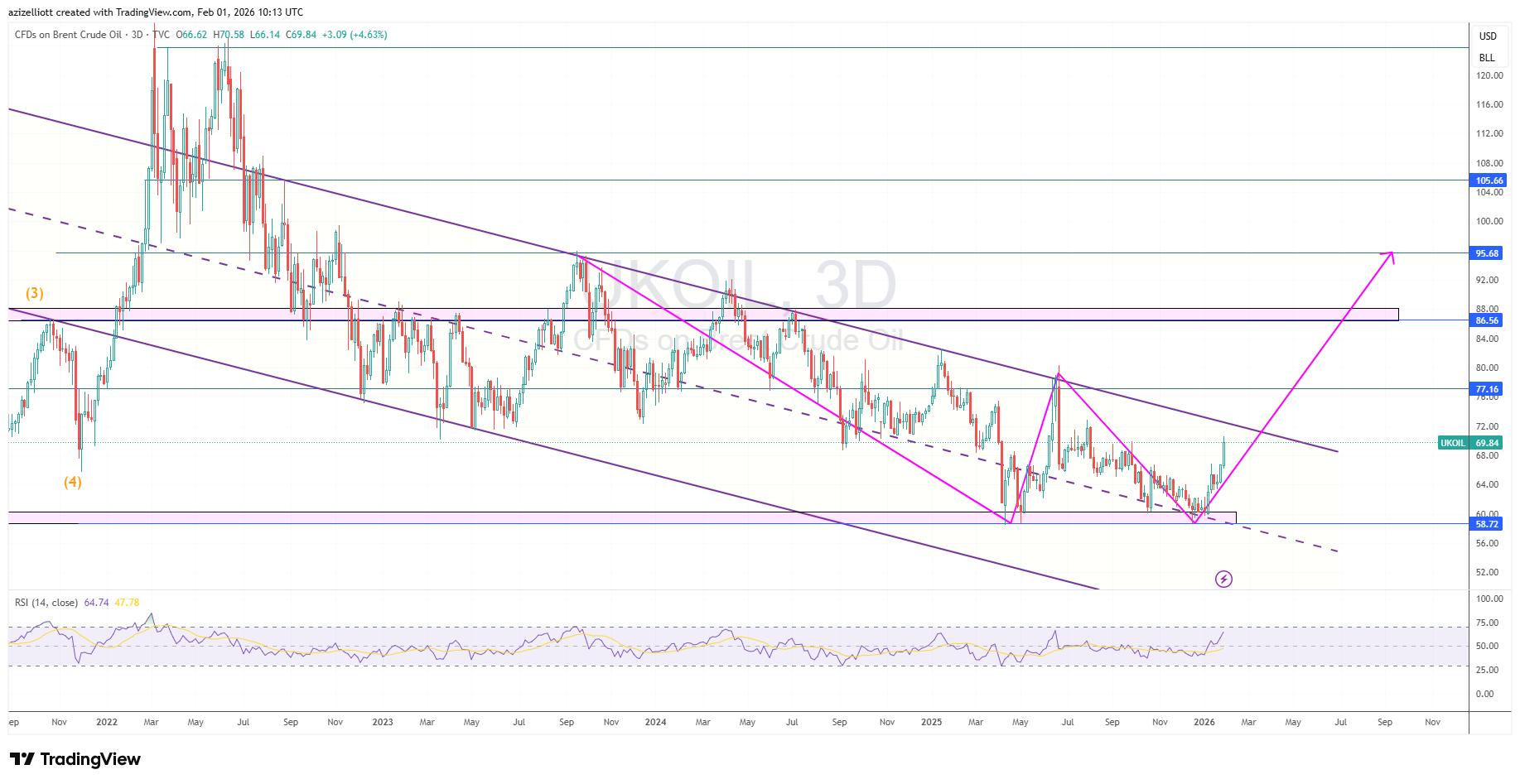
A more precise confirmation of a trend reversal lies in the potential double bottom formation. Sellers have failed twice to push Brent decisively below the $58.7 support, indicating exhaustion of downside momentum. The first rebound occurred near the 0.5 Fibonacci retracement, adding further technical weight to the pattern.
If this structure completes as anticipated, the projected measured move targets the $95–$95.7 area. This zone represents the primary technical objective of the formation and aligns with a broader re-pricing scenario in which geopolitical risk premiums and tightening physical balances begin to reassert themselves.
Key Barriers to Watch
Despite the constructive outlook, several significant resistance levels remain in play:
- $72.5 – a strong dynamic and static resistance, coinciding with the upper boundary of a parallel channel
- $77 – a major horizontal resistance aligned with Fibonacci confluence
- $86.5 – a final barrier before acceleration toward the $95 target
A failure to clear these levels would imply extended consolidation rather than outright trend reversal.

Final Remarks
Taken together, the technical structure in Brent crude strongly favors a completed corrective phase and the early stages of a trend reversal. The repeated defense of long-term support, Fibonacci alignment, and the emerging double bottom pattern collectively point to a market preparing for higher price discovery.
While no technical framework is absolute, the current setup places the odds in favor of upside continuation as long as key supports remain intact. Traders should focus on confirmation through resistance breaks, with geopolitical risk acting as a potential accelerator rather than the primary driver.