
China Mainland equity markets reopen amid the fallout from the US Supreme Court ruling on tariffs, setting the stage for a breakout at the end of February.
Last week, the US Supreme Court ruled that President Trump’s use of the International Emergency Powers Act (IEEPA) to impose tariffs was illegal. Lower tariffs on Chinese goods could boost US demand and ease margin pressure on China’s goods producers.
Meanwhile, consumer sentiment and the housing market remain areas for Beijing to address if stimulus measures are to boost domestic consumption effectively.
Despite the ongoing housing crisis and waning consumer sentiment, optimism of further policy support from Beijing and strong external demand reaffirm the bullish medium-term outlook for Mainland and Hong Kong-listed stocks.
Below, I will explore the key drivers behind recent gains, the medium-term (3-6 months) market outlook, and the key technical levels traders should watch.

US-China Trade War Truce Takes Center Stage
Last week, the US Supreme Court dealt a blow to President Trump’s economic agenda, ruling tariffs under the IEEPA as illegal. Since the ruling, Trump announced a sweeping 10% tariff and then raised it to 15%.
The Supreme Court ruling and Trump’s tariff announcements have revived trade war volatility, sending US stocks south. However, Mainland China-listed stocks are likely to benefit from the latest developments.
Hong Kong Hang Seng Price Forecast
Every new Hong Kong Hang Seng analysis as it publishes, today's technical signal and key levels, live price — on one page.
See all Hong Kong Hang Seng forecastsLower Tariffs and External Demand Dynamics
Lower tariffs could boost external demand for Chinese goods, the key component of China’s dual economy, and ease margin squeezes on China’s goods producers. Manufacturers have faced higher shipping costs in their bid to bypass US levies via transshipments, also squeezing margins. Reduced transshipment costs and lower US tariffs on Chinese goods could be a boon for manufacturers who have successfully sought out alternative trade partners, such as Africa and Latin America.
Wider margins could raise earnings and stock valuations.
Furthermore, improving external demand, coupled with higher margins, may enable manufacturers to increase staffing levels and wages.
Consumer Sentiment and Domestic Demand
A tighter labor market and higher wages could lift consumer sentiment and reignite domestic consumption, the second component of China’s dual economy.
For context, China’s consumer confidence plunged close to record lows in 2025. Improved consumer confidence will be key to more closely aligning domestic and external demand, pivotal for GDP growth prospects. The sharp drop in consumer confidence weighed on private consumption in 2025. Chinese retail sales increased 0.9% year-on-year in December, down from 1.3% in November. Retail sales had surged 6.4% YoY in May before the sharp slumps in confidence and spending.
Policy Uncertainty Ahead of the Xi-Trump Meeting
However, uncertainty remains on whether President Trump will raise tariffs on Chinese goods using alternative executive powers. President Trump is due to meet President Xi in April. Trump’s tariff policies could dictate the tone of the meeting and whether the two Presidents agree to extend the trade war truce.
China’s Commerce Ministry responded to the Supreme Court ruling, calling on the US to drop unilateral tariffs on trade partners. According to CN Wire:
“China says monitoring US trade probes, vows to protect its interests. China Commerce Ministry, on US Supreme Court tariff ruling: US unilateral measures, such as reciprocal tariffs and fentanyl tariffs, violate international trade rules and US domestic law, and are not in the interests of any party.”
Economist Views and China Beige Book Warning
Economists predict that a 15% tariff could lower prior levies on Chinese goods by 5%. However, there was also an air of caution. China Beige Book warned:
“IEEPA is not needed for higher China levels, there’s an active 301. POTUS can snap his fingers & make tariffs go up or down. Will WH do it in run-up to Xi Summit? Diff question.”
US Treasury Scott Bessent downplayed any potential fallout from the Supreme Court ruling, stating:
“President Trump is unwavering in his commitment to reduce the trade deficit and rebuild US manufacturing capacity. US Treasury projections confirm that tariff revenues – and outyear estimates – remain virtually unchanged.”
Bessent remarked on Trump’s commitment to the economic agenda and alternative authority to impose tariffs, adding:
“Using well-established statutory authority dating to 1974, POTUS is advancing a coordinated trade strategy. Investigations underway at the US Trade Representative and the US Commerce Department are expected to bolster enforcement and may further enhance tariff revenues. The America First economic agenda continues without interruption.”
Key Downside Risks to the Bullish Outlook
Despite the upbeat sentiment, downside risks could challenge the positive outlook. These include:
- US-China trade tensions escalate.
- Global trade partners impose tariffs on Chinese goods, and/or external demand weakens.
- Beijing delays fiscal and monetary policy measures.
- Domestic demand deteriorates further.
- Chinese housing market headwinds persist.
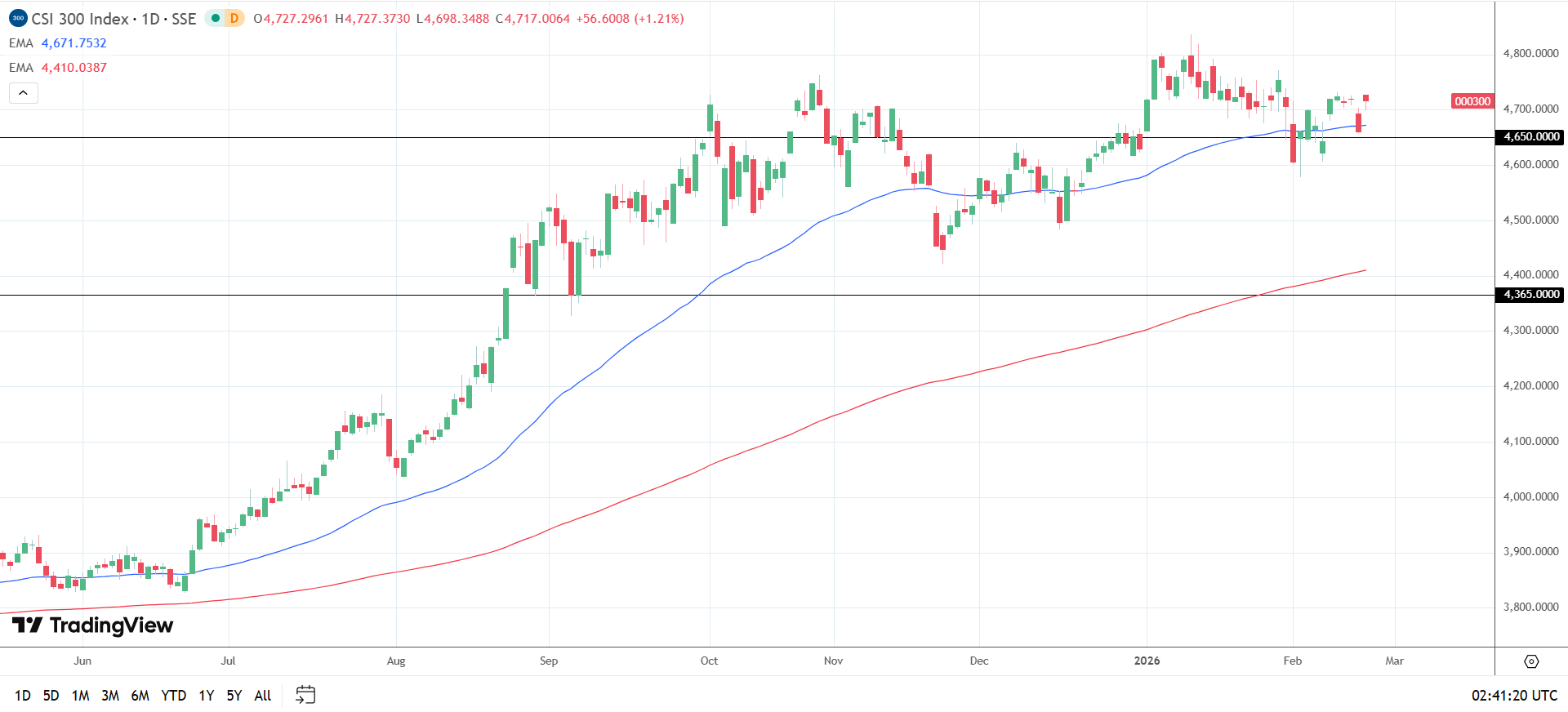
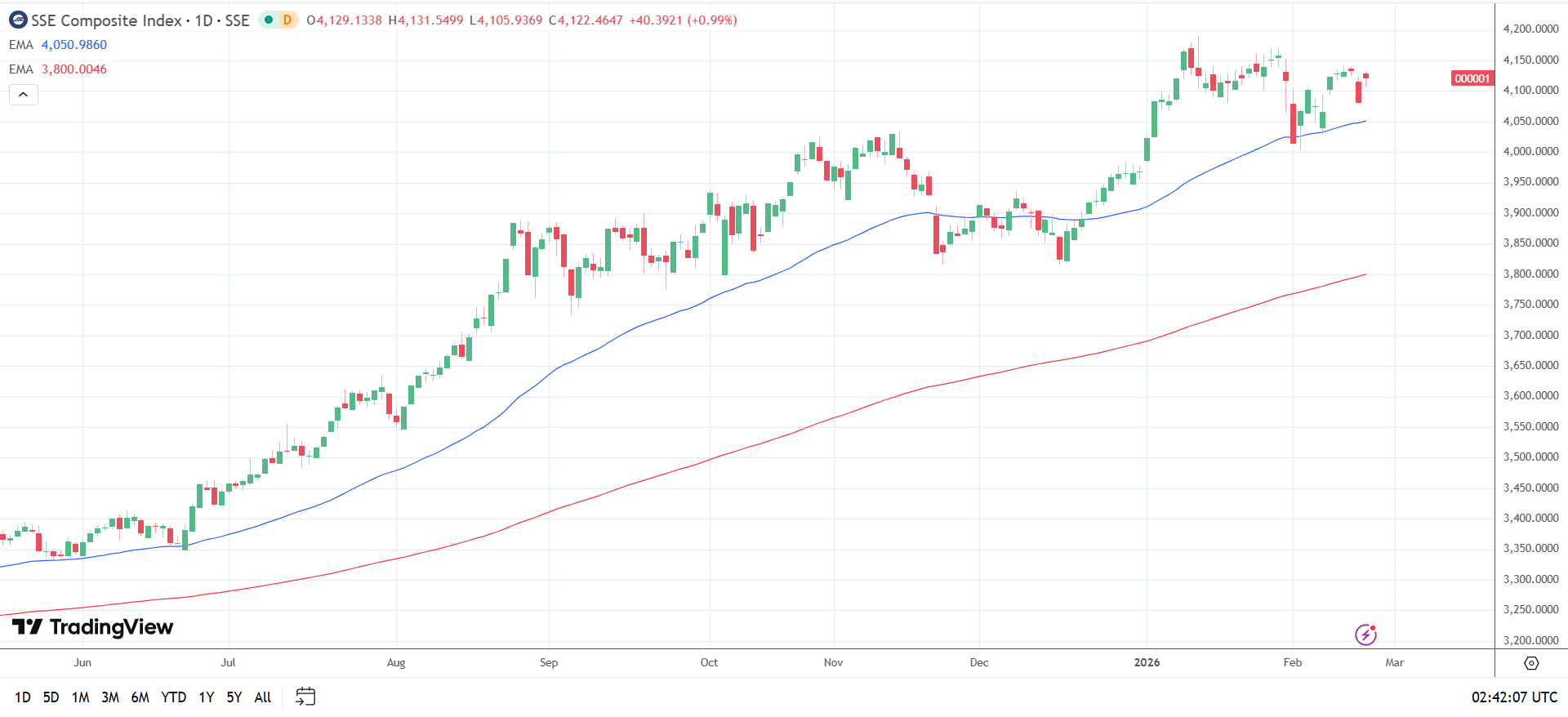
These factors would send the CSI 300 and the SSE Composite Index below their 50-day EMAs, indicating bearish near-term trend reversals.
However, China’s AI advancements, improving chip manufacturing capabilities, and robust external demand reinforce a bullish short- to medium-term bias for Mainland China indexes and the Hang Seng Index.
Furthermore, economists remain optimistic that Beijing can reignite domestic demand through subsidies and lower borrowing rates, while bolstering the housing market.
CSI 300 and SSE Composite Index – Technical Outlook: Resistance Levels in Focus
Chart technicals and fundamentals remain aligned on Tuesday, February 24. Looking at the daily chart, the CSI 300 and the SSE Composite Index trade above their 50-day and 200-day EMAs. The EMA positions signal a bullish bias. However, breaks below the 50-day EMAs would invalidate the short-term bullish trend.
A CSI 300 Index breakout above last week’s high of 4,732 would pave the way toward the January high of 4,837. A sustained move through 4,837 would bring 5,000 into play. Reclaiming 5,000 would open the door to testing the February 2021 all-time high of 5,931.
An SSE Composite Index breakout above last week’s high of 4,143 would enable the bulls to target the January high of 4,191. A sustained move through 4,191 would bring the July 2015 high of 4,317 into play.
Hang Seng Index: Bullish Outlook Intact
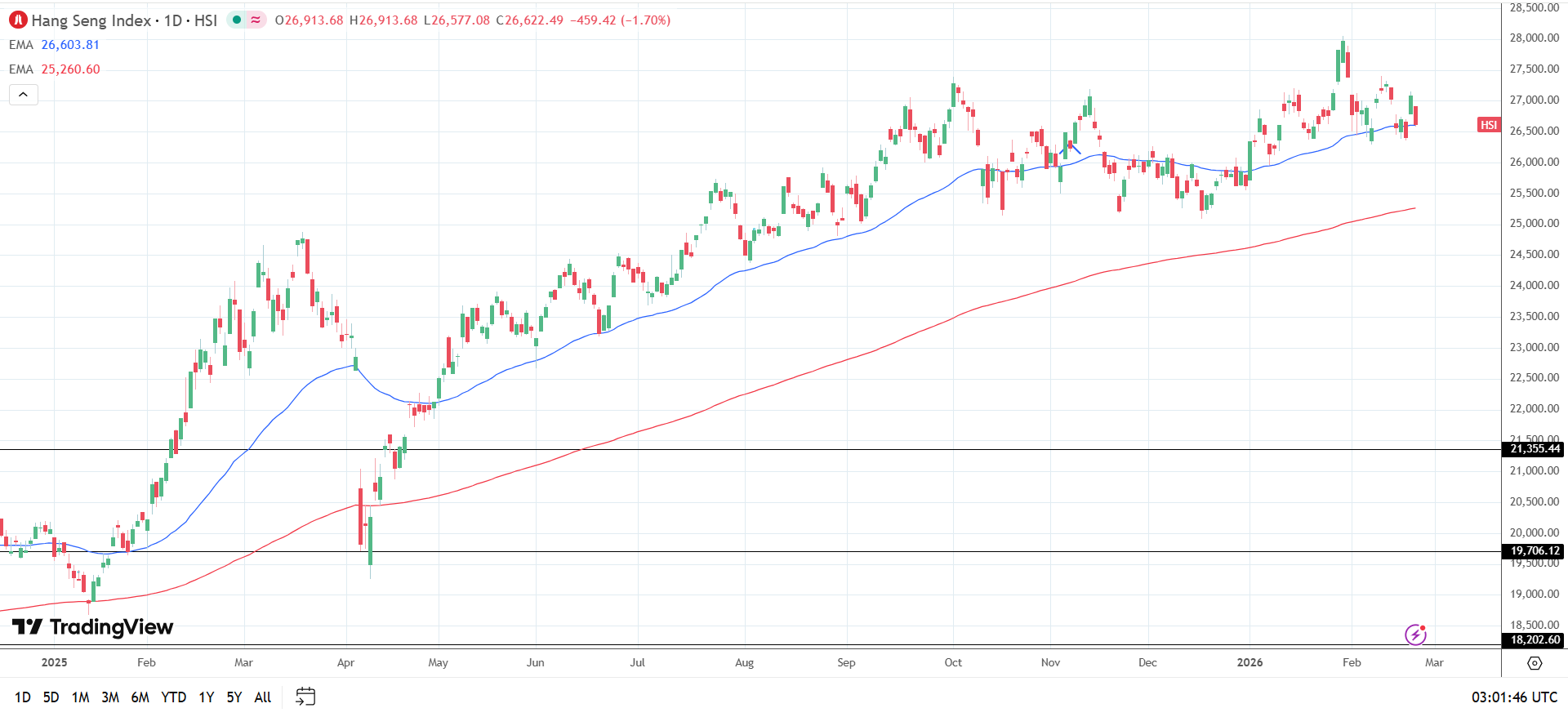
The Hang Seng Index’s outlook aligns with the CSI 300 and the SSE Composite, with the Index trading above its 50-day and 200-day EMAs.
A break above the February 10 high of 27,398 would bring the January high of 28,056 into play. A sustained move through 28,056 would pave the way toward 30,000 for the first time since 2021.
Conclusion:
To summarize, the short- and medium-term outlook remains constructive. Beijing’s ongoing policy support, expectations that the People’s Bank of China will reduce borrowing rates, China’s AI advancements, and robust external demand are tailwinds for Mainland China and Hong Kong-listed stocks.
However, global trade developments, China’s housing market, and consumer sentiment trends remain key for domestic demand. Effective policy measures boosting sentiment and domestic consumption would likely drive the CSI 300 Index and the SSE Composite Index toward 5,931 and 5,000, respectively. April’s President Trump-Xi Summit will likely be key for market trends in Q2.
Discover strategies to navigate this week’s market trends here.