



Geopolitical risks rise as trade tensions between the East and the West intensify, with Mexico targeting Asia and China threatening the EU with levies.
Easing US-China trade tensions, following President Trump’s meeting with Chinese President Xi, boosted demand for Mainland and Hong Kong-listed stocks. However, fresh tariff threats clashed with a stronger Chinese Yuan, fueling uncertainty about demand for Chinese goods.
While trade uncertainties linger, expectations of fresh stimulus from Beijing and AI-related developments support a bullish outlook for Mainland China’s indices.
Below, I will explore the key drivers behind recent gains, the medium-term (3-6 months) market outlook, and the key technical levels traders should watch.
Mexico Tariffs on Asian Imports Add New Pressure on China
Last week, Mexico announced plans to introduce levies of up to 50% on shipments from Asia, potentially closing a crucial gateway into North America. Tariffs will take effect on January 1, 2026, targeting a broad range of products, including cars.
Natixis Asia Pacific Chief Economist Alicia Garcia Herrero recently commented on the potential impact of Mexican tariffs on China, stating:
“For China, the exposure is mainly in automobile, affecting 2.9% of auto parts and 5.5% of vehicle exports. Mexico has emerged as the second-largest export market for Chinese carmakers. Chinese firms will likely absorb tariffs with domestic deflation. Still, it can affect supply chains as China’s auto exports likely target Mexican consumers rather than third markets like the US.”
Garcia Herrero warned that Mexico’s tariffs will likely trigger a response from Beijing. These may include a cut back on investment in Mexico, in addition to export restrictions.
Hong Kong Hang Seng Price Forecast
Every new Hong Kong Hang Seng analysis as it publishes, today's technical signal and key levels, live price — on one page.
See all Hong Kong Hang Seng forecastsEU-China Trade Frictions Escalate as Beijing Targets EU Dairy
Notably, Mexico’s tariffs collided with renewed EU-China trade tensions, setting the stage for a tit-for-tat 2026.
On Monday, December 22, China’s Commerce Ministry reportedly announced up to 42.7% duties on EU dairy after its initial ruling on an anti-subsidy probe into EU dairy products. The tariffs will be effective from Tuesday, December 23. Economists view the levies on EU dairy as retaliation for the EU’s tariffs on Chinese electric vehicles.
While the EU and China continue dialogue on trade terms, Chinese exporters may face another year of uncertainty in 2026. Concerns about China’s low price and overcapacity trade model may see other governments target China with duties.
Stronger Yuan Squeezes Export Margins and Competitiveness
A stronger Chinese Yuan will likely add more strain on Chinese exporters, facing margin squeezes on tariffs. USD/CNY has fallen 0.54% to $7.0362 month-to-date in December, following a 0.59% loss in November. Crucially, USD/CNY has tumbled to a 14-month low, making Chinese goods more expensive for transactions in US dollars.
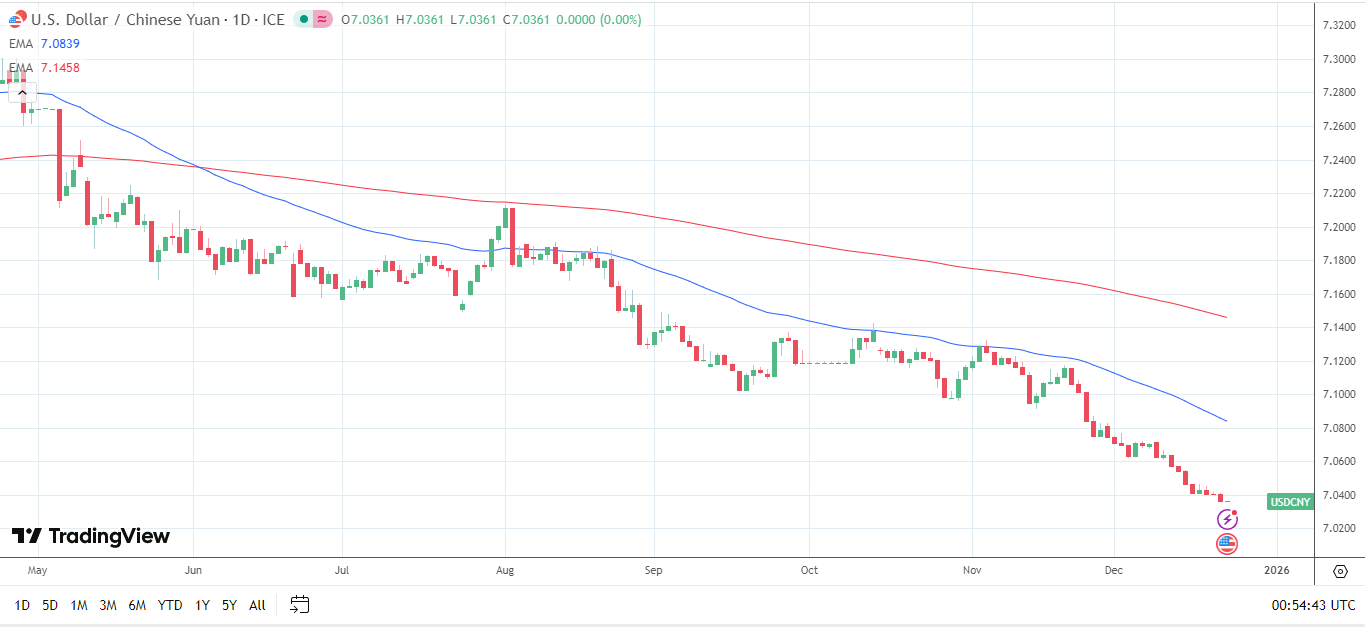
Given these dynamics, Beijing will likely be closely monitoring trade developments and the potential impact of weaker demand on prices, the labor market, and domestic demand.
Weak Consumption and Falling Prices Challenge China’s Growth Path
Chinese exports jumped 5.9% year-on-year in November, rebounding from a 1.1% drop in October. However, producer prices fell at a sharper pace, signaling further margin squeezes.
Narrower margins have forced firms to cut wages and jobs, weighing on consumer sentiment and spending. Notably, retail sales growth slowed from 2.9% YoY in October to 1.3% in November. Retail sales growth has continued to slow since May’s 6.4% YoY surge, suggesting that Beijing’s efforts to boost domestic consumption have yet to gain traction.
AI Momentum and Policy Expectations Shift Market Narrative
In isolation, the threat of higher tariffs on Chinese goods and waning domestic demand challenge Beijing’s 5% GDP growth target for 2025. However, developments in the AI space paint a vastly different picture, supporting a positive economic outlook and bullish trajectory of Mainland Chinese indices.
On Monday, December 22, Goldman Sachs became the latest institution to raise China’s 2025 GDP growth forecast. According to CN Wire, the US banking giant revised its GDP growth forecast from 4.5% to 5.0%, matching Beijing’s target.
Earlier this month, the International Monetary Fund (IMF) raised China’s 2025 GDP growth forecast from 4.8% to 5.0%. The IMF attributed the revision to lower-than-expected tariffs and macroeconomic stimulus.
Upward revisions to GDP growth have boosted demand for Mainland Chinese equities, as the AI race heated up. Goldman Sachs followed its GDP growth forecast with a bullish outlook for Mainland China’s equity markets. CN Wire reported:
“2026-2027 forecasts: Expect continued bull run, but at a slower pace. Projected gains: +38% by end of 2027, supported by 14% profit growth in 2026E and 12% in 2027E. […] AI breakthroughs have redefined the narrative for tech equities. […] Widespread AI adoption could drive ~3% annual earnings growth over the next decade via cost savings, productivity, and new revenue streams. Valuations in China’s AI tech sector have re-rated, but remain cheaper than U.S. peers.”
Continued AI developments and greater Chinese self-reliance on chip manufacturing reinforce the bullish short- to medium outlook for Mainland indices.
Medium-Term China Market Outlook: Cautiously Bullish on Policy Support
Upward revisions to China’s GDP growth forecasts have overshadowed weaker domestic consumption and tariff threats, boosting demand for Mainland-listed stocks.
AI-related developments and expectations of reduced reliance on the US for tech support a positive outlook. The narrative will likely remain the same in 2026, dampening the effect of weak trade data on risk sentiment. Nevertheless, measures aimed at curbing price wars, bolstering the housing market, and driving domestic consumption would add to the bullish outlook.
CSI 300 Technical Outlook: Resistance Levels in Focus
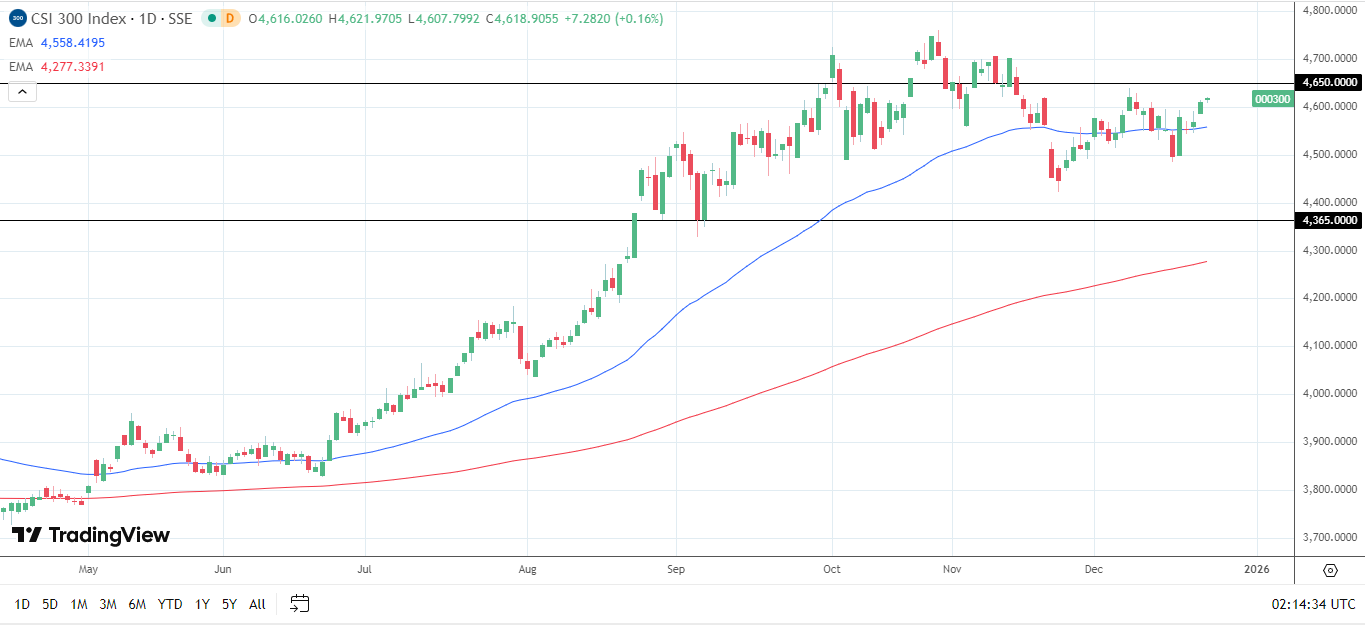
Bullish sentiment aligned with technical indicators in early trading on Tuesday, December 23. Looking at the daily chart, the CSI 300 traded above its 50-day and 200-day EMAs, signaling bullish momentum.
A break above 4,650 would pave the way toward the October 30 calendar year high of 4,762. A sustained move through 4,762 would bring 5,000 into play for the first time since 2021.
Hang Seng Index Forecast: Bullish Bias Holds Above Key EMAs
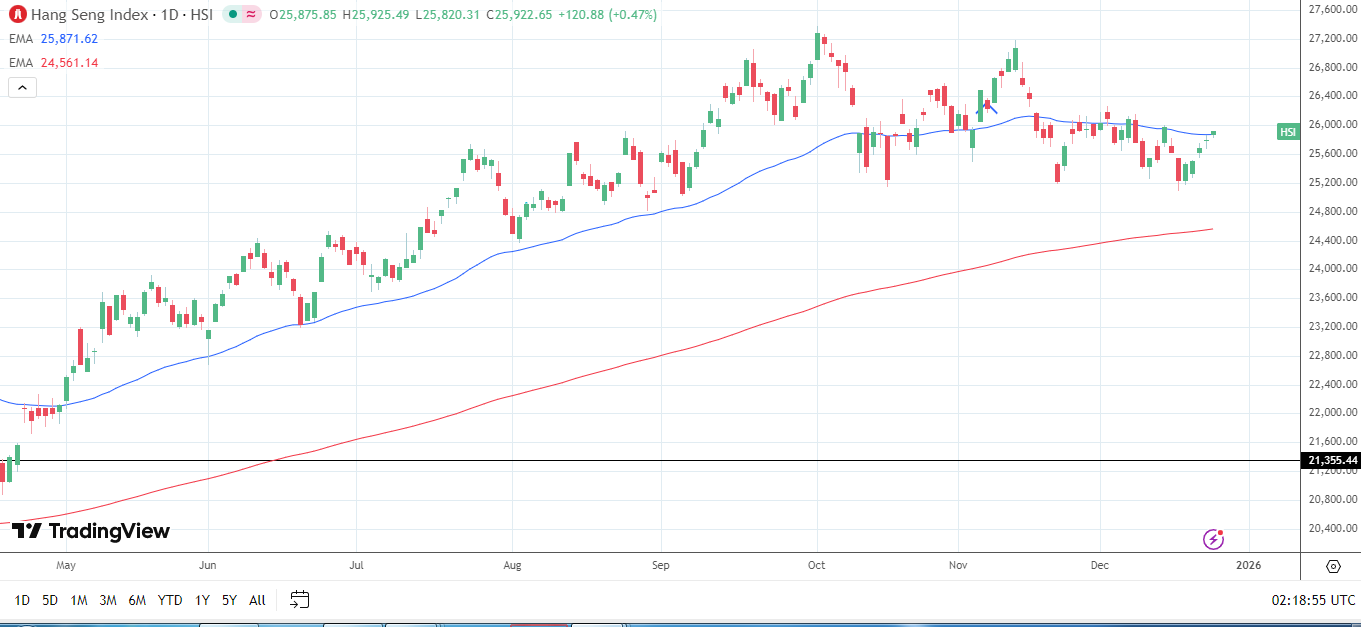
The Hang Seng Index faced similar bullish signals. The Index traded above its 50-day and 200-day EMAs, suggesting a bullish bias.
Holding above the 50-day EMA would open the door to retesting 26,000. A breakout above 26,000 would support a move to 27,000, bringing the calendar year high of 27,382 into play.
Key Risks to the China Market Outlook
Rising trade tensions and weak domestic consumption expose Mainland China’s equity markets to several downside risks, including:
- Beijing delays introducing fresh stimulus and monetary policy support.
- China trade tensions with the West intensify.
- Chinese exports slump, squeezing margins and forcing job cuts.
- Property recovery derails.
Conclusion: Can Policy Support and AI Offset Trade Headwinds?
In summary, the short-term outlook remains cautiously bullish, while the medium-term outlook remains constructive.
Improving US-China ties, China’s tech advancements, and stimulus pledges are likely to boost demand for Mainland China-listed stocks.
Nevertheless, Beijing will need to navigate shifting trade terms and challenges to domestic demand. Effective policy support would likely send the CSI 300 to its 2021 all-time high of 5,931.
Discover strategies to navigate this week’s market trends here.