
Oil prices continued to rise on Tuesday as uncertainty over the U.S.-Iran war continued and the Strait of Hormuz remained restricted. The market is now focused less on political statements and more on physical supply flows. With one of the world’s most important energy routes still disrupted, traders are pricing in deeper supply shock and longer period of volatility.

Oil Prices Climb as Strait of Hormuz Supply Risk Deepens
Crude oil prices continued to advance and Brent oil (BCO) hit $108 per barrel, its seventh consecutive day of price increases. The WTI oil also rallied to $97 in response to the peace deal breakdown. The stalled talks have continued to raise fears over potential supply disruptions, particularly as reports indicated that the latest offer by Iran did not address its nuclear program until the war ends and the shipping issues in the Gulf are sorted out.
The move continues to be driven by the Strait of Hormuz. The passage is normally used to transport energy equivalent to 20% of the world’s oil and gas demand. As Iran curtails shipping and the U.S. continues to blockade Iranian ports, there is less supply flowing to international buyers from the Middle East. That’s why oil prices have been rising for several days.
It is also factoring in the reality of tanker movements. According to vessel-traffic data, six Iranian oil tankers had to turn back because of the U.S. blockade. On average, 125-140 ships used the Strait every day before the war on February 28. This traffic has now fallen. Even with an immediate ceasefire, it could take months for supply outages, port congestion and shipping bottlenecks to be resolved. This also maintains a risk premium in oil prices and supports upside in the short term.
WTI Technical Analysis: Price Rebounds Toward $120 Resistance
The daily chart of WTI oil shows that the price has remained in a strong range between $80 and $120 since the war began. However, the price action before the war was strongly constructive, as seen by the strong bullish price action development above the long-term support of $55.
Brent Oil Price Forecast
Every new Brent Oil analysis as it publishes, today's technical signal and key levels, live price — on one page.
See all Brent Oil forecastsThe price broke above the downtrend line at the $70 region as the war started on 28 February. After the breakout, the price surged quickly to reach $120 but corrected lower to the 50-day SMA at $80.
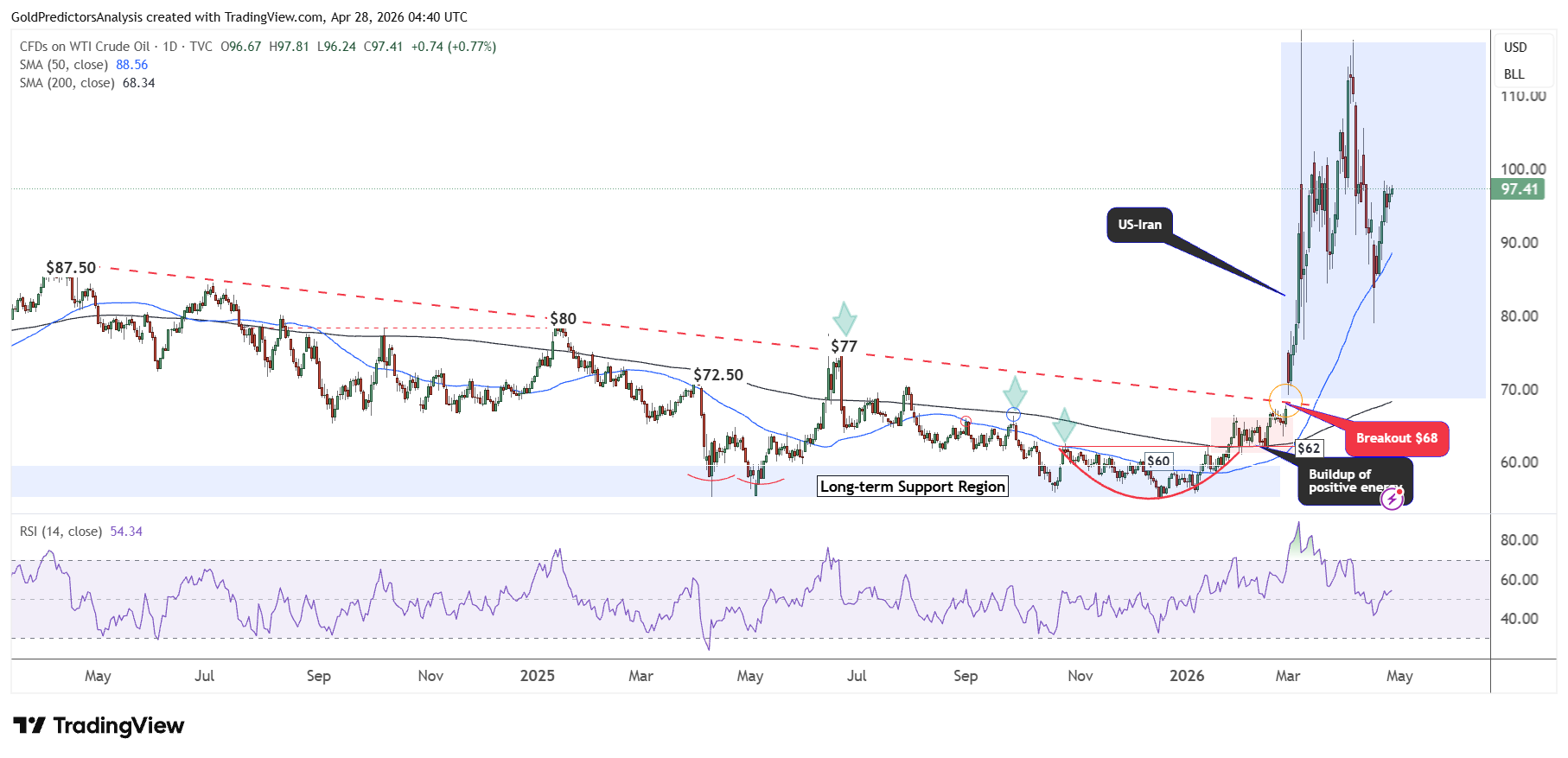
The price is again rebounding toward the $120 region, which indicates strong uncertainty. The RSI also remains above the midline, which indicates further upside in the short term.
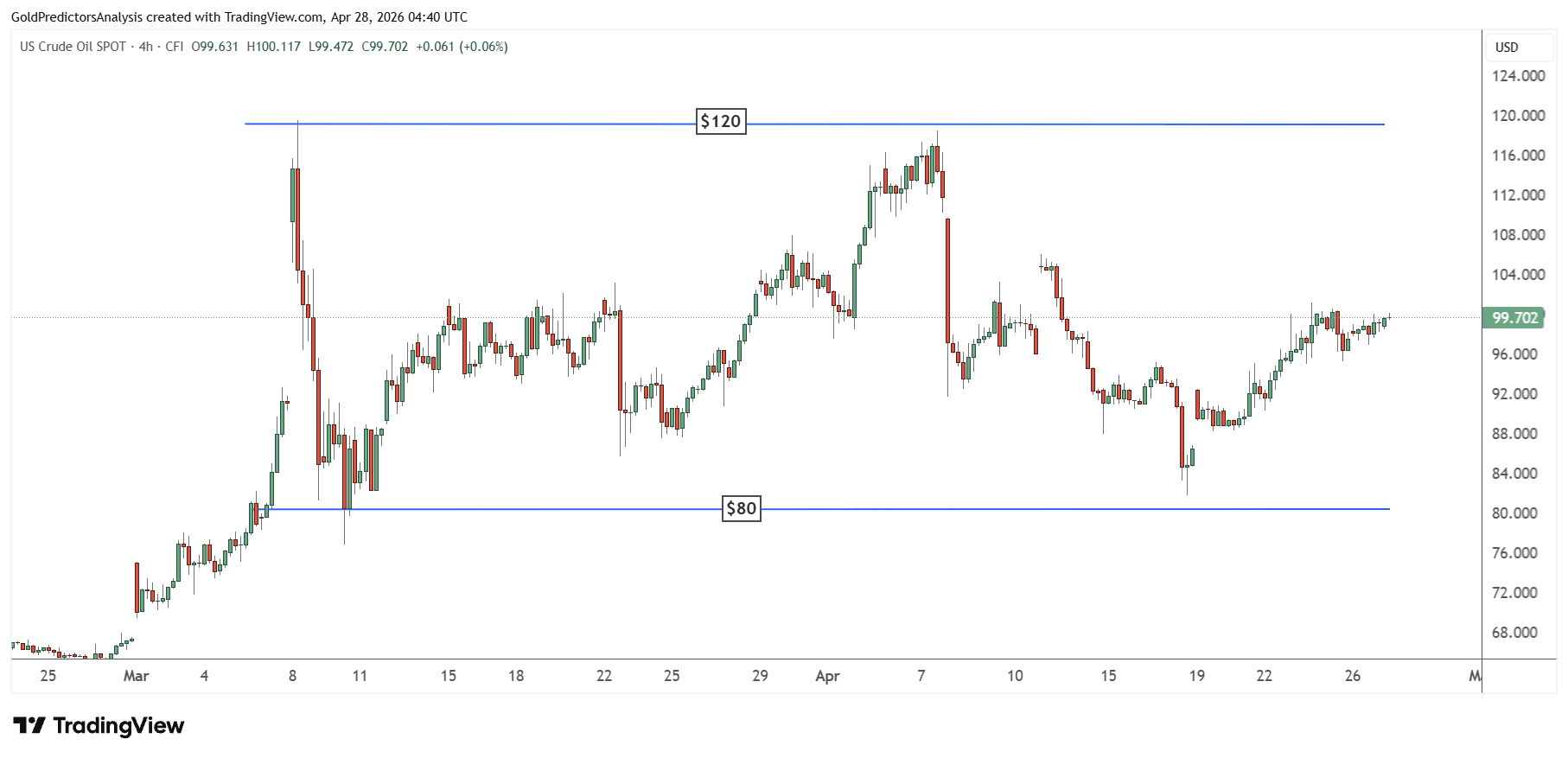
The short-term price action also shows strong consolidation in WTI prices between $80 and $120. The price is now rebounding toward the $120 region as it hit the lower band of support at $80.
Brent Technical Analysis: Breakout Above $90 Supports Further Upside
The daily chart for Brent oil also shows strong fluctuations between $90 and $120, as highlighted in the red region. The overall price structure for Brent oil remains strongly bullish after the breakout from the descending broadening wedge pattern at $72.
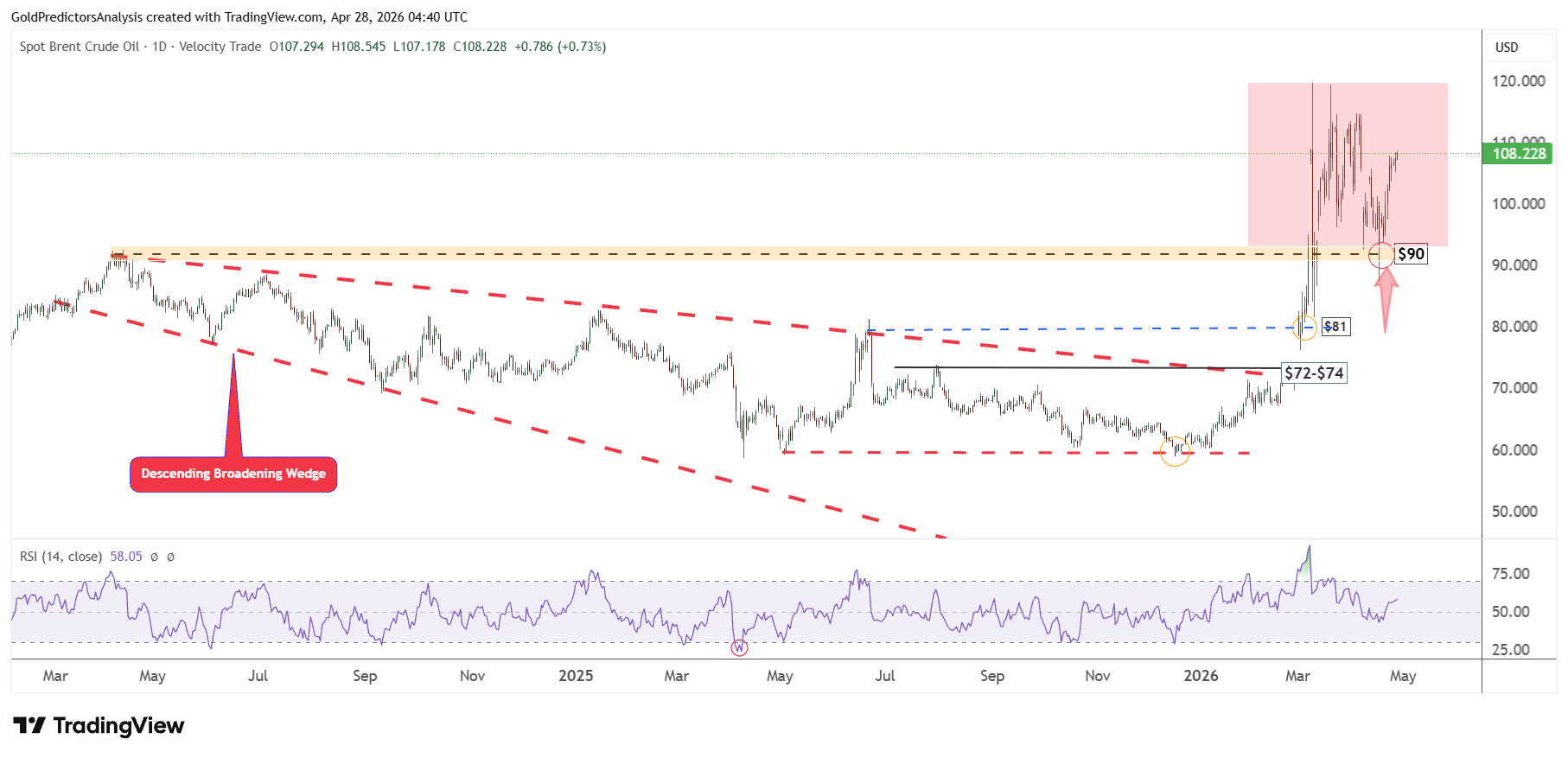
After the breakout of the wedge, the price broke the $90 resistance level and entered a volatile region. The fear of supply disruptions will likely push crude oil prices much higher in May and June.
Bottom Line
Brent and WTI are still supported by the tight physical supply, lack of progress in the U.S.-Iran negotiations and the limited flow through the Strait of Hormuz. Both Brent and WTI are now in volatile price regions, but the overall price structure remains supportive of higher prices. WTI is recovering from $80 support back to $120, and Brent is holding up above $90. While tanker flows remain constrained and the supply risk unresolved, the market will probably maintain a high risk premium for crude. A peace deal would likely dampen the rally, but it could take time for supply flows to improve. This leaves oil at risk of higher prices in May and June.
If you’d like to know more about how to trade crude oil, please visit our educational area.